Lecture 9 Amniotic Fluid Analysis
Study these flashcardsFree · spaced repetition · iPhone, Android, Mac & web
All cards
1
What is amniotic fluid contained within?
Amniotic fluid is contained within a membrane called the amnion.
2
What is the primary function of amniotic fluid?
The primary function of amniotic fluid is to protect the fetus.
3
Who initially produces amniotic fluid?
Amniotic fluid is initially produced by the amnion and placenta.
4
How does the fetus contribute to the composition of amniotic fluid later in pregnancy?
Later in pregnancy, the fetus contributes to the composition of amniotic fluid through swallowing, respiration, and urination.
5
How does the volume of amniotic fluid change from 12 weeks to 37 weeks of pregnancy?
The volume of amniotic fluid increases from 25 to 50 mL at 12 weeks to between 800 to 1200 mL at 37 weeks.
6
What are two conditions associated with abnormal amniotic fluid levels, and what causes them?
Oligohydramnios, which can result from rupture of the amniotic fluid, and polyhydramnios, which can occur if the fetus drinks less amniotic fluid.
7
What type of cells make up the amnion?
single layer of cuboidal epithelial cells (inner surface)
8
what is amniotic fluid composed of?
water (around 98%), with the remaining 2% made up of electrolytes, nutrients, hormones, antibodies, proteins, and other substances like fetal cells
9
What is amniocentesis?
a prenatal procedure that involves extracting a small amount of amniotic fluid from the womb using the aseptic technique with long sterile needle to check for fetal health conditions
10
How is amniocentesis performed?
transabdominally or vaginally with simultaneous ultrasound exam
11
What are some reasons amniocentesis is performed?
diagnosis of genetic and congenital disorders
assessment of fetal lung maturity
estimate and monitor degree of fetal distress.
assessment of fetal lung maturity
estimate and monitor degree of fetal distress.
12
What is one reason for diagnosing genetic and congenital disorders early in gestation?
Early diagnosis allows for the detection of conditions such as neural tube defects, which can cause severe damage to the spinal cord and brain.
13
At what stage of gestation is diagnosis of genetic and congenital disorders typically conducted?
Diagnosis is typically conducted between 15 to 18 weeks of gestation, usually after 14 weeks.
14
Why is the assessment of fetal lung maturity usually done later in pregnancy?
This assessment is done later because the lungs are the last organ to mature in the fetus.
15
At what gestational age range is fetal lung maturity assessed?
Fetal lung maturity is assessed between 32 to 42 weeks of gestation.
16
What are some conditions that might lead to monitoring the degree of fetal distress?
Conditions that may require monitoring for fetal distress include preeclampsia, maternal diabetes mellitus, Rh factor incompatibility, cystic fibrosis, sickle cell disease, older maternal age, infection, and anemia.
17
How much fluid is extracted for an aminocentesis?
10-20 mL of fluid colllected by physician into numbered syringes
18
What type of container is used to collect amniotic fluid?
plastic containers and protected from light!! (covered in aluminum foild or ambered color container because biliruben is sensitive to light!!)
19
Why aren't glass containers used to collect amniotic fluid?
because cells can adhere to glass
20
What factors should be considered for a biliruben test?
light and time and temperature are sensitive
21
What centrifuge speed is used for biliruben test?
high speed
22
If RBCs in amniotic sample are present, what centrifuge speed should be used?
low speed to not damage cells.
23
What is the difference between amniotic fluid and normal urine?
amniotic fluid contains:
glucose
protein 2-8 g/L
creatinine similar to plasma
normal urine
no glucose
no protein
high creatinine
high urea
glucose
protein 2-8 g/L
creatinine similar to plasma
normal urine
no glucose
no protein
high creatinine
high urea
24
What is a better indicator to differentiate normal urine from amniotic fluid? and why?
urea because diabetes or kidney disease can cause abnormal readings compared to nromal urine
25
What color is normal amniotic fluid?
colorless or pale yellow
26
What color is amniotic fluid with bilirubin?
yellow or amber
27
What color is amniotic fluid with meconium? (from fetal intestine)
green
28
What color is amniotic fluid with blood or hemoglobin?
pale pink to red
29
when during the pregnancy is turbidity high and when is it low?
Early pregnancy: not much particulate matter
Late pregnancy: more turbid; increased fetal cells, hair, and vernix (grease from baby's skin) in fluid
Late pregnancy: more turbid; increased fetal cells, hair, and vernix (grease from baby's skin) in fluid
30
When amniotic fluid is turbid, what should be done to prepare the sample?
high speed or filtration
31
What is used to detect chromosal defects like down syndrom or heart defects?
Karyotyping and genetic counseling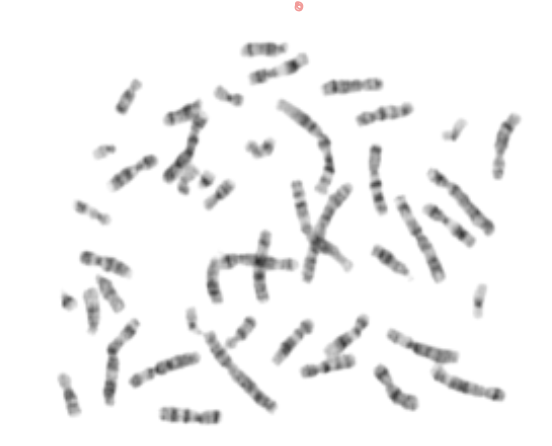
32
Why is a chemical exam of fetal lung maturity tested?
used to assess viability of fetus outside uterus
33
What is the most common cause of death in newborn?
respiratory distress syndrome (RDS)
34
What causes respiratory distress syndrome (RDS)?
From insufficient production of surfactant in newborn's lungs :(
35
where is surfactant produced?
inside alveoli
36
Which cells are responsible for making surfactants?
Type 2 cells (cubodial epithelial cells)
37
What is the purpose of surfactants?
to prevent lung collapse
38
What does type 1 cells in the alveolis do?
responsible for gas exchange.
39
What is Respiratory Distress Syndrome (RDS)?
Respiratory Distress Syndrome (RDS) is a condition often related to fetal lung immaturity, characterized by difficulty in breathing after birth due to underdeveloped lungs.
40
What factors determine the probability of RDS?
The probability of RDS is determined by two factors:
1. the results of fetal lung maturity (FLM) tests and
2. the gestational age of the fetus at the time of testing.
1. the results of fetal lung maturity (FLM) tests and
2. the gestational age of the fetus at the time of testing.
41
What is the correlation between fetal lung maturity and specific phospholipids?
This indicates the maturity of the fetus's lungs.
42
What is the recommended approach for testing fetal lung maturity?
The recommended approach is a cascade approach, where a series of fetal lung maturity (FLM) tests are performed until a mature result is obtained or all tests have been completed.
43
Why is gestational age important in determining the probability of RDS?
Gestational age is important because it helps assess the developmental stage of the fetus, which can affect the likelihood of the lungs being mature enough to avoid RDS.
44
What might a cascade approach in FLM testing involve?
A cascade approach in FLM testing involves performing multiple tests in sequence to evaluate lung maturity until a mature result is found, indicating that the lungs are sufficiently developed.
45
what is lecithin/sphingomyelin (L/S) ratio?
one of the tests for fetal lung maturity
46
Why are phospholipids important in fetal lungs?
Phospholipids are required in fetal lungs to decrease surface tension. They act as surfactants, which are essential for lung function and help prevent lung collapse.
47
What role does lecithin play in the lungs?
Lecithin is a major pulmonary surfactant in the lungs that helps reduce surface tension, enabling proper lung expansion and function.
48
What is the role of sphingomyelin in fetal development?
Sphingomyelin is a phospholipid found in cell membranes. In the context of fetal lung maturity, it is used as a reference point for lecithin levels in the L/S Ratio.
49
At what gestational age do lecithin levels begin to increase significantly compared to sphingomyelin levels?
Lecithin levels begin to increase significantly at around 34 to 36 weeks of gestation, while sphingomyelin levels either remain constant or decrease.
50
What L/S Ratio is considered indicative of lung maturity?
An L/S Ratio of 2.5 or greater is considered indicative of fetal lung maturity, suggesting that the lungs are likely mature enough to function well after birth.
51
Until what gestational week are lecithin and sphingomyelin produced in equal amounts?
Until about 33 weeks of gestation, lecithin and sphingomyelin are produced in approximately equal amounts.
52
What technique is often used to measure the L/S Ratio?
thin-layer Chromatography technique is commonly used to measure the levels of lecithin and sphingomyelin in amniotic fluid for calculating the L/S Ratio.
53
What factors affect the result of L/S ratio? and what does it do?
presence of blood in specimen decreases a mature result and increases an immature result!
54
What type of speciemn should not be used ever for L/S ratio?
Meconium-contaminated specimens
55
Is L/S ratio a better predictor of maturity or immaturity?
MATURITY.
56
Besides L/S Ratio, what other tests are done for lung maturity?
Phosphatidyl glycerol (PG)
57
When is phosphatidyl glycerol detected?
at 34 weeks and on. not detectable until 34 week gestation.
58
What technique is used to detect Phosphatidyl glycerol (PG)?
Thin-layer chromatography or slide agglutination using anti-PG antibodies.
59
slide agglutination is much quick and simpler than what?
Total lung capacity (TLC)
60
are PG tests affected by blood or meconium?
NO
61
what is PG test not affected by?
blood or meconium (fetal poop)
62
Phosphatyidyl glycerol (PG) is very specific, what does that mean? WHAT ARE THE DOWNSIDES?
postive tests are most likely indicate the presence of PG
DOWN SIDE IS THERE ARE MANY FALSE-NEGATIVES, meaning they often fail to detect PG when it is actually present.
DOWN SIDE IS THERE ARE MANY FALSE-NEGATIVES, meaning they often fail to detect PG when it is actually present.
63
In order to determine lung maturity in a patient, what are the expected results?
L/S ratio > or = 2.5 AND "trace" of phosphatidylglycerol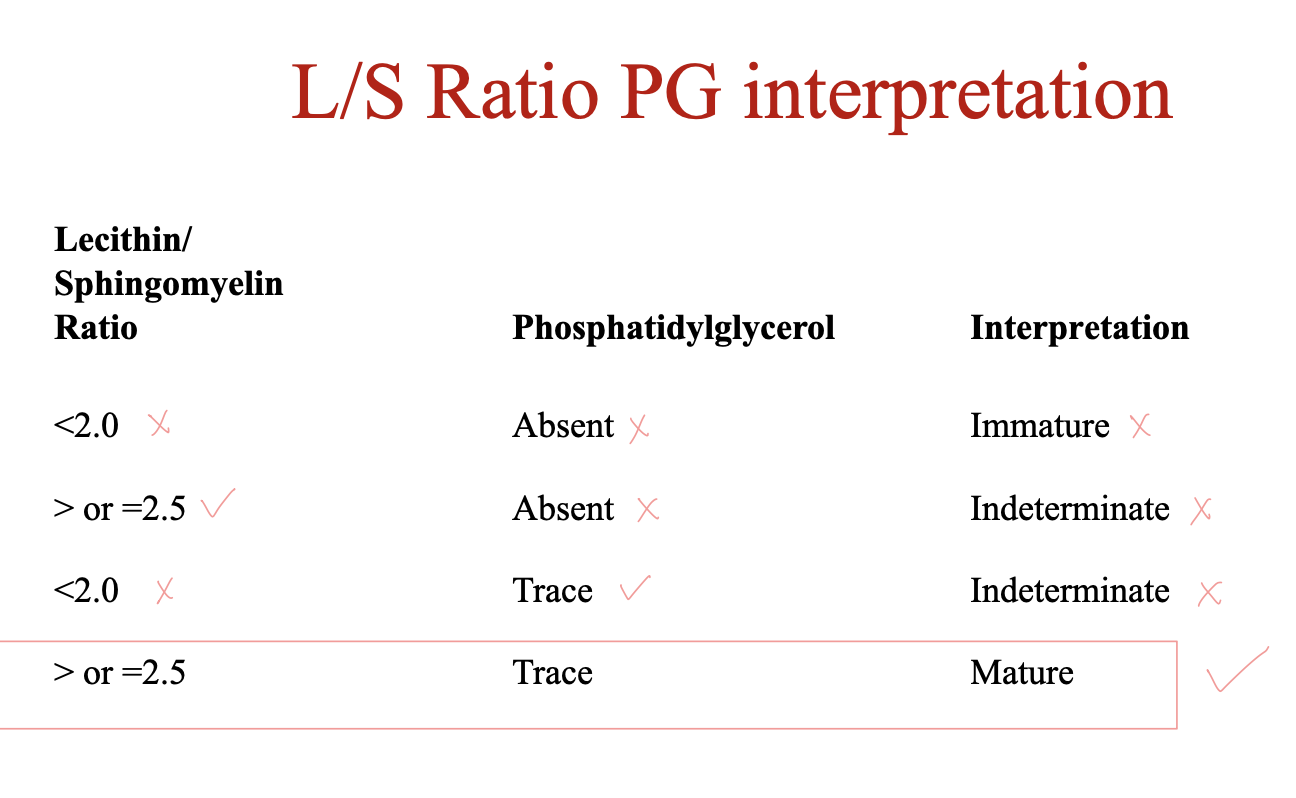
64
what are lamellar body counts?
a diagnostic test used to assess fetal lung maturity.
65
What are the 3 tests done to detect fetal lung maturity?
L/S ratio; Phosphatidyl glycerol (PG); Lamellar Body Counts
66
What are lamellar bodies?
are small storage granules within type 2 cells that contain surfactant. These bodies are produced by the fetal lungs and eventually released into the amniotic fluid, where they can be counted.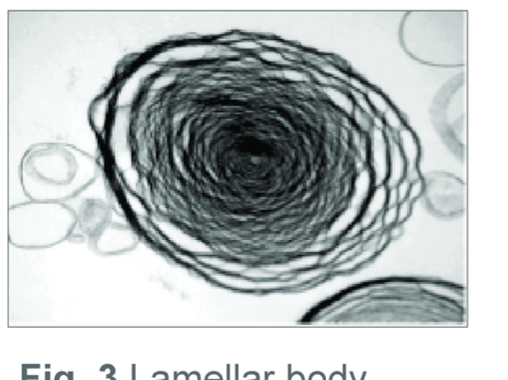
67
At what trimester, are lamellar bodies present in amniotic fluid? and at what quantity per microliter?
3rd trimester; 50,000 to 200,000 per microliter
68
How are lamellar bodies measured? (what equipment is used) and why?
Automated hematology counter's platelet counter because its at rapid, low-cost, small sample size needed.
69
Is bilirubin found in amniotic fluid?
yes!!
70
Yellow amniotic fluid indicates what condition ?
Fetal erythroblastosis (hemolytic disease of the fetus)
71
What is fetal erythroblastosis associated with?
Rh factor incompatibility between mother and fetus
72
When does Rh incompatibility happen?
Rh- mother
Rh+ fetus
Rh+ fetus
73
Explain how Rh incompatibility happens between mother and fetus.
The mother’s immune system may respond by producing antibodies against the Rh-positive cells, a process known as sensitization. This doesn’t typically affect the first pregnancy, as sensitization usually takes time. In a later pregnancy with another Rh-positive fetus, the mother's anti-Rh antibodies can cross the placenta and attack the fetus’s Rh-positive red blood cells. This can lead to hemolytic disease of the fetus and newborn (HDFN)
74
What is administered to prevent fetal erythroblastosis?
Rh incompatibility is managed by giving Rh-negative mothers an injection of Rh immunoglobulin (RhIg or RhoGAM) during and after each pregnancy.
75
in what conditions is biliruben detectable?
not in normal condition, only is significant fetal red blood cell hemolysis occurs.
76
Amount of bilirubin correlates with what?
severity of hemolysis
77
Normal amniotic fluid has a straight line at what absorbance?
365 to 550 nm
78
At what nm does bilirubin peak?
450 nm
79
What type of specimens are not acceptable for detecting biliruben in the spectrophotometer? and why? and what should be done?
bloody specimens because oxyhemoglobin aborbs at 412 to 540 nm
&
meconium -contaminated specimen also not acceptable.
REJECT SAMPLE
&
meconium -contaminated specimen also not acceptable.
REJECT SAMPLE
80
What is something very important about bilirubin?
must be protected from light after collection, as bilirubin is very light sensitive.