Lecture 10 - Gastrointestinal System
Study these flashcardsFree · spaced repetition · iPhone, Android, Mac & web
All cards
1
What are the steps in the gastrointestinal system (starting at the mouth)?
Mouth > pharynx > epiglottis > esophagus > stomach > duodenum > jejunum > ilieum > Ileocecal valve > large intestine > sigmoid colon > rectum > anus
2
What is the movement called when food is travel down the GI tract?
Peristalsis
3
How many layers does the wall of the GI system have?
4
4
What are the 4 layers of the GI system called? inner to outer
Mucosa, submucosa, muscularis, serosa
5
What is found in the mucosa layer?
Epithelium (epithelial cells), loose connective tissue, and smooth muscle
6
What is found in the submucosa layer?
blood vessels, glands, submucosal plexus
7
What is found in the muscularis layer?
Myenteric plexus, inner circular layer, outer longitudinal layer
8
What is found in the serosa layer?
Connective tissue and epithelium of peritoneum
9
What are the main functions of the GI system?
1. Ingestion
2. Mastication (chewing)
3. Deglutition (swallowing)
4. Digestion
5. Absorption
6. Excretion
2. Mastication (chewing)
3. Deglutition (swallowing)
4. Digestion
5. Absorption
6. Excretion
10
What causes the major diseases in the GI tract?
Dental caries, gum disease
Infectious diseases (e.g. gastroenteritis)
Circulatory disorders, hemorrhagic lesions
Multifactorial disorders (e.g. peptic ulcer, inflammatory bowel disease)
Obstructive disorders
Functional disorders (e.g. indigestion, malabsorption)
Neoplasms
Infectious diseases (e.g. gastroenteritis)
Circulatory disorders, hemorrhagic lesions
Multifactorial disorders (e.g. peptic ulcer, inflammatory bowel disease)
Obstructive disorders
Functional disorders (e.g. indigestion, malabsorption)
Neoplasms
11
What is stomatitis?
general term for inflammation and soreness in the mouth, including the tongue, gums, lips, cheeks, and palate.
12
What type of stomatitis is this?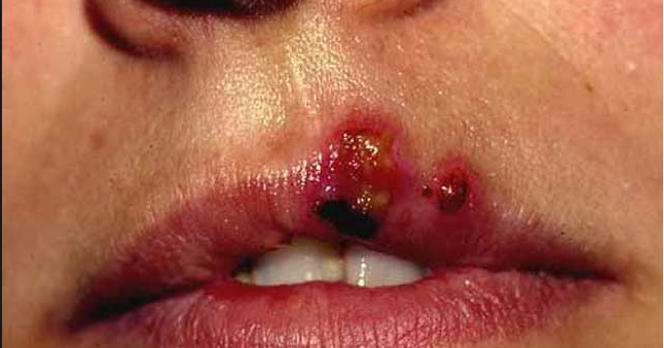
Herpesvirus infecction
13
What type of stomatitis is this?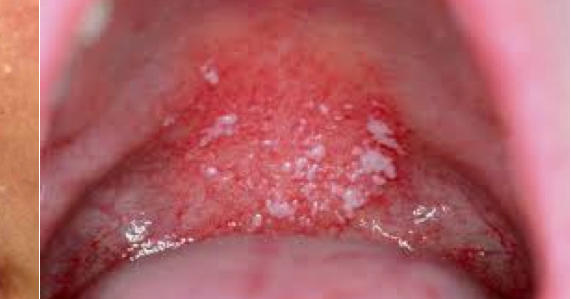
Thrush (Candida Albicans)
14
What type of stomatitis is this?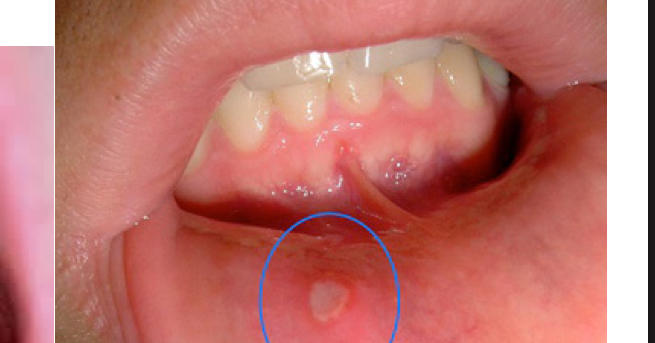
Aphthous Stomatitis (canker sores)
15
What are examples of stomatitis?
1. Herpesvirus infection
2. Candida albicans infection (thrush)
3. Aphthous stomatitis (canker sores)
2. Candida albicans infection (thrush)
3. Aphthous stomatitis (canker sores)
16
Canker sores only happen inside of the mouth because
it targets non-keratinized surfaces
17
What is oral cancer associated with?
tobacco chewing (#1 cause)
18
What is present morphologically in oral cancer?
1. Leukoplakia
2. Erythroplakia
3. Ulcer
4. Crater
5. Nodule
2. Erythroplakia
3. Ulcer
4. Crater
5. Nodule
19
What are most tumors in oral cancer mostly classified as?
Squamous cell carcinomas
20
What are clinical presentation for diseases of the esophagus?
1. Dysphagia
2. Esophageal (retrosternal) pain
3. Aspiration or regurgitation
2. Esophageal (retrosternal) pain
3. Aspiration or regurgitation
21
What is dysphagia?
difficulty swallowing
22
What is Esophageal (retrosternal) pain?
pain that occurs behind the sternum or breastbone
23
What is the normal pH of the stomach?
2-3
24
List diseases/abnormalities that could be seen in the esophagus
Developmental abnormalities: ATRESIA with or without esophageal-tracheal fistula
Hiatal hernia
Motility disorders (achalasia)
Esophagitis
Circulatory disturbances (varices~varicose veins)
Carcinoma
Hiatal hernia
Motility disorders (achalasia)
Esophagitis
Circulatory disturbances (varices~varicose veins)
Carcinoma
25
What is achalasia?
a rare swallowing disorder that makes it difficult for food and liquid to pass from the esophagus into the stomach.
26
What is esophageal atresia?
a CONGENITAL disorder in which a baby's esophagus does not form properly during pregnancy.
27
What is esophageal-tracheal fistula?
an abnormal connection between the esophagus and trachea
28
When does hiatal hernia/"paraesophageal" occur?
occurs when part of the stomach moves up into the chest through a hole in the muscular wall called the diaphragm
29
When does "sliding" hiatal hernia occur?
when the stomach and part of the esophagus “slide” up into the chest
30
What type of epithelium lines the esophagus?
stratified squamous epithelium
31
what type of epithelium lines the esophagus in barrett's esophagus
columnar epithelium
32
What is barrett's esophagus?
condition that occurs when the lining of the esophagus is damaged by acid reflux, causing it to thicken and turn red
33
What is esophagitis?
inflammation of the esophagus
34
What is esophagitis caused by?
Reflux of gastric juice ("peptic esophagitis")
Infection: viruses, fungi (immunosuppressed persons), bacterial superinfection
Chemical irritants: exogenous chemicals or drugs
Infection: viruses, fungi (immunosuppressed persons), bacterial superinfection
Chemical irritants: exogenous chemicals or drugs
35
How do you diagnose esophagitis?
Endoscopy: finding a lot of eosinophils in the stomach
36
Out of all cancers, what percentage is carcinoma of the esophagus accounted for?
4% of all cancers
37
How many carcinoma of the esophagus cases per year are there in the U.S.?
8,000
38
What is usually correlated with carcinoma of the esophagus?
Alcohol and tobacco abuse
39
Is carcinoma of the esophagus more common in men or woman?
MEN
40
What is the prognosis of carcinoma of the esophagus?
POOR: avg survival is 2 years
41
Where is squamous cell carcinoma located?
Upper or lower esophagus
42
Where is adenocarcinoma located and what does it associate to?
Lower esophagus, developing in Barrett's esophagus
43
What are the symptoms of diseases of stomach and duodenum?
1. Pain: midline, upper abdomen
Vomiting
2. Bleeding: acute with hematemesis (blood in vomit) or chronic with melena (stool has blood - oxidized; upper GI bleeding)
3. Dyspepsia ~ indigestion
Systemic consequences: iron deficiency anemia caused by chronic blood loss, vitamin B12 malabsorption-related megaloblastic anemia.
Vomiting
2. Bleeding: acute with hematemesis (blood in vomit) or chronic with melena (stool has blood - oxidized; upper GI bleeding)
3. Dyspepsia ~ indigestion
Systemic consequences: iron deficiency anemia caused by chronic blood loss, vitamin B12 malabsorption-related megaloblastic anemia.
44
What is gastritis?
inflammation of the stomach lining
45
What is dyspepsia?
indigestion
46
Acute (erosive) gastritis is caused by:
stress, shock, food, exogenous chemicals, drugs
EROSIONS ~ more diffused
ULCERATIONS ~ spots that are damaged into the layers
EROSIONS ~ more diffused
ULCERATIONS ~ spots that are damaged into the layers
47
Chronic atrophic gastritis can happen with and without what?
intestinal metaplasia
48
Chronic (nonerosive) atrophic gastritis is mainly caused by:
Helicobacter pylori (H. pylori)
Autoimmune (with pernicious anemia)
Autoimmune (with pernicious anemia)
49
What is the number one cause of gastritis?
Helicobacter pylori (H. pylori)
50
What are peptic ulcers?
an open sore found on the lining of the stomach or duodenum (the first part of the small intestine).
51
What causes peptic ulcers?
MULTIFACTORIAL
52
What are contributing factors in peptic ulcers?
Gastric juice: HCL, pepsin
Mucosal barrier defects: stress, shock, NSAIDs, smoking reduce resistance
H. pylori: found in most patients
Mucosal barrier defects: stress, shock, NSAIDs, smoking reduce resistance
H. pylori: found in most patients
53
What is more common "stomach ulcers" or "duodenum ulcers"?
duodenum ulcers
54
Which layer of the GI system do peptic ulcers bleed and why?
In the muscularis because there are a lot of blood vessels here.
55
How many people are affected by carcinoma of the stomach in the U.S.?
25,000 people
causing 14,000 deaths/year
8 x more common in JAPAN & CHILE
Incidence has decreased over past 70 years in the U.S.
causing 14,000 deaths/year
8 x more common in JAPAN & CHILE
Incidence has decreased over past 70 years in the U.S.
56
What is the etiology of carcinoma of the stomach?
Unknown; maybe nitrosamines in food, maybe H. pylori
57
List the different diseases of the intestines
Developmental abnormalities: Hirschsprung's disease, congenital diverticula (e.g., Meckel's)
Diverticulosis, obstructions, hernias
Vascular disorders
Inflammatory bowel disease
Infections, including peritonitis
Malabsoption syndrome
Neoplasms
Diverticulosis, obstructions, hernias
Vascular disorders
Inflammatory bowel disease
Infections, including peritonitis
Malabsoption syndrome
Neoplasms
58
What is Hirschsprung's disease?
a condition in newborns that affects the large intestine (colon) and causes problems with passing stool because the muscles don't work so there is severe constipation. CURE: surgical intervention
59
What is a large intestine called?
Megacolon
60
What is Meckel diverticulum?
a common congenital abnormality where a small pouch that extends from the wall of the small intestine, caused by incomplete closure of the vitelline duct during the fifth week of fetal development
61
What is Crohn's disease?
Inflammation in your lower small intestine and part of your large intestine
62
What is Diverticulosis?
condition in which pocketS develop on your large intestine
63
What disease is this?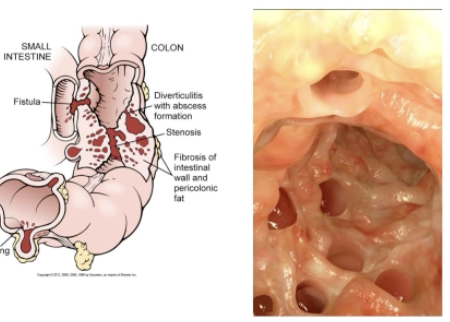
Diverticulosis
64
List examples of intestinal vascular diseases
Hemerrhoids
Angiodysplasia
Ischemic bowel disease
Chronic ischemia
Acute thrombosis of mesenteria arteries, veins
Nonocclusive intestinal infarts
Angiodysplasia
Ischemic bowel disease
Chronic ischemia
Acute thrombosis of mesenteria arteries, veins
Nonocclusive intestinal infarts
65
What happens in hemerrhoids?
Valves are leaky
66
What happens in angiodysplasia?
swollen, fragile blood vessels in the colon. (INCREASE DIAMETER).
67
which population is mostly affected with angiodysplasia?
Older people
68
What happens in ischemic bowel disease?
Occlusive and non-occlusive formations causes necrosis and bowels do not work.
69
What happens in chronic ischemia in the arteries of the intestinal tract?
Number one cause is atherosclerosis. Tissuse starts to die out.
70
What are the similarities in clincial features for Crohn's disease and ulcerative colitis?
Familial (runs in the family) ++
Peak age 15-25years
Immune disturbances +
Extraintestinal complications + (aka other organs are affected)
Treatment (no cure) +
Peak age 15-25years
Immune disturbances +
Extraintestinal complications + (aka other organs are affected)
Treatment (no cure) +
71
What are the differences in clincial features for Crohn's disease and ulcerative colitis?
Distribution: segmental, including ileum and ileocecal (CROHN'S) vs. diffuse, colon ONLY; goes backwards starts at rectum (UC)
Transmural: ++ (CROHN'S) vs. - (UC)
Granuloma: + (CROHN'S) vs. - (UC)
Fistula: + (CROHN'S) vs. - (UC)
Megacolon: - (CROHN'S) vs. + (UC)
Cancer: + CROHN'S vs. ++ (UC)
Transmural: ++ (CROHN'S) vs. - (UC)
Granuloma: + (CROHN'S) vs. - (UC)
Fistula: + (CROHN'S) vs. - (UC)
Megacolon: - (CROHN'S) vs. + (UC)
Cancer: + CROHN'S vs. ++ (UC)
72
Which disease contains patchy or segmented lesions: Crohn's Disease or Ulcerative Colitis?
Crohns
73
Where does Crohn's disease usually start?
Right side of the intestinal tract. Ileum and Ileosecal valve
74
How does Ulcerative colitis travel in the inestines?
Starts at the rectum > sigmoid colon > descending colon > transverse colon > ascending colon (DIFFUSED FORM)
75
Which layers are affected in crohn's disease?
Transmural (affects all)
76
Which layers are affected in ulcerative colitis?
Mucosa and submucosa (dr. nasr said it)
77
Which disease is more prone to fistulas and why? (crohns or ulcerative colitis)
Crohn's; because inflammation can spread through all the layers in the bowel wall
78
Which disease (Crohn's or Ulcerative Colitis) do granulomas form?h
Crohn's disease
79
Which disease (Crohn's or Ulcerative Colitis) does megacolon form?W
UC
80
Which disease (Crohn's or Ulcerative Colitis) causes cancer?
both, mostly UC.
81
List examples of gastrointestinal infections
Food poisioning: bacterial toxins ~ salmonella
Viral infections ~ stomach virus, nora virus (cruise ship)
Infectious diarrhea ~ mexico water
Small-intestine infection: E. coli, Vibrio cholerae, Giardia lamblia, rotavirus
Large-intestine infection: E. coli, shigella, norwalk virus, entamoeba
Viral infections ~ stomach virus, nora virus (cruise ship)
Infectious diarrhea ~ mexico water
Small-intestine infection: E. coli, Vibrio cholerae, Giardia lamblia, rotavirus
Large-intestine infection: E. coli, shigella, norwalk virus, entamoeba
82
What is an example of bacterial toxin that causes food poisoning?
Salmonella
83
What is an example of a viral infection in the GI tract?
Stomach virus, nora virus (cruise ships)
84
What can cause infectious diarrhea in the GI tract?
Water in foreign country
85
Which bacteria target the small intestine?
E.coli, vibrio cholerae
86
which bacteria target the large intestine?
E.coli, shigella Sp
87
which virus target the small intestine?
Rotavirus
88
which virus target the large intestine?
norwalk virus aka norovirus
89
which parasites target the small intestine?
Giardia lamblia
90
which parasites target the large intestine?
Entamoeba histolytica
91
What is acute appendicitis?
an inflammation of the appendix
92
What type of organ is the appendix?
a vestigial hollow tube, same tissue as tonsils
93
Clinical symptoms of acute appendicitis:
pain
94
What is peritonitis?
inflammation of the peritoneum
95
what causes acute infectious peritonitis?
Rupture of stomach
Spread of infection from fallopian tubes
Rupture of abscess
Infection of preexisting ascites
Spread of infection from fallopian tubes
Rupture of abscess
Infection of preexisting ascites
96
When fluid goes into the abdominal cavity, what is the term called?
Peritoneal effusion aka ascites
97
What is ascites?
fluid builds up in the abdomen aka peritoneal effusion
98
What are examples of acute sterile (noninfectious) peritonitis?
Acute pancreatitis
Rupture of the gallbladder
Postsurgical peritonitis
Rupture of the gallbladder
Postsurgical peritonitis
99
What does the pancreas produce?
Major digestive enzymes
100
What is acute sterile (noninfectious) peritonitis?
is a rare form of aseptic peritonitis, or inflammation of the abdominal cavity without infectious pathogens
101
What causes acute sterile (noninfectious) peritonitis?
Acute pancreatitis
Rupture of the gallbladder
Postsurgical peritonitis
Rupture of the gallbladder
Postsurgical peritonitis
102
What is celiac disease?
chronic digestive and immune disorder that damages the small intestine. Loss of villi. It's caused by a sensitivity to gluten
103
What is Whipple's disease?
a rare bacterial infection that causes malabsoption due to big inflammation response
104
What causes whipple's disease?
Tropheryma whipplei
105
List examples that cause malabsorption resulting from defective intraluminal digestion
Deficiency of gastric juices: postgastrectomy conditions, atrophic gastritis
Deficiency of bile: biliary obstruction, liver disease, Crohn's disease
Deficiency of pancreatic juices: chronic pancreatitis
Bacterial overgrowth: G. lamblia
Deficiency of bile: biliary obstruction, liver disease, Crohn's disease
Deficiency of pancreatic juices: chronic pancreatitis
Bacterial overgrowth: G. lamblia
106
In order to absorb food properly, you have to ______ properly.
Digest
107
List examples that cause malabsorption resulting from defective uptake of nutrients
Celiac sprue
Tropical sprue
Infectious enteritis (e.g., E.coli, rotavirus)
Crohn's disease
Whipple's disease
Congenital abetaliproproteinemia
Short bowl syndrome (after surgical resection)
Tropical sprue
Infectious enteritis (e.g., E.coli, rotavirus)
Crohn's disease
Whipple's disease
Congenital abetaliproproteinemia
Short bowl syndrome (after surgical resection)
108
what is Congenital abetaliproproteinemia?
inherited disease that prevents the body from absorbing fats and certain vitamins from food. fatty stool ewwww.
109
what is short bowl syndrome (after surgical resection)?
when the small intestine is unable to absorb nutrients properly after surgery or damage
110
Where do intestinal neoplasms mostly occurs?
Colon
111
How are intestinal neoplasms classified?
Sporadic or familial (S:F = 8:2)
Benign or malignant (B:M = 3:1)
May be Solitary or multiple
Primary or secondary (P > S)
Benign or malignant (B:M = 3:1)
May be Solitary or multiple
Primary or secondary (P > S)
112
what are epithelial tumors known as?
Adenomas, carcinomas
113
Out of all tumors, what precentage are epithelial tumors accounted for and which ones are they?
90%; adenomas, carcinomas
114
Epithelial tumors are more common than ___
Lymphomas or mesenchymal tumors (benign soft tissue tumor, e.g., lipoma, leiomyoma, sarcomas)
115
What do stats say about carcinoma of the large intestine?
3rd most common cancer of internal organs
Affects 190,000 persons per year in the U.S.
Affects 190,000 persons per year in the U.S.
116
How is adenocarcinoma of the colon identified?
Colonoscopy: identifying a napkin-ring lesion because the tumor grows in a circle and narrows the passage
117
Adenocarinoma of the colon mostly appears where?
Sigmoid colon