Exam #1 study guide (what she wants us to know)
Study these flashcardsFree · spaced repetition · iPhone, Android, Mac & web
All cards
1
What is a parasite?
organism that benefits from host (nutrition), while often harming host (pathogenic); immunologic response often initated
2
What type of parasites are there? (general terms)
Obligate - dependent on the host to live
Facultative - can be free-living or parasitic, depending on the situation (ex: naegleria)
Endoparasites: live within the body
Ectoparasites: live on outer surface of the body
Facultative - can be free-living or parasitic, depending on the situation (ex: naegleria)
Endoparasites: live within the body
Ectoparasites: live on outer surface of the body
3
What are the 3 different type of hosts a parasite can live in?
Definitive host: requires host to reach sexual maturity (part of life cycle)
Intermediate host: temporary part of life cycle, short of sexual maturity
Transfer/paratenic host: not necessary for life cycle, temporary refuge
Intermediate host: temporary part of life cycle, short of sexual maturity
Transfer/paratenic host: not necessary for life cycle, temporary refuge
4
What are vectors?
arthropods - mosquitos
5
What are examples of animal hosts?
sheep, fish, and pig (could be WIlD OR DOMESTIC ANIMAL)
6
Parasites reproduce fast or slow?
SLOW; less progeny
7
Do parasites usually cause chronic or acute infections?
CHRONIC
8
Do bacteria/viruses/fungi reproduce fast or slow?
Reproduce rapdily; high numbers of progeny
9
Do bacteria/viruses/fungi cause chronic or acute infections?
ACUTE
10
How is parasitic transmission controlled?
targeting the intermediate hosts (careful not to harm the host)
or
vector control (mosquito repellant)
or
vector control (mosquito repellant)
11
what is the difference between hyperplasia and hypertrophy?
Hyperplasia - result of inflammation/attempted repair
Hypertrophy - increase in organ size, often due to engorgement by intracellular parasites.
Hypertrophy - increase in organ size, often due to engorgement by intracellular parasites.
12
Which cell in commonly seen under the microscope due to host immunologic response?
Eosinophils
13
what are the 3 different means of locmotion that helps classify different types of protozoans?
Amoeba, flagellates, ciliates
14
What does Entamoeba histolytica like to ingest?
RBCs
15
Describe the nucleus of Entamoeba histolytica.
Central karyosome and evenly distributed chromatin.
16
What are the 2 stages of parasites (in general)?
trophozoites and cysts
17
Which is the infective stage: trophozoite or cysts?
CYSTS
18
What are the 6 lumen dwelling AMOEBAS we talked about in class?
Entamoeba histolytica,
Entamoeba hartmani
Entamoeba coli
Endolimax nana
Iodamoeba butshlii
Blastocyctis hominis
Entamoeba hartmani
Entamoeba coli
Endolimax nana
Iodamoeba butshlii
Blastocyctis hominis
19
Which species are morphologically identical to Entamoeba histolytica but are noninvasive?
E. dispar, E bangladeshi, E. moshkovskii
20
What does lumen dwelling mean?
commonly found in the alimentary tracts (GI tract) of hosts
21
Describe the karyosome and nuclear chromatin in E. histolytica trophozoite.
Karyosome: small and central
Chromatin: evenly distributed.
Chromatin: evenly distributed.
22
How many nuclei does E. histolytica cyst have?
can have up to 4!
23
What else do E. histolytica cysts have besides nuclei?
chromatoid bodies with round edges
24
What is the treatment for E. histolytica?
blood and fluid transfusions
&
Metronidazole (flagy)
&
Metronidazole (flagy)
25
what is the mode of transmission for E. histolytica?
Fecal-oral transmission
26
Which is the infective stage for E. histolytica life cycle?
CYSTS
27
what are the 3 different pathways that E. histolytica can have its life cycle?
Noninvasive: remain confined to intestinal lumen
Intestinal: invade intestinal mucosa
Extraintestinal: invade the blood -> reach extraintestinal dites (liver, brain, lungs)
Intestinal: invade intestinal mucosa
Extraintestinal: invade the blood -> reach extraintestinal dites (liver, brain, lungs)
28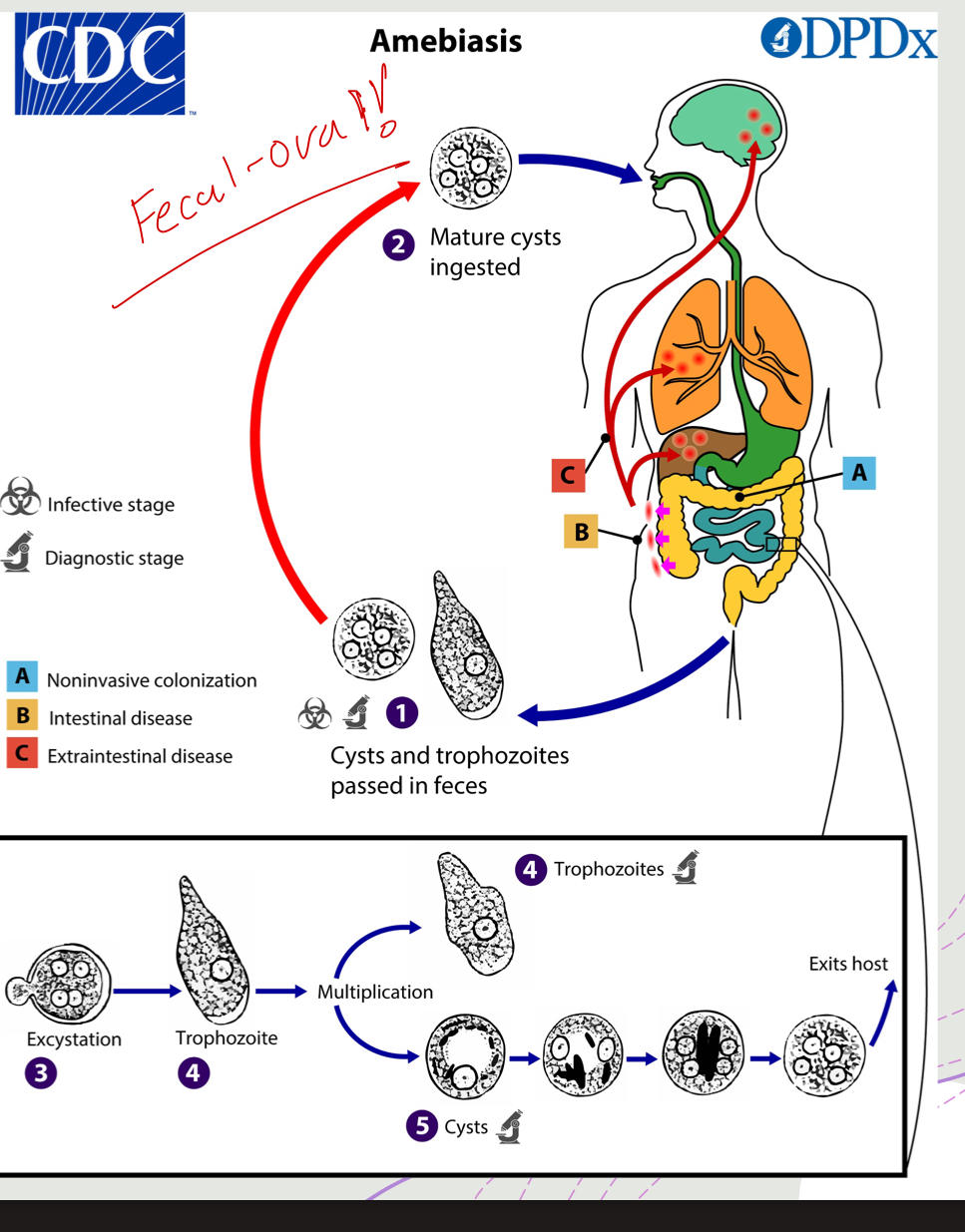
Draw the life cycle for E. histolytica
29
What are the 5 different clinical features that can be seen in E. histolytica?
Intestinal
Hepatic
Brain
Lung
Asymptomatic/ non-invasive
Hepatic
Brain
Lung
Asymptomatic/ non-invasive
30
Which clinical feature is mostly common which E. histolytica? and why can it be worrisome?
Intestinal infection & worrisome: can form "flask-like lesions/ ulcers
31
Which clinical feature is most commly assocaited with extraintestinal complication in e. histolytica? & what can it contain?
Hepatic infection; amboebic abscess: described as containing 'anchovy paste' like material
32
What is the main differences between E. histolytica and E. hartmani?
LOOKS LIKE E. HISTOLYTICA BUT SMALLER & WILL NOT SEE RBCs IN CYTOPLASM - it's not invasive
33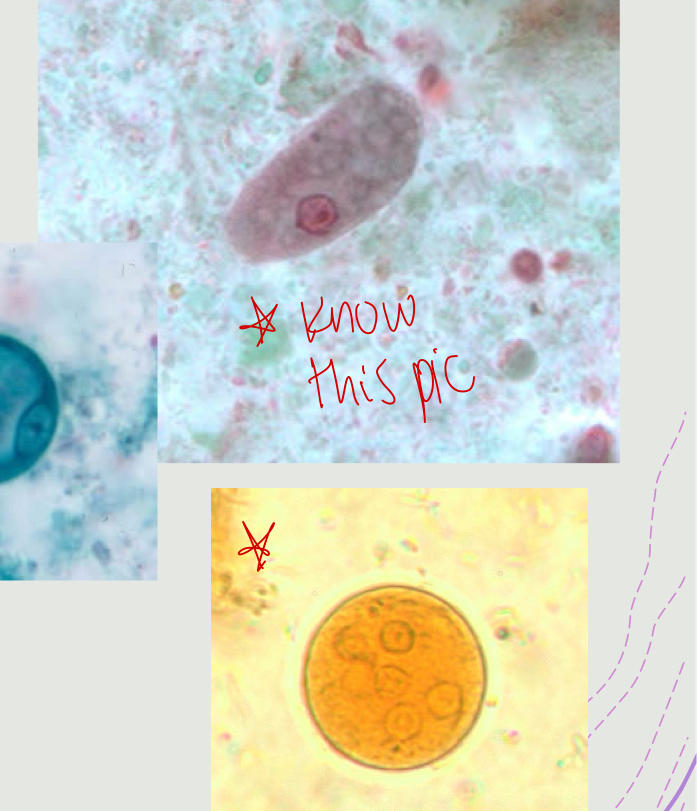
E. coli