Chapter 3
Study these flashcardsFree · spaced repetition · iPhone, Android, Mac & web
All cards
1
Which structure is most responsible for bacterial motility?
A. Cilia
B. Flagella
C. Fimbriae
D. Pseudopodia
A. Cilia
B. Flagella
C. Fimbriae
D. Pseudopodia
B. Flagella
2
Bacteria capsules help bactiera avoid human immune defenses. (True/false)
True
3
Which external structure help bacteria transfer DNA between cells?
A. Fimbriae
B. Axial filament
C. Glycocalyx
D. Pilus
A. Fimbriae
B. Axial filament
C. Glycocalyx
D. Pilus
D. Pilus
4
A Gram-negative bacteria has one pair of rings in the flagellar basal body (True/False)
False
5
Whihc is most associated with diffusion?
A. Symports
B. Antiports
C. Carrier Proteins
D. Endocytosis
A. Symports
B. Antiports
C. Carrier Proteins
D. Endocytosis
C. Carrier Proteins
6
Which cellular structure is important in classifying a bacterial species as Gram-positive or Gram-negative?
A. Flagella
B. Cell Wall
C. Glycocalyx
D. Slime Layer
A. Flagella
B. Cell Wall
C. Glycocalyx
D. Slime Layer
B. Cell Wall
7
Gram-positive bacteria appear purple after gram staining (true/false).
True
8
Acid-fast staining is useful in identifying Mycobacteria. (true/false)
True
9
What are the 3 basic shapes of bacteria?
Coccus, bacillus, and spiral
10
What is the avereage size of bacteria?
0.2-20 µM diameter (< 10µm length)
11
What are the external structures that make up bacteria?
Glycocalyx, cell wall, flagella, axial filaments, frimbriae and pili.
12
What is the glycocalyces?
External to the cell wall
Viscous and stickyyyyy
Viscous and stickyyyyy
13
What are the 2 types of glycocalyces?
Capsules: firmly attached
Slime layers: loosly attached and water soluble
Slime layers: loosly attached and water soluble
14
What role does the glycocolyces play in bacteria?
Virulence
15
How do capsules help the bacteria?
By preventing bacteria from being recognized by host
16
How do slime layers help the bacteria?
It is sticky and allows attachment to surfaces
17
What structures do spirochetes contain?
Axial filaments
18
What is flagella?
Long structures external to the cell wall
19
Do all bacteria have flagella?
No
20
Flagella is important in _____
biofilm formation and adhesion
21
What can flagella trigger?
Immune response
22
What is flagella made out of?
Flagellin ~ protein
23
What is flagella responsible for?
Movement and taxis
24
What is flagella structure composed of?
Filament
Hook
Basal Body
Hook
Basal Body
25
What anchors the hook and filament to the bacteria's cell wall?
basal body
26
How many rings do gram + bacteria have?
2 rings
27
How many rings do gram - bacteria have?
2-4 rings
28
What differentiates a bacteria from being gram + or gram -?
The structure of the basal body
29
What are the different types of flagella arrangement?
Peritrichous: covering the surface
Polar: one end only
Tufts: multiple polar flagella
Polar: one end only
Tufts: multiple polar flagella
30
What flagella arrangement is this?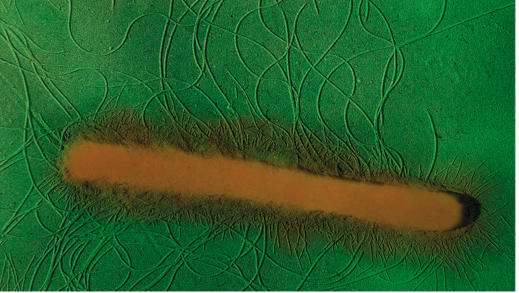
Peritrichous
31
What flagella arrangement is this?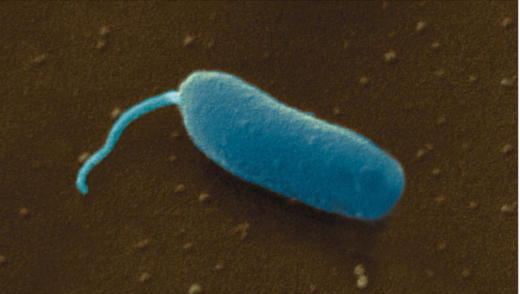
Single or "polar"
32
What flagella arrangement is this?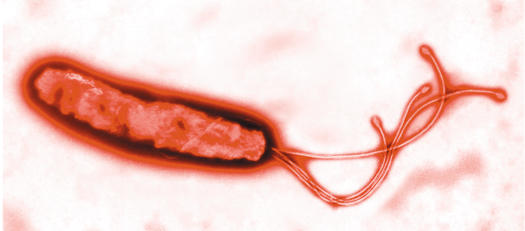
Tuft
33
If bacteria only has 1 flagella, what is it called?
Monotrichous
34
If bacteria only has 2 flagella at either ends, what is it called?
Amphitrichous
35
If bacteria has a tuft of flagella, what is it called?
Lophotrichous
36
If bacteria has flagella throughout the whole body of the bacteria, what is it called?
Peritrichous
37
What are axial filaments?
used for motility
38
What type of bacteria have axial filaments?
Spirochetes
39
What are axial filaments composed of?
Bundles of fibrils called endoflagella
40
Where are fimbriae located on the bacteria?
External to the cell wall
41
Do all bacteria have fimbriae?
No
42
What do fimbriae look like?
Sticky, bristle-like projections
Shorter and more numerous than flagella
Shorter and more numerous than flagella
43
What is the fimbriae function?
Help bacteria adhere to host tissue/form biofilms
44
what are pili?
Special type of fimbriae
AKA conjugation pili
AKA conjugation pili
45
What is used to transfer DNA between cells?
Pili via conjugation
46
How big are pili?
Longer than fimbriae,
Shorter than flagella
Shorter than flagella
47
How many pili are present on bacteria?
One to a few present.
48
What are biofilms?
a community of microbe on a surface
49
What are biofilms composed of?
slime layers, fimbriae, and pili
50
How often are biofilms involved in human bacterial infections?
2/3
51
What are biofilms resistant to?
antibiotics and host defense system