Secondary Hemostasis - Coag Cascade
Study these flashcardsFree · spaced repetition · iPhone, Android, Mac & web
All cards
1
What is formed during primary hemostasis?
Platelet plug
2
Why is the platelet plug alone insufficient?
Not enough to stop hemorrhage in larger blood vessels
3
What must occur simultaneously as primary hemostasis?
Secondary hemostasis
4
What is secondary hemostasis also called?
Activated coagulation cascade
5
What do activated coagulation factors, specifically thrombin, form?
forms insoluble, cross-linked fibrin, which help to stabilize the primary platelet plug
6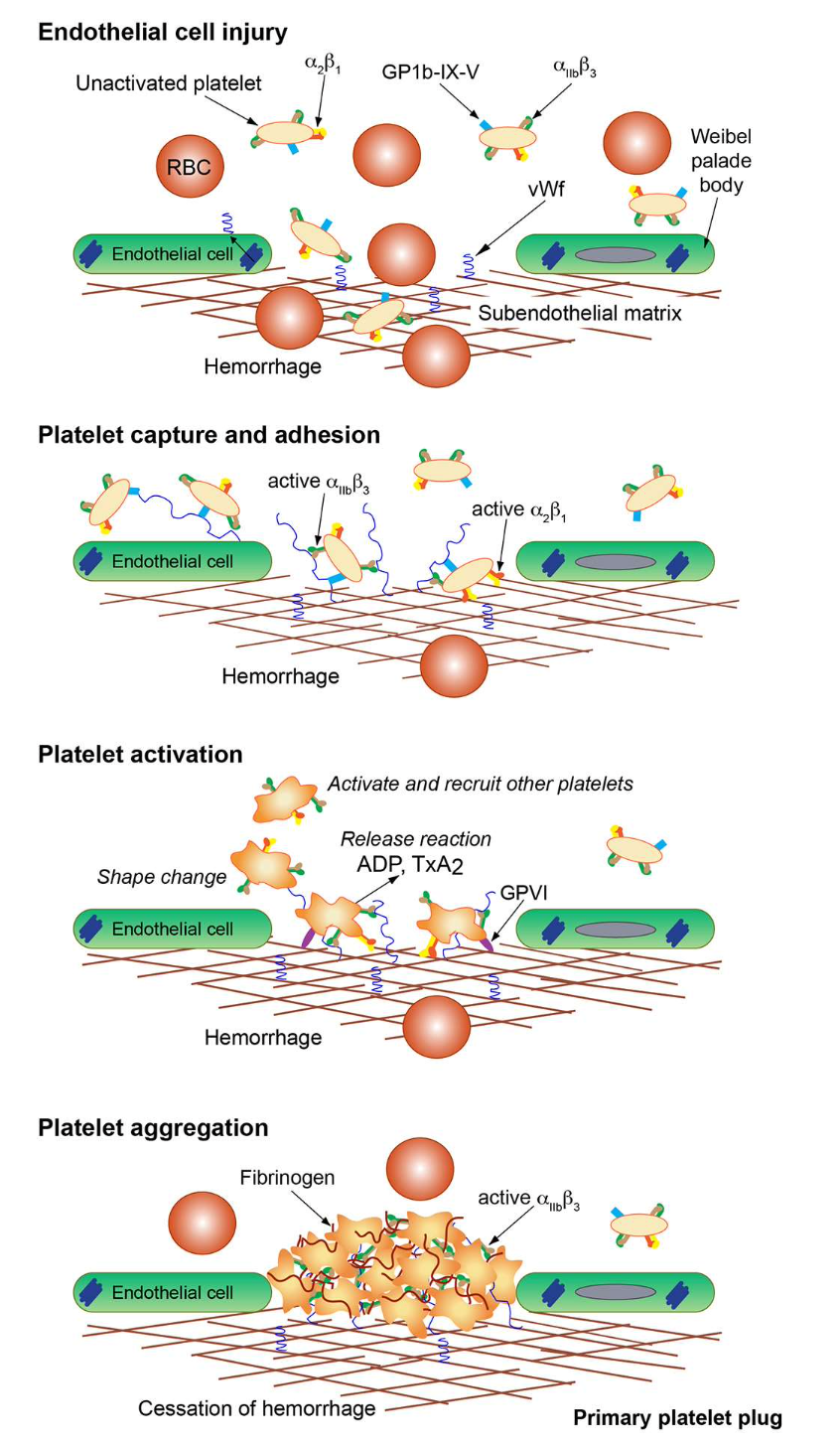
chatgpt explaination: 1. Endothelial cell injury
- Normally, the endothelium prevents platelet adhesion.
- When it is injured, the subendothelial matrix (collagen, vWF) is exposed.
- von Willebrand factor (vWF) is released from Weibel–Palade bodies of endothelial cells and binds exposed collagen.
- Platelets adhere to vWF through their GPIb-IX-V receptor complex, initiating platelet attachment.
- Integrins (α2β1, αIIbβ3) are also involved in binding to the matrix.
2. Platelet capture and adhesion
- Platelets are captured and tethered to the site of vascular injury.
- Adhesion occurs mainly via vWF-GPIb interaction, plus integrin receptors that anchor platelets to collagen.
- The platelets begin to spread and become activated.
3. Platelet activation
- Bound platelets undergo shape change (from discoid to spiny forms).
- Activated platelets release granules containing ADP and TxA₂ (thromboxane A₂), which further stimulate platelet activation.
- Platelets express GPVI receptor that interacts with collagen to reinforce activation.
- Activated platelets recruit additional platelets to the site of injury.
4. Platelet aggregation
- Activated platelets expose binding sites on integrin αIIbβ3 (GP IIb/IIIa).
- Fibrinogen acts as a bridging molecule, cross-linking platelets together through αIIbβ3.
- This results in the formation of a primary platelet plug.
- The plug temporarily stops bleeding (cessation of hemorrhage) but is fragile. It will later be reinforced by secondary hemostasis (fibrin formation).
- Normally, the endothelium prevents platelet adhesion.
- When it is injured, the subendothelial matrix (collagen, vWF) is exposed.
- von Willebrand factor (vWF) is released from Weibel–Palade bodies of endothelial cells and binds exposed collagen.
- Platelets adhere to vWF through their GPIb-IX-V receptor complex, initiating platelet attachment.
- Integrins (α2β1, αIIbβ3) are also involved in binding to the matrix.
2. Platelet capture and adhesion
- Platelets are captured and tethered to the site of vascular injury.
- Adhesion occurs mainly via vWF-GPIb interaction, plus integrin receptors that anchor platelets to collagen.
- The platelets begin to spread and become activated.
3. Platelet activation
- Bound platelets undergo shape change (from discoid to spiny forms).
- Activated platelets release granules containing ADP and TxA₂ (thromboxane A₂), which further stimulate platelet activation.
- Platelets express GPVI receptor that interacts with collagen to reinforce activation.
- Activated platelets recruit additional platelets to the site of injury.
4. Platelet aggregation
- Activated platelets expose binding sites on integrin αIIbβ3 (GP IIb/IIIa).
- Fibrinogen acts as a bridging molecule, cross-linking platelets together through αIIbβ3.
- This results in the formation of a primary platelet plug.
- The plug temporarily stops bleeding (cessation of hemorrhage) but is fragile. It will later be reinforced by secondary hemostasis (fibrin formation).
7
What is used to measure clotting time in Prothrombin Time (PT)?
Consists of the use of thromboplastin (rabbit brain) to measure the clotting time of the patient’s plasma
8
What does PT correlate to in vivo?
Correlates to Tissue factor in vivo
9
What role does CaCl2 in Neoplastine play in PT?
CaCl2 is in the Neoplastine, making it a one step reagent that is added to prewarmed plasma
10
Why does PT have a heparin inhibitor in Neoplastine?
Heparin inhibitor is in Neoplastine, this makes PT useful to monitor warfarin when bridging from heparin to warfarin therapy
11
What factors are measured by PT?
It measures the activity of the coagulation factor II (Prothrombin), V (Proaccelerin), VII (Proconvertin), X (Stuart factor), and I (Fibrinogen)
12
What is PT commonly used for?
Commonly used for monitoring vitamin K antagonist therapy
13
What is the formula for INR?
INR (International Normalized Ratio) = [(Patient’s PT)/(Mean Normal PT)]^ISI (International Sensitivity Index)
14
What does Activated Partial Thromboplastin Time (APTT) involve?
Involves the recalcification of plasma in the presence of a standardized amount of cephalin (platelet substitute) and a particulate activator (silica)
15
What is cephalin and why is APTT called “partial”?
Cephalin is a phospholipid, “partial” refers to lacking tissue factor
16
What does “activated” mean in APTT?
“Activated” refers to activation of contact factor group (F12, HMWK, PK) with silica
17
Why is APTT a two-step reaction?
Plasma is pre incubated several minutes before calcium is added, making this a two step reaction
18
What pathways does APTT evaluate?
Evaluates the intrinsic and common pathways; only factors VII and XIII are not evaluated
19
Which factors are screened by APTT?
Coagulation screening test of the coagulation factors, including: Factor XII (Hageman factor), Factor XI (Plasma thromboplastin), Factor IX (Christmas factor), Factor VIII, Factor X (Stuart-Prower factor), Factor V (Proaccelarin/Labile factor), and Factor II (Prothrombin)
20
What therapy is monitored by APTT?
Heparin therapy
21
What is added to diluted plasma in a fibrinogen test?
Calcium/Thrombin is added to diluted plasma
22
What type of reagent is used in fibrinogen testing?
One step reagent
23
How are results expressed in fibrinogen testing?
Secs are converted to mg/dL Fibrinogen
24
How is heparin interference minimized in fibrinogen testing?
Dilution with saline buffer minimizes heparin interference
25
What additional feature is present in fibrinogen reagent?
There is also a heparin inhibitor in reagent
26
Why is balance important in anticoagulation?
To maintain a well-balanced state
27
What happens if too much anticoagulant is used?
hemorrhage might occur
28
What happens if not enough anticoagulant is used?
hematomas may occur
29
Is monitoring important during anticoagulant therapy?
Yes, monitoring is important when patient is on anticoagulation medication
30
What is the normal balance of coagulation in the body?
Our body is constantly coagulating and anticoagulating
31
What causes a hypercoagulable state?
Excessive generation of thrombin by TF and endothelial injury combined with a lack of adequate inhibitors may contribute to a hypercoagulable state, at risk of developing microvascular thrombi
32
Why is thrombosis difficult to recognize clinically?
Thrombi frequently occurs in internal small vessels
33
How is bleeding time measured?
Small incision is made to measure the time it took to stop bleeding
34
What factors affect bleeding time?
Both platelet number and function affect the bleeding time
35
What diseases prolong bleeding time?
Diseases, such as thrombocytopenia, von willebrand disease, and storage pool disorder, that affect platelet count and function would prolong bleeding time
36
Where are coagulation factors synthesized?
Factors synthesized in liver
37
What is the exception to liver synthesis of factors?
Exception is Factor 8; made in part of liver that is not affected by liver disease and also in endothelial system
38
What is notable about pediatric coagulation factors?
Pediatric factor reference range and liver immaturity
39
What factor levels are low at birth?
All factors are “low” at birth except Factor 8 which is the same as adult range
40
What factors are monitored in liver transplant service?
Liver transplant service monitors F5 and F7
41
Why is Factor 7 a sensitive indicator?
Factor 7 is a sensitive indicator because of short half life (4-6 hours)
42
What is the primary initiator of the extrinsic (Tissue Factor) coagulation pathway?
Coagulation Factor III (also known as Tissue Factor (TF), Thromboplastin, and CD142) is the primary initiator of the extrinsic coagulation pathway
43
Which factor is part of the extrinsic pathway?
Factor VII (Stable factor)
44
Which factors are part of the intrinsic pathway?
- Factor XII (with HMW Kininogen and Prekallikrein)
- Factor XI
- Factor IX
- Factor VIII
- Factor XI
- Factor IX
- Factor VIII
45
Which factors are in the common pathway?
- Factor X
- Factor V
- Factor II (Prothrombin) → Factor IIa (Thrombin)
- Factor I (Fibrinogen) → Factor Ia (Fibrin)
- Factor V
- Factor II (Prothrombin) → Factor IIa (Thrombin)
- Factor I (Fibrinogen) → Factor Ia (Fibrin)
46
How is hemophilia classified by severity?
Severe (<1%), Moderate (1%-5%), Mild (6%-20%)
47
What is Hemophilia A caused by?
Factor VIII deficiency
48
What is Hemophilia B caused by?
Factor IX deficiency
49
What is Hemophilia C caused by?
Factor XI deficiency
50
Is hemophilia always inherited?
No, can be congenital (X-linked) and 30% acquired without a family history
51
What percentage of hemophilia cases are Hemophilia A in boys?
85% are boys with hemophilia A
52
What are treatments for specific factor deficiencies?
- Factor Concentrates
- Plasma-Derived Immunopurified Products
- Recombinant Human Factor Products
- Frozen Plasma
- Cryo – Factor XIII deficiency
- Plasma-Derived Immunopurified Products
- Recombinant Human Factor Products
- Frozen Plasma
- Cryo – Factor XIII deficiency
53
What are rare factor deficiencies?
Factor II (Prothrombin), Factor VII, and Factor X deficiencies are rare; when they occur, they may present with spontaneous bleeding or bleeding triggered by invasive procedures
54
What role does Vitamin K play in coagulation?
Vitamin K is a fat-soluble enzyme aids in fibrin formation
55
How does Vitamin K support factor function?
Carboxylation of y-glutamic acid GLA- residues allows these coagulation factors to bind calcium
56
Which factors are Vitamin K dependent?
FII, VII, IX, and X
57
Which inhibitors are Vitamin K dependent?
Protein C and Protein S
58
What is the antidote for Warfarin overdose?
Vitamin K
59
Will warfarin affect PT or APTT?
Answer is both, but PT is a more sensitive indicator of decreased common pathway factors
60
add info after in person lecture
61
What is the therapeutic INR range for general patients?
Therapeutic INR range 2.0-3.0
62
What is the therapeutic INR range for mechanical valve patients?
Therapeutic INR range is higher (2.5-3.5 or higher)
63
What are the half-lives of Factor 2 and Factor 7?
Factor 7 has the shortest half-life of 4-6 hours, Factor 2 has 60 hour half-life
64
What are the half-lives of Factor 9 and Factor 10?
The normal half-life for Factor 9 (FIX) is approximately 18-24 hours, while the half-life for Factor 10 (FX) is typically around 24-48 hours.
65
Why does warfarin take time to stabilize?
Warfarin affects synthesis; half life explains why it takes time for warfarin to take effect and stabilize
66
What are disadvantages of warfarin?
- Needs monitoring
- Diet restrictions (cannot eat too many leafy greens)
- Not for pregnant patients since it is a mutagenic (use LMW(Low Molecular Weight) heparin instead)
- Requires time to be effective and stabilize
- Diet restrictions (cannot eat too many leafy greens)
- Not for pregnant patients since it is a mutagenic (use LMW(Low Molecular Weight) heparin instead)
- Requires time to be effective and stabilize
67
What alternatives are trending instead of warfarin?
Trending toward use of other oral anti-Xa like rivaroxaban and apixaban, no monitoring needed
68
What is unfractionated heparin (UFH) and how does it act?
IV Heparin drug and Affects Factor Xa and Thrombin (needs adequate AT)
69
Why is heparin useful?
Heparin is useful in emergent situation like thrombosis, since it acts
quickly (vs. warfarin)
quickly (vs. warfarin)
70
How is UFH monitored?
Monitored by ACT, APTT, or Heparin test
71
What is heparin bridging?
Eventually patient needs to be bridged to an oral anticoagulant like warfarin before discharge. Bridging: patient is on heparin and warfarin until PT INR is stable
72
What is a disadvantage of UFH?
Heparin associated platelet antibody, HIT
73
What is the antidote for UFH overdose?
Protamine Sulfate
74
What are the low molecular weight heparins (LMWH) drugs and what do they affect?
- Subcutaneous drug like
Enoxaparin (Lovenox),
Nadroparin, and
Dalteparin (Fragmin)
- Affects Xa
Enoxaparin (Lovenox),
Nadroparin, and
Dalteparin (Fragmin)
- Affects Xa
75
How is LMWH monitored and how is used?
- Monitored by Heparin test
- may be used by outpatients and used for high risk pregnancy (LA pos),
- may be used by outpatients and used for high risk pregnancy (LA pos),
76
How likely is LMWH to cause HIT and what is the antidote for overdose?
Less likely to cause HIT and no antidote available for overdose.
77
What are examples of direct oral anti-Xa drugs (DOACs)?
Rivaroxaban and Apixaban
78
What are the advantages DOACs?
Advantage: no monitoring needed, not affected by diet
79
What are the disadvantages of DOACs?
Disadvantage: more expensive, no monitoring so compliance may be an issue. Testing may be sent out, but is not FDA approved. No antidote for overdose
80
What are examples of Direct Thrombin Inhibitors?
Argatroban and Dabigatran
81
What does an APTT mixing study establish?
APTT Mixing study establishes the presence of an alloimmune or autoimmune factor inhibitor
82
After APTT Mixing study, how is a factor inhibitor confirmed?
Followed by Factor activity assay and Bethesda titer is performed to quantitate the inhibitor
83
Where are Specific Coagulation Factor inhibitors usually seen? intrinsic or extrinsic
Usually seen in intrinsic factors
84
How do Specific Coagulation Factor inhibitors act?
Inhibitor binds to the specific factor and causes immediate clearance of the factor
85
What treatments are required for Specific Coagulation Factor inhibitors?
Treatment requires agents that bypass factor VIII or IX such as
FEIBA FH (Factor VIII Inhibitor Bypass Activity: a plasma-derived concentrate of Factors II, VII, IX, and X that contains a combination of activated and nonactivated factors) and
recombinant activated factor VII (NovoSeven)
FEIBA FH (Factor VIII Inhibitor Bypass Activity: a plasma-derived concentrate of Factors II, VII, IX, and X that contains a combination of activated and nonactivated factors) and
recombinant activated factor VII (NovoSeven)
86
What is Antithrombin (AT) and what does it inhibit?
Enzyme produced by liver, Important endogenous anticoagulant, Inhibits the activity of most activated coagulation factors (FIIa, IXa, Xa, XIa and XIIa),
87
What is AT's greatest inhibitor effect and what enhances the activity?
Greatest inhibitory effect is against thrombin (FIIa) and activity is enhanced by heparin, AT complexes with thrombin and the complex is then removed by the monocyte-macrophage system
88
How is functional Protein C measured?
Quantitative measurement of functional PC based on the prolongation of APTT
89
What activates Protein C in laboratory testing?
PC is activated in the presence of the Agkistrodon c. contortrix venom activator
90
What factors does activated Protein C inhibit?
Activated PC inhibits the factors V and VIII, and thus prolongs the APTT of a system, given that all the factors are present and constant in excess, except PC, which is derived from the sample being tested
91
What types of Protein C deficiencies exist?
PC deficiencies can be both acquired and congenital
92
In what cases are acquired Protein C deficiencies found?
Acquired PC deficiencies are found in cases of hepatic disorders.
93
What role does Protein C have in relation to thrombin?
Thrombin inhibitor
94
What type of enzyme is Protein C?
Vitamin K-dependent enzyme
95
Where is Protein C produced?
Produced by liver
96
What are the main functions of Protein C?
Antithrombotic and profibrinolytic
97
How is Protein C activated in the body?
Protein C is activated when thrombin binds to thrombomodulin on endothelial cells
98
What enhances the activity of Protein C?
Activity of Protein C is enhanced by free Protein S, which is also vitamin K-dependent and produced in the liver
99
What inhibits the extrinsic pathway?
Extrinsic pathway: Tissue factor pathway inhibitor (TFPI) inhibits the TF-FVIIa complex and the TF-FVIIa-FXa complex. TFPI rapidly downregulates the initiation phase of coagulation. Activity of TFPI is promoted by Protein S. Antithrombin also weakly inhibits FVIIa.
100
What are the main inhibitors of the intrinsic pathway?
Intrinsic Pathway: The main inhibitors are Antithrombin (AT) and Protein C.
101
What effect do fibrin degradation products (FDP) have?
High concentration of fibrin degradation products (FDP) can inhibit fibrin polymerization.
102
What autoimmune disease can cause inhibitors to arise?
Inhibitors can arise in certain autoimmune diseases such as antiphospholipid antibodies in Systemic Lupus Erythematosis (SLE).
103
What are pathologic inhibitors and how do they affect hemophilia patients?
Alloantibodies – Up to 30% of severe hemophilia A and 2-3% of hemophilia B patients develop factor inhibitors after a few doses of concentrate.
104
What patient groups or conditions are associated with inhibitor development?
- Patients >= 60 years of age may have an underlying autoimmune disorder - such as rheumatoid arthritis
- Postpartum
- Severe hemorrhage
- Sudden onset of bleeding with normal PT and abnormal PTT.
- Postpartum
- Severe hemorrhage
- Sudden onset of bleeding with normal PT and abnormal PTT.
105
How does heparin act as a pharmacological inhibitor?
Heparin potentiates the action of antithrombin.
106
What does unfractionated heparin (UFH) inhibit?
Unfractionated heparin has more number of pentasaccharides (than LMWH) and inhibits both FXa and thrombin.
107
What does low molecular weight heparin (LMWH) inhibit?
Low Molecular Weight Heparin has shorter chain of pentasaccharides and only inhibits FXa. LMWH has more predictable pharmacodynamics and are less likely to cause excessive bleeding.
108
How can the inhibitory effect of heparin be evaluated?
Inhibitory effect of heparin can be evaluated by prolongation of the APTT (UFH) or decreased FXa activity (UFH and LMWH).
109
How does warfarin act as a pharmacological inhibitor?
Warfarin inhibits recycling of vitamin K, resulting in a relative deficiency of vitamin K-dependent factors (FII, VII, IX, and X) – these are being produced but they just cannot bind to PS and become activated.