Lecture 13 - BM failure Myelodysplastic syndromes (final)
Study these flashcardsFree · spaced repetition · iPhone, Android, Mac & web
All cards
1
What is BM Failure (general)?
reduction or cessation of blood cell production affecting one or more cell lines
2
What are the features of BM failure?
pancytopenia, decreased circulating RBCs, WBCs, and platelets
3
What is the pathophysiology of BM failure?
1. destruction of HSCs
2. premature senescence/apoptosis of HSCs
3. ineffective hematopoiesis
4. disruption of BM microenvironment
5. decreased production of hematopoietic growth factors or hormones
6. loss of abnormal hematopoietic tissue
2. premature senescence/apoptosis of HSCs
3. ineffective hematopoiesis
4. disruption of BM microenvironment
5. decreased production of hematopoietic growth factors or hormones
6. loss of abnormal hematopoietic tissue
4
What can cause destruction of HSCs?
drugs, chemicals, radiation,
viruses, autoimmune mechanisms
viruses, autoimmune mechanisms
5
What causes premature senescence and apoptosis of HSCs?
genetic mutations
6
What causes ineffective hematopoiesis leading to BM failure?
stem cell mutations or vitamin B12 or folate def
7
What causes "loss of normal hematopoietic tissue" in the process of BM failure?
infiltration of the marrow space with abnormal cells
8
What are the characteristics of aplastic anemia?
pancytopenia
reticulocytopenia
BM hypocellularity
depletion of hematopoietic stem cells
reticulocytopenia
BM hypocellularity
depletion of hematopoietic stem cells
9
What are the etiology (causes) of aplastic anemia?
1. idiopathic
2. secondary
3. inherited/congenital BM failure syndromes
2. secondary
3. inherited/congenital BM failure syndromes
10
What are the secondary causes that lead to aplastic anemia?
drugs, viruses, PNH, autoimmune disease
11
What are inherited/congenital BM failure syndromes that lead to aplastic anemia?
Fanconi anemia, Dyskeratosis congenita, Schwachman-Bodian-Diamond syndrome
12
Describe moderate aplastic anemia (MAA)
hypocellular bone marrow plus (at least) 2 of the following:
1. neuts 0.5-1.5 x10⁹/L
2. plt 20-50 x109/L
3. HGB<10 g/dL + retics <30 x109/L
1. neuts 0.5-1.5 x10⁹/L
2. plt 20-50 x109/L
3. HGB<10 g/dL + retics <30 x109/L
13
Describe severe aplastic anemia (SAA)
BM cellularity <25% plus (at least) 2 of the following:
1. neuts 0.2-0.5 x10⁹
2. plt <20 x109
3. retics <20 x109 or <1% corrected for HCT
1. neuts 0.2-0.5 x10⁹
2. plt <20 x109
3. retics <20 x109 or <1% corrected for HCT
14
Describe VERY severe aplastic anemia (VSAA)
BM cellularity <25%, plus (at least) 2 of the following:
1. neuts <0.2 x10⁹ /L
2. plt <20 x109/L (SAME AS SAA)
3. retics <20 x109/L or <1% corrected for HCT (SAME AS SAA)
1. neuts <0.2 x10⁹ /L
2. plt <20 x109/L (SAME AS SAA)
3. retics <20 x109/L or <1% corrected for HCT (SAME AS SAA)
15
What is myelodysplastic syndrome (MDS)?
acquired clonal hematopoietic disorder
due to somatic gene mutation at HSC level
due to somatic gene mutation at HSC level
16
How is MDS characterized?
progressive cytopenias in PB (reflecting defective maturation in erythroid, myeloid, megakaryocytic lines)
and dyspoiesis in each line
and dyspoiesis in each line
17
What is the risk of MDS?
development into AML
18
What age does MDS affect?
median age 76
19
What are the risk factors for MDS?
old age (>65)
inherited BM failure syndromes
inherited BM failure syndromes
20
Describe MDS dyserythropoiesis in PB
oval MACROCYTES(most common)
hypochromic microcytes
= dimorphic RBC pop
hypochromic microcytes
= dimorphic RBC pop
21
Describe MDS dyserthropoiesis in BM
1. RBC precursors with…
>1+ nucleus,
abnormal shape,
uneven cytoplasmic staining
2. Ring sideroblasts
>1+ nucleus,
abnormal shape,
uneven cytoplasmic staining
2. Ring sideroblasts
22
Describe MDS dysmyelopoiesis in PB
1.persistence of basophilia in cytoplasm in mature WBCs (N:C asynchrony)
2. agranular/hypogranular neuts
3. hyposeg/hyperseg, nuclear rings
2. agranular/hypogranular neuts
3. hyposeg/hyperseg, nuclear rings
23
Describe MDS dysmyelopoiesis in BM
1.N:C asynchrony
2. uneven basophilia in cyto
3. abnormal cytoplasmic granulation (pro or myelo or both may lack granules)
3. agranular pro may be mistaken for blast
4. hyposeg/hypersegmentation
2. uneven basophilia in cyto
3. abnormal cytoplasmic granulation (pro or myelo or both may lack granules)
3. agranular pro may be mistaken for blast
4. hyposeg/hypersegmentation
24
Describe MDS dysmegakarypoiesis in PB
1. giant platelets
2. micromegakaryocyte
3. agranular or hypogranular plts
2. micromegakaryocyte
3. agranular or hypogranular plts
25
Describe MDS dysmegakarypoiesis in BM
1. large mononuclear megakaryocytes
2. bilobed nuclei or multiple small nuclei
2. bilobed nuclei or multiple small nuclei
26
What does this flow pattern of MDS describe?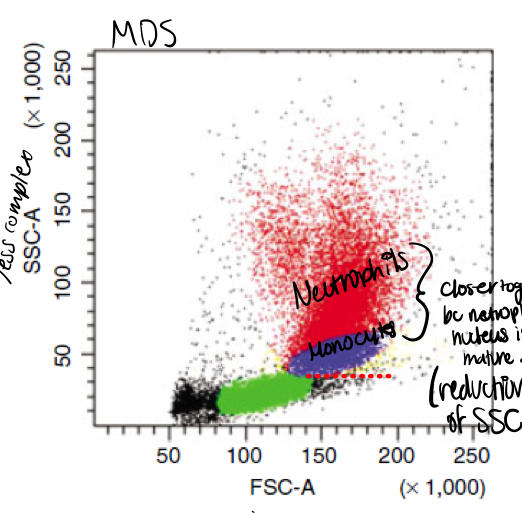
loss of granularity causes merging into monocyte zone.
Neutrophils and monocytes are normally clearly separated
Neutrophils and monocytes are normally clearly separated
27
What happens when neutrophils are gated on CD14/CD64?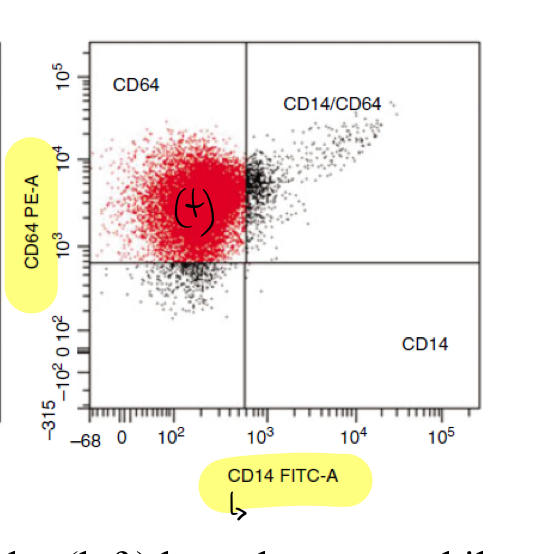
large portion of granulocytes are expressing CD64 (immature myeloid/monocyte antigen) in aberrant fashion
28
What is MDS with single lineage dysplasia (MDS-SLD)?
anemia, infection, or petechia
(depending on lineage involved)
<1% blast in PB and <5% blasts in BM
(depending on lineage involved)
<1% blast in PB and <5% blasts in BM
29
What is MDS with multilineage dysplasia (MDS-MLD)?
more than 1 lineage is dyspoietic
<1% blast in PB and <5% in BM
<1% blast in PB and <5% in BM
30
What is MDS with ring sideroblasts (MDS-RS)?
SF3B1 gene (spliceosome) mutation
>5% ring sideroblasts, dimorphic RBC on PBS (combo of hypochromic and normochromic)
>5% ring sideroblasts, dimorphic RBC on PBS (combo of hypochromic and normochromic)
31
What is MDS with excess blasts (MDS-EB)?
trilineage cytopenia
2 types: MDS-EB1 and MDS-EB2
2 types: MDS-EB1 and MDS-EB2
32
What is MDS-EB1?
5%-9% blasts in BM or
2%-4% blasts in PB
2%-4% blasts in PB
33
What is MDS-EB2?
10%-19% blasts in BM and
5%-19% blasts in PB
5%-19% blasts in PB
34
What is MDS with isolated del(5q) (5q- syndrome)?
affects predominantly women, med age 70
patients have anemia without other cytopenias
patients have anemia without other cytopenias
35
What is the major indication of MDS in PB and BM? (proper term)
dyspoiesis
36
An alert hematologist should recognize all of the following PB abnormalities as diagnostic clues in MDS except…
a. oval mac
b. TARGET CELLS
c. agranular neutrophils
d. circ micromegakaryocyte
a. oval mac
b. TARGET CELLS
c. agranular neutrophils
d. circ micromegakaryocyte
a. oval mac
**b. TARGET CELLS
c. agranular neutrophils
d. circ micromegakaryocyte
**b. TARGET CELLS
c. agranular neutrophils
d. circ micromegakaryocyte
37
A patient has anemia, oval mac, and hyperseg neuts. Which of the following tests would be most efficient in diff diagnosis of this disorder?
vitamin B12 and folate levels