Antidepressant Serotonin Syndrome (SS) and Neuroleptic Malignant Syndrome (NMS)
Study these flashcardsFree · spaced repetition · iPhone, Android, Mac & web
All cards
1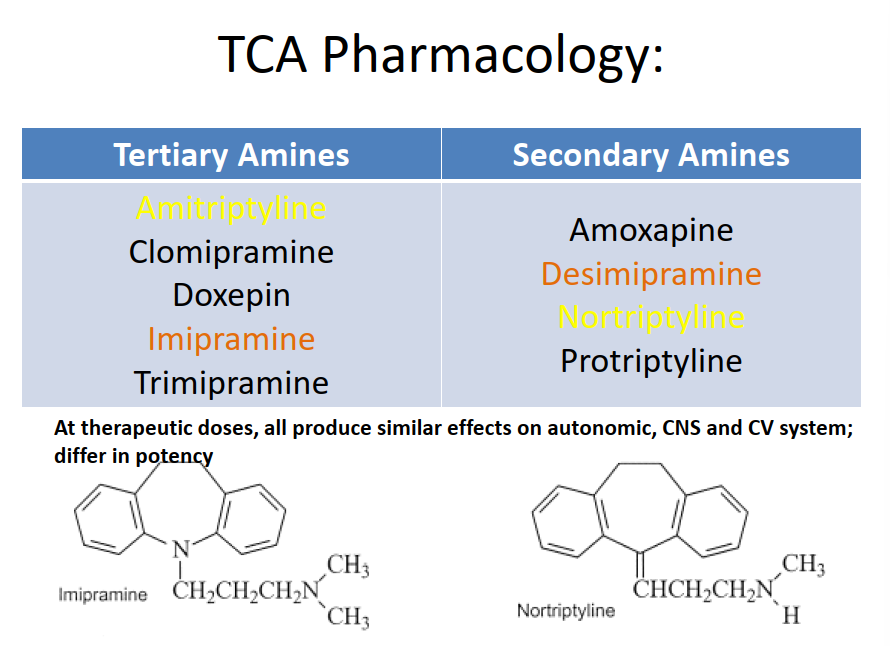
Image occlusion: name the hidden labels
2
Image occlusion: name the hidden labels
3
Image occlusion: name the hidden labels
4
TCA Pharmacology
• Inhibit presynaptic reuptake of norepinephrine and/or serotonin
• Multiple receptor actions account for therapeutic and toxic effects
– GABA-A receptor antagonist
– Antihistaminic
– Anticholinergic effects thru antagonism of muscarinic receptors
– Alpha-adrenergic receptor blockade
– Na+ and k+ channel blockade in myocardial cells (most prominent effect of OD)
• Multiple receptor actions account for therapeutic and toxic effects
– GABA-A receptor antagonist
– Antihistaminic
– Anticholinergic effects thru antagonism of muscarinic receptors
– Alpha-adrenergic receptor blockade
– Na+ and k+ channel blockade in myocardial cells (most prominent effect of OD)
5
TCA Pharmacokinetics& Toxicokinetics (ADME)
• Readily absorbed, peak levels occur within 2-8 hours post ingestion with therapeutic doses
– Toxic doses
• Delayed GI motility causing absorption to be slow due to anticholinergic effects of TCA, exhibit enterohepatic recirculation
• Highly plasma protein bound (73-97%)
• Highly lipophilic: Vd ranges 15-40 L/kg
• Readily crosses blood brain barrier
• Therapeutic doses: ↑t1/2 ranges (7 to 58 hrs)
– OD up to 72 hours or longer
• Metabolism
– Extensive first pass metabolism by liver
– Renal clearance <5%
– Toxic doses
• Delayed GI motility causing absorption to be slow due to anticholinergic effects of TCA, exhibit enterohepatic recirculation
• Highly plasma protein bound (73-97%)
• Highly lipophilic: Vd ranges 15-40 L/kg
• Readily crosses blood brain barrier
• Therapeutic doses: ↑t1/2 ranges (7 to 58 hrs)
– OD up to 72 hours or longer
• Metabolism
– Extensive first pass metabolism by liver
– Renal clearance <5%
6
TCA Toxicity Pathophysiology
Sodium Channel Blockade
A. Usual state
– Sodium depolarizes the cell →conduction →complete cardiac depolarization → opens voltage-
dependent Ca2+ channels → producing contraction
• B. TCA Toxicity
– Impairs sodium entry into myocardial cells
– Slows the action potential, prolongs depolarization (phase 0) → negative dromotropic and inotropic effects
Potassium Channel Blockade
• Prevents efflux during repolarization
• QT interval prolongation
• Torsades de pointes may develop, but is rare in TCA toxicity
Antihistaminic effects
• Potent inhibitors of histamine receptors
• Manifested as CNS sedation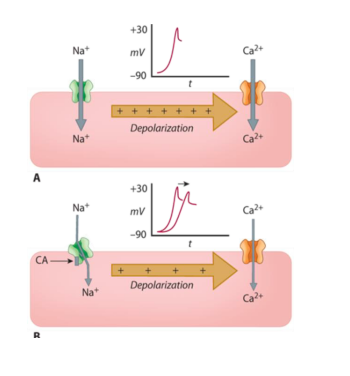
A. Usual state
– Sodium depolarizes the cell →conduction →complete cardiac depolarization → opens voltage-
dependent Ca2+ channels → producing contraction
• B. TCA Toxicity
– Impairs sodium entry into myocardial cells
– Slows the action potential, prolongs depolarization (phase 0) → negative dromotropic and inotropic effects
Potassium Channel Blockade
• Prevents efflux during repolarization
• QT interval prolongation
• Torsades de pointes may develop, but is rare in TCA toxicity
Antihistaminic effects
• Potent inhibitors of histamine receptors
• Manifested as CNS sedation
7
Clinical Features of TCA Toxicity
• Therapeutic index of TCA is narrow
• < 1mg/kg non-toxic
• Acute ingestion of 10-20mg/kg potentially lethal dose (considered moderate to severe exposure)
• > 35mg/kg can be fatal if left untreated
• General presentation
• Varies from mild antimuscarinic to severe CV collapse
– Manifestation primarily in the autonomic system, CNS, CV
– Symptoms develop within the 1st few hours
• If NO symptoms observed w/in first 6 hours following ingestion; not likely to develop toxicity
• BUT serious complications usually occur w/in the first 12 hours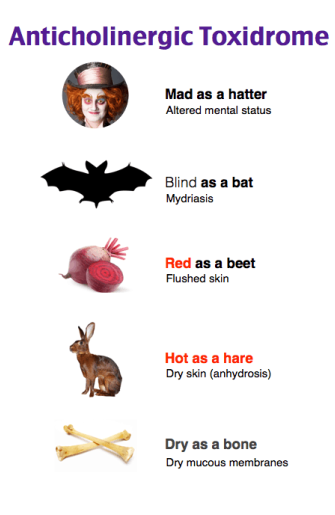
• < 1mg/kg non-toxic
• Acute ingestion of 10-20mg/kg potentially lethal dose (considered moderate to severe exposure)
• > 35mg/kg can be fatal if left untreated
• General presentation
• Varies from mild antimuscarinic to severe CV collapse
– Manifestation primarily in the autonomic system, CNS, CV
– Symptoms develop within the 1st few hours
• If NO symptoms observed w/in first 6 hours following ingestion; not likely to develop toxicity
• BUT serious complications usually occur w/in the first 12 hours
8
Cardiovascular Effects of TCAs
– Mechanisms
• Alpha adrenergic receptor blockade
• Anticholinergic activity
• Blockade of fast inward sodium channels
– Sinus tachycardia (50%)
• Due to anticholinergic effects
• May last hours to days
– Hypotension (15%) (multifactorial)
• Alpha1 blockade leads to vasodilation, slowed cardiac conduction and delayed CO with reduced contractility due to Na+/K+ channel blockade
• Alpha adrenergic receptor blockade
• Anticholinergic activity
• Blockade of fast inward sodium channels
– Sinus tachycardia (50%)
• Due to anticholinergic effects
• May last hours to days
– Hypotension (15%) (multifactorial)
• Alpha1 blockade leads to vasodilation, slowed cardiac conduction and delayed CO with reduced contractility due to Na+/K+ channel blockade
9
Conduction abnormalities with TCAs
– Arise from Na+/K+ channel blockade leading to both reduced conduction velocity and automaticity of cardiac cells
– Slowing of the influx of sodium during phase 0 of AP
• Can lead to life-threatening arrhythmias
• Prolongation of QRS complex (≥ 100 msec)
– Prolonged PR and QTc interval and AV block
• Arrhythmias
– Premature ventricular contraction, VT, VF, asystole
– Slowing of the influx of sodium during phase 0 of AP
• Can lead to life-threatening arrhythmias
• Prolongation of QRS complex (≥ 100 msec)
– Prolonged PR and QTc interval and AV block
• Arrhythmias
– Premature ventricular contraction, VT, VF, asystole
10
CNS effects with TCAs
– Antihistaminic effects: Confusion, agitation, hallucination, coma (35%)
– Seizures (10%)
• Generalized tonic-clonic occurs early during ingestion
– Depressed mental status: Severe acidosis
– Lactic acid may build up, further exacerbating cardiotoxicity
• Myoclonic jerking
– Benign muscle contraction
– Seizures (10%)
• Generalized tonic-clonic occurs early during ingestion
– Depressed mental status: Severe acidosis
– Lactic acid may build up, further exacerbating cardiotoxicity
• Myoclonic jerking
– Benign muscle contraction
11
TCA Toxicity Diagnosis
• TCA intoxication should be suspected in any patient with lethargy, coma or seizures
• Accompanied with CV collapse
• Characteristic ECG findings
– Widened QRS, prolonged QTc
• Anticholinergic toxidrome
• Accompanied with CV collapse
• Characteristic ECG findings
– Widened QRS, prolonged QTc
• Anticholinergic toxidrome
12
EKG Findings
• Normal: QRS Interval
– QRS < 100 milliseconds (msec)
• QRS > 100 msec increased toxicity
– Coma
– Intubation
– Hypotension
– Seizures
• Increased risk arrhythmia
– > 160 msec
– QRS < 100 milliseconds (msec)
• QRS > 100 msec increased toxicity
– Coma
– Intubation
– Hypotension
– Seizures
• Increased risk arrhythmia
– > 160 msec
13
Approach to a TCA Overdose Patient
ABC, IV access, stabilize vital signs (fluid resuscitation), cardiac monitoring (evaluate QRS duration)
Contact Poison control
GI decontamination - Delayed TCA absorption in overdose
• Gastric lavage
– Life-threatening OD in a symptomatic patient
– Delayed GI motility with TCA may yield unabsorbed drug at 12 hours following ingestion, ER formulation
• Activated charcoal (within 2 hours)
– SDAC 1g/kg
– MDAC as TCA undergo enterohepatic recirculation are associated with ↓GI motility, may be of benefit to give 0.5-1g/kg q2h
Contact Poison control
GI decontamination - Delayed TCA absorption in overdose
• Gastric lavage
– Life-threatening OD in a symptomatic patient
– Delayed GI motility with TCA may yield unabsorbed drug at 12 hours following ingestion, ER formulation
• Activated charcoal (within 2 hours)
– SDAC 1g/kg
– MDAC as TCA undergo enterohepatic recirculation are associated with ↓GI motility, may be of benefit to give 0.5-1g/kg q2h
14
Sodium Bicarbonate
• Considered first-line treatment for TCA-induced cardiac conduction defects, arrhythmias, and hypotension
– Indications
• Prolonged QRS interval
• TCA-induced ventricular dysrhythmias
• Hypotension
• Acidosis
• Mechanism: Na+ dependent effect: increase Na+ gradient across poisoned fast Na+ channel
to reverse Na+/K+ blockade
– ↑Plasma alkalinization, Na+ load,
– ↑TCA plasma protein binding
(↓free drug available)
– Correction of acidosis
– Goal plasma pH between 7.45-7.55
– Indications
• Prolonged QRS interval
• TCA-induced ventricular dysrhythmias
• Hypotension
• Acidosis
• Mechanism: Na+ dependent effect: increase Na+ gradient across poisoned fast Na+ channel
to reverse Na+/K+ blockade
– ↑Plasma alkalinization, Na+ load,
– ↑TCA plasma protein binding
(↓free drug available)
– Correction of acidosis
– Goal plasma pH between 7.45-7.55
15
Serum Alkalinization
• Sodium bicarbonate 1 – 2 mEq/kg per dose
– Repeated every 3-5 minutes until QRS narrows and/or hypotension resolves
– Desired serum pH of 7.45 to 7.55
– Followed by continuous infusion for 12 – 24 hours
• NaCl 3% - theoretical alternative
• Intubation and hyperventilation (increases pH)
• Intravenous fat emulsion
– Enhanced elimination due to redistribution
– Lipid sink to trap lipophilic drug
– 1.5mg/kg (up to 6 doses)
– Repeated every 3-5 minutes until QRS narrows and/or hypotension resolves
– Desired serum pH of 7.45 to 7.55
– Followed by continuous infusion for 12 – 24 hours
• NaCl 3% - theoretical alternative
• Intubation and hyperventilation (increases pH)
• Intravenous fat emulsion
– Enhanced elimination due to redistribution
– Lipid sink to trap lipophilic drug
– 1.5mg/kg (up to 6 doses)
16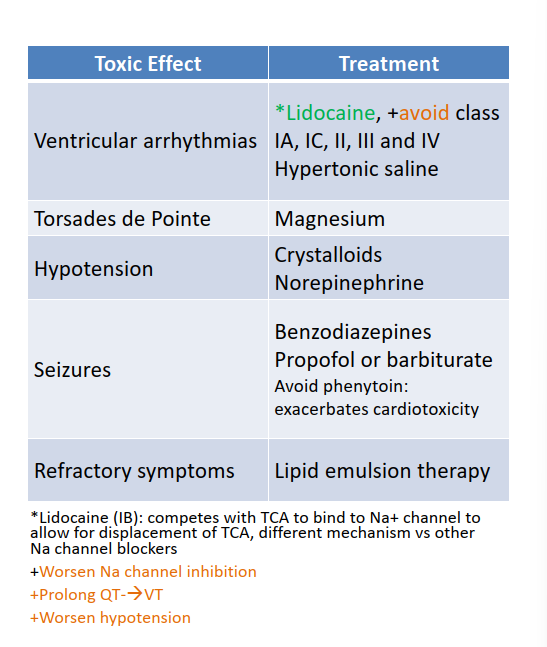
Image occlusion: name the hidden labels
17
Image occlusion: name the hidden labels
18
Image occlusion: name the hidden labels
19
Image occlusion: name the hidden labels
20
Image occlusion: name the hidden labels
21
Image occlusion: name the hidden labels
22
Image occlusion: name the hidden labels
23
Image occlusion: name the hidden labels
24
Image occlusion: name the hidden labels
25
Image occlusion: name the hidden labels
26
Image occlusion: name the hidden labels
27
Image occlusion: name the hidden labels
28
Image occlusion: name the hidden labels
29
Image occlusion: name the hidden labels
30
Image occlusion: name the hidden labels
31
Image occlusion: name the hidden labels
32
Image occlusion: name the hidden labels
33
Image occlusion: name the hidden labels
34
Image occlusion: name the hidden labels
35
Image occlusion: name the hidden labels
36
Image occlusion: name the hidden labels
37
Intravenous Lipid Emulsion Therapy
• Lack of antidotes or reliable reversal agents
– Antidepressants
– Antipsychotics
– Local anesthetics
• Search for novel rescue therapy
• Intralipid ® 20% Emulsion
– Oil-in-water emulsion
– Typically used for parenteral nutrition
– Antidepressants
– Antipsychotics
– Local anesthetics
• Search for novel rescue therapy
• Intralipid ® 20% Emulsion
– Oil-in-water emulsion
– Typically used for parenteral nutrition
38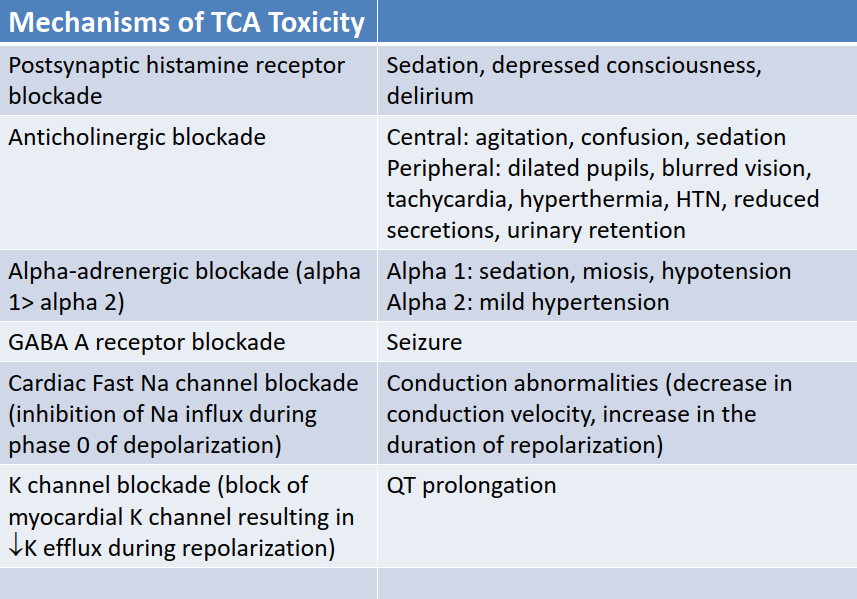
Image occlusion: name the hidden labels
39
Image occlusion: name the hidden labels
40
Image occlusion: name the hidden labels
41
Image occlusion: name the hidden labels
42
Image occlusion: name the hidden labels
43
Image occlusion: name the hidden labels
44
Image occlusion: name the hidden labels
45
Image occlusion: name the hidden labels
46
Image occlusion: name the hidden labels
47
Image occlusion: name the hidden labels
48
Image occlusion: name the hidden labels
49
Image occlusion: name the hidden labels
50
Image occlusion: name the hidden labels
51
Image occlusion: name the hidden labels
52
Image occlusion: name the hidden labels
53
Image occlusion: name the hidden labels
54
Image occlusion: name the hidden labels
55
Image occlusion: name the hidden labels
56
Image occlusion: name the hidden labels
57
Image occlusion: name the hidden labels
58
Image occlusion: name the hidden labels
59
Selective Serotonin Reuptake Inhibitors (SSRIs)
• MOA
– Block reuptake of serotonin (5-HT) into the nerve terminal
• Clinical features of SSRI toxicity
– N/V, lethargy, sedation, seizure (rare)
– QT prolongation associated with citalopram and escitalopram, maybe delayed up to 24 hours following ingestion
– Block reuptake of serotonin (5-HT) into the nerve terminal
• Clinical features of SSRI toxicity
– N/V, lethargy, sedation, seizure (rare)
– QT prolongation associated with citalopram and escitalopram, maybe delayed up to 24 hours following ingestion
60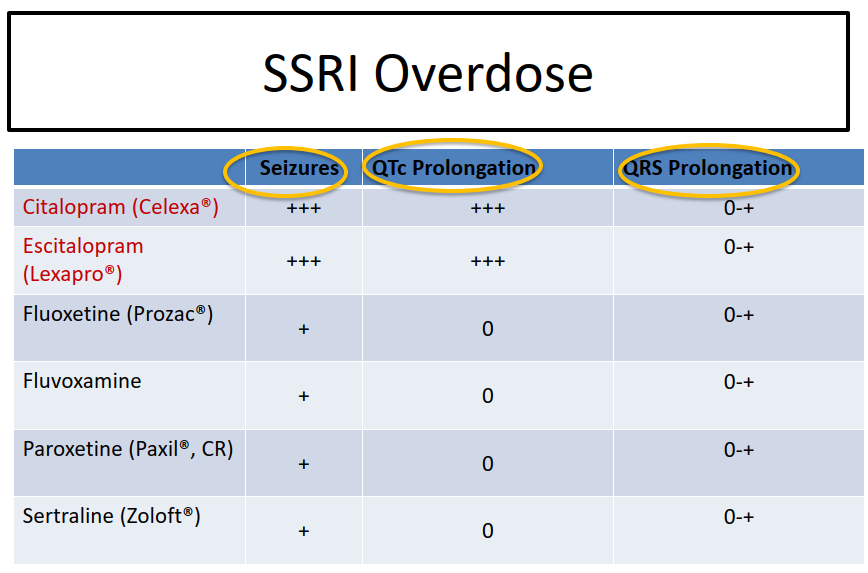
Image occlusion: name the hidden labels
61
Image occlusion: name the hidden labels
62
Image occlusion: name the hidden labels
63
Image occlusion: name the hidden labels
64
Image occlusion: name the hidden labels
65
Image occlusion: name the hidden labels
66
Atypical Antidepressants (SN/SSRI)
• Venlafaxine, desvenlafaxine, duloxetine
• Seizures – predominant effect during overdose
• Cardiac toxicity - Venlafaxine likely to cause QRS prolongation
• Other effects
– Nausea, vomiting, dizziness, tachycardia, CNS depression, hypotension
– Duloxetine - elevated hepatic enzyme concentrations
• Seizures – predominant effect during overdose
• Cardiac toxicity - Venlafaxine likely to cause QRS prolongation
• Other effects
– Nausea, vomiting, dizziness, tachycardia, CNS depression, hypotension
– Duloxetine - elevated hepatic enzyme concentrations
67
Bupropion And Hydroxybupropion
• SSRI, SNRI, SDRI
– Hydroxybupropion responsible for seizures
• Overdose clinical manifestations
– Tachycardia, hypertension, gastrointestinal symptoms, and agitation
– Dose dependant drug induced seizures and QRS prolongation
• Chronic doses greater than 450-500 mg/d place the patient at risk for seizures
– Benzodiazepines mainstay of treatment (seizures)
• Delayed effects
– Up to 10 hours (particularly with sustained-release)
– Symptoms can continue for up to 48 hours
– Hydroxybupropion responsible for seizures
• Overdose clinical manifestations
– Tachycardia, hypertension, gastrointestinal symptoms, and agitation
– Dose dependant drug induced seizures and QRS prolongation
• Chronic doses greater than 450-500 mg/d place the patient at risk for seizures
– Benzodiazepines mainstay of treatment (seizures)
• Delayed effects
– Up to 10 hours (particularly with sustained-release)
– Symptoms can continue for up to 48 hours
68
SSRI Overdose Management
• Largely supportive – rarely fatal alone
– Cardiac monitoring – citalopram and escitalopram
• GI decontamination
– Activated charcoal (1 g/kg)
– Orogastric lavage not generally indicated
• Serotonin syndrome
– Monitor for evidence of serotonin syndrome
– Cardiac monitoring – citalopram and escitalopram
• GI decontamination
– Activated charcoal (1 g/kg)
– Orogastric lavage not generally indicated
• Serotonin syndrome
– Monitor for evidence of serotonin syndrome
69
Serotonin Syndrome
• Serotonin syndrome (SS) is an adverse drug reaction
• Mechanism: Excessive selective stimulation of serotonin 5-HT2A receptors
– Lesser extent 5-HT1A receptors (hyperreflexia)
• Combinations of serotonergic agents (polypharmacy)
– Drug-drug interactions
– Drug-food interactions
– Switching therapies
– Single dose
– High therapeutic dosing
– Overdose
• Mechanism: Excessive selective stimulation of serotonin 5-HT2A receptors
– Lesser extent 5-HT1A receptors (hyperreflexia)
• Combinations of serotonergic agents (polypharmacy)
– Drug-drug interactions
– Drug-food interactions
– Switching therapies
– Single dose
– High therapeutic dosing
– Overdose
70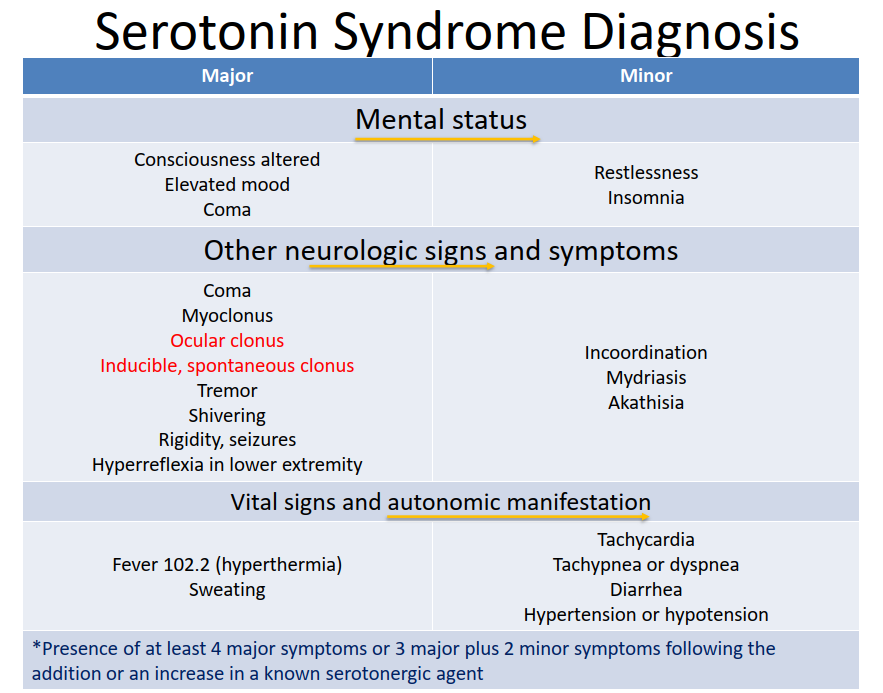
Image occlusion: name the hidden labels
71
Image occlusion: name the hidden labels
72
Image occlusion: name the hidden labels
73
Image occlusion: name the hidden labels
74
Image occlusion: name the hidden labels
75
Image occlusion: name the hidden labels
76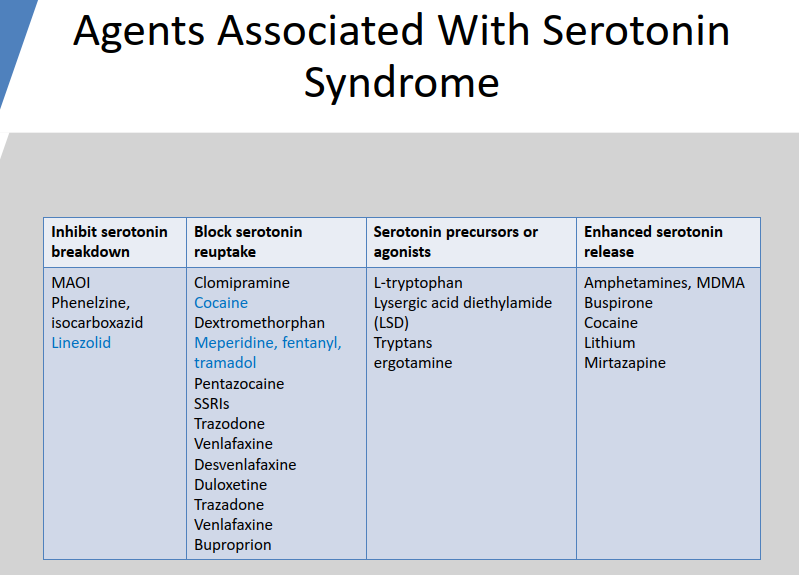
Image occlusion: name the hidden labels
77
Image occlusion: name the hidden labels
78
Image occlusion: name the hidden labels
79
Diagnostic Tests for Serotonin Syndrome
• Quantitative serum drug concentrations are not helpful
• Based on presence of clinical findings in patient at risk (several diagnostic criteria developed)
• Rule out other etiologies
– Infectious, metabolic, withdrawal and substance abuse
• Hunters criteria: 84% sensitive, 97% specific
– Presence of ONE of the five criteria is suggestive
– Spontaneous clonus, inducible clonus, ocular clonus, tremor and hyperreflexia, hypertonia (spasticity,
rigidity) and temp > 38oC with inducible or ocular clonus
• Based on presence of clinical findings in patient at risk (several diagnostic criteria developed)
• Rule out other etiologies
– Infectious, metabolic, withdrawal and substance abuse
• Hunters criteria: 84% sensitive, 97% specific
– Presence of ONE of the five criteria is suggestive
– Spontaneous clonus, inducible clonus, ocular clonus, tremor and hyperreflexia, hypertonia (spasticity,
rigidity) and temp > 38oC with inducible or ocular clonus
80
Serotonin Syndrome Management
• Treatment goals
– Reduce muscle rigidity and prevent hyperthermia
• Benzodiazepines
• External cooling / cool IV fluids (ex: NS 0.9% @ 4˚C)
• Neuromuscular block in severe cases
• Serotonin syndrome resolves within 24 hours in most patients
– Prolonged by active metabolites, long half-lives
• Cyproheptadine 4 mg oral or IV
– Antihistamine
– Nonspecific antagonist effects at 5-HT1A and 5-HT2A
– Use in patients with mild to moderate symptoms – not hyperthermic
• Alternative diagnosis
– Reduce muscle rigidity and prevent hyperthermia
• Benzodiazepines
• External cooling / cool IV fluids (ex: NS 0.9% @ 4˚C)
• Neuromuscular block in severe cases
• Serotonin syndrome resolves within 24 hours in most patients
– Prolonged by active metabolites, long half-lives
• Cyproheptadine 4 mg oral or IV
– Antihistamine
– Nonspecific antagonist effects at 5-HT1A and 5-HT2A
– Use in patients with mild to moderate symptoms – not hyperthermic
• Alternative diagnosis
81
Antipsychotic FGAs
• High Potency
– Fluphenazine
(Prolixin)
– Haloperidol
(Haldol)
– Perphenazine
(Trilafon)
– Thiothixene
(Navane)
– Trifluoperazine
(Stelazine)
– Loxapine
(Loxitane)
– Molindone
(Moban)
• Low Potency
– Chlorpromazine
(Thorazine)
– Thioridazine
(Mellaril)
– Mesoridazine
(Serentil
– Fluphenazine
(Prolixin)
– Haloperidol
(Haldol)
– Perphenazine
(Trilafon)
– Thiothixene
(Navane)
– Trifluoperazine
(Stelazine)
– Loxapine
(Loxitane)
– Molindone
(Moban)
• Low Potency
– Chlorpromazine
(Thorazine)
– Thioridazine
(Mellaril)
– Mesoridazine
(Serentil
82
Second-generation agents “Atypicals”
– Clozapine (Clozaril)
– Olanzapine (Zyprexa)
– Quetiapine (Seroquel)
– Risperidone (Risperdal)
– Ziprasidone (Geodon)
– Aripiprazole (Abilify)
– Paliperidone (Invega)
– Olanzapine (Zyprexa)
– Quetiapine (Seroquel)
– Risperidone (Risperdal)
– Ziprasidone (Geodon)
– Aripiprazole (Abilify)
– Paliperidone (Invega)
83
Cardiac Effects of Antipsychotics
• Similar to TCA toxicity
• QRS prolongation
– Blockade of the sodium current
• QTc prolongation
– Torsades de pointes (>500msec)
• Normal QTc 400msec + 76 msec
– Thioridazine > Ziprasidone>
Quetiapine > Risperidone > Olanzapine > Haloperidol
• Sinus tachycardia (anticholinergic)
• Reflex tachycardia (alpha-1 antagonism)
• QRS prolongation
– Blockade of the sodium current
• QTc prolongation
– Torsades de pointes (>500msec)
• Normal QTc 400msec + 76 msec
– Thioridazine > Ziprasidone>
Quetiapine > Risperidone > Olanzapine > Haloperidol
• Sinus tachycardia (anticholinergic)
• Reflex tachycardia (alpha-1 antagonism)
84
Pathophysiology of Antipsychotic Toxicity
Not fully understood
Probably dopaminergic blockade or depletion in CNS
Genetics may be involved
Probably dopaminergic blockade or depletion in CNS
Genetics may be involved
85
Neuroleptic Malignant Syndrome
• Life-threatening neurologic emergency
– Associated with every antipsychotic
– Incidence ranges from 0.2-1.4%, mortality
20% with prompt recognition and treatment
• Less severe episodes may go
undiagnosed
– Lower incidence with antipsychotics that antagonize 5-HT2A
• Pathophysiology/etiology
– Any agent that exerts antagonism at the dopamine D2 receptor
– Abrupt reductions in central dopaminergic neurotransmission in the hypothalamus, altering the core temperature "set point“
– Altered thermoregulation and other manifestations of autonomic dysfunction
– Associated with every antipsychotic
– Incidence ranges from 0.2-1.4%, mortality
20% with prompt recognition and treatment
• Less severe episodes may go
undiagnosed
– Lower incidence with antipsychotics that antagonize 5-HT2A
• Pathophysiology/etiology
– Any agent that exerts antagonism at the dopamine D2 receptor
– Abrupt reductions in central dopaminergic neurotransmission in the hypothalamus, altering the core temperature "set point“
– Altered thermoregulation and other manifestations of autonomic dysfunction
86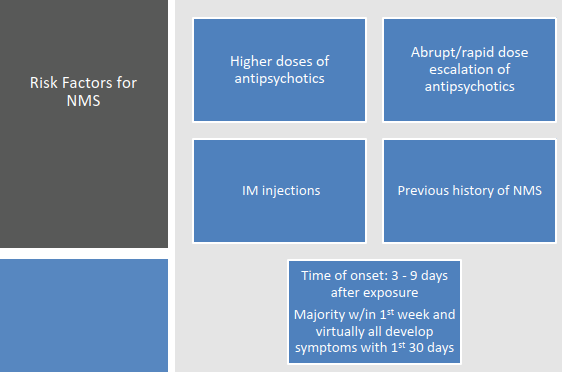
Image occlusion: name the hidden labels
87
Image occlusion: name the hidden labels
88
Image occlusion: name the hidden labels
89
Image occlusion: name the hidden labels
90
Image occlusion: name the hidden labels
91
Image occlusion: name the hidden labels
92
Image occlusion: name the hidden labels
93
Image occlusion: name the hidden labels
94
Image occlusion: name the hidden labels
95
Image occlusion: name the hidden labels
96
Image occlusion: name the hidden labels
97
Image occlusion: name the hidden labels
98
Image occlusion: name the hidden labels
99
Image occlusion: name the hidden labels
100
Image occlusion: name the hidden labels
101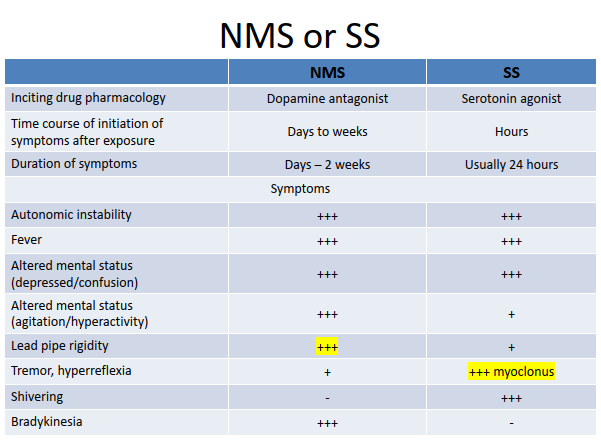
Image occlusion: name the hidden labels
102
Image occlusion: name the hidden labels
103
Image occlusion: name the hidden labels
104
Image occlusion: name the hidden labels
105
Image occlusion: name the hidden labels
106
Image occlusion: name the hidden labels
107
Image occlusion: name the hidden labels
108
Image occlusion: name the hidden labels
109
Image occlusion: name the hidden labels
110
Image occlusion: name the hidden labels
111
Diagnosis of NMS
• Based on clinical findings in a patient at risk and careful medication history
• Lab findings
– ↑ Creatine kinase (>1000 IU/L)
– ↑ LDH, ALT, AST
– Leukocytosis
– Rhabdomyolysis and myoglobinuria
• No universally accepted diagnostic criteria
• Lab findings
– ↑ Creatine kinase (>1000 IU/L)
– ↑ LDH, ALT, AST
– Leukocytosis
– Rhabdomyolysis and myoglobinuria
• No universally accepted diagnostic criteria
112
NMS Treatment
• Rapid external cooling with ice bath if needed
• Reduce muscle rigidity (muscle relaxation), sedation
– Benzodiazepines
• Alternatives or adjuncts
– Bromocriptine (Parlodel)-central dopamine agonist
• 2.5 - 10 mg TID (titrate up)
– Reverses dopamine blockade
• Amantadine (prevents re-uptake of dopamine into presynaptic neurons
– Dantrolene (rarely indicated) extreme cases of NMS to ↓muscle rigidity and fever
• Oral: 50-100 mg/d
• IV infusion: 2-10 mg/kg/d divided q6h
» Reduces skeletal muscle activity by inhibiting ryanodine receptor calcium release channels
• Reduce muscle rigidity (muscle relaxation), sedation
– Benzodiazepines
• Alternatives or adjuncts
– Bromocriptine (Parlodel)-central dopamine agonist
• 2.5 - 10 mg TID (titrate up)
– Reverses dopamine blockade
• Amantadine (prevents re-uptake of dopamine into presynaptic neurons
– Dantrolene (rarely indicated) extreme cases of NMS to ↓muscle rigidity and fever
• Oral: 50-100 mg/d
• IV infusion: 2-10 mg/kg/d divided q6h
» Reduces skeletal muscle activity by inhibiting ryanodine receptor calcium release channels
113
Clinical Course of NMS
• Duration of up to 2 weeks
• Reintroduction of neuroleptics
– At least 1-2 weeks should pass after symptom resolution before restarting therapy
– Choose a different class of antipsychotic and with minimal EP effects
• Reintroduction of neuroleptics
– At least 1-2 weeks should pass after symptom resolution before restarting therapy
– Choose a different class of antipsychotic and with minimal EP effects
114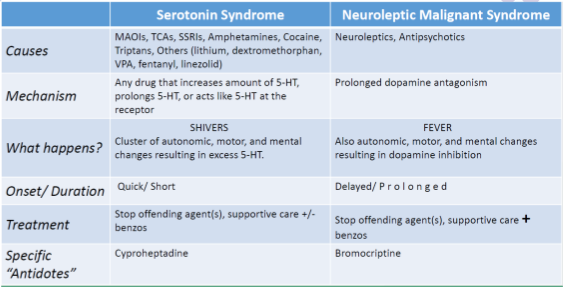
Image occlusion: name the hidden labels
115
Image occlusion: name the hidden labels
116
Image occlusion: name the hidden labels