Dementia and Delirium
Study these flashcardsFree · spaced repetition · iPhone, Android, Mac & web
All cards
1
Neurocognitive Disorders
- primary **cognitive** deficit
- must be acquired; not developmental
- must be acquired; not developmental
2
DSM-5-TR Neurocognitive Disorders
- Delirium
- Major and Mild Neurocognitive Disorders
- Alzheimer’s disease
- Frontotemporal degeneration
- Lewy body disease
- Vascular disease
- Major and Mild Neurocognitive Disorders
- Alzheimer’s disease
- Frontotemporal degeneration
- Lewy body disease
- Vascular disease
3
Delirium DSM-5 Criteria
- A disturbance in attention
- Additional disturbance in cognition
- The disturbance develops over a short period of time (usually hours to a few days), represents a change from baseline attention and awareness, and tends to fluctuate in severity during the course of a day.
- The disturbances are not better explained by another condition
- Additional disturbance in cognition
- The disturbance develops over a short period of time (usually hours to a few days), represents a change from baseline attention and awareness, and tends to fluctuate in severity during the course of a day.
- The disturbances are not better explained by another condition
4
Delirium Rating Scales
- Confusion Assessment Method (CAM)
- Delirium Rating Scale (DRS)
- Memorial Delirium Assessment Scale (MDAS)
- Delirium Rating Scale (DRS)
- Memorial Delirium Assessment Scale (MDAS)
5
Delirium Etiology
- Multifactorial
- Incidence related to polypharmacy, hospital admissions
- Many medical conditions related
- Other causes are sensory and environmental issues
- Incidence related to polypharmacy, hospital admissions
- Many medical conditions related
- Other causes are sensory and environmental issues
6
Delirium Pathophysiology
- Unknown
- ↓ acetylcholine
- Dopamine excess
- Glucocorticoid excess
- ↓ acetylcholine
- Dopamine excess
- Glucocorticoid excess
7
Delirium Risk Factors
- Dementia
- Older age
- Severity of illness
Infection
- Immobility
- Medications
- Opioids
- Benzodiazepines
- Dihydropyridines
- Antihistamines
- Older age
- Severity of illness
Infection
- Immobility
- Medications
- Opioids
- Benzodiazepines
- Dihydropyridines
- Antihistamines
8
Delirium Society of Critical Care Guidelines
- Delirium Prevention
- Recommends: multicomponent, non-pharm interventions
- Recommends against: Haloperidol, atypical antipsychotic, dexmedetomidine, statins or ketamine
- Delirium Treatment
- Recommends: Multicomponent, non-pharmacologic interventions;
Dexmedetomidine in mechanically ventilated adults with agitation
- Recommends against: Haloperidol, atypical antipsychotic, or statin
- Recommends: multicomponent, non-pharm interventions
- Recommends against: Haloperidol, atypical antipsychotic, dexmedetomidine, statins or ketamine
- Delirium Treatment
- Recommends: Multicomponent, non-pharmacologic interventions;
Dexmedetomidine in mechanically ventilated adults with agitation
- Recommends against: Haloperidol, atypical antipsychotic, or statin
9
NICE Guidelines for Delirium
- Delirium Prevention
- same as crit cares
- low quality evidence for meds
- Delirium Treatment
- Recommends: same as crit care but no mention of dexmedetomidine; low quality evidence for meds - haloperidol for one week or less
- same as crit cares
- low quality evidence for meds
- Delirium Treatment
- Recommends: same as crit care but no mention of dexmedetomidine; low quality evidence for meds - haloperidol for one week or less
10
Antipsychotics in Delirium
- no clinically significant effects
- Memorial Delirium Assessment Scale scores ↓ with antipsychotic use
- Haloperidol, risperidone, aripiprazole, and olanzapine were equally effective in management of delirium
- Memorial Delirium Assessment Scale scores ↓ with antipsychotic use
- Haloperidol, risperidone, aripiprazole, and olanzapine were equally effective in management of delirium
11
Benzodiazepines in Delirium
may worsen or prolong D:
12
Melatonin/Ramelteon in Delirium
may reduce delirium incidence
13
Neurocognitive Disorders DSM-5 Criteria
- Evidence of significant cognitive decline from a previous level of performance in one or more cognitive domains
- Learning, memory, language
- Complex attention
- Executive function
- Perceptual-motor, social cognition
- The deficits interfere with independence in everyday activities
- The cognitive deficits do not occur exclusively in the context of a delirium.
- The cognitive deficits are not better explained by another mental disorder (e.g., major depressive disorder, schizophrenia)
- Learning, memory, language
- Complex attention
- Executive function
- Perceptual-motor, social cognition
- The deficits interfere with independence in everyday activities
- The cognitive deficits do not occur exclusively in the context of a delirium.
- The cognitive deficits are not better explained by another mental disorder (e.g., major depressive disorder, schizophrenia)
14
Rating Scales for Neurocognitive Disorders
- Alzheimer’s Disease Assessment Scale (ADAS)
- Clinical Dementia Rating Scale
- Mini-Mental State Exam (MMSE)
- Montreal Cognitive Assessment (MOCA)
- Clinical Dementia Rating Scale
- Mini-Mental State Exam (MMSE)
- Montreal Cognitive Assessment (MOCA)
15
Alzheimer’s Disease DSM-5 Criteria
- The criteria are met for major or mild neurocognitive disorder.
- There is insidious onset and gradual progression of impairment in one or more cognitive domains (for major neurocognitive disorder, at least two domains must be impaired).
- Criteria are met for either probable or possible Alzheimer’s disease as follows:
- Probable: evidence of a causative Alzheimer’s disease genetic mutation
- Possible:
- Clear evidence of decline in memory and learning.
- Steadily progressive, gradual decline in cognition, without extended plateaus.
- No evidence of mixed etiology
- There is insidious onset and gradual progression of impairment in one or more cognitive domains (for major neurocognitive disorder, at least two domains must be impaired).
- Criteria are met for either probable or possible Alzheimer’s disease as follows:
- Probable: evidence of a causative Alzheimer’s disease genetic mutation
- Possible:
- Clear evidence of decline in memory and learning.
- Steadily progressive, gradual decline in cognition, without extended plateaus.
- No evidence of mixed etiology
16
Alzheimer’s Etiology
- Multifactorial
- Increasing age
- Genetic risks
- Down syndrome
- Head trauma
- Depression
- Incidence increases with age
- Increasing age
- Genetic risks
- Down syndrome
- Head trauma
- Depression
- Incidence increases with age
17
Alzheimer's Pathophysiology
- Two proteins become toxic to the brain
- Amyloid beta (Aβ)
- Leads to plaque development
- Markedly increased in hippocampus, amygdala, and cortex
- Tau protein
- Abnormally phosphorylated tau protein
- Leads to neurofibrillary tangles
- Disrupt cellular function and can cause cell death
- Amyloid beta (Aβ)
- Leads to plaque development
- Markedly increased in hippocampus, amygdala, and cortex
- Tau protein
- Abnormally phosphorylated tau protein
- Leads to neurofibrillary tangles
- Disrupt cellular function and can cause cell death
18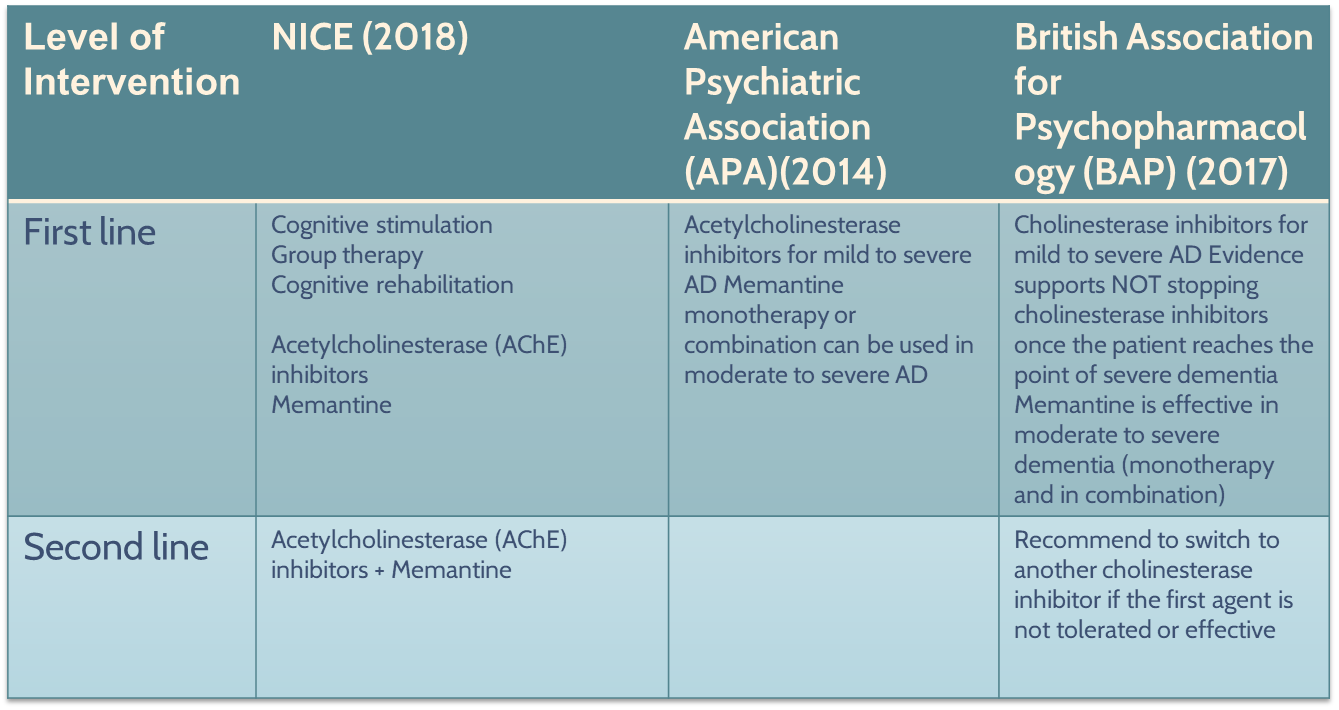
Image occlusion: name the hidden labels
19
Image occlusion: name the hidden labels
20
Image occlusion: name the hidden labels
21
Vascular Dementia DSM-5 Criteria
- The criteria are met for major or mild neurocognitive disorder.
- The clinical features are consistent with a vascular etiology, as suggested by either of the following:
- Onset of the cognitive deficits is temporally related to one or more cerebrovascular events.
- Evidence for decline is prominent in complex attention (including processing speed) and frontal-executive function.
- There is evidence of the presence of cerebrovascular disease
- Probable: clinical criteria are supported by neuroimaging evidence of significant parenchymal injury attributed to cerebrovascular disease
- The clinical features are consistent with a vascular etiology, as suggested by either of the following:
- Onset of the cognitive deficits is temporally related to one or more cerebrovascular events.
- Evidence for decline is prominent in complex attention (including processing speed) and frontal-executive function.
- There is evidence of the presence of cerebrovascular disease
- Probable: clinical criteria are supported by neuroimaging evidence of significant parenchymal injury attributed to cerebrovascular disease
22
Vascular Dementia Etiology
- Major risk factors same as those for stroke
- Atrial fibrillation
- Diabetes
- Hyperlipidemia
- Hypertension
- Smoking
- Genetic risk
- Atrial fibrillation
- Diabetes
- Hyperlipidemia
- Hypertension
- Smoking
- Genetic risk
23
Vascular Dementia Pathophysiology
- Multiple causes:
- Large vessel dementia
- Small vessel dementia
- Hypoperfusion
- Hemorrhagic dementia
- Large vessel dementia
- Small vessel dementia
- Hypoperfusion
- Hemorrhagic dementia
24
Vasuclar Dementia Treatment Guidelines
- APA guidelines:
- Do not offer specific recommendations for vascular dementia
- BAP guidelines:
- Do not recommend acetylcholinesterase inhibitors or memantine
- Do not offer specific recommendations for vascular dementia
- BAP guidelines:
- Do not recommend acetylcholinesterase inhibitors or memantine
25
Medication Review for Vascular Dementia
- Acetylcholinesterase inhibitors had a slight beneficial cognitive effect
- Change is unlikely to be clinically significant
- Increased side effects
- Change is unlikely to be clinically significant
- Increased side effects
26
Lewy Body Dementia DSM-5 Criteria
- The criteria are met for major or mild neurocognitive disorder.
- The disorder has an insidious onset and gradual progression.
- The disorder meets a combination of core diagnostic features and suggestive diagnostic features for either probable or possible neurocognitive disorder with Lewy bodies.
- Core diagnostic features:
- Fluctuating cognition with pronounced variations in attention and alertness.
- Recurrent visual hallucinations that are well formed and detailed.
- Spontaneous features of parkinsonism, with onset subsequent to the development of cognitive decline.
- The disorder has an insidious onset and gradual progression.
- The disorder meets a combination of core diagnostic features and suggestive diagnostic features for either probable or possible neurocognitive disorder with Lewy bodies.
- Core diagnostic features:
- Fluctuating cognition with pronounced variations in attention and alertness.
- Recurrent visual hallucinations that are well formed and detailed.
- Spontaneous features of parkinsonism, with onset subsequent to the development of cognitive decline.
27
Lewy Body Dementia Etiology
- Risk Factors: age >60; male
- Prevalence: 10-25% all dementia cases; rapid course
- Prevalence: 10-25% all dementia cases; rapid course
28
Lewy Body Dementia Pathophysiology
- Cerebral atrophy
- Alpha-Synuclein (α-Syn) protein is a major component of Lewy bodies
- Symptoms of Parkinson’s disease
- Pallor in substantia nigra
- Symptoms of visual hallucinations
- Diffuse Lewy bodies throughout the cortical region
- Alpha-Synuclein (α-Syn) protein is a major component of Lewy bodies
- Symptoms of Parkinson’s disease
- Pallor in substantia nigra
- Symptoms of visual hallucinations
- Diffuse Lewy bodies throughout the cortical region
29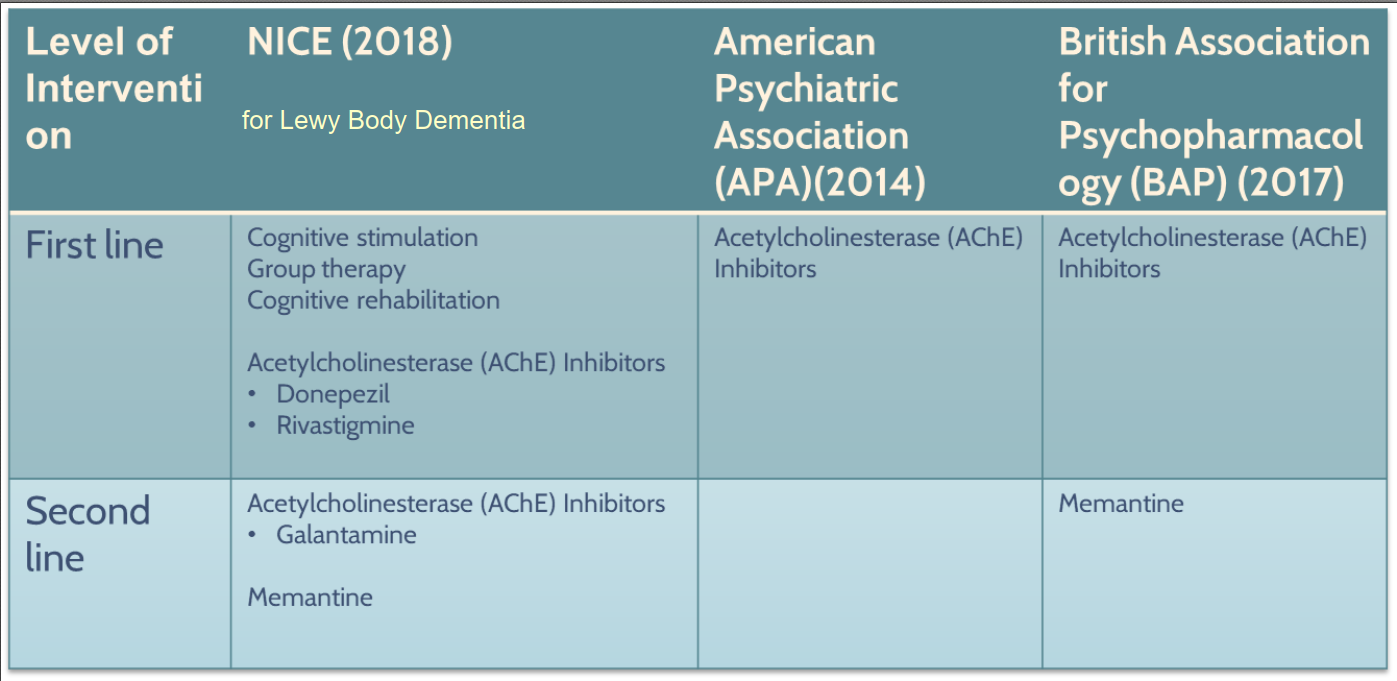
Image occlusion: name the hidden labels
30
Image occlusion: name the hidden labels
31
Image occlusion: name the hidden labels
32
Frontotemporal Dementia DSM-5 Criteria
- The criteria are met for major or mild neurocognitive disorder.
- The disturbance has insidious onset and gradual progression.
- Either (1) or (2):
- Behavioral variant:
- Behavioral disinhibition.
- Apathy or inertia.
- Loss of sympathy or empathy.
- Perseverative, stereotyped or compulsive\/ritualistic behavior.
- Hyperorality and dietary changes.
- Prominent decline in social cognition and/or executive abilities.
- The disturbance has insidious onset and gradual progression.
- Either (1) or (2):
- Behavioral variant:
- Behavioral disinhibition.
- Apathy or inertia.
- Loss of sympathy or empathy.
- Perseverative, stereotyped or compulsive\/ritualistic behavior.
- Hyperorality and dietary changes.
- Prominent decline in social cognition and/or executive abilities.
33
Frontotemporal Dementia Etiology
- Unknown causes
- Linked to genetic abnormalities
- Family history is the only known risk
- Linked to genetic abnormalities
- Family history is the only known risk
34
Frontotemporal Dementia Pathophysiology
- Abnormal protein aggregates in the frontal and temporal lobe leads to:
- Degeneration of neurons
- Microvacuoles formation
- Astrocytosis
- Degeneration of neurons
- Microvacuoles formation
- Astrocytosis
35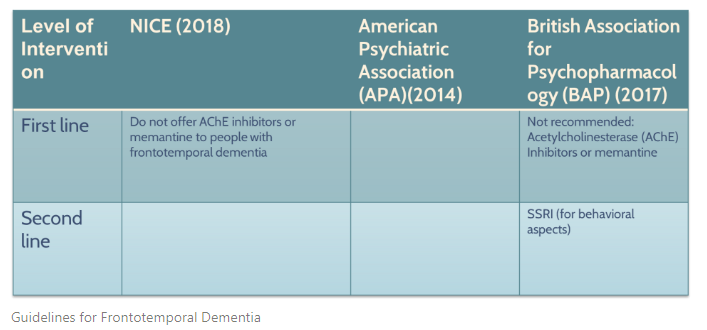
Image occlusion: name the hidden labels
36
Image occlusion: name the hidden labels
37
Image occlusion: name the hidden labels
38
Dementia Prevention
- Diet
- mediterranean diet may delay onset of dementia
- leafy greens
- fish consumption
- high salt = bad (cognitive impairment)
- Exercise
- Blood Pressure Control
- Cholesterol Control
- Brain Games
- mediterranean diet may delay onset of dementia
- leafy greens
- fish consumption
- high salt = bad (cognitive impairment)
- Exercise
- Blood Pressure Control
- Cholesterol Control
- Brain Games
39
Medications for Neurocognitive Disorders
Acetylcholinesterase Inhibitors
- Donepezil (Aricept®)
- Galantamine (Razadyne®)
- Rivastigmine (Exelon®)
- Donepezil (Aricept®)
- Galantamine (Razadyne®)
- Rivastigmine (Exelon®)
40
How to pick an agent
- Donepezil:
- Formulations:
- Once-daily tablet
- Once-daily disintegrating tablet
- Once-daily capsule combination product with memantine (Namzaric®)
- Weekly patch (Adlarity®)
- Galantamine:
- Mechanism: additionally modulates nicotinic receptors
- Formulations:
- Twice-daily tablet, solution
- Once-daily capsule
- Rivastigmine:
- Mechanism: additionally inhibits butyrylcholinesterase
- Formulations:
- Twice-daily capsule, solution
- 24-hour transdermal patch
- Formulations:
- Once-daily tablet
- Once-daily disintegrating tablet
- Once-daily capsule combination product with memantine (Namzaric®)
- Weekly patch (Adlarity®)
- Galantamine:
- Mechanism: additionally modulates nicotinic receptors
- Formulations:
- Twice-daily tablet, solution
- Once-daily capsule
- Rivastigmine:
- Mechanism: additionally inhibits butyrylcholinesterase
- Formulations:
- Twice-daily capsule, solution
- 24-hour transdermal patch
41
Warnings and Precautions for Anticholinesterase Drugs
- Peptic ulcer disease and gastrointestinal bleeding
- Use of nonsteroidal anti-inflammatory drugs (NSAIDs)
- Use of nonsteroidal anti-inflammatory drugs (NSAIDs)
42
NMDA Antagonist
Memantine
- Mechanism of action
- Uncompetitive, N-methyl-D-aspartate (NMDA) receptor antagonist
- Excessive NMDA receptor activity causes excitotoxicity
- Mechanism of action
- Uncompetitive, N-methyl-D-aspartate (NMDA) receptor antagonist
- Excessive NMDA receptor activity causes excitotoxicity
43
Amyloid Beta-directed Antibody
- Aducanumab-avwa (Aduhelm®)
- Lecanemab-irmb (Leqembi®)
- Donanemab (pipeline)
- Mechanism of action:
- Human, immunoglobulin gamma 1 (IgG1) monoclonal antibody
- Directed against aggregated soluble and insoluble forms of amyloid beta and decreases amyloid beta plaques
- Lecanemab-irmb (Leqembi®)
- Donanemab (pipeline)
- Mechanism of action:
- Human, immunoglobulin gamma 1 (IgG1) monoclonal antibody
- Directed against aggregated soluble and insoluble forms of amyloid beta and decreases amyloid beta plaques
44
Aducanumab-avwa (Aduhelm)
- Before use:
- Confirm presence of amyloid pathology and mild cognitive impairment or dementia
- Obtain brain MRI before starting
- Warnings and precautions:
- Amyloid Related Imaging Abnormalities (ARIA)
- Hypersensitivity reaction
- Adverse effects: (at least 10% and higher incidence compared to placebo)
- ARIA-Edema
- Headache
- ARIA-H microhemorrhage
- ARIA-H superficial siderosis
- Fall
- Confirm presence of amyloid pathology and mild cognitive impairment or dementia
- Obtain brain MRI before starting
- Warnings and precautions:
- Amyloid Related Imaging Abnormalities (ARIA)
- Hypersensitivity reaction
- Adverse effects: (at least 10% and higher incidence compared to placebo)
- ARIA-Edema
- Headache
- ARIA-H microhemorrhage
- ARIA-H superficial siderosis
- Fall
45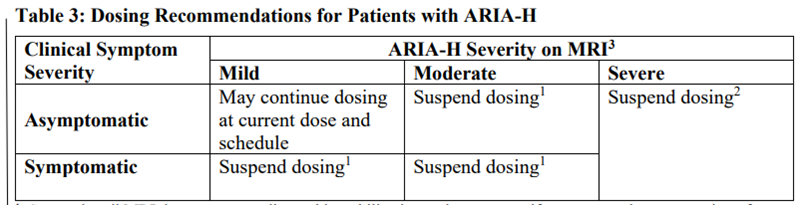
Image occlusion: name the hidden labels
46
Image occlusion: name the hidden labels
47
Image occlusion: name the hidden labels
48
Image occlusion: name the hidden labels
49
Image occlusion: name the hidden labels
50
Image occlusion: name the hidden labels
51
Lecanemab-irmb (Leqembi)
- Before use:
- Confirm presence of amyloid pathology and mild cognitive impairment or dementia
- Obtain brain MRI before starting
- Warnings and precautions:
- Amyloid Related Imaging Abnormalities (ARIA)
- Infusion related reactions
- Adverse effects: (at least 5% and higher incidence compared to placebo)
- Literature: got rid of amyloid plaques but not dementia
- Confirm presence of amyloid pathology and mild cognitive impairment or dementia
- Obtain brain MRI before starting
- Warnings and precautions:
- Amyloid Related Imaging Abnormalities (ARIA)
- Infusion related reactions
- Adverse effects: (at least 5% and higher incidence compared to placebo)
- Literature: got rid of amyloid plaques but not dementia
52
Medications that contribute to neurocognitive disorders
exposure to anticholinergics, benzos for long period of time = bad for your brain
53
Behavioral and Psychological Symptoms of Dementia
- Diagnosis
- No specific criteria
- Agitation
- Excessive motor activity
- Verbal aggression
- Physical aggression
- DSM-5-TR
- “With behavioral disturbance”
- If the cognitive disturbance is accompanied by a clinically significant behavioral disturbance (e.g., psychotic symptoms, mood disturbance, agitation, apathy, or other behavioral symptoms)
- No specific criteria
- Agitation
- Excessive motor activity
- Verbal aggression
- Physical aggression
- DSM-5-TR
- “With behavioral disturbance”
- If the cognitive disturbance is accompanied by a clinically significant behavioral disturbance (e.g., psychotic symptoms, mood disturbance, agitation, apathy, or other behavioral symptoms)