Headaches and Migraines
Study these flashcardsFree · spaced repetition · iPhone, Android, Mac & web
All cards
1
Pharmacology of Headaches
Classification of headaches
Headaches with no identifiable causes (e.g., aneurysms, ischemia, blood pressure abnormalities, meningeal infections, brain tumors, etc.), identified based on symptoms -
1. Common
2. Migraine – affects 10 - 20% of the population (~30 million in US)
Both types of headaches result from dysregulated neurotransmission within specific brain regions but with the abnormalities more severe and complex in migraines than in common headaches.
Headaches with no identifiable causes (e.g., aneurysms, ischemia, blood pressure abnormalities, meningeal infections, brain tumors, etc.), identified based on symptoms -
1. Common
2. Migraine – affects 10 - 20% of the population (~30 million in US)
Both types of headaches result from dysregulated neurotransmission within specific brain regions but with the abnormalities more severe and complex in migraines than in common headaches.
2
Migraines
A collection of severe headaches:
occur in distinct stages (~4; not all patients experience all 4 stages).
frequencies, symptoms and pain intensity vary between patients.
pain may be bilateral or unilateral and pulsatile
female:male incidence of 3:1
- common in children, peaks at adolescence.
- mean age at onset: 7.2 yrs for boys, 10.9 yrs for girls
- wanes with age (but usually maximum between 25-50 yrs)
- 60-70% of cases familial.
occur in distinct stages (~4; not all patients experience all 4 stages).
frequencies, symptoms and pain intensity vary between patients.
pain may be bilateral or unilateral and pulsatile
female:male incidence of 3:1
- common in children, peaks at adolescence.
- mean age at onset: 7.2 yrs for boys, 10.9 yrs for girls
- wanes with age (but usually maximum between 25-50 yrs)
- 60-70% of cases familial.
3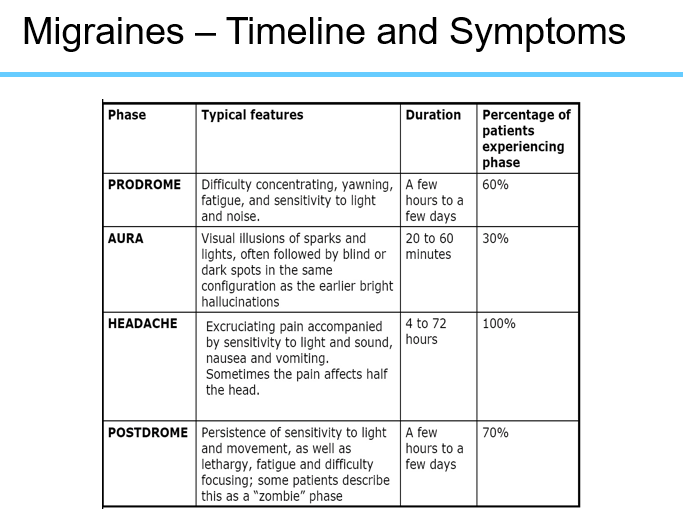
Image occlusion: name the hidden labels
4
Image occlusion: name the hidden labels
5
Image occlusion: name the hidden labels
6
Image occlusion: name the hidden labels
7
Image occlusion: name the hidden labels
8
Image occlusion: name the hidden labels
9
Image occlusion: name the hidden labels
10
Image occlusion: name the hidden labels
11
Image occlusion: name the hidden labels
12
Image occlusion: name the hidden labels
13
Migraine with aura
“Classical migraine”
accounts for ~20 - 30% of all cases
characterized by premonitory aura (varying neurological symptoms, largely visual) that:
- precedes pain onset;
- lasts 20 to 60 minutes
accounts for ~20 - 30% of all cases
characterized by premonitory aura (varying neurological symptoms, largely visual) that:
- precedes pain onset;
- lasts 20 to 60 minutes
14
Migraine without aura
– “Common Migraine”
Lacks aura
Comprises ~70% of cases
Lacks aura
Comprises ~70% of cases
15
Familial hemiplegic migraine
rare
Migraine attacks with aura and one-sided motor paralysis
Mutations in genes for:
Voltage sensitive calcium channel subunit (may increase channel activity & be trigger for CSD)
Na+/K+ ATPase
Voltage sensitive Na+ channel subunit
Migraine attacks with aura and one-sided motor paralysis
Mutations in genes for:
Voltage sensitive calcium channel subunit (may increase channel activity & be trigger for CSD)
Na+/K+ ATPase
Voltage sensitive Na+ channel subunit
16
Tension-type Headache
most common
Episodic: Less than 15 per month (22% of all cases), can be 2-12 days/month
Chronic: 15 or more per month (0.9-2.2% of all cases)
69% of men, 88% of all women experience during lifetime
Gradual onset during or after stress
Occur when neck, scalp, face, shoulders muscles become tense
Other triggers: physical, emotional stress; dental problems (teeth grinding, jaw clenching), eye strain, fatigue
Variable frequency, lasting 30 min. to a week (average 12 hrs)
Pain is bilateral, band-like, usually forehead, around temples, back of head, radiates down neck and shoulders
Described as a dull, aching pain
Episodic: Less than 15 per month (22% of all cases), can be 2-12 days/month
Chronic: 15 or more per month (0.9-2.2% of all cases)
69% of men, 88% of all women experience during lifetime
Gradual onset during or after stress
Occur when neck, scalp, face, shoulders muscles become tense
Other triggers: physical, emotional stress; dental problems (teeth grinding, jaw clenching), eye strain, fatigue
Variable frequency, lasting 30 min. to a week (average 12 hrs)
Pain is bilateral, band-like, usually forehead, around temples, back of head, radiates down neck and shoulders
Described as a dull, aching pain
17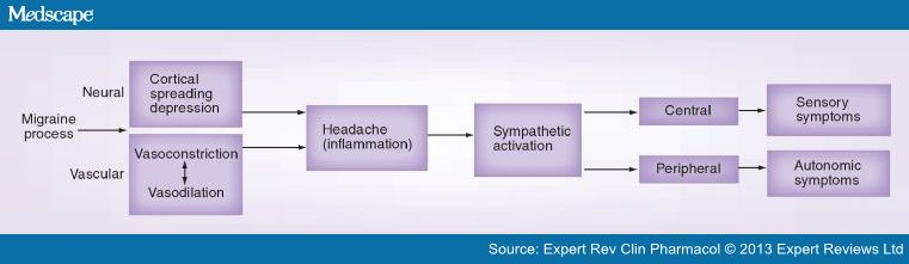
Image occlusion: name the hidden labels
18
Image occlusion: name the hidden labels
19
Image occlusion: name the hidden labels
20
Image occlusion: name the hidden labels
21
Image occlusion: name the hidden labels
22
Image occlusion: name the hidden labels
23
Image occlusion: name the hidden labels
24
Image occlusion: name the hidden labels
25
Image occlusion: name the hidden labels
26
Image occlusion: name the hidden labels
27
Image occlusion: name the hidden labels
28
Image occlusion: name the hidden labels
29
Image occlusion: name the hidden labels
30
Image occlusion: name the hidden labels
31
Image occlusion: name the hidden labels
32
Image occlusion: name the hidden labels
33
Image occlusion: name the hidden labels
34
Image occlusion: name the hidden labels
35
Image occlusion: name the hidden labels
36
Image occlusion: name the hidden labels
37
Image occlusion: name the hidden labels
38
Image occlusion: name the hidden labels
39
Image occlusion: name the hidden labels
40
Image occlusion: name the hidden labels
41
Image occlusion: name the hidden labels
42
Image occlusion: name the hidden labels
43
Image occlusion: name the hidden labels
44
Image occlusion: name the hidden labels
45
Migraine Pathophysiology
Cortical Spreading Depression (CSD) Hypothesis
A wave of electrophysiological hyperactivity followed by a wave of inhibition, usually in the visual cortex - manifestations include scintillating scotoma (blind spots)
The spreading depression wave progresses across the cortex at approximately 2 - 5 mm/minute.
Neurochemical changes during CSD include increased extracellular potassium ion concentration and glutamate
- both contribute to the initiation and propagation of
CSD.
CSD accounts for the aura of migraine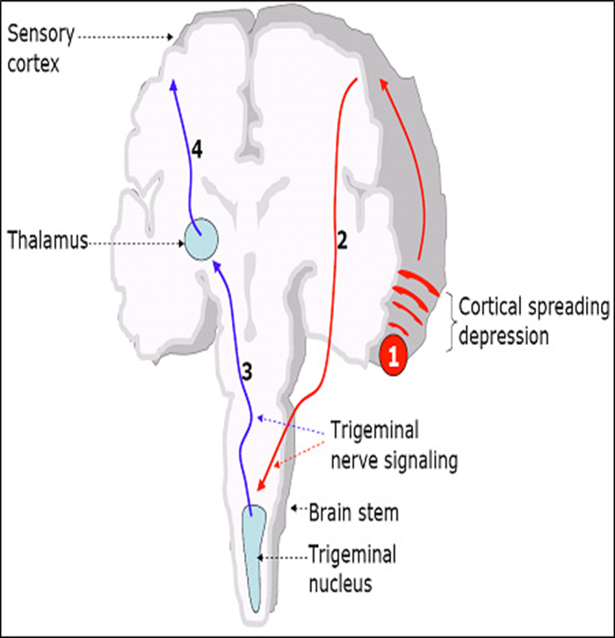
A wave of electrophysiological hyperactivity followed by a wave of inhibition, usually in the visual cortex - manifestations include scintillating scotoma (blind spots)
The spreading depression wave progresses across the cortex at approximately 2 - 5 mm/minute.
Neurochemical changes during CSD include increased extracellular potassium ion concentration and glutamate
- both contribute to the initiation and propagation of
CSD.
CSD accounts for the aura of migraine
46
Aura Development
It’s believed to be caused by a wave of electrical activity that spreads across the cortex of the brain. This wave is then followed by a prolonged suppression of nerve cell activity. This can lead to various changes, such as changes in blood flow, which may lead to migraine symptoms 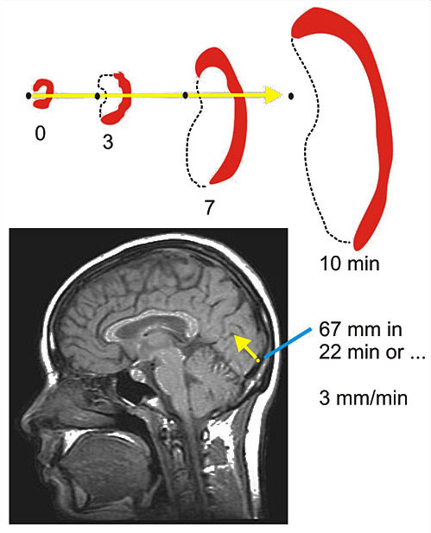
47
Image occlusion: name the hidden labels
48
Image occlusion: name the hidden labels
49
Image occlusion: name the hidden labels
50
Image occlusion: name the hidden labels
51
Image occlusion: name the hidden labels
52
Image occlusion: name the hidden labels
53
Image occlusion: name the hidden labels
54
Image occlusion: name the hidden labels
55
Image occlusion: name the hidden labels
56
Image occlusion: name the hidden labels
57
Image occlusion: name the hidden labels
58
Image occlusion: name the hidden labels
59
Image occlusion: name the hidden labels
60
Image occlusion: name the hidden labels
61
Image occlusion: name the hidden labels
62
Image occlusion: name the hidden labels
63
Image occlusion: name the hidden labels
64
Image occlusion: name the hidden labels
65
Image occlusion: name the hidden labels
66
Image occlusion: name the hidden labels
67
Image occlusion: name the hidden labels
68
Image occlusion: name the hidden labels
69
Image occlusion: name the hidden labels
70
Image occlusion: name the hidden labels
71
Image occlusion: name the hidden labels
72
Image occlusion: name the hidden labels
73
Image occlusion: name the hidden labels
74
Image occlusion: name the hidden labels
75
Botulinum Toxin
OnabotulinumtoxinA (BoTox) – injected around cranial dermatomes that are involved in headaches, enters nerve endings, prevents acetylcholine release
Used for chronic migraine
Possibly acts centrally by retrograde and anterograde axonal transport from periphery
Also inhibits release of CGRP, substance P, serotonin, glutamate, GABA, noradrenaline, dopamine, enkephalin and glycine
Down regulates surface expression of nociceptive receptors (e.g. TRPV1).
Agonistic effect on m-opioid receptors.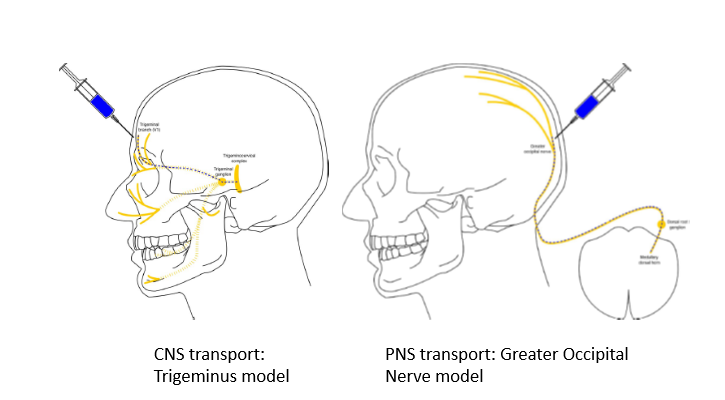
Used for chronic migraine
Possibly acts centrally by retrograde and anterograde axonal transport from periphery
Also inhibits release of CGRP, substance P, serotonin, glutamate, GABA, noradrenaline, dopamine, enkephalin and glycine
Down regulates surface expression of nociceptive receptors (e.g. TRPV1).
Agonistic effect on m-opioid receptors.
76
Acute (abortive) treatment
Specific treatments
- include ergots, triptans and gepants
- are effective in migraine and other types of
headache
- are ineffective against other pain disorders
● Nonspecific treatments
- are effective in migraine
- can be used to treat all types of pain
- include analgesics and opioids
- include ergots, triptans and gepants
- are effective in migraine and other types of
headache
- are ineffective against other pain disorders
● Nonspecific treatments
- are effective in migraine
- can be used to treat all types of pain
- include analgesics and opioids
77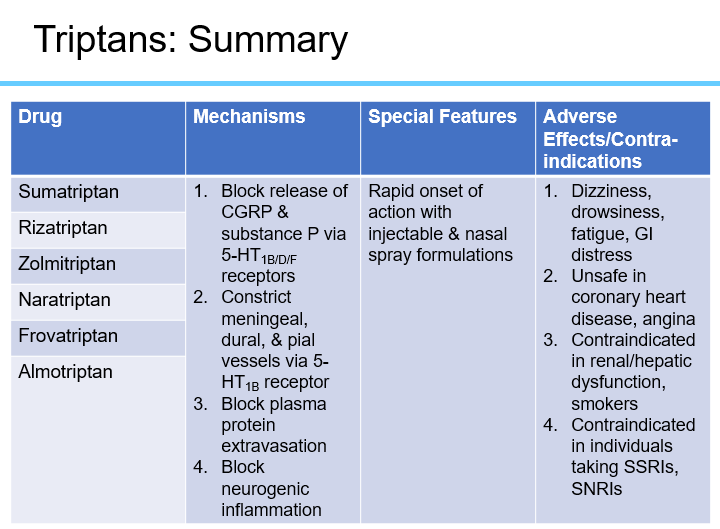
Image occlusion: name the hidden labels
78
Image occlusion: name the hidden labels
79
Image occlusion: name the hidden labels
80
Image occlusion: name the hidden labels
81
Image occlusion: name the hidden labels
82
Image occlusion: name the hidden labels
83
Triptans and Ergots: Mechanisms of Action
Receptor agonists – block release of CGRP and substance P by acting on presynaptic 5-HT1B/D/F receptors
Stimulation of 5-HT1B receptor – constriction of meningeal, dural, cerebral & pial vessels:
Blocks plasma protein extravasation
Blocks neurogenic inflammation
Can have severe side effects related to binding to “off target” receptors
Ergots have a broader spectrum of adverse effects than triptans: 5-HT1A, 5-HT2, adrenergic, and dopaminergic receptor-binding affinity: ergots >> triptans
Stimulation of 5-HT1B receptor – constriction of meningeal, dural, cerebral & pial vessels:
Blocks plasma protein extravasation
Blocks neurogenic inflammation
Can have severe side effects related to binding to “off target” receptors
Ergots have a broader spectrum of adverse effects than triptans: 5-HT1A, 5-HT2, adrenergic, and dopaminergic receptor-binding affinity: ergots >> triptans
84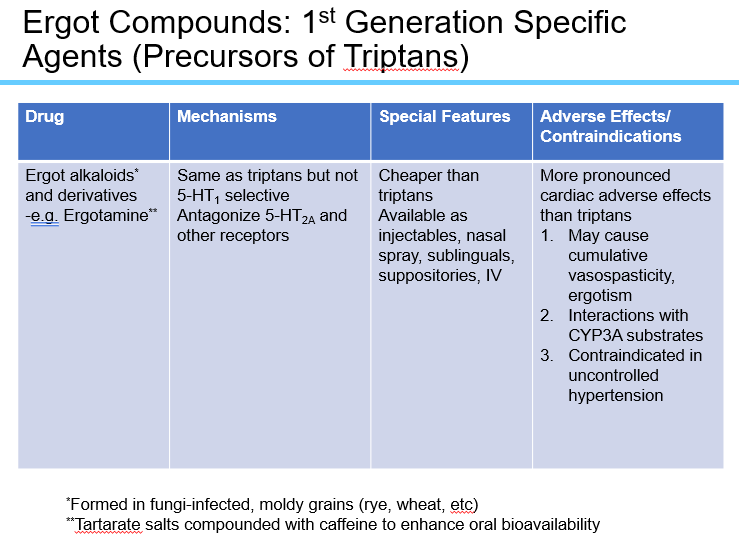
Image occlusion: name the hidden labels
85
Image occlusion: name the hidden labels
86
Image occlusion: name the hidden labels
87
Image occlusion: name the hidden labels
88
Image occlusion: name the hidden labels
89
Image occlusion: name the hidden labels
90
Image occlusion: name the hidden labels
91
Image occlusion: name the hidden labels
92
Image occlusion: name the hidden labels
93
Ergotism (Ergot Poisoning)
• A manifestation of the potent vasoconstrictive effects of ergot compounds that involves:
1 adrenergic receptors
2. 5-HT receptors
• Has a sustained vasospasm component—from direct smooth muscle stimulation:
- vasospasm is not reversible by alpha1 adrenergic or 5-HT
receptor antagonists.
- when cumulative (from overdose/repeated dosing),
vasospasm results in:
a. poor heat exchange -- severe burning sensation;
b. poor tissue perfusion -- ischemia & restricted
blood flow to extremities -- gangrene (may require amputation).
• An associated central dopaminergic and serotonergic
(5-HT) receptor activation -- hallucinations
1 adrenergic receptors
2. 5-HT receptors
• Has a sustained vasospasm component—from direct smooth muscle stimulation:
- vasospasm is not reversible by alpha1 adrenergic or 5-HT
receptor antagonists.
- when cumulative (from overdose/repeated dosing),
vasospasm results in:
a. poor heat exchange -- severe burning sensation;
b. poor tissue perfusion -- ischemia & restricted
blood flow to extremities -- gangrene (may require amputation).
• An associated central dopaminergic and serotonergic
(5-HT) receptor activation -- hallucinations
94
5-HT1F receptor agonists
Lasmiditan (Reyvow) (FDA approved, 10/2019), considered a new class of drug, “ditans”, different scaffold than triptans.
New, highly selective, centrally acting 5-HT1F agonist
Inhibits dural plasma protein extravasation (PPE)
Does not cause vasoconstriction (unlike triptans)
Inhibits second order neurons in trigeminal nucleus (decrease action potential)
New, highly selective, centrally acting 5-HT1F agonist
Inhibits dural plasma protein extravasation (PPE)
Does not cause vasoconstriction (unlike triptans)
Inhibits second order neurons in trigeminal nucleus (decrease action potential)
95
Calcitonin Gene-Related peptide (CGRP) antagonists
lack vasoconstrictive properties (& other) side effects of triptans (remember: CGRP elevated in external jugular venous blood during migraine attack, CGRP receptors located on: meningeal blood vessels, trigeminal ganglion, periaqueductal gray and other brain areas assoc with migraine)
Gepants: selective CGRP receptor antagonists – ubrogepant (Ubrelvy), first of its class to be approved, for acute use.
Rimegepant (Zydis) – for daily or prophylactic use
Atogepant (Qulipta) – FDA approved 9/21, can be used for daily or prophylatic use
Zavegepant (Zavzpret) – first intranasally administered CGRP receptor antagonist, for acute use, approved 3/2023
Anti-CGRP antibodies – against CGRP: fremanezumab-vfrm (Ajovy), galcanezumab (Emgality), eptinezumab (Vyepti) or CGRP receptor; erenumab-aooe (Aimovig), all FDA approved, for prophylactic use on episodic or chronic migraines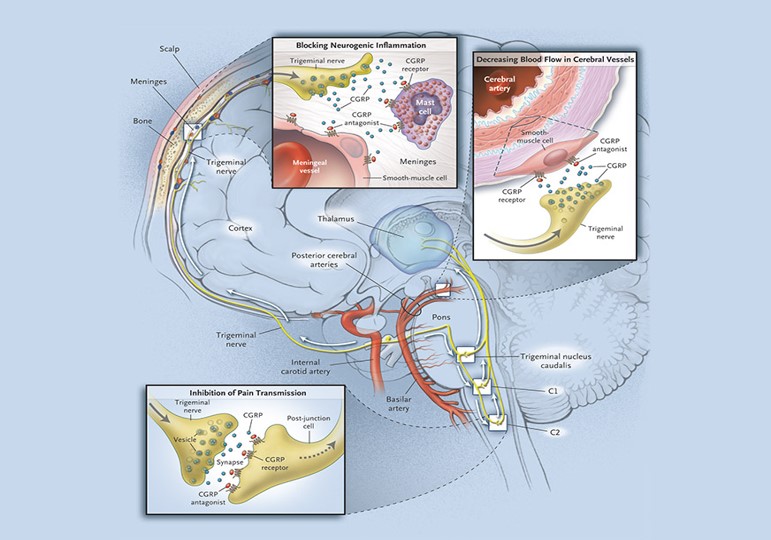
Gepants: selective CGRP receptor antagonists – ubrogepant (Ubrelvy), first of its class to be approved, for acute use.
Rimegepant (Zydis) – for daily or prophylactic use
Atogepant (Qulipta) – FDA approved 9/21, can be used for daily or prophylatic use
Zavegepant (Zavzpret) – first intranasally administered CGRP receptor antagonist, for acute use, approved 3/2023
Anti-CGRP antibodies – against CGRP: fremanezumab-vfrm (Ajovy), galcanezumab (Emgality), eptinezumab (Vyepti) or CGRP receptor; erenumab-aooe (Aimovig), all FDA approved, for prophylactic use on episodic or chronic migraines