Seizure Pharmacology
Study these flashcardsFree · spaced repetition · iPhone, Android, Mac & web
All cards
1
Seizure
brief behavioral changes in response to abnormal, synchronized, and repetitive burst activity of neuron populations.
2
Epilepsy
a syndrome of recurrent, spontaneous seizures (that are not triggered by acute systemic or neurologic insults)
3
Partial seizures
emanate from a localized brain region – may evolve into generalized seizures
4
Generalized seizures
exhibit diverse, bilateral activity.
5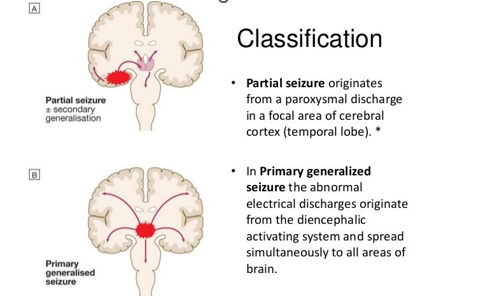
Image occlusion: name the hidden labels
6
Image occlusion: name the hidden labels
7
Image occlusion: name the hidden labels
8
Seizure activity is characterized by
excessive glutamatergic signaling
9
Seizure characteristics
Clinical signs during seizures may reflect:
the brain area of origin (focus) of the neuronal discharges extent of spread of the discharges beyond the focus:
□ motor e.g., convulsions:
- motor cortex
□ sensory e.g., visual, auditory, olfactory:
- sensory cortex (occipital, parietal)
□ psychic e.g., hallucinations (visual, auditory):
- hypothalamus.
the brain area of origin (focus) of the neuronal discharges extent of spread of the discharges beyond the focus:
□ motor e.g., convulsions:
- motor cortex
□ sensory e.g., visual, auditory, olfactory:
- sensory cortex (occipital, parietal)
□ psychic e.g., hallucinations (visual, auditory):
- hypothalamus.
10
$GABA_A$ Receptor
Pentamer
Three predominant subunits $\alpha, \beta, \gamma$
Activation by binding to two $\alpha$
Inhibitory post-synaptic current (IPSC)
Inhibitory post-synaptic potential (IPSP)
Three predominant subunits $\alpha, \beta, \gamma$
Activation by binding to two $\alpha$
Inhibitory post-synaptic current (IPSC)
Inhibitory post-synaptic potential (IPSP)
11
Antiepileptic Drugs (AEDs)
Antiepileptic drugs decrease/prevent seizure activities by
□ enhancing neuronal inhibition
□ inhibiting neuronal excitability
• Overall effect:
- prevent initiation of electrical discharges.
- block the spread of discharges from the focus to adjacent brain areas.
□ enhancing neuronal inhibition
□ inhibiting neuronal excitability
• Overall effect:
- prevent initiation of electrical discharges.
- block the spread of discharges from the focus to adjacent brain areas.
12
Prevention of Seizure Spread from a Focus
Surround inhibition prevents synchronization of adjacent neurons. In this simplified neuronal circuit, neuron A sends excitatory projections (light yellow) to proximal neurons such as B. In addition to activating nearby neurons, cell A also activates GABAergic interneurons (C) that send inhibitory projections (dark yellow) to surrounding neurons (D). This type of circuit creates an “inhibitory surround" (light brown), so that action potentials generated by neuron A, even if rapid and robust, are unable to activate surrounding circuits.
13
First Generation Drugs
• Characterized by severe drug interaction liability (the drugs are potent inducers and inhibitors of major drug-metabolizing enzymes )
14
Sodium Channel Inhibitors
The voltage-sensitive Na+ channel exists in three different conformations during the course of an action potential.
2: The channel opens transiently in response to membrane depolarization, followed by 3: spontaneous channel inactivation. Channel closure – decreases the strength of Na+-mediated depolarization. – Na Channels recover from inactivation only after membrane potential is restored to resting level. – Membrane depolarization also activates hyperpolarizing transient K+ channels. 1: Under hyperpolarizing conditions, the Na+ channel adopts its closed/resting conformation, during which membranes are refractory to depolarizing signals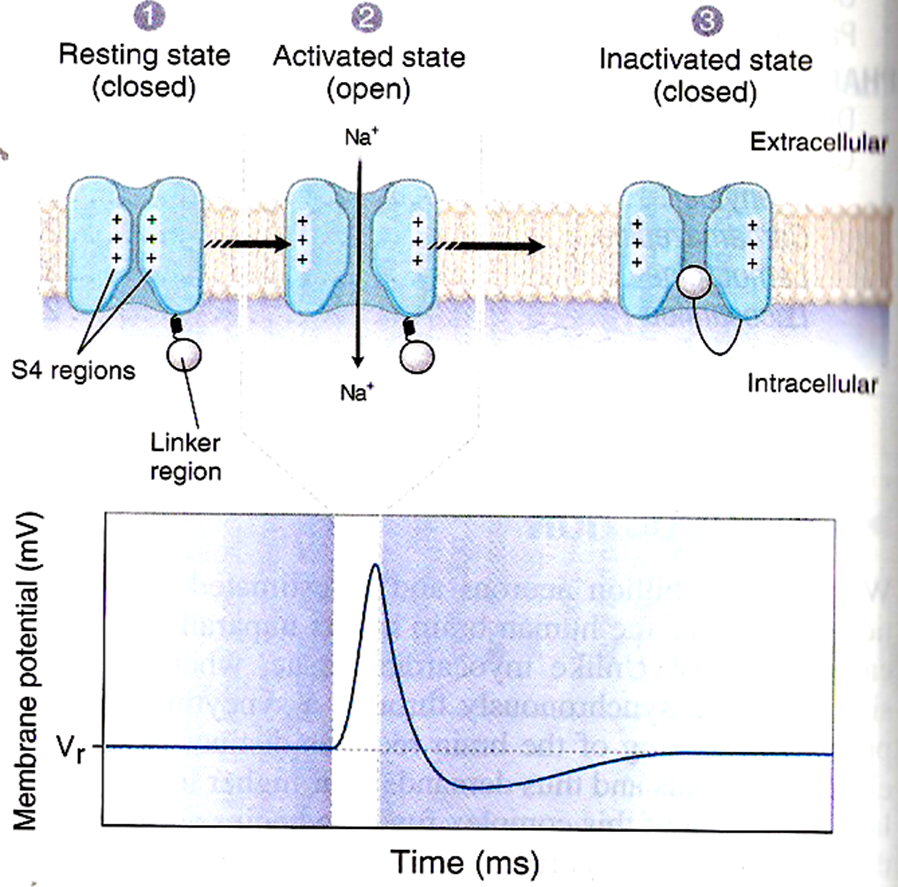
2: The channel opens transiently in response to membrane depolarization, followed by 3: spontaneous channel inactivation. Channel closure – decreases the strength of Na+-mediated depolarization. – Na Channels recover from inactivation only after membrane potential is restored to resting level. – Membrane depolarization also activates hyperpolarizing transient K+ channels. 1: Under hyperpolarizing conditions, the Na+ channel adopts its closed/resting conformation, during which membranes are refractory to depolarizing signals
15
Phenytoin
- Relatively non-sedating, first gen anticonvulsant
- MOA: prolongs duration of inactivated state of the sodium channel
- blockade of voltage-dependent channels firing frequencies
- MOA: prolongs duration of inactivated state of the sodium channel
- blockade of voltage-dependent channels firing frequencies
16
Phenytoin Drug Interactions
- Interactions related to metabolism:
- drugs that inhibit phenytoin metabolism (e.g., isoniazid, cimetidine, warfarin, sulfonamides)→ increase plasma level and potential toxicity of phenytoin.
- Phenytoin induces CYP2B, CYP2C, and CYP3A4: → ↓efficacy of concomitantly administered drugs metabolized by these enzymes (e.g., oral contraceptive steroids):
- Phenytoin induces metabolism of some endogenous compounds - e.g., folic acid, vitamin D, other steroid hormones
- Interactions related to distribution
- Protein binding:
- Certain coadministered, high protein-binding drugs (e.g., warfarin, sulfonamides, etc) will displace bound phenytoin with resulting increased plasma level and potential toxicity of phenytoin and the coadministered drug:
- effect enhanced under physiological and pathological conditions associated with **decreased plasma protein concentration (e.g., in uremia, aging, infancy).**
- drugs that inhibit phenytoin metabolism (e.g., isoniazid, cimetidine, warfarin, sulfonamides)→ increase plasma level and potential toxicity of phenytoin.
- Phenytoin induces CYP2B, CYP2C, and CYP3A4: → ↓efficacy of concomitantly administered drugs metabolized by these enzymes (e.g., oral contraceptive steroids):
- Phenytoin induces metabolism of some endogenous compounds - e.g., folic acid, vitamin D, other steroid hormones
- Interactions related to distribution
- Protein binding:
- Certain coadministered, high protein-binding drugs (e.g., warfarin, sulfonamides, etc) will displace bound phenytoin with resulting increased plasma level and potential toxicity of phenytoin and the coadministered drug:
- effect enhanced under physiological and pathological conditions associated with **decreased plasma protein concentration (e.g., in uremia, aging, infancy).**
17
Phenytoin Toxicity/AE
- CNS (cerebellar and vestibular) depression ataxia, nystagmus, diplopia.
- Gastrointestinal: nausea and vomiting.
- Oral: gingival hyperplasia
- Dermatological: hirsutism
- Vitamin deficiency (e.g., folate; vit. D
- Endocrinological
- Major Idiosyncratic reactions include
- epidermal: Steven-Johnson
- Teratogenicity [Fetal hydantoin syndrome (FHS)]
- cleft lip, cleft palate, cardiovascular abnormalities, physical and mental retardation.
- Gastrointestinal: nausea and vomiting.
- Oral: gingival hyperplasia
- Dermatological: hirsutism
- Vitamin deficiency (e.g., folate; vit. D
- Endocrinological
- Major Idiosyncratic reactions include
- epidermal: Steven-Johnson
- Teratogenicity [Fetal hydantoin syndrome (FHS)]
- cleft lip, cleft palate, cardiovascular abnormalities, physical and mental retardation.
18
Carbamazepine
- Mechanism similar to phenytoin
- Indications
- Partial seizures
- Generalized seizures;
- contraindicated in absence seizures
- Non-seizure indications include
- trigeminal neuralgia
- manic-depressive disorders
- others
- Indications
- Partial seizures
- Generalized seizures;
- contraindicated in absence seizures
- Non-seizure indications include
- trigeminal neuralgia
- manic-depressive disorders
- others
19
Carbamazepine AE
- CNS: cerebellar dysfunction (ataxia, diplopia)
Gastrointestinal: GI distress (including nausea and vomiting)
- Idiosyncratic reactions
- Hepatotoxicity (may be related to metabolites of the drug).
- Stevens-Johnson syndrome (SJS) and toxic epidermal necrolysis (TEN)
- Susceptibility factors include:
- HLA-B*1502 allele*
- *Asian ancestry*
- *HLA-A*3101 allele
- Northern European ancestry (2–5% incidence)
- Hematological disorders (leukopenia, aplastic anemia, thrombocytopenia).
- Teratogenicity
Gastrointestinal: GI distress (including nausea and vomiting)
- Idiosyncratic reactions
- Hepatotoxicity (may be related to metabolites of the drug).
- Stevens-Johnson syndrome (SJS) and toxic epidermal necrolysis (TEN)
- Susceptibility factors include:
- HLA-B*1502 allele*
- *Asian ancestry*
- *HLA-A*3101 allele
- Northern European ancestry (2–5% incidence)
- Hematological disorders (leukopenia, aplastic anemia, thrombocytopenia).
- Teratogenicity
20
Lacosamide
- A sodium channel modulator for adjunctive therapy of focal seizures
- Has low to marginal drug-drug interactions (thus offers an alternative to phenytoin and carbamazepine) for partial and generalized seizures (except absence seizures).
- Mechanisms of action:
- enhances slow inactivation of voltage-gated sodium channels without directly blocking the channel.
may modulate the NMDA receptor.
- Has low to marginal drug-drug interactions (thus offers an alternative to phenytoin and carbamazepine) for partial and generalized seizures (except absence seizures).
- Mechanisms of action:
- enhances slow inactivation of voltage-gated sodium channels without directly blocking the channel.
may modulate the NMDA receptor.
21
Phenobarbital
- Mechanism of action
- Prolongs GABA-mediated chloride channel openings post-synaptically:
- some AEDs modulate GABA-mediated inhibitory neurotransmission presynaptically.
- antiepileptic doses of phenobarbital may not directly activate the GABAA-R or inhibit the NMDA-R (as might hypnotic doses)
- Some blockade of voltage-dependent sodium channels.
- Prolongs GABA-mediated chloride channel openings post-synaptically:
- some AEDs modulate GABA-mediated inhibitory neurotransmission presynaptically.
- antiepileptic doses of phenobarbital may not directly activate the GABAA-R or inhibit the NMDA-R (as might hypnotic doses)
- Some blockade of voltage-dependent sodium channels.
22
Primidone
- A metabolic precursor of phenobarbital
- anticonvulsant activity and AE profiles similar to phenobarbital
- metabolites active, with activity in order of primidone ≥ phenobarbital > PEMA
- anticonvulsant activity and AE profiles similar to phenobarbital
- metabolites active, with activity in order of primidone ≥ phenobarbital > PEMA
23
Benzodiazepines
- Clonazepam, clorazepate and diazepam are among the widely used benzodiazepines for the management of a variety of seizures:
- Clonazepam for chronic management of epilepsy is limited by rapid development of tolerance (via ↑ GABAA-R down-regulation/dysregulation).
- Diazepam (i.v., rectally) and lorazepam (by infusion) are used for managing seizure emergencies, including status epilepticus.
- Clonazepam for chronic management of epilepsy is limited by rapid development of tolerance (via ↑ GABAA-R down-regulation/dysregulation).
- Diazepam (i.v., rectally) and lorazepam (by infusion) are used for managing seizure emergencies, including status epilepticus.
24
Ganaxolone
- Neurosteroid targeting for the treatment of epilepsy (also posttraumatic stress disorder and other conditions)
- Ganaxolone is a synthetic analog of the neurosteroid allopregnanolone, a metabolite of progesterone.
- Mimics allopregnanolone activity without enzymatic conversion to an active steroid
- does not form pharmacologically active
or toxic active metabolites
- Did not achieve FDA approval for epilepsy
- Ganaxolone is a synthetic analog of the neurosteroid allopregnanolone, a metabolite of progesterone.
- Mimics allopregnanolone activity without enzymatic conversion to an active steroid
- does not form pharmacologically active
or toxic active metabolites
- Did not achieve FDA approval for epilepsy
25
Ethosuximide
- Mechanism of action: blocks transient (T-type) neuronal calcium channels to prevent propagation of abnormal electrical discharges.
- Indications:
- Absence (petit mal) seizures.
- not indicated for partial seizures
- Adverse Effects
- GI Distress (pain, N/V, headache)
- SJS
- Hematological disorders (leukopenia, eosinophilia, thrombocytopenia)
- Systemic Lupus Erythematosus
- Indications:
- Absence (petit mal) seizures.
- not indicated for partial seizures
- Adverse Effects
- GI Distress (pain, N/V, headache)
- SJS
- Hematological disorders (leukopenia, eosinophilia, thrombocytopenia)
- Systemic Lupus Erythematosus
26
Valproate
- Mechanisms of action: (a broad-spectrum AED)
- Inhibition of T-type calcium channels
- Inhibition of sodium channels
- Enhancement of GABAergic neurotransmission (**presynaptically**) via:
- ↓GABA transaminase activity
- ↓succinic semialdehyde (SSA) dehydrogenase activity
- ↑glutamic acid decarboxylase (GAD) activity— the rate-limiting enzyme in GABA synthesis
- Adverse Effects
- Dose-dependent effects include
- Gastrointestinal (most commonly nausea and vomiting);
- increased appetite and weight gain
- hair loss.
- Idiosyncratic effects include:
- hepatotoxicity (risk highest in children ≤ 2 years); (valproate metabolites implicated)
- also inborn errors of ammonia metabolism
- thrombocytopenia;
- teratogenicity (spina bifida, malformed hearts,
arteries and genitals; mental retardation in
offspring of treated pregnant mothers)
- Inhibition of T-type calcium channels
- Inhibition of sodium channels
- Enhancement of GABAergic neurotransmission (**presynaptically**) via:
- ↓GABA transaminase activity
- ↓succinic semialdehyde (SSA) dehydrogenase activity
- ↑glutamic acid decarboxylase (GAD) activity— the rate-limiting enzyme in GABA synthesis
- Adverse Effects
- Dose-dependent effects include
- Gastrointestinal (most commonly nausea and vomiting);
- increased appetite and weight gain
- hair loss.
- Idiosyncratic effects include:
- hepatotoxicity (risk highest in children ≤ 2 years); (valproate metabolites implicated)
- also inborn errors of ammonia metabolism
- thrombocytopenia;
- teratogenicity (spina bifida, malformed hearts,
arteries and genitals; mental retardation in
offspring of treated pregnant mothers)
27
Gabapentin
first anticonvulsant developed on the concept of rational drug design (GABA mimetic synthesized as a lipophilic GABA analog)
- Mechanism of action:
- Exact mechanism remains uncertain (but does increase presynaptic GABA concentration)
- Has very few drug-drug interactions but does not appear to be as effective as the other AEDs, and it is seldom used as a first-line agent.
- Nonseizure indications: include bipolar disorder, neuropathic pain, migraine prophylaxis.
- Adverse effects: include sedation, movement disorders, leukopenia.
- Mechanism of action:
- Exact mechanism remains uncertain (but does increase presynaptic GABA concentration)
- Has very few drug-drug interactions but does not appear to be as effective as the other AEDs, and it is seldom used as a first-line agent.
- Nonseizure indications: include bipolar disorder, neuropathic pain, migraine prophylaxis.
- Adverse effects: include sedation, movement disorders, leukopenia.
28
Tiagabine
Mechanism of action: Inhibition of [GABA transporter (GAT-1)-mediated] presynaptic and astrocytic GABA reuptake.
29
Vigabatrin
Mechanism of action: Inhibition of GABA transaminase activity (presynaptic GABA degradation)
30
Lamotrigine
- Mechanism of action: Inhibition of voltage-gated sodium channels.
- Adverse effects:
- sedation
- hematological effects
- skin reactions (life-threatening) — (Steven-Johnson syndrome
- Adverse effects:
- sedation
- hematological effects
- skin reactions (life-threatening) — (Steven-Johnson syndrome
31
Topiramate
- Mechanism of action:
- inhibition of voltage-gated sodium channel
- inhibition of glutamate signaling
- Adverse effects:
- Sedation
- emotional liability
- Tremor
- weight loss
- metabolic acidosis
- ↑intraocular pressure
- inhibition of voltage-gated sodium channel
- inhibition of glutamate signaling
- Adverse effects:
- Sedation
- emotional liability
- Tremor
- weight loss
- metabolic acidosis
- ↑intraocular pressure
32
Zonisamide
- Mechanism of action:
- Inhibition of voltage-gated sodium channels
- Inhibition of T-type calcium channels.
- Adverse effects: Sedation, fatigue, rare serious hypersensitivity reactions (Stevens-Johnson syndrome) and other dermatological reactions, hepatic necrosis, agranulocytosis, aplastic anemia); contraindicated in patients with histories of sulfonamide sensitivity.
- Inhibition of voltage-gated sodium channels
- Inhibition of T-type calcium channels.
- Adverse effects: Sedation, fatigue, rare serious hypersensitivity reactions (Stevens-Johnson syndrome) and other dermatological reactions, hepatic necrosis, agranulocytosis, aplastic anemia); contraindicated in patients with histories of sulfonamide sensitivity.
33
Problems Associated with AED Therapy
Major drug-metabolism enzymes induced or inhibited by AEDs:
- Phase I enzymes: CYP3A4, CYP2C9, CYP2C19, CYP2B6
- Phase II enzymes: UGT
- Overexpression of AED-metabolizing enzymes may contribute to lowered AED efficacy (via ↑↑metabolism of the drug).
- Deficiency in AED-metabolizing enzymes enhances risk of AED-induced toxicity.
- Consider potential adverse consequences of simultaneous administration of 2 AEDs (at standard doses) that are metabolized primarily by a single common enzyme.
- Teratogenicity (mental retardation with valproate)
- Phase I enzymes: CYP3A4, CYP2C9, CYP2C19, CYP2B6
- Phase II enzymes: UGT
- Overexpression of AED-metabolizing enzymes may contribute to lowered AED efficacy (via ↑↑metabolism of the drug).
- Deficiency in AED-metabolizing enzymes enhances risk of AED-induced toxicity.
- Consider potential adverse consequences of simultaneous administration of 2 AEDs (at standard doses) that are metabolized primarily by a single common enzyme.
- Teratogenicity (mental retardation with valproate)