Epilepsy Part 1
Study these flashcardsFree · spaced repetition · iPhone, Android, Mac & web
All cards
1
Seizure
abnormal electrical activity in the brain resulting in behavioral or physical changes
2
Unprovoked seizure
seizure of unknown etiology or remote cause
3
Convulsion
physical manifestation of a tonic-clonic seizure (usually); often
used interchangeably with seizure
used interchangeably with seizure
4
Epilepsy
occurrence of at least 1 unprovoked seizure that can give rise to other seizures
5
Refractory seizures
failure of two or more AEDs and occurrence of one or more seizure per month over 18 months
6
Status Epilepticus (SE)
a situation where there is a failure of the mechanisms responsible for seizure termination and prevention of prolonged seizures; traditionally defined as:
• (a) any seizure lasting longer than 30 minutes whether or not consciousness is impaired or
• (b) recurrent seizures without an intervening period of consciousness between seizures
• (a) any seizure lasting longer than 30 minutes whether or not consciousness is impaired or
• (b) recurrent seizures without an intervening period of consciousness between seizures
7
Epidemiology
• Fourth most common neurologic disorder
• 2.4 million people diagnosed each year worldwide
• Prevalence in US about 1.2% (~3.4 million individuals) with an additional
150k diagnosed each year
• 80% have their first seizure before age 20 or after age 60; largest
population with epilepsy is between 15 and 64
• New-onset seizures are most common in infants < 1 and adults ≥ 65 years
• 2.4 million people diagnosed each year worldwide
• Prevalence in US about 1.2% (~3.4 million individuals) with an additional
150k diagnosed each year
• 80% have their first seizure before age 20 or after age 60; largest
population with epilepsy is between 15 and 64
• New-onset seizures are most common in infants < 1 and adults ≥ 65 years
8
Social Impact
Profound impact on patient’s lifestyle
• May limit activities that increase the risk of death if seizure occurs
• Limited driving privileges
• Must be seizure free for 3 months to 1 year
• May affect school attendance
• ~50% of patients with epilepsy complain of cognitive difficulties; lower
graduation rates and poorer performance on standardized tests
• 55% of patients with uncontrolled seizures have depression; higher risk of suicide
• May limit activities that increase the risk of death if seizure occurs
• Limited driving privileges
• Must be seizure free for 3 months to 1 year
• May affect school attendance
• ~50% of patients with epilepsy complain of cognitive difficulties; lower
graduation rates and poorer performance on standardized tests
• 55% of patients with uncontrolled seizures have depression; higher risk of suicide
9
Prognosis and Mortality
• Majority of patients have good prognosis - with treatment:
• ~1/3 of patients will be seizure free
• ~1/3 will have a 50% reduction in seizures
• ~20% will have refractory seizures
• Mortality rate of patients with epilepsy is 2-3 times that of general population
• Sudden, unexpected death of someone with epilepsy (SUDEP)
• Exact mechanism unknown
• Accounts for 15% of all epilepsy-related deaths
• Lifetime risk: 4.6-8.0%
• ~1/3 of patients will be seizure free
• ~1/3 will have a 50% reduction in seizures
• ~20% will have refractory seizures
• Mortality rate of patients with epilepsy is 2-3 times that of general population
• Sudden, unexpected death of someone with epilepsy (SUDEP)
• Exact mechanism unknown
• Accounts for 15% of all epilepsy-related deaths
• Lifetime risk: 4.6-8.0%
10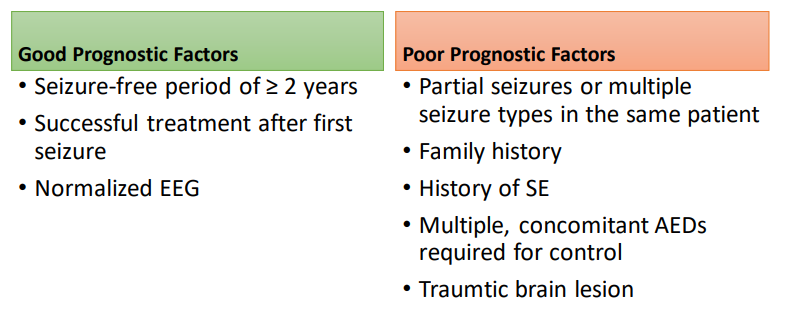
Image occlusion: name the hidden labels
11
Image occlusion: name the hidden labels
12
Image occlusion: name the hidden labels
13
About 60% of patients whose seizures are well-controlled by drugs can eventually
stop the drugs and remain seizure-free
14
Etiology
• For nearly 80% of patients, underlying etiology is unknown
• What likely causes epilepsy?
• Head trauma and stroke
• Developmental and genetic defects
• CNS tumors, infections, neurodegenerative diseases
• Metabolic disturbances (low Na, hypoglycemia, hypoxia)
• Seizures due to correctable causes do not usually need continued therapy
• What likely causes epilepsy?
• Head trauma and stroke
• Developmental and genetic defects
• CNS tumors, infections, neurodegenerative diseases
• Metabolic disturbances (low Na, hypoglycemia, hypoxia)
• Seizures due to correctable causes do not usually need continued therapy
15
6 categories of etiology
▪ Genetic
▪ Structural
▪ Infectious
▪ Metabolic
▪ Immune
▪ Unknown
▪ Not mutually exclusive
▪ Structural
▪ Infectious
▪ Metabolic
▪ Immune
▪ Unknown
▪ Not mutually exclusive
16
Risk Factors
• Premature birth with small gestational weight
• Perinatal injury (e.g., anoxia)
• History of alcohol withdrawal seizures
• History of febrile seizures
• Family history of seizures
• Perinatal injury (e.g., anoxia)
• History of alcohol withdrawal seizures
• History of febrile seizures
• Family history of seizures
17
Common Triggers
• Hyperventilation
• Photostimulation (e.g., flashing lights, rapidly changing images)
• Other sensory stimulation
• Physical/emotional stress
• Sleep deprivation
• Hormonal changes
• Medications
• Photostimulation (e.g., flashing lights, rapidly changing images)
• Other sensory stimulation
• Physical/emotional stress
• Sleep deprivation
• Hormonal changes
• Medications
18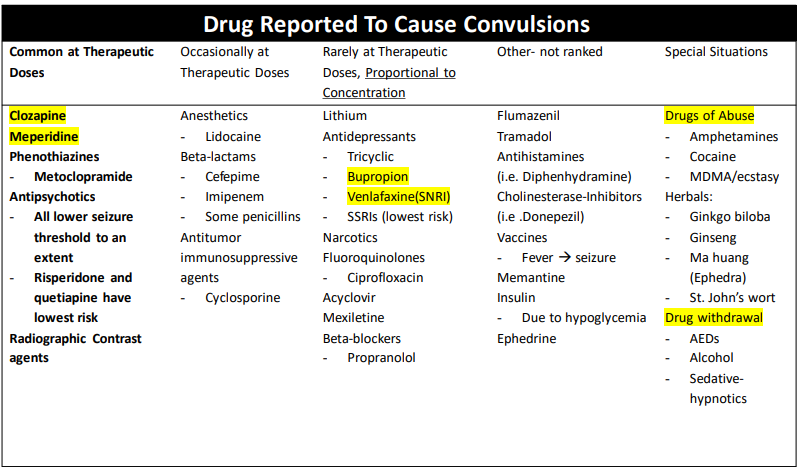
Image occlusion: name the hidden labels
19
Image occlusion: name the hidden labels
20
Image occlusion: name the hidden labels
21
Image occlusion: name the hidden labels
22
Image occlusion: name the hidden labels
23
Image occlusion: name the hidden labels
24
Medications Most Commonly Reported to Be Associated with Seizures
• Bupropion
• Maprotiline
• Antimicrobials
• Vinca Alkaloids
• Clozapine
• Phenothiazines
• CNS stimulants – amphetamines, cocaine, methylphenidate, methylxanthine
• Maprotiline
• Antimicrobials
• Vinca Alkaloids
• Clozapine
• Phenothiazines
• CNS stimulants – amphetamines, cocaine, methylphenidate, methylxanthine
25
Basic Mechanisms of Seizure Initiation
Membrane function – changes in voltagedependent ion channels lead to excess depolarization
Decreased inhibition – excess neuronal firing
Increased excitation – may be mediated through glutamate at the NMDA receptor
Alterations in extracellular ion concentration
Decreased inhibition – excess neuronal firing
Increased excitation – may be mediated through glutamate at the NMDA receptor
Alterations in extracellular ion concentration
26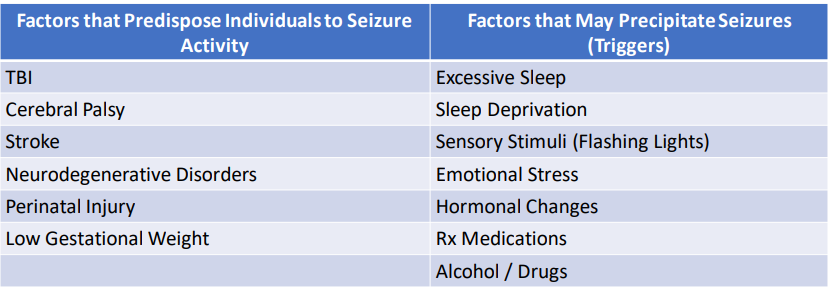
Image occlusion: name the hidden labels
27
Image occlusion: name the hidden labels
28
Image occlusion: name the hidden labels
29
Pathophysiology: Neurotransmitters
• Major excitatory neurotransmitter in the cerebral cortex is glutamate
• Glutamate opens membrane channels to allow Na+ and Ca++ to flow and transmit the signal
• Some AEDs work by blocking the release of glutamate or by blocking Na+ or Ca++ channels
• e.g., phenytoin, carbamazepine, oxcarbazepine, lamotrigine, lacosamide
• Glutamate opens membrane channels to allow Na+ and Ca++ to flow and transmit the signal
• Some AEDs work by blocking the release of glutamate or by blocking Na+ or Ca++ channels
• e.g., phenytoin, carbamazepine, oxcarbazepine, lamotrigine, lacosamide
30
Motor sx/s
jerking (e.g., myoclonus), stiffening (tonic contraction), or automatic movements (automatisms) such as smacking lips, rubbing hands, and picking at clothes
31
Nonmotor sx/s
– changes in sensation, emotions, thinking, or experience
32
Postictal sx/s
altered consciousness, drowsiness, confusion, paranoia, deep sleep
33
Seizure Classification and Presentation
• Diagnosis and identification of seizure types is essential to proper treatment
• Classification is based upon EEG findings combined with clinical findings or the semiology (signs) of the seizure event
• Classification is based upon EEG findings combined with clinical findings or the semiology (signs) of the seizure event
34
Focal Seizure (previously partial seizures)
start in network of cells on one side of the brain
35
Generalized Seizure (previously primary generalized)
start in bilaterally distributed network
36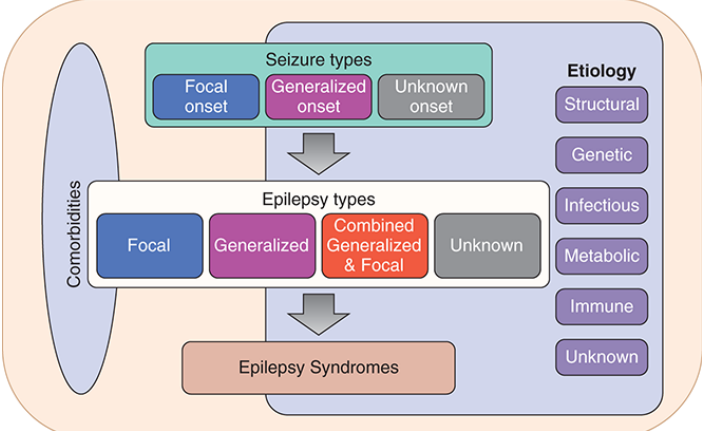
Image occlusion: name the hidden labels
37
Image occlusion: name the hidden labels
38
Image occlusion: name the hidden labels
39
Image occlusion: name the hidden labels
40
Image occlusion: name the hidden labels
41
Image occlusion: name the hidden labels
42
Seizure Classification: Epilepsy Syndromes
• Characterized by a known etiology and by a cluster of s/sx including distinctive comorbidities (e.g., intellectual and psychiatric dysfunction) that customarily occur together
43
Epilepsy Diagnosis
• Clinical diagnosis
• Must meet the following conditions:
• Diagnosis of an epilepsy syndrome; OR
• At least 2 unprovoked (or reflex) seizures (occurring > 24 hrs apart); OR
• One unprovoked (or reflex) seizure and a probability of further seizures similar to the general recurrence risk (at least 60%) after 2 unprovoked seizures, occurring over the next 10 years
• Tools used in diagnosis:
• History (rule out pseudoseizures)
• Non-focal neurologic exam
• EEG (abnormal only in about 50% of cases)
• Imaging (e.g., CT, MRI)
• Labs (e.g., screen for secondary causes, elevated prolactin)
• Must meet the following conditions:
• Diagnosis of an epilepsy syndrome; OR
• At least 2 unprovoked (or reflex) seizures (occurring > 24 hrs apart); OR
• One unprovoked (or reflex) seizure and a probability of further seizures similar to the general recurrence risk (at least 60%) after 2 unprovoked seizures, occurring over the next 10 years
• Tools used in diagnosis:
• History (rule out pseudoseizures)
• Non-focal neurologic exam
• EEG (abnormal only in about 50% of cases)
• Imaging (e.g., CT, MRI)
• Labs (e.g., screen for secondary causes, elevated prolactin)
44
Treatment Goals
• Ultimate goal is to eliminate seizures without any adverse effects of treatment
• In complex patients, the goal of therapy may be to provide a balance between seizure frequency and medication adverse effects while helping the patient have a lifestyle as normal as possible
• Eventually, discontinuing AED
• In complex patients, the goal of therapy may be to provide a balance between seizure frequency and medication adverse effects while helping the patient have a lifestyle as normal as possible
• Eventually, discontinuing AED
45
General Approach to Treatment
▪ Categorize etiology of patient’s seizure
▪ Classify seizure type/syndrome
▪ Initiate AED therapy if patient is at risk for recurrent seizures (e.g., sleep deprivation, substance use, fever)
▪ Individualize therapy based on:
▪ Efficacy/evidence
▪ Concurrent disease/medications
▪ Cost
▪ Toxicity
▪ Adherence
▪ Classify seizure type/syndrome
▪ Initiate AED therapy if patient is at risk for recurrent seizures (e.g., sleep deprivation, substance use, fever)
▪ Individualize therapy based on:
▪ Efficacy/evidence
▪ Concurrent disease/medications
▪ Cost
▪ Toxicity
▪ Adherence
46
Non-Pharmacologic Treatment
• Ketogenic Diet (indicated in children with refractory epilepsy who have failed ≥ 2 AEDs)
• Vagus Nerve stimulation (indicated for children and adults with intractable seizures)
• Responsive Neurostimulation (indicated to reduce seizure frequency in patients who not
responding well to AEDs)
• Surgery (indicated in patients with intractable seizures who have failed at least 2 first line
AEDs and a combo trial of at least 2 AEDs)
• Resection
• Disconnection
• Vagus Nerve stimulation (indicated for children and adults with intractable seizures)
• Responsive Neurostimulation (indicated to reduce seizure frequency in patients who not
responding well to AEDs)
• Surgery (indicated in patients with intractable seizures who have failed at least 2 first line
AEDs and a combo trial of at least 2 AEDs)
• Resection
• Disconnection
47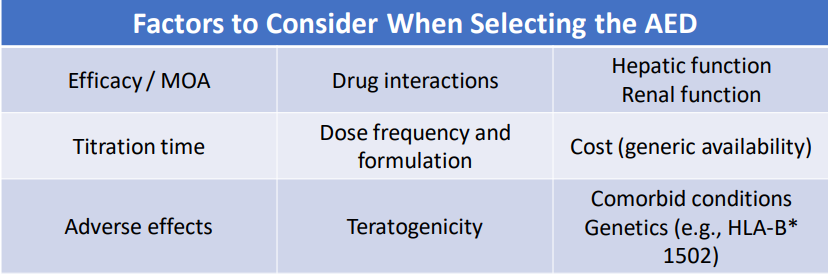
Image occlusion: name the hidden labels
48
Image occlusion: name the hidden labels
49
Image occlusion: name the hidden labels
50
Image occlusion: name the hidden labels
51
Image occlusion: name the hidden labels
52
Image occlusion: name the hidden labels
53
Principles of Pharmacologic Treatment: Initial Treatment
Weigh advantages and disadvantages of options
Use principles of shared decision making
Start low and go slow
Consider HS administration and/or administration with food to minimize ADRs
Use principles of shared decision making
Start low and go slow
Consider HS administration and/or administration with food to minimize ADRs
54
Principles of Pharmacologic Treatment: Initial Treatment Failure –Next Option
If due to lack of efficacy –choose an agent with a different MOA
If due to side-effect/ADR –choose an agent with low risk of causing same/similar side-effect/ADR
If due to side-effect/ADR –choose an agent with low risk of causing same/similar side-effect/ADR
55
Switching AEDs
• Start new AED at low dose and increase until minimal effective dose, then start taper of old AED
• If withdrawal seizures occur:
• If reason for d/c was not ADR-related: slow rate of taper of old AED
• If reason for d/c was ADR-related: continue taper of old AED, but add benzodiazepine for breakthrough seizures
• If withdrawal seizures occur:
• If reason for d/c was not ADR-related: slow rate of taper of old AED
• If reason for d/c was ADR-related: continue taper of old AED, but add benzodiazepine for breakthrough seizures
56
Using Multiple AEDs
• Seizure freedom in newly diagnosed patients
• First AED - 47% of patients are seizure free
• Add 2nd drug- 60% are seizure free (pick one with a different MOA)
• Add 3rd drug – 61% are seizure free
• Use AED poly-therapy if patient fails mono-therapy:
• Some experts favor combining AEDs with different mechanism of actions, side effect profiles, and potential for PK interactions
• Addition of 3 AEDs provides little added benefit in seizure reduction
• First AED - 47% of patients are seizure free
• Add 2nd drug- 60% are seizure free (pick one with a different MOA)
• Add 3rd drug – 61% are seizure free
• Use AED poly-therapy if patient fails mono-therapy:
• Some experts favor combining AEDs with different mechanism of actions, side effect profiles, and potential for PK interactions
• Addition of 3 AEDs provides little added benefit in seizure reduction
57
Image occlusion: name the hidden labels
58
Image occlusion: name the hidden labels
59
Image occlusion: name the hidden labels
60
Image occlusion: name the hidden labels
61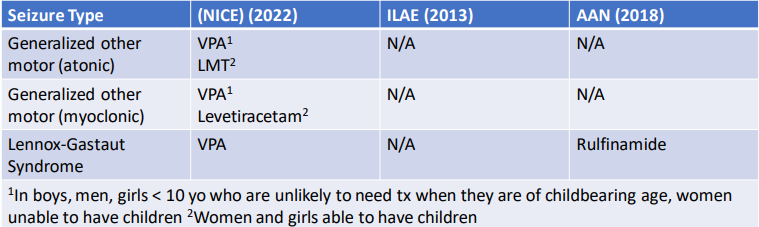
Image occlusion: name the hidden labels
62
AEDs Likely to Exacerbate Seizures
• Absence: CBZ, GBP, LMT, OXB, PHT, pregabalin, tiagabine, vigabatrin
• Atonic: CBZ, GBP, OXB, pregabalin, tiagabine, vigabatrin
• Myoclonic: CBZ, GBP, OXB, PHT, pregabalin, tiagabine, vigabatrin
• Lennox-Gastaut Syndrome: CBZ, GBP, lacosamide, LMT, OXC, PB, pregabalin, tiagabine, vigabatrin
• Atonic: CBZ, GBP, OXB, pregabalin, tiagabine, vigabatrin
• Myoclonic: CBZ, GBP, OXB, PHT, pregabalin, tiagabine, vigabatrin
• Lennox-Gastaut Syndrome: CBZ, GBP, lacosamide, LMT, OXC, PB, pregabalin, tiagabine, vigabatrin
63
Treatment-Resistant Epilepsy
• Level A: pregabalin, perampanel, vigabatrin
• NOTE: vigabatrin usually avoided due to retinopathy
• Level B: lacosamide, eslicarbazepine
• Level C: clobazam, OXB
• NOTE: vigabatrin usually avoided due to retinopathy
• Level B: lacosamide, eslicarbazepine
• Level C: clobazam, OXB
64
AED According to Comorbid Conditions Preferred Agents
• Mood disorders: VPA, LTG, CBZ, OXC, TPM, GBP
• Migraine: VPA, TPM, OXC, TPM, GBP, levetiracetam, lacosamide (avoid LTG)
• Neuropathic pain: CBZ, GBP, TPM, tiagabine, pregabalin
• Trigeminal neuralgia: CBZ, LTG, PHT, VPA
• Essential tremor: GBP, TPM
• Osteoporosis: LMT, levetiracetam
• Migraine: VPA, TPM, OXC, TPM, GBP, levetiracetam, lacosamide (avoid LTG)
• Neuropathic pain: CBZ, GBP, TPM, tiagabine, pregabalin
• Trigeminal neuralgia: CBZ, LTG, PHT, VPA
• Essential tremor: GBP, TPM
• Osteoporosis: LMT, levetiracetam
65
AED According to Comorbid Conditions Agents to Avoid
• Hepatic disease: VPA (increase ammonia levels)
• Renal calculi: TPM, ZNS
• Hyponatremia: CBZ, OXB
• HIV, organ-transplant recipients, cancer: enzyme inducing drugs (primidone, PB, PHT, CBZ)
• Partial or complete heart block: CBZ
• Blood dyscrasias: CBZ
• Thrombocytopenia: VPA
• Obesity: VPA, GBP, pregabalin
• Underweight: felbamate, TPM, ZNS
• Renal calculi: TPM, ZNS
• Hyponatremia: CBZ, OXB
• HIV, organ-transplant recipients, cancer: enzyme inducing drugs (primidone, PB, PHT, CBZ)
• Partial or complete heart block: CBZ
• Blood dyscrasias: CBZ
• Thrombocytopenia: VPA
• Obesity: VPA, GBP, pregabalin
• Underweight: felbamate, TPM, ZNS
66
AED: Complications – Common ADRs
• GI Upset: nausea, upset stomach, diarrhea
• Hematologic: blood dyscrasias (greater with CBZ, PHT, VPA, PB, ZNS)
• CNS: diplopia, visual problems, sedation, somnolence, cognitive slowing, ataxia, dizziness, headache
• Metabolic: Thyroid function tests, LFT, cholesterol, folate, vitamin D (osteoporosis), glucose (PHT)
• Hematologic: blood dyscrasias (greater with CBZ, PHT, VPA, PB, ZNS)
• CNS: diplopia, visual problems, sedation, somnolence, cognitive slowing, ataxia, dizziness, headache
• Metabolic: Thyroid function tests, LFT, cholesterol, folate, vitamin D (osteoporosis), glucose (PHT)
67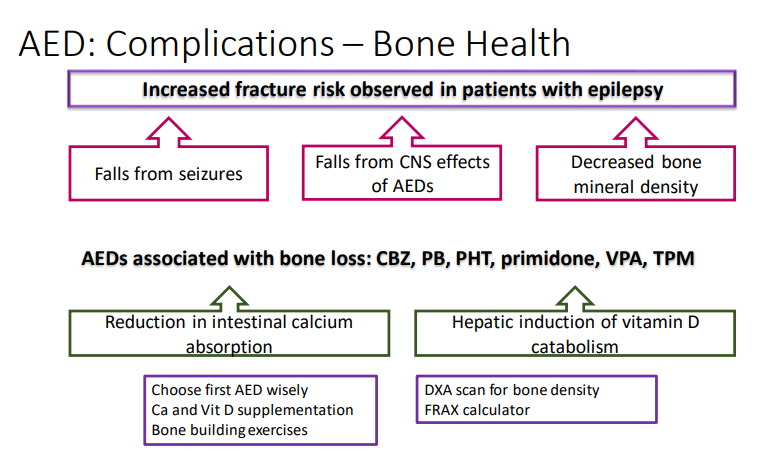
Image occlusion: name the hidden labels
68
Image occlusion: name the hidden labels
69
Image occlusion: name the hidden labels
70
Image occlusion: name the hidden labels
71
Image occlusion: name the hidden labels
72
Image occlusion: name the hidden labels
73
Image occlusion: name the hidden labels
74
Image occlusion: name the hidden labels
75
Image occlusion: name the hidden labels
76
Image occlusion: name the hidden labels
77
AED: Complications – Pregnancy
• If seizure free for 9 months prior to pregnancy, 84-92% will remain seizure free during pregnancy
• Seizures disorders may increase risk of giving birth to children w/ congenital defects in absence of
AEDs
• AED-associated teratogenic risks include:
• Orofacial clefts
• Heart defects
• Microcephaly
• Neural tube defects
• Low birth weight
• Prematurity
• Stillbirths
• Lower IQ (especially w/ VPA and PB)
• Seizures disorders may increase risk of giving birth to children w/ congenital defects in absence of
AEDs
• AED-associated teratogenic risks include:
• Orofacial clefts
• Heart defects
• Microcephaly
• Neural tube defects
• Low birth weight
• Prematurity
• Stillbirths
• Lower IQ (especially w/ VPA and PB)
78
AED: Complications – Estrogen-Containing Contraceptives
• AEDs that decrease estrogen (Require a higher dose of ethinyl estradiol [>50mcg] or alternative agent): CBZ, OXB, PHT, PB, TMP
• Reduce LMT Cpss
• Start LMT at usual dose
• May need to increase dose ~2x
• May need to decrease during placebo time
• Reduce LMT Cpss
• Start LMT at usual dose
• May need to increase dose ~2x
• May need to decrease during placebo time
79
AED: Complications – Hypersensitivity Syndrome
• Delayed ADR - clinical diagnosis may occur 2-12 weeks after initial exposure
• Cross-reactivity among aromatic AEDs
• Include: CBZ*, OXB*, PB*, PHT*, eslicarbazepine, ethosuximide, LMT, primidone, ZSN
• Aromatic AEDs metabolized in part by CYP450 to reactive aromatic epoxide intermediates
(arene oxides) that can accumulate and cause immunological response or cell death
• Presents as triad of symptoms:
1. Dermatologic reactions
2. Fever
3. Evidence of systemic organ failure (e.g., liver)
• Ranges from mild and self-limiting to fatal
• Cross-reactivity among aromatic AEDs
• Include: CBZ*, OXB*, PB*, PHT*, eslicarbazepine, ethosuximide, LMT, primidone, ZSN
• Aromatic AEDs metabolized in part by CYP450 to reactive aromatic epoxide intermediates
(arene oxides) that can accumulate and cause immunological response or cell death
• Presents as triad of symptoms:
1. Dermatologic reactions
2. Fever
3. Evidence of systemic organ failure (e.g., liver)
• Ranges from mild and self-limiting to fatal
80
AED: Complications – Suicidality
• FDA-issues class warning for AEDs
• Based on 11 placebo-controlled trials
• Risk w/ AEDs in 2x placebo
• Risk higher in patients w/ epilepsy compared to those using AEDs for other reasons (e.g., neuropathic pain, mood disorders, etc.)
• May be attributed to undiagnosed depression, psychiatric ADRs of AEDs, and postictal psychotic states
• Based on 11 placebo-controlled trials
• Risk w/ AEDs in 2x placebo
• Risk higher in patients w/ epilepsy compared to those using AEDs for other reasons (e.g., neuropathic pain, mood disorders, etc.)
• May be attributed to undiagnosed depression, psychiatric ADRs of AEDs, and postictal psychotic states