Anticonvulsant Toxicity
Study these flashcardsFree · spaced repetition · iPhone, Android, Mac & web
All cards
1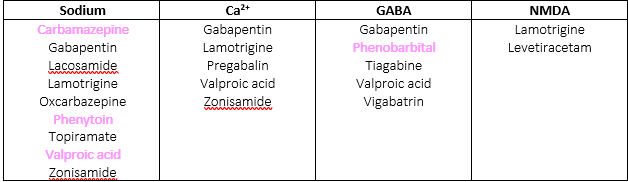
Image occlusion: name the hidden labels
2
Image occlusion: name the hidden labels
3
Image occlusion: name the hidden labels
4
Image occlusion: name the hidden labels
5
Image occlusion: name the hidden labels
6
Image occlusion: name the hidden labels
7
Image occlusion: name the hidden labels
8
Image occlusion: name the hidden labels
9
Image occlusion: name the hidden labels
10
Image occlusion: name the hidden labels
11
Image occlusion: name the hidden labels
12
Image occlusion: name the hidden labels
13
Image occlusion: name the hidden labels
14
Image occlusion: name the hidden labels
15
Phenobarbital Mechanism of Toxicity
Mechanism of toxicity
o Main channel activity: GABA-mediated chloride channels
Binds to barbiturate receptor on GABA-mediated chloride channels
Increases amount of time that chloride channels remain open
• More chloride ions pass through channel
• Hyperpolarizes cell membrane to increase the refractory period
• Increases the threshold for action potential
Depresses central sympathetic tone and cardiac contractility
o Main channel activity: GABA-mediated chloride channels
Binds to barbiturate receptor on GABA-mediated chloride channels
Increases amount of time that chloride channels remain open
• More chloride ions pass through channel
• Hyperpolarizes cell membrane to increase the refractory period
• Increases the threshold for action potential
Depresses central sympathetic tone and cardiac contractility
16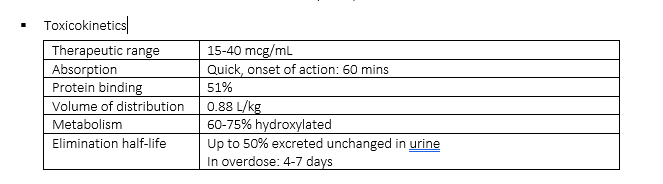
Image occlusion: name the hidden labels
17
Image occlusion: name the hidden labels
18
Image occlusion: name the hidden labels
19
Image occlusion: name the hidden labels
20
Image occlusion: name the hidden labels
21
Image occlusion: name the hidden labels
22
Image occlusion: name the hidden labels
23
Image occlusion: name the hidden labels
24
Image occlusion: name the hidden labels
25
Image occlusion: name the hidden labels
26
Image occlusion: name the hidden labels
27
Image occlusion: name the hidden labels
28
Image occlusion: name the hidden labels
29
Image occlusion: name the hidden labels
30
Image occlusion: name the hidden labels
31
Image occlusion: name the hidden labels
32
Image occlusion: name the hidden labels
33
Image occlusion: name the hidden labels
34
Image occlusion: name the hidden labels
35
Image occlusion: name the hidden labels
36
Image occlusion: name the hidden labels
37
Clinical Manifestations of Phenobarbital Toxicity
Can be fatal;
o CNS: lethargy, nystagmus, slurred speech, coma (>150 mcg/mL), hypothermia
o Respiratory: respiratory depression, hypoventilation, pulmonary edema
o Cardiovascular: hypotension (60-80 mcg/mL), bradycardia
o Hepatic failure
o Renal failure
o Assess ABC since it can affect all of them
o CNS: lethargy, nystagmus, slurred speech, coma (>150 mcg/mL), hypothermia
o Respiratory: respiratory depression, hypoventilation, pulmonary edema
o Cardiovascular: hypotension (60-80 mcg/mL), bradycardia
o Hepatic failure
o Renal failure
o Assess ABC since it can affect all of them
38
Phenobarbital Toxicity Diagnosis
o Serum phenobarbital concentration: repeat until downward trend
o Vital signs + EKG
o Urinalysis: urine pH
o CMP: renal function
o Hepatic work-up: transaminases, coagulation panel
o Vital signs + EKG
o Urinalysis: urine pH
o CMP: renal function
o Hepatic work-up: transaminases, coagulation panel
39
Phenobarbital Toxicity Treatment
o ABCs
o GI decontamination: activated charcoal
o Treatment of choice: enhance elimination
Urinary alkalinization
Hemodialysis
Multi-dose activated charcoal (MDAC)
o GI decontamination: activated charcoal
o Treatment of choice: enhance elimination
Urinary alkalinization
Hemodialysis
Multi-dose activated charcoal (MDAC)
40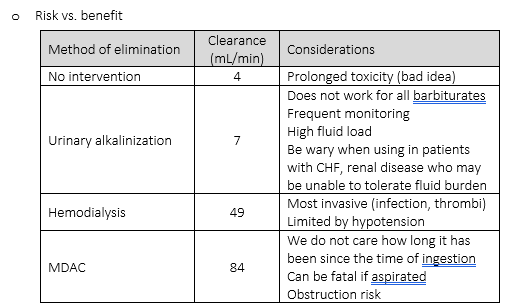
Image occlusion: name the hidden labels
41
Image occlusion: name the hidden labels
42
Image occlusion: name the hidden labels
43
Image occlusion: name the hidden labels
44
Image occlusion: name the hidden labels
45
Image occlusion: name the hidden labels
46
Image occlusion: name the hidden labels
47
Image occlusion: name the hidden labels
48
Image occlusion: name the hidden labels
49
Image occlusion: name the hidden labels
50
MDAC
Works if a drug undergoes entero-enteric or entero-hepatic recirculation
Mechanism of action
• Forms a negative concentration gradient (interrupts recirculation)
• Pulls drug from serum into the gut lumen where it adsorbs to charcoal
Contraindications
• Unprotected airway
• Known intestinal obstruction
• GI tract is not anatomically intact
Mechanism of action
• Forms a negative concentration gradient (interrupts recirculation)
• Pulls drug from serum into the gut lumen where it adsorbs to charcoal
Contraindications
• Unprotected airway
• Known intestinal obstruction
• GI tract is not anatomically intact
51
MDAC Monitoring
• Prior to EVERY dose
o Verify presence of normal bowel sounds
Do not administer if bowel sounds are hypoactive or absent
o Evaluate for aspiration risks
Aspirated activated charcoal has been fatal
• When to discontinue MDAC
o Obtain serial serum phenobarbital levels (every 2-6 hours)
o Endpoint: reversal of life-threatening CNS, respiratory and/or CV symptoms
o Verify presence of normal bowel sounds
Do not administer if bowel sounds are hypoactive or absent
o Evaluate for aspiration risks
Aspirated activated charcoal has been fatal
• When to discontinue MDAC
o Obtain serial serum phenobarbital levels (every 2-6 hours)
o Endpoint: reversal of life-threatening CNS, respiratory and/or CV symptoms
52
Hemodialysis for Phenobarbital
Reserved for severe toxicity when unable to tolerate other methods
Severe toxicity is defined as
• Renal or hepatic failure
• Pulmonary edema
• Coma
• Serum phenobarbital >100 mcg/mL
Severe toxicity is defined as
• Renal or hepatic failure
• Pulmonary edema
• Coma
• Serum phenobarbital >100 mcg/mL
53
Phenytoin Mechanisms of Toxicity
o Neurological
Associated with both oral and parenteral formulations
Mechanism is related to the drug
• Extension of its pharmacotherapy
• Increases refractory period of voltage-gated channels
o Suppresses high-frequency neuronal firing → CNS depression
o Cardiovascular and dermal
Associated with parenteral formulation
Mechanism is related to diluent
• Diluent = propylene glycol 40% + ethanol 10% + sodium hydroxide
• Cardiovascular: decreased peripheral vascular resistance + myocardial contractility (sodium, potassium and calcium channel blockade)
• Dermal: alkalinity leads to dermal necrosis (pH 12)
Associated with both oral and parenteral formulations
Mechanism is related to the drug
• Extension of its pharmacotherapy
• Increases refractory period of voltage-gated channels
o Suppresses high-frequency neuronal firing → CNS depression
o Cardiovascular and dermal
Associated with parenteral formulation
Mechanism is related to diluent
• Diluent = propylene glycol 40% + ethanol 10% + sodium hydroxide
• Cardiovascular: decreased peripheral vascular resistance + myocardial contractility (sodium, potassium and calcium channel blockade)
• Dermal: alkalinity leads to dermal necrosis (pH 12)
54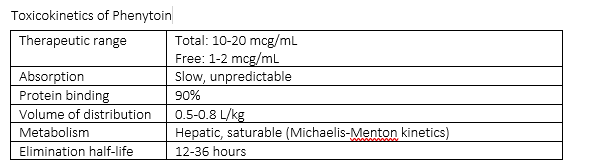
Image occlusion: name the hidden labels
55
Image occlusion: name the hidden labels
56
Image occlusion: name the hidden labels
57
Image occlusion: name the hidden labels
58
Image occlusion: name the hidden labels
59
Image occlusion: name the hidden labels
60
Image occlusion: name the hidden labels
61
Image occlusion: name the hidden labels
62
Image occlusion: name the hidden labels
63
Image occlusion: name the hidden labels
64
Image occlusion: name the hidden labels
65
Image occlusion: name the hidden labels
66
Image occlusion: name the hidden labels
67
Image occlusion: name the hidden labels
68
Image occlusion: name the hidden labels
69
Image occlusion: name the hidden labels
70
Image occlusion: name the hidden labels
71
Image occlusion: name the hidden labels
72
Image occlusion: name the hidden labels
73
Image occlusion: name the hidden labels
74
Image occlusion: name the hidden labels
75
Clinical manifestations of Phenytoin Toxicity
o It’s all about timing: over how long did the ingestion occur?
Acute: ingestion occurs over <8 hours (e.g. swallow an entire bottle in a suicide attempt)
Chronic: regularly taking the medication (e.g. incidental finding of supratherapeutic level)
Acute: ingestion occurs over <8 hours (e.g. swallow an entire bottle in a suicide attempt)
Chronic: regularly taking the medication (e.g. incidental finding of supratherapeutic level)
76
Phenytoin Toxicity Diagnosis
Serum phenytoin
• Free or total
• Initially obtain every 1-2 hours
• Once stable: daily
CBC, BMP
Albumin
Vital signs
Neurologic exam
EKG
• Free or total
• Initially obtain every 1-2 hours
• Once stable: daily
CBC, BMP
Albumin
Vital signs
Neurologic exam
EKG
77
Phenytoin Toxicity Treatment
ABCs
GI decontamination: activated charcoal
Treatment of choice: enhanced elimination = MDAC
• Rising or persistently elevated serial serum concentrations
• Remember contraindications and precautions!
Cardiotoxicity (IV only)
• Typically resolves on its own within 30-60 mins
• If it does not resolve: stop the infusion + IV Fluid Bolus
GI decontamination: activated charcoal
Treatment of choice: enhanced elimination = MDAC
• Rising or persistently elevated serial serum concentrations
• Remember contraindications and precautions!
Cardiotoxicity (IV only)
• Typically resolves on its own within 30-60 mins
• If it does not resolve: stop the infusion + IV Fluid Bolus
78
Valproic Acid Toxicity
o CNS depressant
Inhibits GABA transaminase → increasing levels of GABA
Prolongs recovery of inactivated sodium channels
o Alters metabolism of free fatty acids
Impairs mitochondrial beta-oxidation
Disrupts urea cycle
Inhibits GABA transaminase → increasing levels of GABA
Prolongs recovery of inactivated sodium channels
o Alters metabolism of free fatty acids
Impairs mitochondrial beta-oxidation
Disrupts urea cycle
79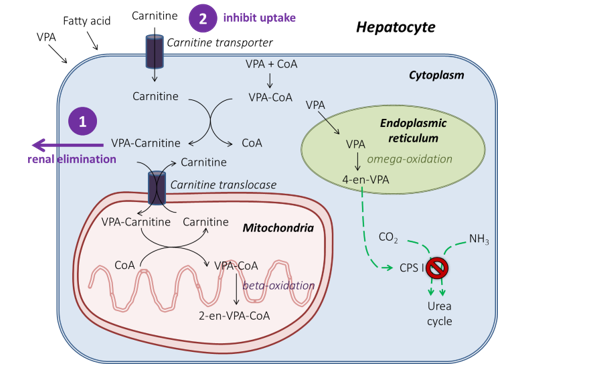
Image occlusion: name the hidden labels
80
Image occlusion: name the hidden labels
81
Image occlusion: name the hidden labels
82
Image occlusion: name the hidden labels
83
Image occlusion: name the hidden labels
84
Image occlusion: name the hidden labels
85
Hyperammonemia
leads to encephalopathy
Normally: glutamine synthetase converts ammonia + glutamate → glutamine
Amount of ammonia overcomes ability of glutamine synthetase
• Ammonia is directly toxic to the brain tissue
• Astrocytes cannot communicate → encephalopathy
Normally: glutamine synthetase converts ammonia + glutamate → glutamine
Amount of ammonia overcomes ability of glutamine synthetase
• Ammonia is directly toxic to the brain tissue
• Astrocytes cannot communicate → encephalopathy
86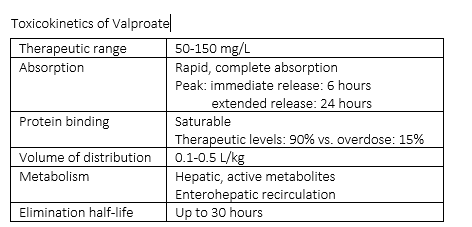
Image occlusion: name the hidden labels
87
Image occlusion: name the hidden labels
88
Image occlusion: name the hidden labels
89
Image occlusion: name the hidden labels
90
Image occlusion: name the hidden labels
91
Image occlusion: name the hidden labels
92
Image occlusion: name the hidden labels
93
Image occlusion: name the hidden labels
94
Image occlusion: name the hidden labels
95
Image occlusion: name the hidden labels
96
Image occlusion: name the hidden labels
97
Image occlusion: name the hidden labels
98
Image occlusion: name the hidden labels
99
Image occlusion: name the hidden labels
100
Image occlusion: name the hidden labels
101
Image occlusion: name the hidden labels
102
Image occlusion: name the hidden labels
103
Image occlusion: name the hidden labels
104
Image occlusion: name the hidden labels
105
Image occlusion: name the hidden labels
106
Image occlusion: name the hidden labels
107
Clinical manifestations of Valproate Toxicity
Early
• >200 mg/L: drowsiness, confusion, disorientation, QT prolongation
• >400 mg/L: obtundation, encephalopathy, cerebral edema, hemodynamic instability
• >850 mg/L: Seizures, coma, metabolic acidosis, hypernatremia
Late
• Late sequelae
o Optic nerve atrophy
o Non-cardiogenic pulmonary edema
o Anuria
o Hemorrhagic pancreatitis
o Pancytopenia (transient)
• Chronic ingestions
o Hepatotoxicity (asymptomatic → fatal hepatitis)
o Microvascular steatosis
• >200 mg/L: drowsiness, confusion, disorientation, QT prolongation
• >400 mg/L: obtundation, encephalopathy, cerebral edema, hemodynamic instability
• >850 mg/L: Seizures, coma, metabolic acidosis, hypernatremia
Late
• Late sequelae
o Optic nerve atrophy
o Non-cardiogenic pulmonary edema
o Anuria
o Hemorrhagic pancreatitis
o Pancytopenia (transient)
• Chronic ingestions
o Hepatotoxicity (asymptomatic → fatal hepatitis)
o Microvascular steatosis
108
Diagnosis of Valproate Toxicity
Serum valproic acid
• Repeat until trends downward
• Delayed peak with extended release
Ammonia
CMP, CBC
Calcium
Hepatic transaminases
Coagulation panel
EKG
Lipase or amylase
Serum osmolality
• Repeat until trends downward
• Delayed peak with extended release
Ammonia
CMP, CBC
Calcium
Hepatic transaminases
Coagulation panel
EKG
Lipase or amylase
Serum osmolality
109
Valproate Toxicity Treatment
ABCs
GI decontamination: activated charcoal (if there is no C/I; typically, a good answer)
Antidote: levocarnitine
Enhanced elimination
• MDAC: enteric coated or extended-release products
• Hemodialysis
o Hemodynamic or neurologic instability
o Life-threatening hyperammonemia
o [VPA] >900 mg/L
o Cerebral edema
GI decontamination: activated charcoal (if there is no C/I; typically, a good answer)
Antidote: levocarnitine
Enhanced elimination
• MDAC: enteric coated or extended-release products
• Hemodialysis
o Hemodynamic or neurologic instability
o Life-threatening hyperammonemia
o [VPA] >900 mg/L
o Cerebral edema
110
Levocarnitine (Carnitor) **Know Dosing**
• Mechanism of action
o Restores urea cycle → reduces ammonia production
o Reduced ammonia → reduced encephalopathy
o Indicated if: ingestion of >400 mg/kg or [valproic acid] >450 mg/L
• Symptomatic: Intravenous route/dosing
o Loading dose: 100 mg/kg IV (max 6 g) over 30 mins
o Maintenance dose: 50 mg/kg IV every 8 hours (max 3 g/day)
• Asymptomatic: oral route/dosing
o 100 mg/kg PO divided every 6 hours (max 3 g/day)
• Adverse effects: nausea, vomiting, diarrhea, fishy odor
• Continue until clinical improvement and return to baseline ammonia
o Restores urea cycle → reduces ammonia production
o Reduced ammonia → reduced encephalopathy
o Indicated if: ingestion of >400 mg/kg or [valproic acid] >450 mg/L
• Symptomatic: Intravenous route/dosing
o Loading dose: 100 mg/kg IV (max 6 g) over 30 mins
o Maintenance dose: 50 mg/kg IV every 8 hours (max 3 g/day)
• Asymptomatic: oral route/dosing
o 100 mg/kg PO divided every 6 hours (max 3 g/day)
• Adverse effects: nausea, vomiting, diarrhea, fishy odor
• Continue until clinical improvement and return to baseline ammonia
111
Carbamazepine mechanism of toxicity
o Extension of pharmacology
Prolongs inactivation of sodium channels
Alters cerebellar-vestibular brainstem function
o Structural similarity to cyclic antidepressants
Weak anticholinergic effects
Cardiac conduction disturbances + seizures
Prolongs inactivation of sodium channels
Alters cerebellar-vestibular brainstem function
o Structural similarity to cyclic antidepressants
Weak anticholinergic effects
Cardiac conduction disturbances + seizures
112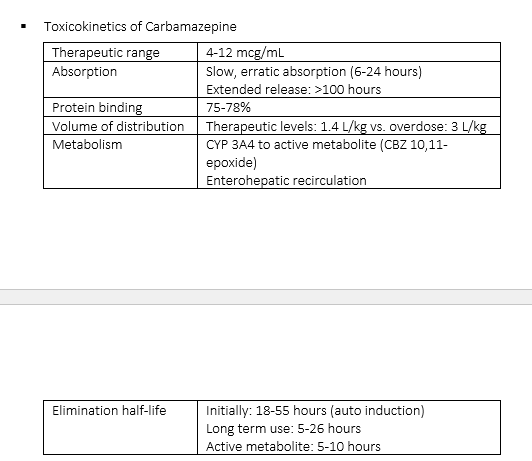
Image occlusion: name the hidden labels
113
Image occlusion: name the hidden labels
114
Image occlusion: name the hidden labels
115
Image occlusion: name the hidden labels
116
Image occlusion: name the hidden labels
117
Image occlusion: name the hidden labels
118
Clinical Manifestations of Carbamazepine Toxicity
o Neurological
Confusion, agitation, drowsiness
Nystagmus
Ataxia
Dysarthria
Cyclic coma
Seizures
o Cardiovascular
Tachycardia, hypotension
QRS widening, QT prolongation
o Miscellaneous
Respiratory depression
Hyperthermia
Hyponatremia
Bone marrow suppression
Confusion, agitation, drowsiness
Nystagmus
Ataxia
Dysarthria
Cyclic coma
Seizures
o Cardiovascular
Tachycardia, hypotension
QRS widening, QT prolongation
o Miscellaneous
Respiratory depression
Hyperthermia
Hyponatremia
Bone marrow suppression
119
Diagnosis of Carbamazepine Toxicity
o Serum carbamazepine
Repeat every 4-6 hours
Repeat until downward trend
o CBC
o CMP
o EKG
o Can cause false positive for cyclic antidepressants
Repeat every 4-6 hours
Repeat until downward trend
o CBC
o CMP
o EKG
o Can cause false positive for cyclic antidepressants
120
Carbamazepine Toxicity Treatment
o ABCs
o GI decontamination: activated charcoal
o Enhanced elimination
MDAC
Hemodialysis (high-flux)
• Refractory seizures or life-threatening arrhythmias
• Prolonged coma, respiratory depression
o QRS widening: sodium bicarbonate
o Hyponatremia (seizures): hypertonic saline (3%)
o GI decontamination: activated charcoal
o Enhanced elimination
MDAC
Hemodialysis (high-flux)
• Refractory seizures or life-threatening arrhythmias
• Prolonged coma, respiratory depression
o QRS widening: sodium bicarbonate
o Hyponatremia (seizures): hypertonic saline (3%)
121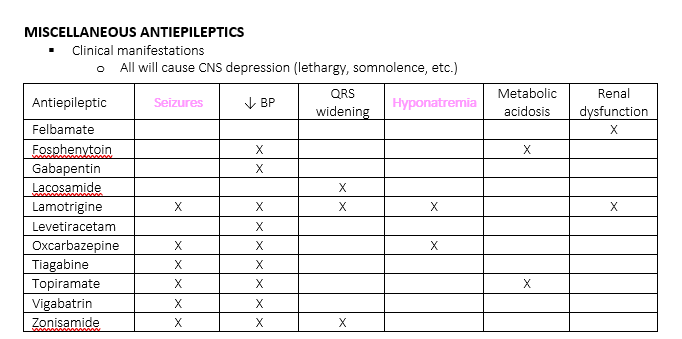
Image occlusion: name the hidden labels
122
Image occlusion: name the hidden labels
123
Image occlusion: name the hidden labels
124
Image occlusion: name the hidden labels
125
Image occlusion: name the hidden labels
126
Image occlusion: name the hidden labels
127
Image occlusion: name the hidden labels
128
Image occlusion: name the hidden labels
129
Image occlusion: name the hidden labels
130
Image occlusion: name the hidden labels
131
Image occlusion: name the hidden labels
132
Image occlusion: name the hidden labels
133
Image occlusion: name the hidden labels
134
Image occlusion: name the hidden labels
135
Image occlusion: name the hidden labels
136
Image occlusion: name the hidden labels
137
Image occlusion: name the hidden labels
138
Image occlusion: name the hidden labels
139
Image occlusion: name the hidden labels
140
Image occlusion: name the hidden labels
141
Image occlusion: name the hidden labels
142
Diagnosis of Miscellaneous Antiepileptic Toxicity
o Serum concentration usually unavailable
o Based on history of ingestion/clinical suspicion
o Based on history of ingestion/clinical suspicion
143
Treatment of Miscellaneous Antiepileptic Toxicity
o ABCs
o GI decontamination: activated charcoal
o Symptomatic and supportive care
QRS widening: sodium bicarbonate
Hypotension: IV fluids, vasopressors if needed
Seizures: benzodiazepines→ propofol → barbiturates
o GI decontamination: activated charcoal
o Symptomatic and supportive care
QRS widening: sodium bicarbonate
Hypotension: IV fluids, vasopressors if needed
Seizures: benzodiazepines→ propofol → barbiturates