Hypoglycemic Agents
Study these flashcardsFree · spaced repetition · iPhone, Android, Mac & web
All cards
1
Hypoglycemia Etiology
Physiologic
• Cirrhosis
• Alcoholism
• Hemodialysis
• Pregnancy
• Sepsis
• Shock
• Gastric surgery
• Anorexia
• Endocrine disorders
Medications
• Insulin
• Sulfonylureas
• Antidiabetics
• Beta blockers
• Quinidine
• Salicylates
• Valproic acid
• Venlafaxine
• Cirrhosis
• Alcoholism
• Hemodialysis
• Pregnancy
• Sepsis
• Shock
• Gastric surgery
• Anorexia
• Endocrine disorders
Medications
• Insulin
• Sulfonylureas
• Antidiabetics
• Beta blockers
• Quinidine
• Salicylates
• Valproic acid
• Venlafaxine
2
Risk Factors for Hypoglycemia
Advanced Age
Polypharmacy
Recent Medication Change
Restricted Diet
Renal or Hepatic Disease
Polypharmacy
Recent Medication Change
Restricted Diet
Renal or Hepatic Disease
3
Signs and Symptoms of Hypoglycemia
Neurogenic:
• Sweating
• Palpitations
• Tachycardia
• Tremors
• Anxiety
• Hunger
• Irritability
• Tingling
Neuroglycopenic:
• Confusion
• Drowsiness/Lethargy
• Unable to follow commands
• Inappropriate behavior
• Headache
• Blurred vision
• Cool skin
• Unconsciousness
• Seizure
• Coma
• Sweating
• Palpitations
• Tachycardia
• Tremors
• Anxiety
• Hunger
• Irritability
• Tingling
Neuroglycopenic:
• Confusion
• Drowsiness/Lethargy
• Unable to follow commands
• Inappropriate behavior
• Headache
• Blurred vision
• Cool skin
• Unconsciousness
• Seizure
• Coma
4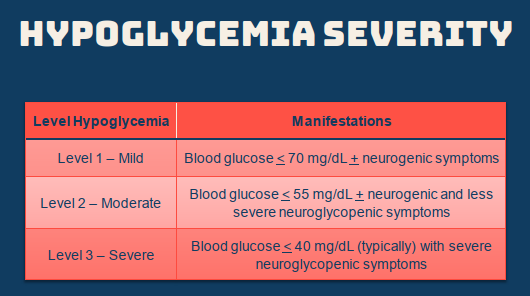
Image occlusion: name the hidden labels
5
Image occlusion: name the hidden labels
6
Image occlusion: name the hidden labels
7
General Treatment of Hypoglycemia if Patient is Awake
15 g fast acting carbohydrates
Wait 15 minutes and check BG again
Call 911 if BG remains < 70 mg/dL
Wait 15 minutes and check BG again
Call 911 if BG remains < 70 mg/dL
8
General Treatment of Hypoglycemia if Patient is Unconscious
Dextrose
• Dose: 0.5 – 1 g/kg IV
• Maximum peripheral concentrations:
• Adult: Dextrose 50%
• Children: Dextrose 25%
• Infants: Dextrose 10%
• ”One amp” D50W = 25 g dextrose
• Adverse effects: hypokalemia, hypophosphatemia
Glucagon
• MOA: mobilizes glycogen from liver to cause catecholamine release
• Dosing
• IM/IV/SQ: 1 mg
• IN: 3 mg into one nostril
• Repeat dosing in 15 minutes if needed
• Duration of effect ~30 minutes
• Adverse effects: nausea/vomiting
• Dose: 0.5 – 1 g/kg IV
• Maximum peripheral concentrations:
• Adult: Dextrose 50%
• Children: Dextrose 25%
• Infants: Dextrose 10%
• ”One amp” D50W = 25 g dextrose
• Adverse effects: hypokalemia, hypophosphatemia
Glucagon
• MOA: mobilizes glycogen from liver to cause catecholamine release
• Dosing
• IM/IV/SQ: 1 mg
• IN: 3 mg into one nostril
• Repeat dosing in 15 minutes if needed
• Duration of effect ~30 minutes
• Adverse effects: nausea/vomiting
9
Insulin MOA
Regulates metabolism of carbohydrate, protein, and fats
Stimulates hepatic glycogen synthesis
Promotes hepatic synthesis of fatty acids
Increased protein synthesis and increased glycogen synthesis at skeletal muscle
Stimulates hepatic glycogen synthesis
Promotes hepatic synthesis of fatty acids
Increased protein synthesis and increased glycogen synthesis at skeletal muscle
10
Insulin Toxicokinetics
Formulations with delayed onset, prolonged MOA can lead to delayed and prolonged hypoglycemia
Depot effect when administered IM or SQ
Poor absorption due to poor perfusion in hypoglycemic states
Finite number of insulin receptors in body
Depot effect when administered IM or SQ
Poor absorption due to poor perfusion in hypoglycemic states
Finite number of insulin receptors in body
11
Insulin Overdose Management
ABC’s
• Airway, Breathing, Circulation
Correct Hypoglycemia
• D50W 0.5-1 g/kg IV
• Glucagon IM if no IV access
Decontamination
• Case reports of surgical excision of insulin injection site
• Airway, Breathing, Circulation
Correct Hypoglycemia
• D50W 0.5-1 g/kg IV
• Glucagon IM if no IV access
Decontamination
• Case reports of surgical excision of insulin injection site
12
Sulfonylureas Mechanism
Stimulate insulin release from the pancreatic beta cells
Reduce glucose output from the liver
Insulin sensitivity increased at peripheral target sites
Reduce glucose output from the liver
Insulin sensitivity increased at peripheral target sites
13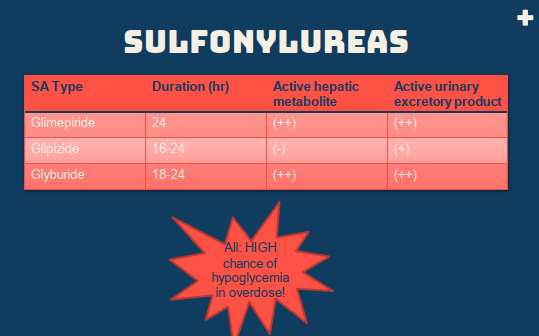
Image occlusion: name the hidden labels
14
Image occlusion: name the hidden labels
15
Image occlusion: name the hidden labels
16
Sulfonylureas Toxicokinetics
Long durations of action leading to long periods of hypoglycemia
Delayed onset of hypoglycemia
Failure of counterregulatory mechanisms over time
Delayed onset of hypoglycemia
Failure of counterregulatory mechanisms over time
17
Sulfonylurea Overdose Management
ABC’s
• Airway, Breathing, Circulation
Gastric Decontamination
• Activated charcoal
Correct hypoglycemia
• Octreotide
• Use of dextrose transient, often stimulates insulin release from pancreas
• Airway, Breathing, Circulation
Gastric Decontamination
• Activated charcoal
Correct hypoglycemia
• Octreotide
• Use of dextrose transient, often stimulates insulin release from pancreas
18
Gastric Decontamination
• Removal of the patient from the source of toxicity via removal of the toxin from the body
• Activated charcoal in awake patients with intact airway
• Most effective within 1 hour of ingestion at a 10:1 charcoal:toxin ratio
• Typical single dose range 25-100 g PO
• Adverse effects: vomiting, constipation
• Sulfonylureas: high affinity to activated charcoal
• Activated charcoal in awake patients with intact airway
• Most effective within 1 hour of ingestion at a 10:1 charcoal:toxin ratio
• Typical single dose range 25-100 g PO
• Adverse effects: vomiting, constipation
• Sulfonylureas: high affinity to activated charcoal
19
Octreotide Mechanism
• Somatostatin analog: binds to somatostatin receptor on Ca2+ channel of β islet cells of
pancreas → inhibits calcium entry into cell → inhibits insulin release
• Indicated in recurrent hypoglycemia due to sulfonylurea ingestion to reduce ongoing glucose-stimulated insulin release
pancreas → inhibits calcium entry into cell → inhibits insulin release
• Indicated in recurrent hypoglycemia due to sulfonylurea ingestion to reduce ongoing glucose-stimulated insulin release
20
Management with Octreotide
• T1/2 of 1.5 hours, peak effect within 30 minutes, duration ~24 hours
• Shown to decrease episodes of recurrent hypoglycemia, reduce overall dextrose requirements
• Dosing: 50-100 mcg SQ or IV, can be repeated in 6 hours
• Continuous infusion: 125 mcg/hr x 24 hours
• Adverse effects: injection site pain, GI upset
• Shown to decrease episodes of recurrent hypoglycemia, reduce overall dextrose requirements
• Dosing: 50-100 mcg SQ or IV, can be repeated in 6 hours
• Continuous infusion: 125 mcg/hr x 24 hours
• Adverse effects: injection site pain, GI upset
21
Metformin Mechanism
Decreases hepatic glucose production
Decreases intestinal absorption of glucose
Increases peripheral glucose uptake and utilization to improve insulin sensitivity
Decreases intestinal absorption of glucose
Increases peripheral glucose uptake and utilization to improve insulin sensitivity
22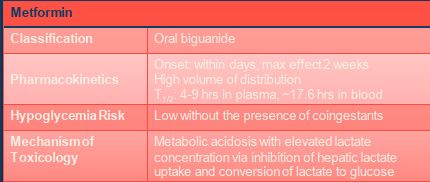
Image occlusion: name the hidden labels
23
Metformin Associated Lactic Acidosis (MALA) Risk Factors
Renal dysfunction
Advanced age
Alcohol abuse
Sepsis
Administration of contrast media
Advanced age
Alcohol abuse
Sepsis
Administration of contrast media
24
MALA Management
ABC’s
• Airway, Breathing, Circulation
Sodium bicarbonate IV infusion
• Critically ill patients, severe acidosis
Hemodialysis
• Moderately dialyzable
• Large volume of distribution
• Airway, Breathing, Circulation
Sodium bicarbonate IV infusion
• Critically ill patients, severe acidosis
Hemodialysis
• Moderately dialyzable
• Large volume of distribution
25
Maintenance of Euglycemia
• Caution with initiation of continuous infusion of dextrose – can potentiate further insulin release from pancreas
• D50W bolus in recurrent hypoglycemia episodes followed by infusion of D5W
• Infusion with hypertonic D10W as needed to maintain serum glucose goal of 100-150 mg/dL
• Feeding with carbohydrates and proteins
• Glucose monitoring q1-2hrs following initial stabilization, q4-6hrs with
maintained stabilization
• Monitor for hypophosphatemia, hypokalemia and replete as necessary
• D50W bolus in recurrent hypoglycemia episodes followed by infusion of D5W
• Infusion with hypertonic D10W as needed to maintain serum glucose goal of 100-150 mg/dL
• Feeding with carbohydrates and proteins
• Glucose monitoring q1-2hrs following initial stabilization, q4-6hrs with
maintained stabilization
• Monitor for hypophosphatemia, hypokalemia and replete as necessary
26
Additional Agents with Low Hypoglycemia Risk
GLP-1 Receptor Agonists (tides)
DPP-4 Inhibitors (gliptins)
SGLT-2 Inhibitors (gliflozins)
TZDs (glitazones)
DPP-4 Inhibitors (gliptins)
SGLT-2 Inhibitors (gliflozins)
TZDs (glitazones)