Acid Base Disorders
Study these flashcardsFree · spaced repetition · iPhone, Android, Mac & web
All cards
1
Hyperventilation
often caused by respiratory stimulus
2
Hypoventilation
caused by primary depression of consciousness and respiration
3
Arterial Blood Gas (ABG)
measurement of acidity or alkalinity of arterial blood circulation, measures gases
4
Arterial or Venous Blood Gas Analysis
Recommended to determine acid-base disorder associated with a change in ventilation
5
pH
7.35-7.45
6
$PaCO_2$
35-45 mmHg
7
$PaO_2$
80-100 mmHg
8
$HCO_3^-$
22-26 mEq/L
9
BE
-2 to +2
10
Acidemia
Arterial pH below the normal range (pH<7.35)
pH= -log[H+] $\rightarrow$↓pH=acidemia
pH= -log[H+] $\rightarrow$↓pH=acidemia
11
Alkalemia
Arterial pH above the normal range (pH>7.45)
pH= -log[H+] $\rightarrow$↑pH=alkalemia
pH= -log[H+] $\rightarrow$↑pH=alkalemia
12
Acidosis
Process lowering pH, may be caused by a ↓ in serum
bicarbonate and/or a rise in the partial pressure of carbon dioxide ($PaCO_2$)
bicarbonate and/or a rise in the partial pressure of carbon dioxide ($PaCO_2$)
13
Alkalosis
Process raising pH, may be caused by a rise in serum bicarbonate and/or a ↓ in $PaCO_2$
14
Acid-Base Balance
Maintained by various chemical buffer systems
• Primarily HCO3/CO2 buffer system
• CO2 via alveolar ventilation in the lungs
• HCO3 via excretion/reabsorpon in the kidney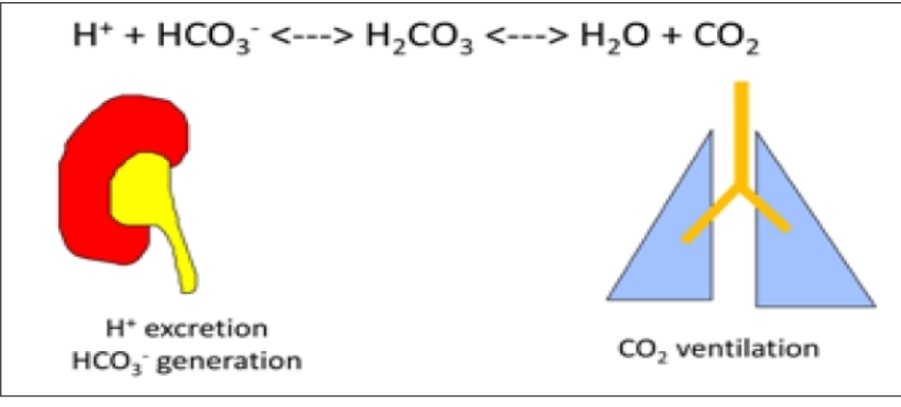
• Primarily HCO3/CO2 buffer system
• CO2 via alveolar ventilation in the lungs
• HCO3 via excretion/reabsorpon in the kidney
15
Clinical Consequences of Acid/Base Disorders
• Poor vascular tone $\longrightarrow$ Hypotension
• Myocardial pump failure $\longrightarrow$↓Cardiac Output
• Altered Mental Status
• Reduced responsiveness to catecholamines
• Arrhythmias
• Myocardial pump failure $\longrightarrow$↓Cardiac Output
• Altered Mental Status
• Reduced responsiveness to catecholamines
• Arrhythmias
16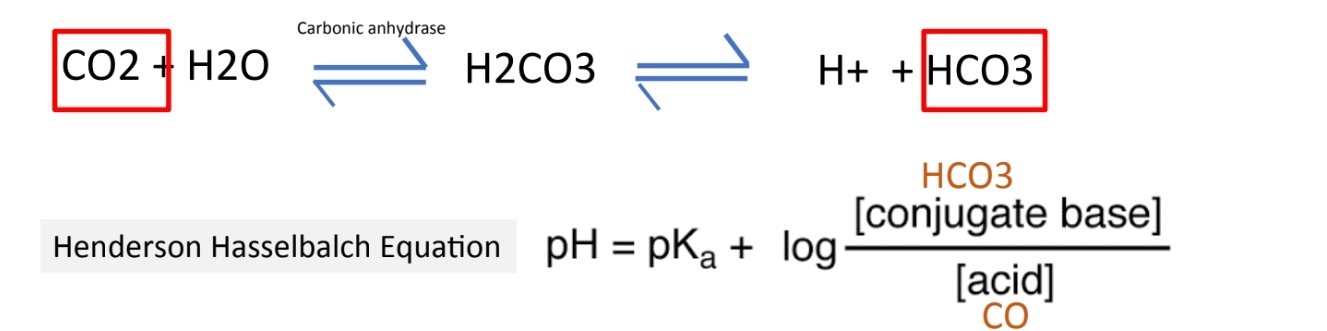
Image occlusion: name the hidden labels
17
Image occlusion: name the hidden labels
18
Image occlusion: name the hidden labels
19
Image occlusion: name the hidden labels
20
Image occlusion: name the hidden labels
21
Mechanisms to Control Acid-Base Balance
Chemical Buffering
Respiratory Regulation
Renal Regulation
Respiratory Regulation
Renal Regulation
22
Chemical Buffering
• Intracellular: proteins (albumin, globulins), phosphate
• Extracellular: bicarbonate, phosphate, ammonia, proteins
• Immediate effect (within minutes)
• Extracellular: bicarbonate, phosphate, ammonia, proteins
• Immediate effect (within minutes)
23
Respiratory Regulation
• Adjust $CO_2$ excretion (increase or decrease $PCO_2$)
• Over minutes to hours
• Over minutes to hours
24
Renal Regulation
• Adjust $HCO_3$ - excretion and reabsorption
• Over hours to days
• Over hours to days
25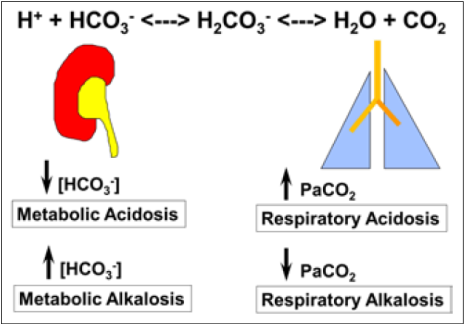
Image occlusion: name the hidden labels
26
Image occlusion: name the hidden labels
27
Image occlusion: name the hidden labels
28
Image occlusion: name the hidden labels
29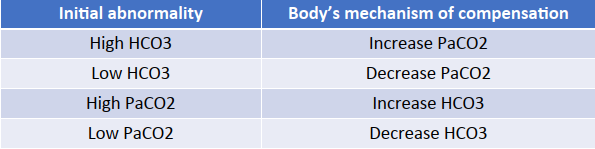
Image occlusion: name the hidden labels
30
Image occlusion: name the hidden labels
31
Image occlusion: name the hidden labels
32
Image occlusion: name the hidden labels
33
Metabolic acidosis
the arterial pH is less than 7.35 and serum bicarbonate concentration ([HCO3−]) is less than 22 mEq/L
34
Metabolic Alkalosis
the arterial pH is greater than 7.45 and serum [HCO3−] is greater than 26 mEq/L
35
Respiratory Acidosis
if the arterial pH is less than 7.35 and partial pressure of carbon dioxide (PCO2) is > 45 mm Hg (PaCO2 is high, ie. Hypoventilation)
36
Respiratory Alkalosis
If the arterial pH is greater than 7.45 and PCO2 is less than 35 mm Hg (PaCO2 is low, ie hyperventilation)
37
An acidosis or alkalosis may occur even when...
pH is in the normal range
38
Winter's Formula
only used in metabolic acidosis
$Expected pCO_2 = 1.5 x HCO_3 + 8 ∓ 2$
$Expected pCO_2 = 1.5 x HCO_3 + 8 ∓ 2$
39
Compensation
A primary metabolic disorder will result in respiratory compensaion
A primary respiratory disorder will result in metabolic compensation
Compensation does not return pH to normal
Patients never overcompensate
A primary respiratory disorder will result in metabolic compensation
Compensation does not return pH to normal
Patients never overcompensate
40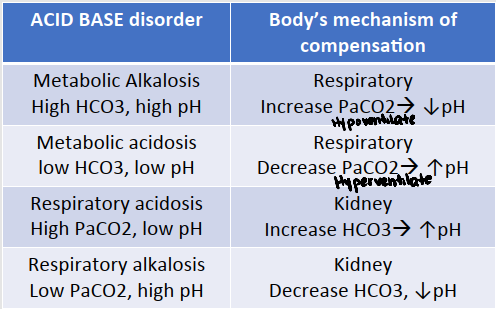
Image occlusion: name the hidden labels
41
Image occlusion: name the hidden labels
42
Image occlusion: name the hidden labels
43
Image occlusion: name the hidden labels
44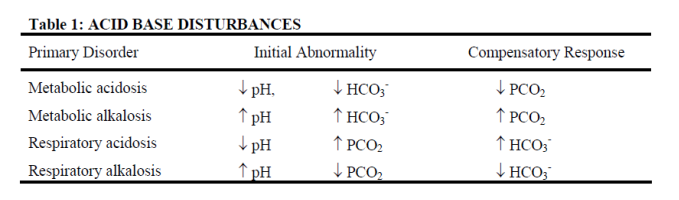
Image occlusion: name the hidden labels
45
Anion Gap
is the difference between extracellular cations and anions in the blood
$AG=Na^+ - (Cl^- + HCO_3)$
$AG=Na^+ - (Cl^- + HCO_3)$
46
Causes of AG Metabolic Acidosis
• Methanol
• Uremia
• DKA
• Paraldehyde
• Isoniazid, Iron, Ibuprofen (massive OD)
• Lactic acidosis (most common)
• Ethylene glycol
• Salicylates
• Uremia
• DKA
• Paraldehyde
• Isoniazid, Iron, Ibuprofen (massive OD)
• Lactic acidosis (most common)
• Ethylene glycol
• Salicylates
47
Delta Gap
$(AG-12)/(24-HCO_3^-)= DG$
48
Osmolal Gap
If the anion gap is elevated, consider calculating the osmolal gap in compatible clinical situations
• Elevation in AG is not explained by an obvious case (DKA, lactic acidosis, renal failure)
• Toxic ingestion is suspected!!
• Elevation in AG is not explained by an obvious case (DKA, lactic acidosis, renal failure)
• Toxic ingestion is suspected!!
49
Non-Anion Gap Metabolic Acidosis
AG = < 12 (NAGMA)
H = hyperchloridemia/ hyperalimenta on (e.g., starting TPN).
A = acetazolamide use (causes loss of HCO3 by kidneys)
R = renal tubular acidosis
D = diarrhea (loose HCO3)
U = uretosigmoid fistula (because the colon will waste bicarbonate).
P = pancreatic fistula (because of alkali loss–the pancreas secretes a
bicarbonate-rich fluid)
H = hyperchloridemia/ hyperalimenta on (e.g., starting TPN).
A = acetazolamide use (causes loss of HCO3 by kidneys)
R = renal tubular acidosis
D = diarrhea (loose HCO3)
U = uretosigmoid fistula (because the colon will waste bicarbonate).
P = pancreatic fistula (because of alkali loss–the pancreas secretes a
bicarbonate-rich fluid)
50
Metabolic Acidosis Treatment
• Correct underlying disorder
• Give sodium bicarbonate (only in severe cases)
Who gets sodium bicarbonate?
• Only in severe metabolic acidosis when pH < 7.15
• Toxin excretion
• Life-threatening hyperkalemia
Why doesn’t everyone get it?
• Worsen intracellular acidosis through CO2 production
• Overcorrection
• Hypernatremia or hypokalemia
• Alteration of O2-Hgb dissociation
• Give sodium bicarbonate (only in severe cases)
Who gets sodium bicarbonate?
• Only in severe metabolic acidosis when pH < 7.15
• Toxin excretion
• Life-threatening hyperkalemia
Why doesn’t everyone get it?
• Worsen intracellular acidosis through CO2 production
• Overcorrection
• Hypernatremia or hypokalemia
• Alteration of O2-Hgb dissociation
51
Chloride Responsive Metabolic Alkalosis
low urine chloride (<10 mEq/L) are those that have chloride-responsive alkalosis,
52
Chloride Unresponse Metabolic Alkalosis
normal or high urine chloride (>10 mEq/L) have chloride unresponsive alkalosis
53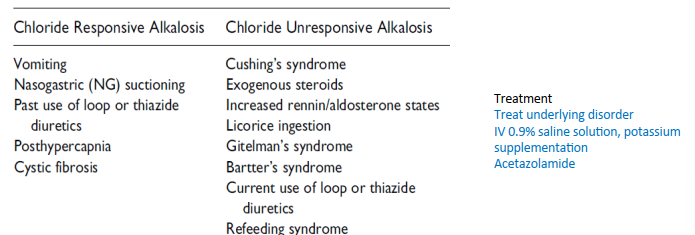
Image occlusion: name the hidden labels
54
Image occlusion: name the hidden labels
55
Image occlusion: name the hidden labels