LEC 12 BIOL 431
Study these flashcardsFree · spaced repetition · iPhone, Android, Mac & web
All cards
1
What is the functional residual capacity? (FRC)
amount of air left in lung after tidal expiration
2
What is the inspiration capacity? (IC)
Amount of air that can be inhaled after tidal expiration
(TV)500+(IRV)3100=3600mls
(TV)500+(IRV)3100=3600mls
3
What is the vital capacity? (VC)
Max air exhaled after max inhibition
(TV)500+(IRV)3100+(ERV)1200=4800mls
(TV)500+(IRV)3100+(ERV)1200=4800mls
4
What is the total lung capacity? (TLC)
Sum of all volumes
(TV)500+(IRV)3100+(ERV)1200+(RV)1200= 6000mls
(TV)500+(IRV)3100+(ERV)1200+(RV)1200= 6000mls
5
What are the 4 capicities?
Total lung capacity
vital capacity
inspiratory capacity
functional residual capacity
vital capacity
inspiratory capacity
functional residual capacity
6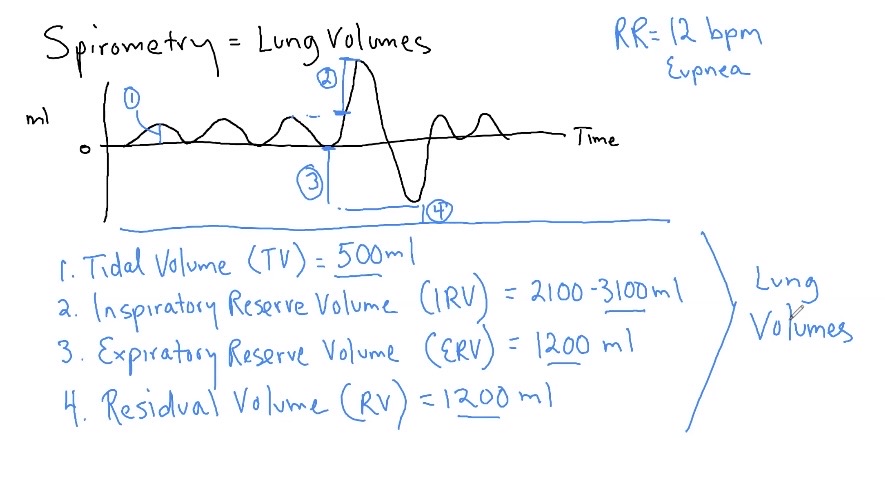
Name 1 - 4 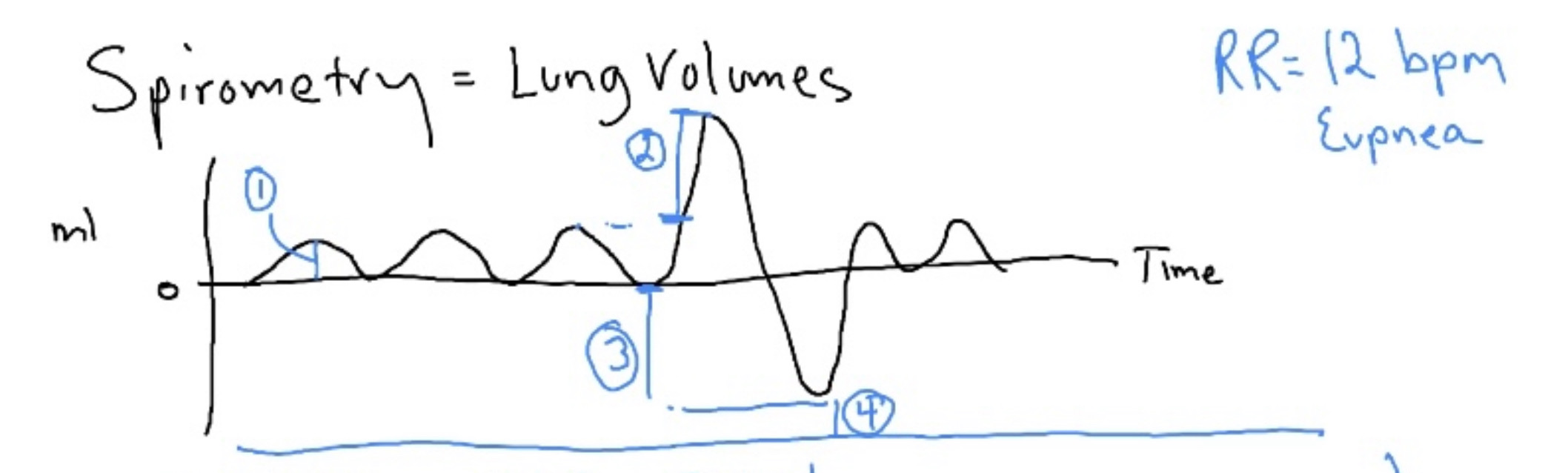
7
What is the residual volume?
Vol of air left in lung event after forced exhalation
=1200mls
prevents collapse of aveolis
=1200mls
prevents collapse of aveolis
8
What is the expiratory reserve volume?
Remain ari which can be forced out after quiet expiration
1200ml + 500 (TV) out
1200ml + 500 (TV) out
9
What is the inspiration reserve volume?
Deep inhale beyond norm m
tv=2100-3100 additional tp the 500mls
tv=2100-3100 additional tp the 500mls
10
What is the tidal volume?
Vol of 1 breath in and out
@ rest typically 500mls
@ rest typically 500mls
11
What are the 4 volumes?
Tidal volumes
inspiratory reserve vol
expiratory reserve volume
residual volume
inspiratory reserve vol
expiratory reserve volume
residual volume
12
What are 3 factors that influence pulmonary ventilation?
1 resistance =smaller airway has more resistance
2 surface tension = nature of water is sticky which would cause collapse - surfactant prevents this
3 compliance - elasticity of lungs / ability of thoracic cavity to expand
2 surface tension = nature of water is sticky which would cause collapse - surfactant prevents this
3 compliance - elasticity of lungs / ability of thoracic cavity to expand
13
What structures are used in forced exhalation?
Abdominal and intercostal muscles contract > rib compression > organ compression > forcing diaphragm upward
14
What structures are required for quiet expiration ?
Diaghram relaxes beginning to form dome > increases pressure on lungs > causing exhale
15
What structures are used during forced inspiration?
Sternocleiodmastoid > scalenes > upper 2 ribs
16
What happens structurally when we breath quietly
Diaghram flattens > ext intercostal contracts ( lift rib cage) > Icreases thoracic cav volume > increasing lung volume
causes drop in Palv by 1 mmHg
causes drop in Palv by 1 mmHg
17
What are the 2 forms of Inspiration ?
quiet
forced - exercise or pulmonary disease (COPD)
forced - exercise or pulmonary disease (COPD)
18
What is pulmonary ventilation?
Mechanical process that relies in change in volume of the thoracic cavity
19
What foes intrapulmonnaury pressure read? Palv
Pressure of alveoli’s
Increas in volume = 758mmHg
decrease in volume = 762mmHg
Increas in volume = 758mmHg
decrease in volume = 762mmHg
20
What do posite, negative, and zero respiratory pressure mean ?
Negatibe = below 760mmhg
positive = above
zero = @ 760 mmHg
positive = above
zero = @ 760 mmHg
21
What is Respiratory pressure?
1atm = 760mmhg @ sea level
decreases by .5atm= 18K feet above sea level
increase by 1 atm @ 33 ft under sea level
decreases by .5atm= 18K feet above sea level
increase by 1 atm @ 33 ft under sea level
22
What are the 2 phases of breathing?
inspiration
expiration
expiration
23
What is the intrapleural pressure? (PIP) what are the 2 forces?
always around Palv - 4 = Pip mmHg
1. elastic fibers shrinking the lung
2. outward expansion of the rib cage
1. elastic fibers shrinking the lung
2. outward expansion of the rib cage
24
What is the respiratory membrane and what are some complications ?
Area of gas exchange between the lung and blood
complication = if fluid fills area causes reduction in gas exchange leading to shortness in breath and build up of CO2
complication = if fluid fills area causes reduction in gas exchange leading to shortness in breath and build up of CO2
25
What are the 4 parts of the respiratory membrane
Type 1 alveolar cells
fused lamina basal
capillary endothelium
Type 2 alveolar cell
fused lamina basal
capillary endothelium
Type 2 alveolar cell
26
What are the alveolar pores?
Communiaction between alveoli
also was air pressure to =ize in all
provides alternate air route to alveoli in case collapse bronchioles
also was air pressure to =ize in all
provides alternate air route to alveoli in case collapse bronchioles
27
What is the type 1 alveolar cell made out of and what happens here?
Simple squamous epithelial
point at which gas exchange occurs
point at which gas exchange occurs
28
What is capillary endothelium made out of and what role does it function ?
simple squamous epithelial
gas diffusion
gas diffusion
29
What is the function of Type 2 alveolar cells?
Secrecte fluid to keep resp membrane moist
Produces surfactant
Produces surfactant
30
What are dust cells?
Alveolar macrophages
wondering phagocytes that clean dust and Debri from alveoli’s
wondering phagocytes that clean dust and Debri from alveoli’s