BIOL 431 - LEC 3
Study these flashcardsFree · spaced repetition · iPhone, Android, Mac & web
All cards
1
What are the 2 parts of the myocardium muscle? and there %?
Intrinsic conduction system ( 1%), Contractile tissue (99%)
2
What is the Intrinsic conduction system? and what is its function?
specialized cardiac muscle that doesn’t rely on NS for stim, can beat w/o nerve impulse, NS modifys intrinsic pace of heart (stim = increase in HR)
3
Whatis the contractile tissue? and What is its function?
Stable resting membrane (needs stim from NS to fire), 2 sources for Ca2+, contraction is 250msec, refractory is 250msec, function = self excitatory results in pacemaker potential
4
What is the automatic and autorythmic systems?what is the function?
rely on presence of gap junction for coordination, non contractile tissue ( few myo-filaments actin/myosin, function = Disttributes impulses (AP) throughout heart in orderly & sequential fashion, Starts at atria and moves to ventricles
5
What is the unstable resting membrane potential?
Found in auto0rythmic cells, results in them being self excitable ( can develop AP without stim), this constant depolarization = pacemaker potential
6
what is the pacemaker potential? And what causes this?
caused by increased Na permeability, membrane potential hits a certain point (+) = AP generated—> after repolarization Na again begins to leak —> repeats 75x/min at SA node
7
What is the chemical layout of the pacemaker potential?
Na leaks in while K+ usually leak out —> however k efflux is thought to decrease —> upsets charge balance across membrane —> depolarization —> threshold of -40mV reached —> voltage reg fast Ca gates open —> Ca rushes in from exytracellulr fluid —> greater depolarization —-> Ca responsible for final depoliration in auto rhythmic cells only —> repolarization occurs when k moves out.
8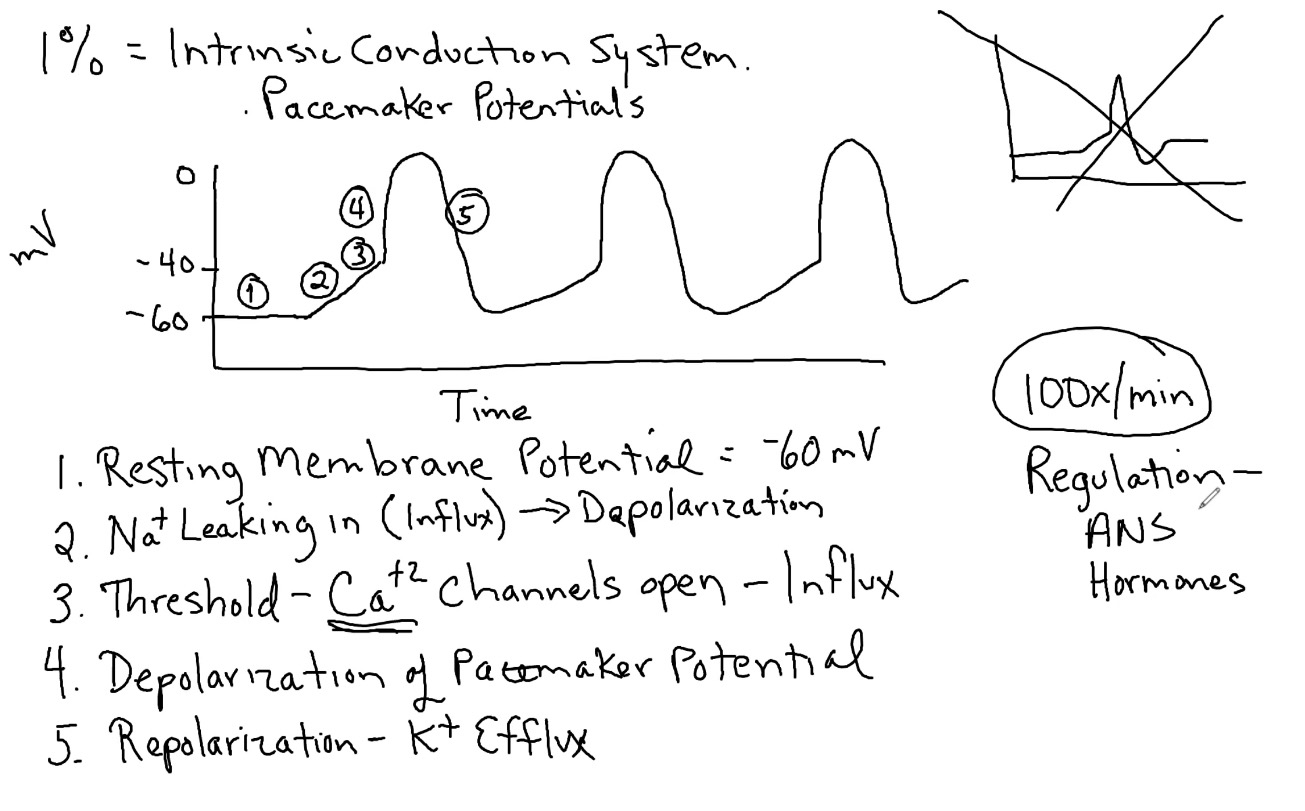
What happens at points 1-5?
9
What are the 5 sequences of excitation in order?
SA node (sinoatrial node), AV node (atrioventricular Node), Atrioventricular bundle, R & L bundle branches, Purkinje fibers
10
What is the sequence of excitation of the SA node? and location?
located in R atrium wall near superior vena cava, uncontrolled rate = 100bpm (fastest depolarization), w/ neuronal and hormonal influence 75 bpm, SA node set rate (pacemaker), This is known as sinus rythm
11
What is the sequence of excitation of the AV node? and location? and depolarization rate? *what is junctional rythm?
Once AP produced by SA node spreads over atria via gap junctions along the INTERNODAL pathway and stimulates AV node, Delay AP by 0.1 sec, located at base of interatrial septum, 50 bpm *occurs if AV becomes the pacemaker
12
What is the sequence of the excitation of the atrioventricular bundle? and location? and depolarization rate?
From AV node travels down bundle of his, From superior margin of interventricular septum, separates into 2 branches 1/2 way down, Depole rate = 30 bpm
13
What is the sequence of excitation of the R & L bundle branches? and location? and depolarization rate?
the branching of the bundle of his in the intervenvular septum, travel down toward apex, each cover walls evenly, depole rate = 30 bpm
14
What is the sequence of excitation of the Purkinje fibers? and location? and depolarization rate?
Emerge from bundle branches, barrel shaped cardiac muscle, enter myocardium @ apex, spread upward within ventricular walls —>passes into cells of myocardium to stim excitation of muscle cells —> AP then spreads via gap junction to neighboring cells —> contraction spreads from apex runs supeiorly in a wave towards atria. **total time for depolarization = 0.22 seconds from SA node to depole of last ventricular muscle cell
15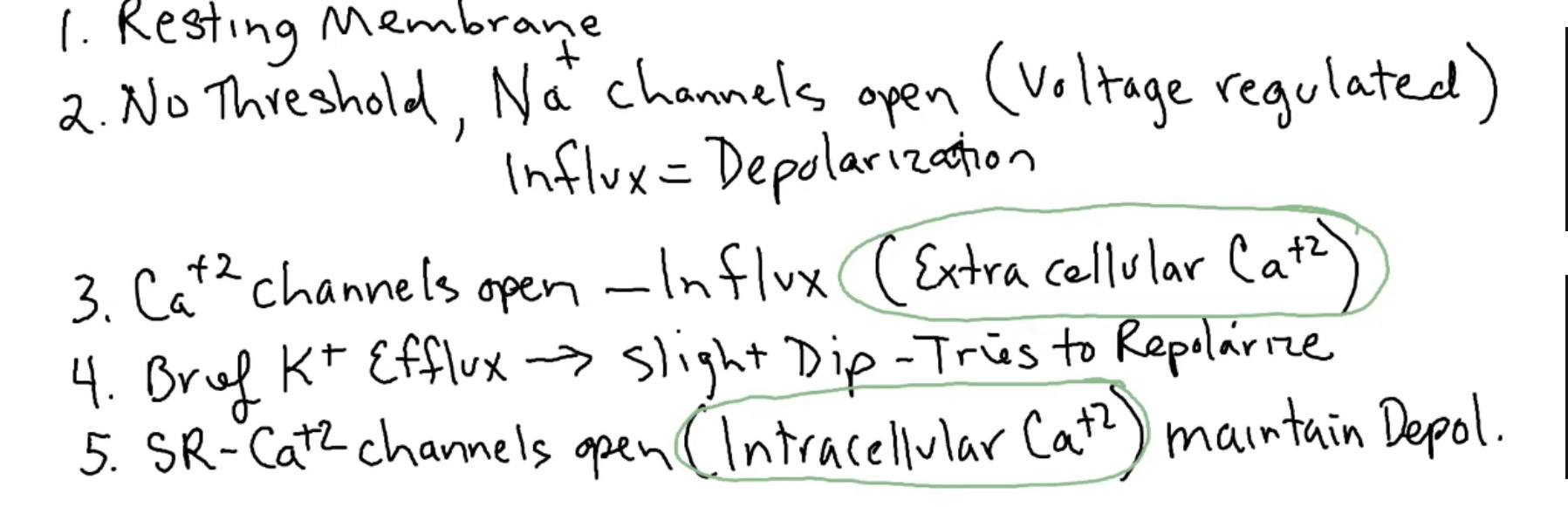
What happens at points 1-5?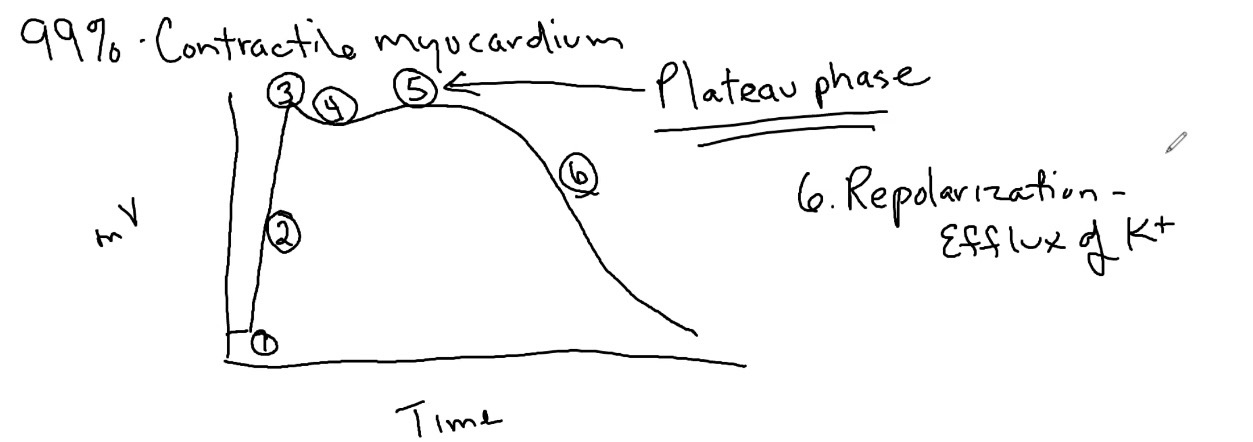
16
What are some facts about the contractile myocardium and its muscle contractions ?
stable resting membrane, sliding of filaments is = to skeletal muscle, Once stim by intrinsic conduction system Ca is released causing contraction, *in cardiac muscle Ca channels are in sarcolema (found in extracelulalr fluid (20%)) and sarcoplasmic reticulum (80%)
17
3 main parts of contractile myocardium?
Depoliration, Plateau, Repolorization
18
What happens during depolarization of the contractile myocardium?
normal resting potential = -90mV —> Voltage reg fast Na+ open —> perm of Na increases —> influx of Na —> rapid depole to +30mV —> Na channels close
19
What happens during plateau of the contractile myocardium?
Depole = slow Ca+ open in sarcolema —> perm of Ca increases —> Ca in cytosol stimulate initial contraction —> Ca entering cytosol also triggers openings of Ca gates in SR —> burst of Ca leading to extended contraction —> K+ perm decreases for 250msec —> time required for blood ejection from ventricles
20
What happens during repolarization of the contractile myocardium?
after delay voltage K+ open —> INcreas in K perm —> K efflux to outside cell —> Ca channels begin to close stopping influx of Ca —-> as K leaves cells become more (-)—> Na starts pumpmoing out before contraction terminates
21
What are 2 ways we can regulate HR and contarctility?
Autonomic NS, and Chemical regulation
22
What are the 2 ways the autonomic NS adjust the heart?
sympathetic NS & parasympathetic NS
23
What is the sympathetic NS role in adjusting heart rate and contractility?
cardiac accelerators nerves = centers located in medulla aoblongata —> pass down spinal chord to SA node, AV node, and myocardium —> norepinephrine is realeased —> binds to beta 1 receptors on cardiac muscle —> 2 effects: 1. SA & AV Node increases rate of spontaneous depole = increases HR, 2. increased perm of Ca in contractile fibers through voltage Ca = increased ejection blood volume during systole
24
What is the parasympathetic NS role in adjusting HR and contractility?
cardiac inhibitory center in Medulla, parasympathetic fibers travel down Vagus nerve to SA node an AV node and Atrium —> Acetycolene releasesed —> effects; hyperpolorization of SA & AV node -> stim of K+ gates = k released -> hyperpolorization = slower HR
25
What are the chemical hormones used to regulate HR?
Epinephrine, norepinephrine, thyroid hormones
26
What is the effect of epinephrine and norepinephrine on HR and Volume?
increase HR and volume similar to sympathetic, released from adrenal medulla during stress, excitement, excerise
27
What is the effect of thyroid hormones on HR?
Increases HR by increasing cell metabolism, symptoms of hyperthyroidism is tachycardia, hypothyroidism = bradycardia (low thyroid hormones)