Jack Sparrow Deck - Biological and Biochemical Foundations of Living Systems
Study these flashcardsFree · spaced repetition · iPhone, Android, Mac & web
First 300 of 6300 cards
1
what cues are taken into account when perceptually organizing?
depth, form, motion, constancy
2
what do binocular cues provide?
depth perception(due to retinal disparity)
Retinal disparity is defined as the way that your left eye and your right eye view slightly different images. ... Retinal disparity is important in gauging how far away objects are. The more difference (or greater disparity) between the image each eye has of the same object, the closer it is to you.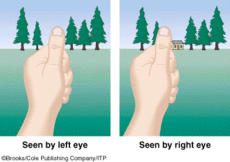
Retinal disparity is defined as the way that your left eye and your right eye view slightly different images. ... Retinal disparity is important in gauging how far away objects are. The more difference (or greater disparity) between the image each eye has of the same object, the closer it is to you.
3
what is convergence?
gives depth perception based on how much eyes are turned inward
4
what do monocular cues provide?
relative size
interpositon
relative height
shading/countour
motion (through motion parallax) - things farther away move slower, closer moves faster
constancy - perception of object doesn't change even if the image cast on the retina is diferent. size constancy, shape constancy, color constancy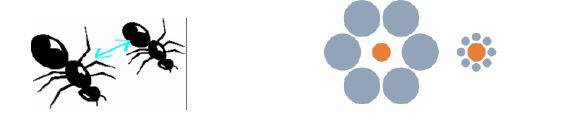
interpositon
relative height
shading/countour
motion (through motion parallax) - things farther away move slower, closer moves faster
constancy - perception of object doesn't change even if the image cast on the retina is diferent. size constancy, shape constancy, color constancy
5
how does your inner ear adapt to loud noises?
muscle contracts tympanic membrane to prevent damage
6
what is proprioception?
sense of "self in space"
7
what is just noticeable difference? (and what is the weird vocab)
threshold at which you can notice a change in sensation (50% of the time)
If you're inside/within\/below the JND threshold you CANT notice a difference, if you're outside/above the JND you CAN notice a difference
Remember JND threshold is plus or minus
If you're inside/within\/below the JND threshold you CANT notice a difference, if you're outside/above the JND you CAN notice a difference
Remember JND threshold is plus or minus
8
weber's law?
the ratio of background intensity to incremental intensity is constant
ΔI = Ik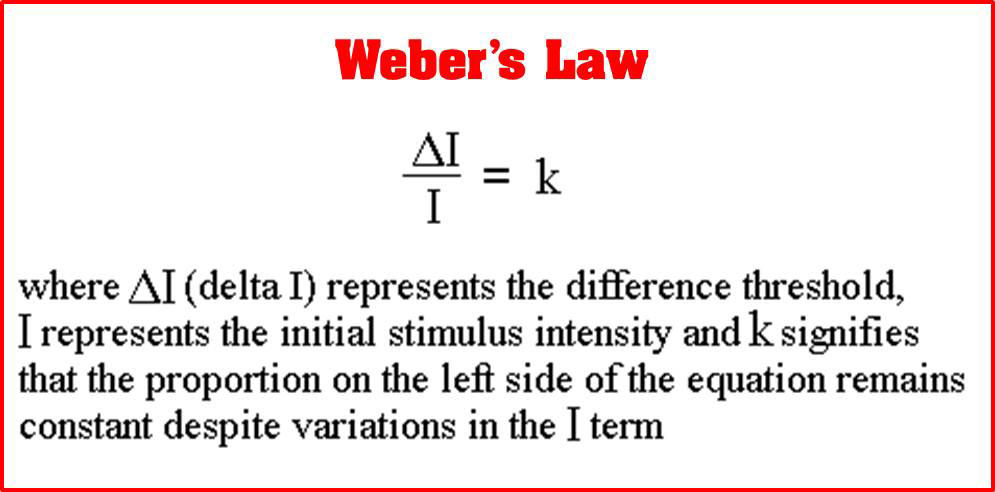
ΔI = Ik
9
what is absolute threshold of sensation?
minimum intensity of stimulus needed to correctly detect it 50% of the time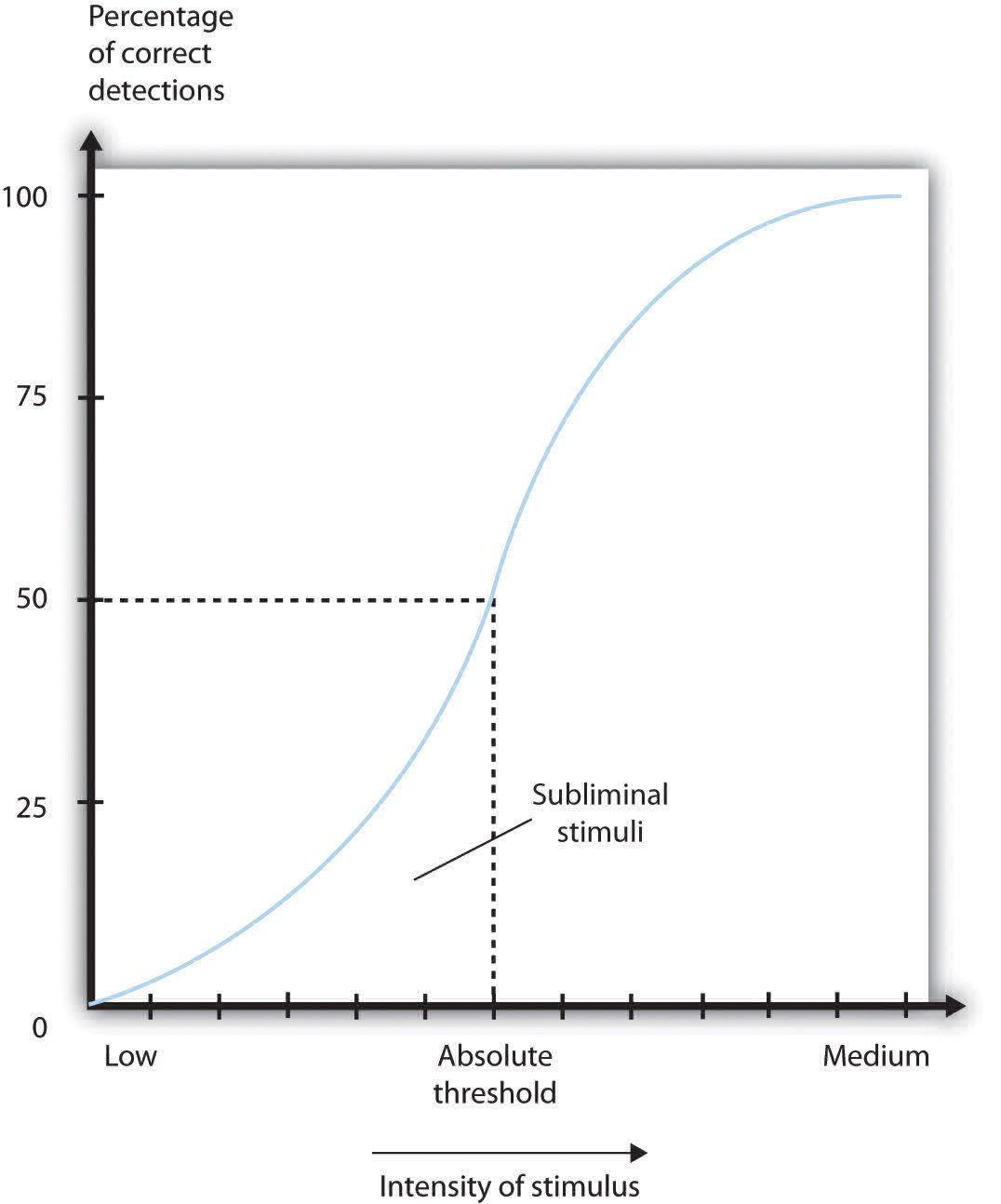
10
what is a subliminal stimulus?
stimulus that is just below our absolute threshold of sensation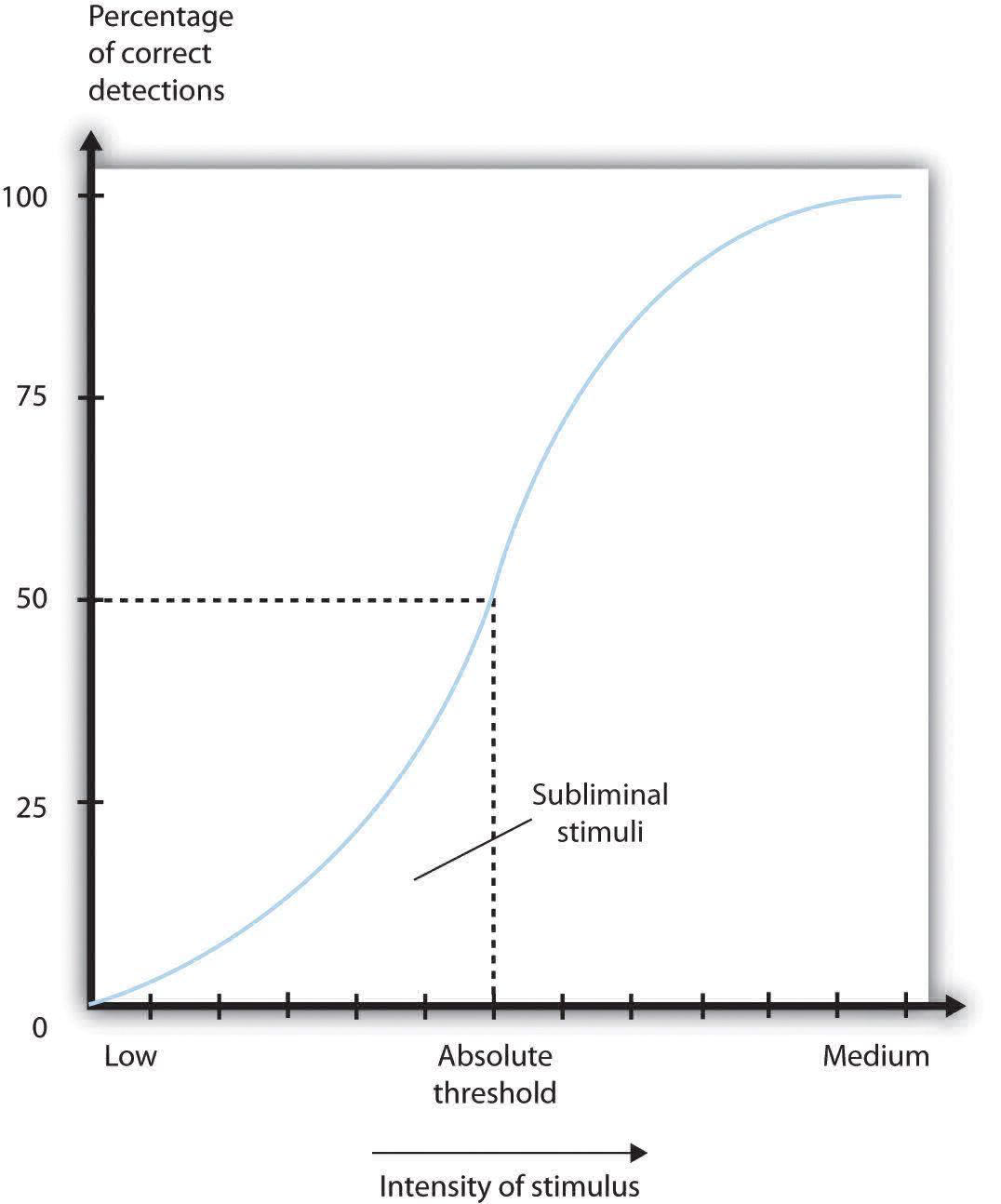
11
thermoception
temperature
12
mechanoception
pressure
13
nociception
pain
14
proprioception
position
15
non adapting neuron
neuron fires at constant rate
16
slow adapting neuron
neuron fires rapidly at first then tapers off
17
fast adapting neuron
fires as soon as stimulus starts, stops, then starts up again once stimulus stops
18
what portion of the inner ear helps determine strength of rotation/movement of head?
endolymph inside semicircular canals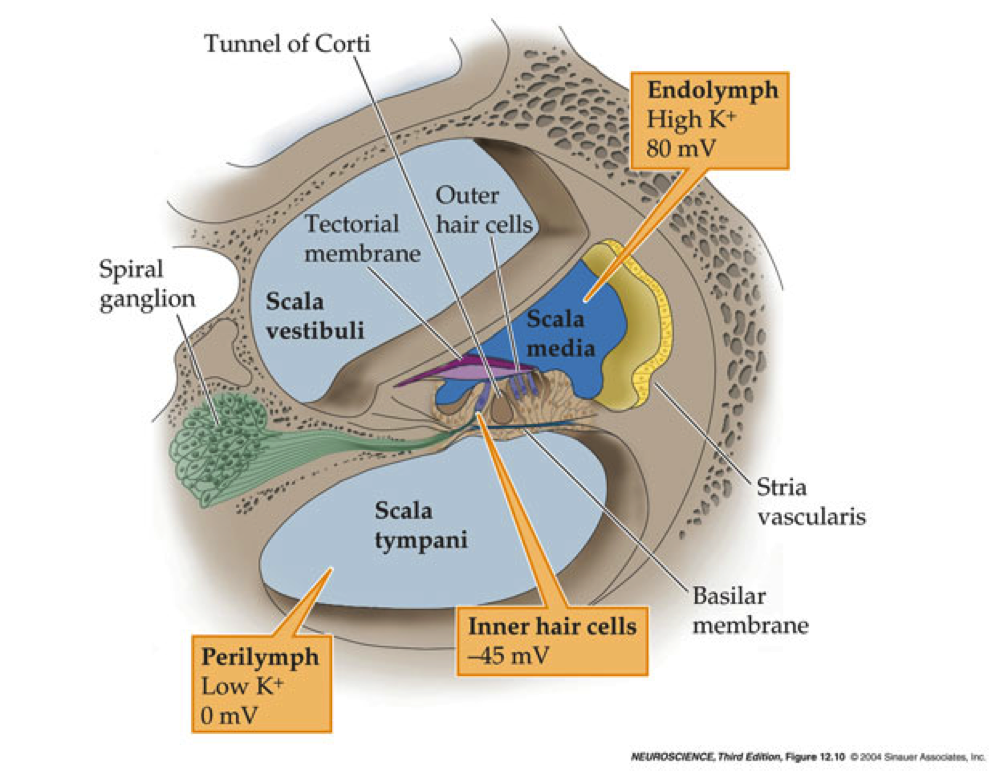
19
otolithic organs?
utricle and saccule
calcium carbonate crystals that drag hair cells with the help of gravity to determine linear acceleration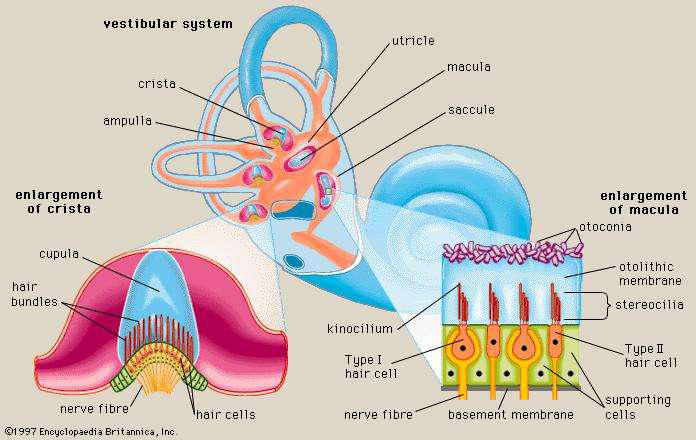
calcium carbonate crystals that drag hair cells with the help of gravity to determine linear acceleration
20
what is signal detection theory?
discerning between important and unimportant stimuli.
can have hit, miss, false alarm, or correct rejection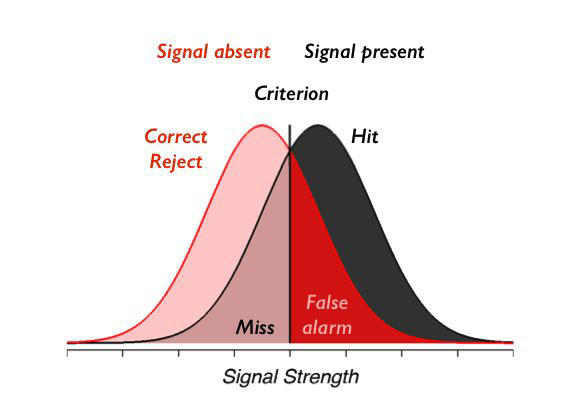
can have hit, miss, false alarm, or correct rejection
21
what is d' (d prime, signal detection theory)?
strength of a signal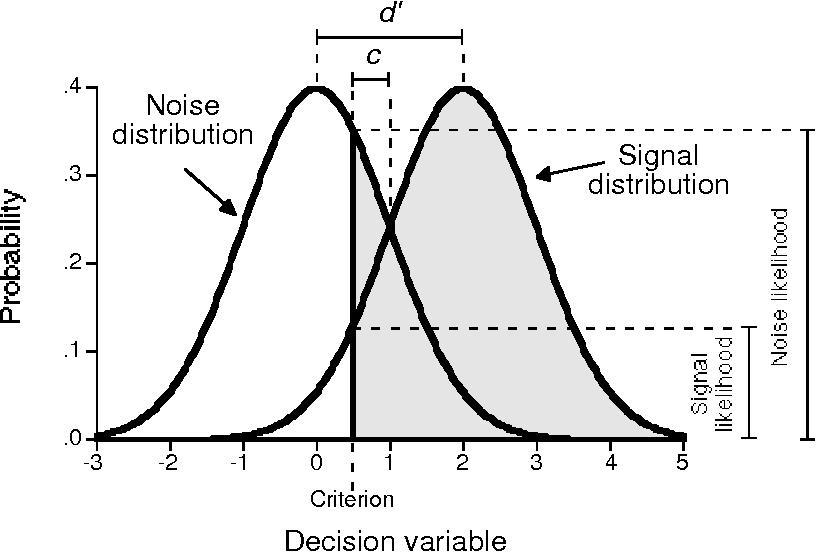
22
what is c (signal detection theory?)
strategy used
23
what is the liberal strategy (signal detection theory?)
always saying yes, youll get all the hits but might get false alarms
24
what is the conservative strategy? (signal detection theory)
always say no unless 100% sure, will correctly get all false rejections but might get some misses
25
what is bottom-up processing? accuracy level?
stimulus affects our perception, data driven (always right)
Details go to big picture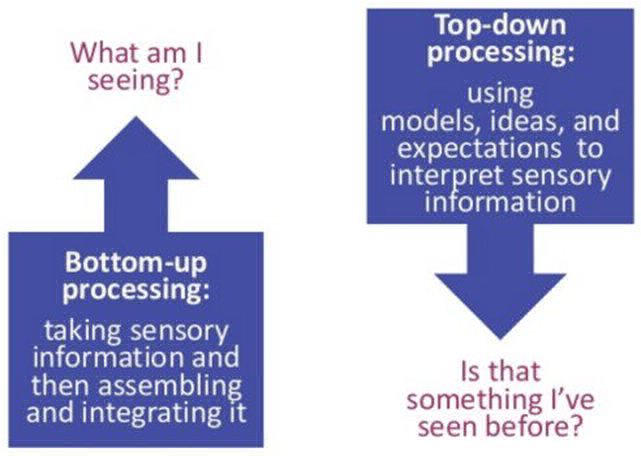
Details go to big picture
26
what is top-down processing?
uses background knowledge to influence perceptions (cube illusion). theory driven
theory down to detail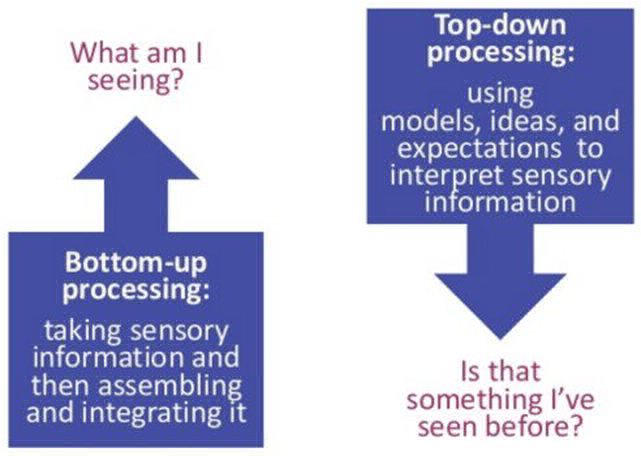
theory down to detail
27
what is gestalt's law of similarity?
items similar to one another grouped together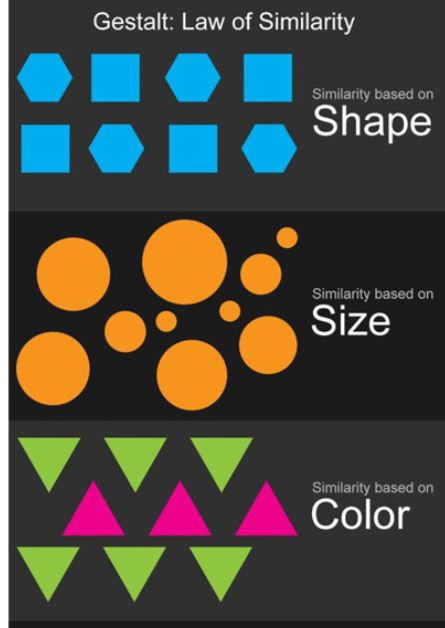
28
what is gestalt's law of pragnanz
reality reduced to simplest form possible (think, olympic rings). instead of seeing 5 rings you see olympic logo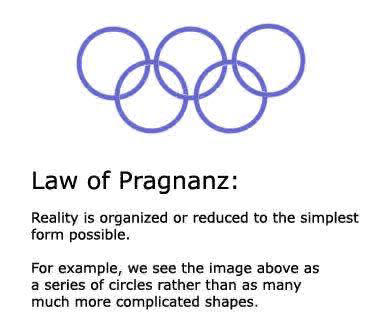
29
what is gestalt's law of proximity?
items that are close together are grouped together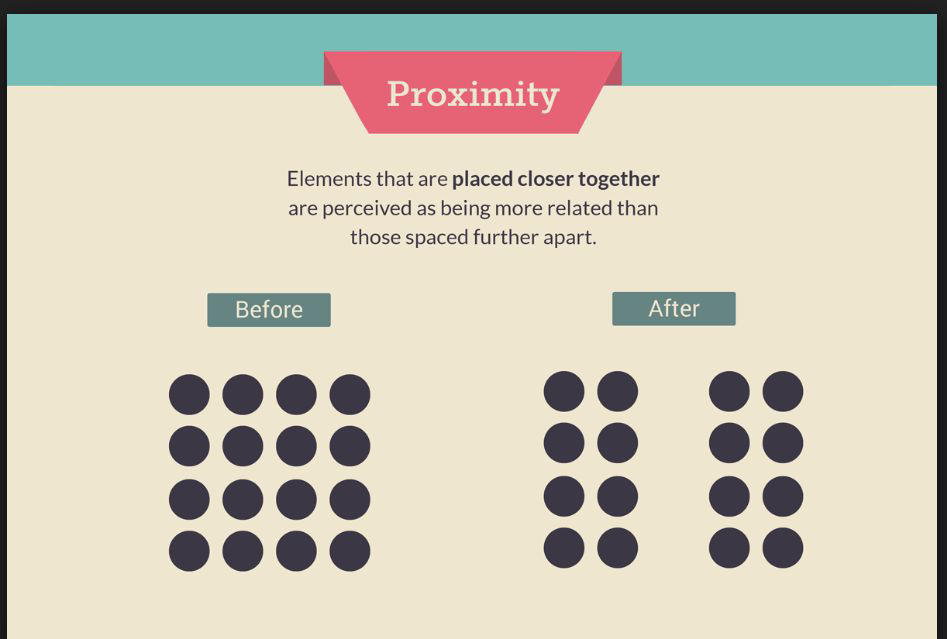
30
what is gestalt's law of continuity?
lines are seen as following smoothest possible path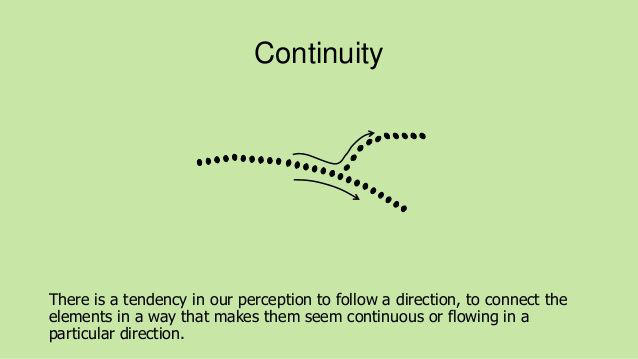
31
what is gestalt's law of closure?
objects grouped together are seen as whole (filling in a triangle where there is none, pacman shit)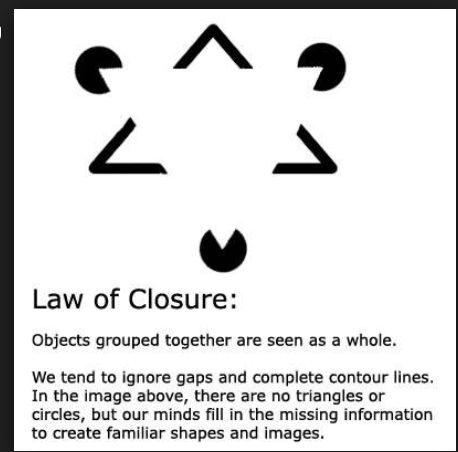
32
what is gestalt's law of symmetry?
you perceive symmetry in objects and forming around a central point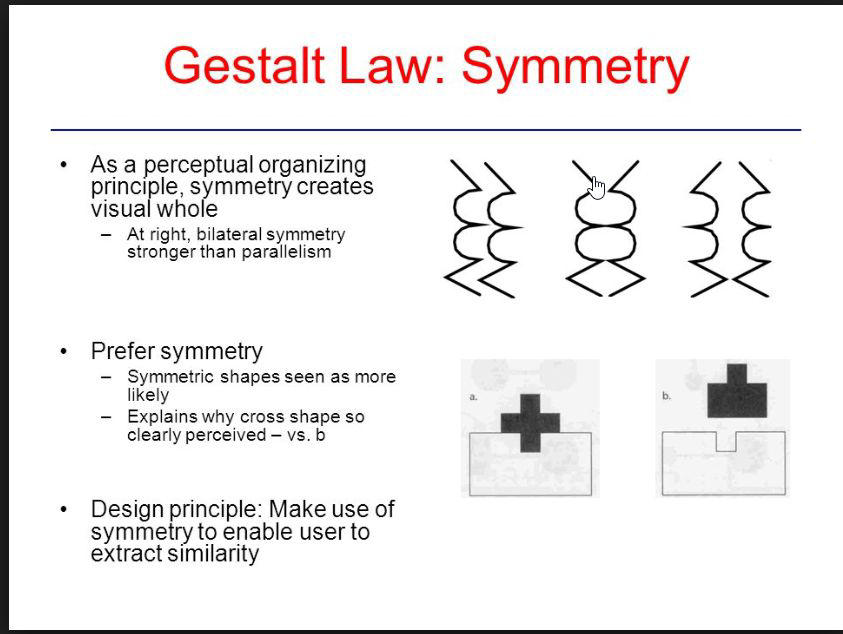
33
what is the conjunctiva?
thin layer of cells that line the inside of eyelids from the eye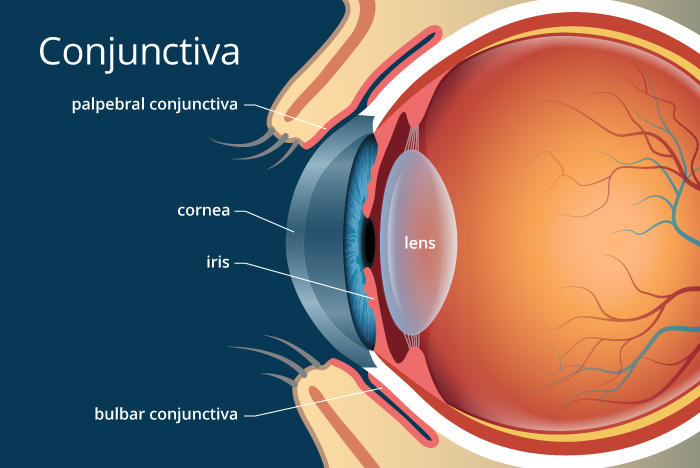
34
what is the cornea and its fxn?
covers over pupil, serves to bend light primarily.compose of thick connective tissue
anterior 1/6th
anterior 1/6th
35
what is the anterior chamber of the eye?
filled with aqueous humor - provides pressure to maintain shape of the eyball - allows nutrients and minerals to supply cells of cornea/iris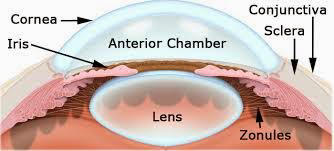
36
what is the aqeous humor?
composes the anterior chamber, provides support, in front of pupil
37
what is the pupil?
opening in middle of iris. opens and closes due to iris contraction.
38
what is the iris?
gives the eye color - muscle that constricts\/relaxes to change the size of the pupil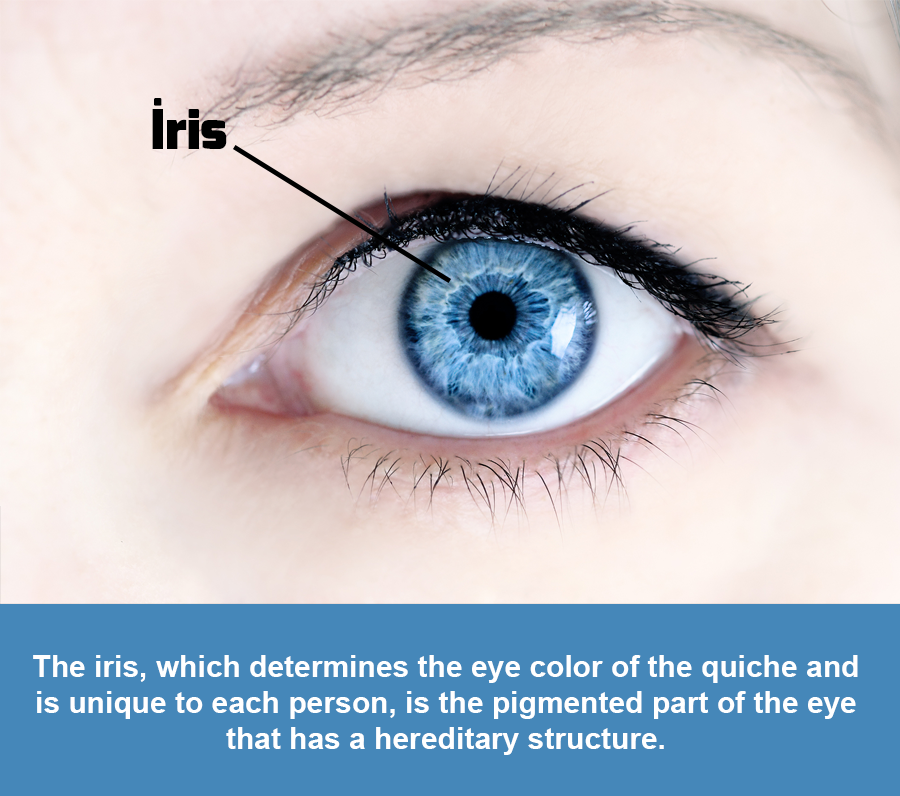
39
what is the lens of the eye?
located behind pupil, bends light towards fovea. changes shape based on suspentory ligaments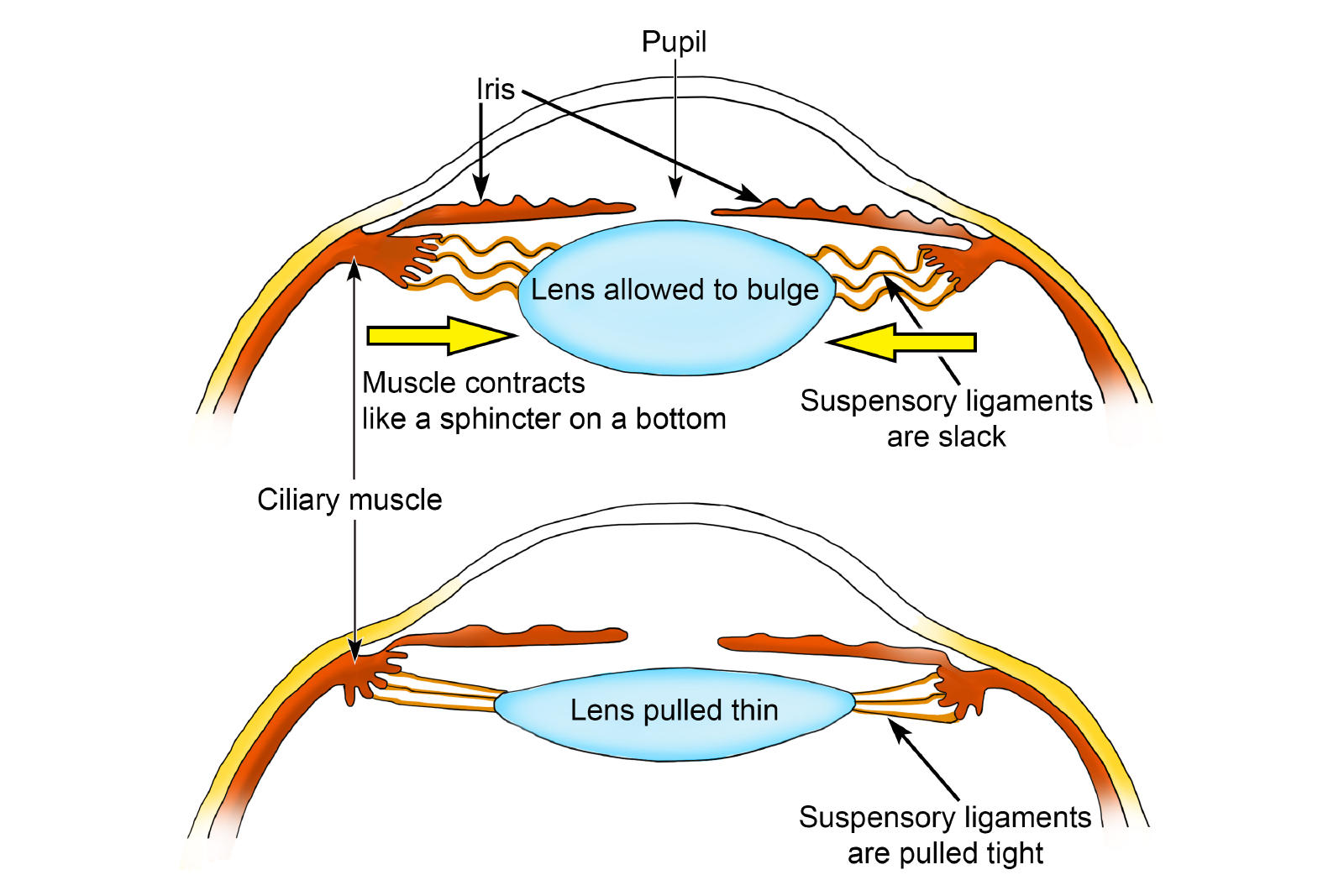
40
what is the ciliary body?
suspensory ligaments+ciliary muscle
41
what is the posterior chamber?
area between iris and lens, filled with aqueous humor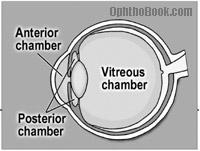
42
what is the vitreous chamber?
filled with vitreous humor, jelly like substance, gives pressure to eye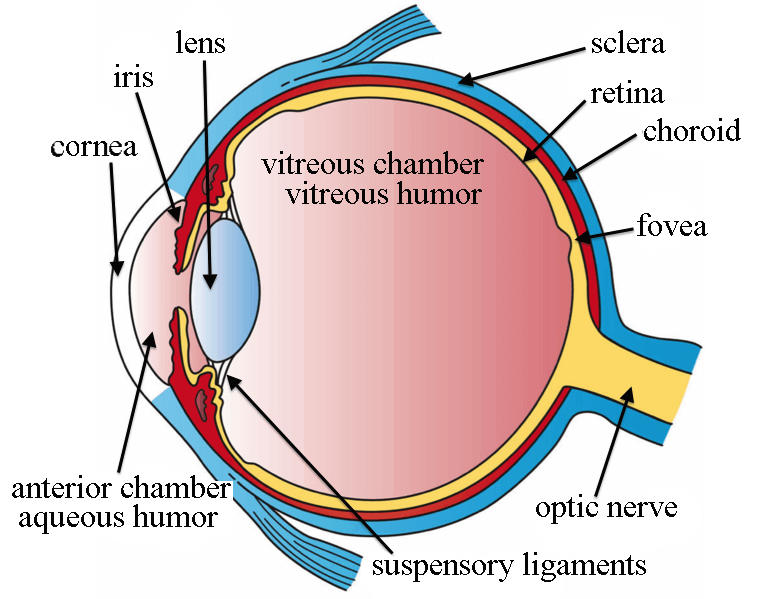
43
what is the retina?
covers back of eye, contains many of the necessary photoreceptors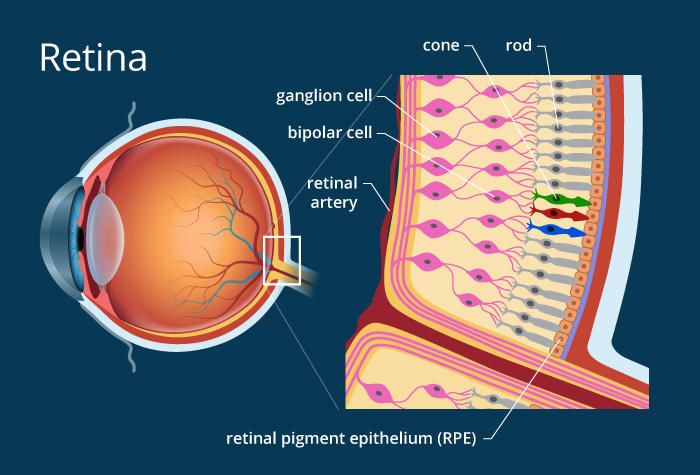
44
what is the macula?
area of retina with high cone density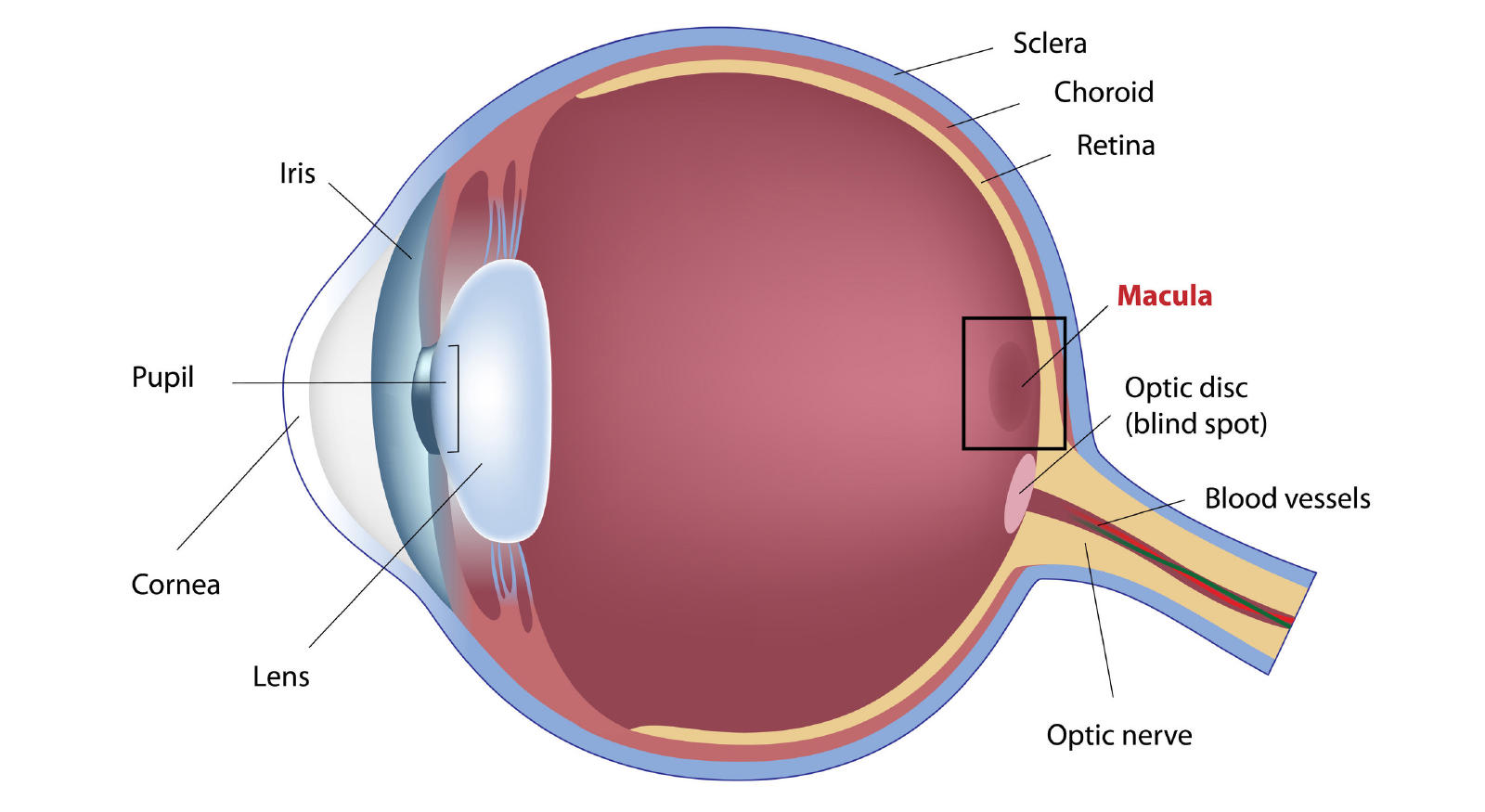
45
what is the fovea and why does it dimple in?
special part of macula that has ONLY cones. Dimples in so there are no axons in the way from light directly hitting cones (higher detail)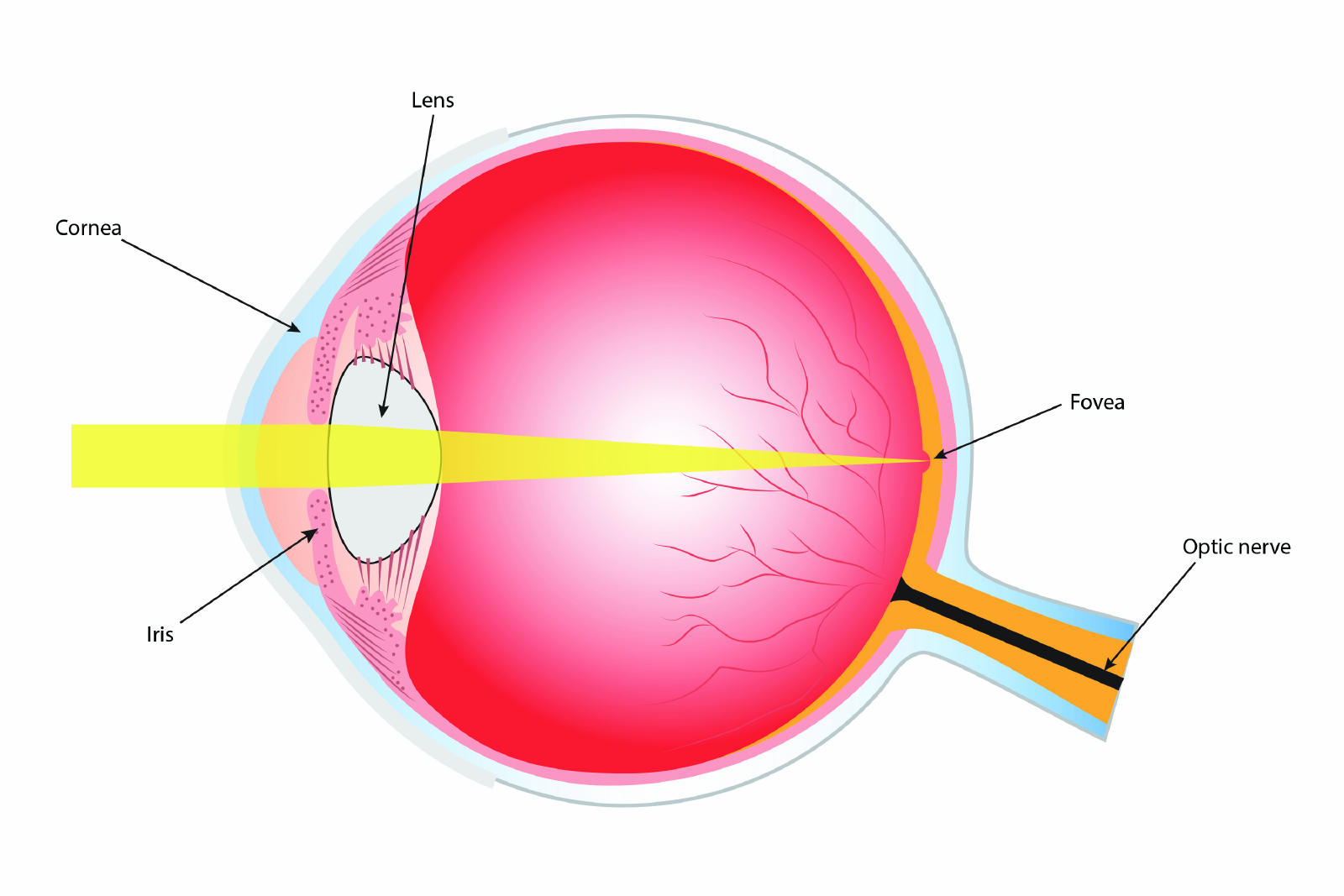
46
what do cones do?
detect color, high detailed shit
47
what do rods do
detect light, not as fine detail
48
what is the choroid?
black pigmented network of blood vessels used to nourish the eye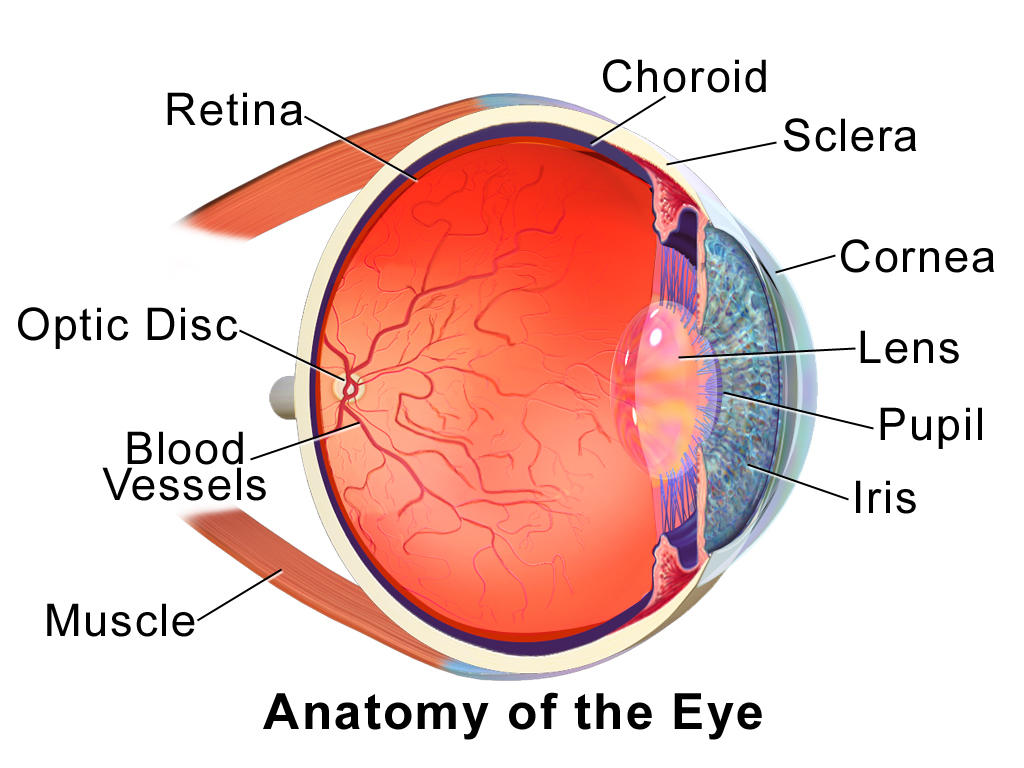
49
what is the sclera?
thick fibrous tissue covering posterior 5/6 of eye. (1/6 covered by cornea)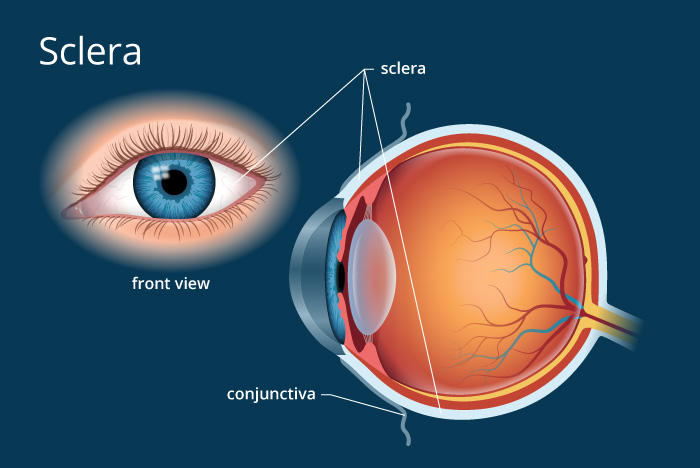
50
what happens when light hits a rod?
rod turned OFF-->bipolar cell turned ON-->retinal ganglion cell turned ON-->goes to brain
51
what happens to retinal when struck by light?
converts from cis-retinal to all trans retinal
52
what are the basic steps of the phototransduction cascade?
light hits retinal-->retinal changes conformation to trans-->rhodopsin protein changes conformation-->transducin released-->transducin binds to phosphodiesterase-->lower levels of cGMP-->Na+ channels close-->rod turns OFF (hyperpolarized)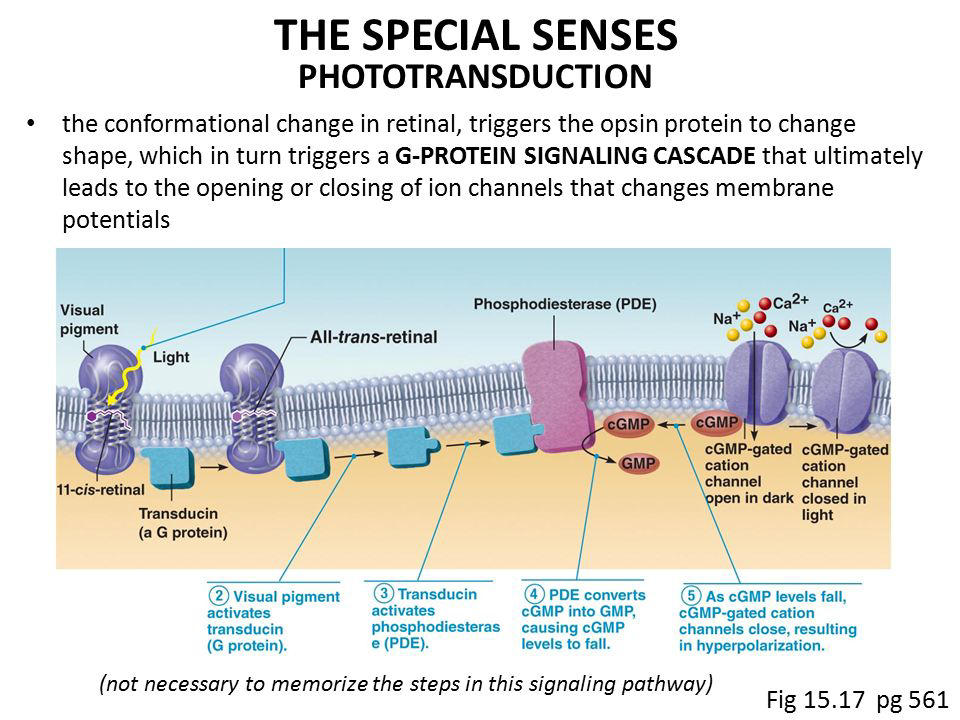
53
what are optic discs? (and alternate definition)
located inside rods/cones. contain proteins that fire APs to brain
also term for Blind spot??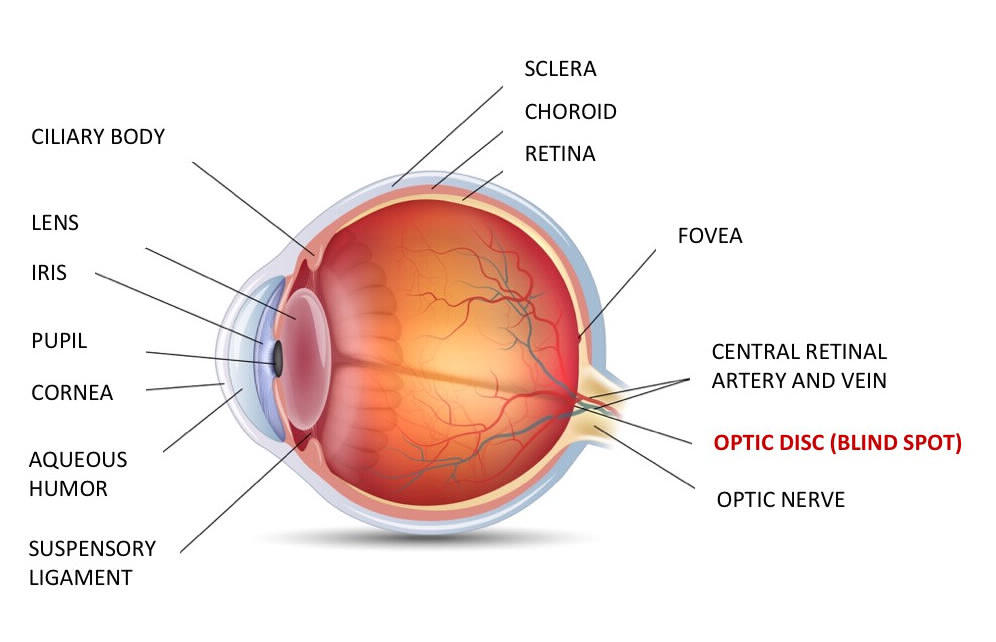
also term for Blind spot??
54
are there more rods or more cones?
more rods
20x more rods in each eye
20x more rods in each eye
55
rods are specialized for perceiving?
light vs dark, black vs white, very sensitive to light vision
56
rods have a very ___ recovery time compared to cones,
slow. which is why takes time to adjust to a dark room
57
cones are found primarily in the
fovea
60% red
30% green
10% blue
60% red
30% green
10% blue
58
there is a blind spot in the eye where
the optic nerve connects
59
why is there higher resolution at the fovea?
no axons in the way of light entering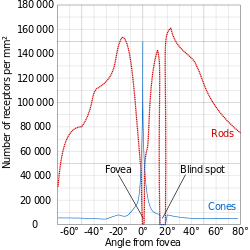
60
the right visual field goes to the __ side of the brain
left
61
light from the left visual field will strike..
the right temporal and left nasal retinas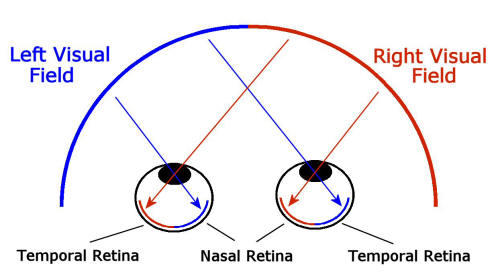
62
light from the right visual field will strike the
left temporal and right nasal retina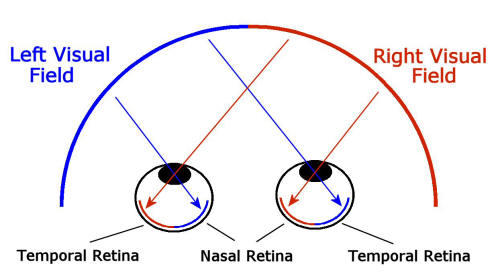
63
nerves from the nasal retinas cross over at the
optic chiasm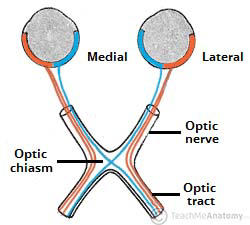
64
what are the 3 elements of feature detection? what sense is it used for?
color, form, motion
Feature detection involves the perceptual discrimination of specific aspects of a given stimulus via feature detectors. Feature detectors are specific neurons that preferentially fire in response to very specific stimuli.
Feature detection occurs for all the senses but is most often described regarding vision. Feature detectors in the visual system respond to aspects of the visual stimulus, such as horizontal lines or right angles (among others). The visual system is organized such that feature detectors synapse on neurons that respond to more complex stimuli (eg, faces) localized in certain areas of the brain (eg, fusiform face area)
EXCLUSIVELY VISION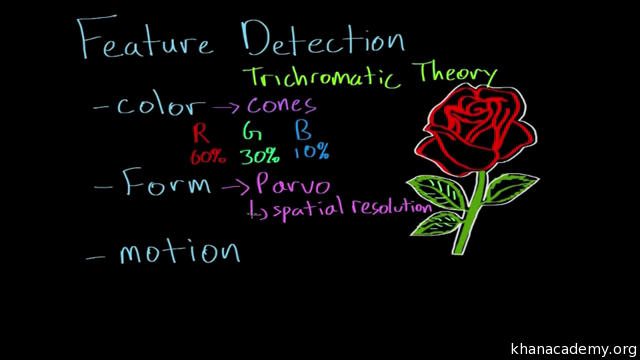
Feature detection involves the perceptual discrimination of specific aspects of a given stimulus via feature detectors. Feature detectors are specific neurons that preferentially fire in response to very specific stimuli.
Feature detection occurs for all the senses but is most often described regarding vision. Feature detectors in the visual system respond to aspects of the visual stimulus, such as horizontal lines or right angles (among others). The visual system is organized such that feature detectors synapse on neurons that respond to more complex stimuli (eg, faces) localized in certain areas of the brain (eg, fusiform face area)
EXCLUSIVELY VISION
65
what is the parvo(cellular) pathway?
form - spatial resolution, details, color - cones, bad at detecting motion
detects form and color, magno detects depth and motion
(ONLY STATIONARY - POOR TEMPORAL RESOLUTION - time)
mnemonic: pink pyramid (a type of "form"/"shape")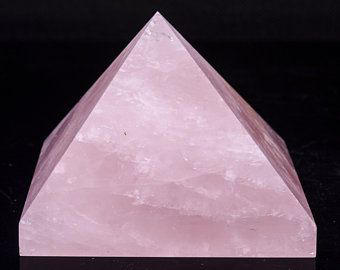
detects form and color, magno detects depth and motion
(ONLY STATIONARY - POOR TEMPORAL RESOLUTION - time)
mnemonic: pink pyramid (a type of "form"/"shape")
66
what is the magno(cellular) pathway?
good at detecting motion (and depth according to uworld), rods responsible
HIGH TEMPORAL resolution (think time, motion)
POOR SPATIAL - no color
RODS
mnemonic: picture magneto moving shit
HIGH TEMPORAL resolution (think time, motion)
POOR SPATIAL - no color
RODS
mnemonic: picture magneto moving shit
67
what is audition?
our sense of sound
68
what are the 2 things needed to perceive sound?
pressurized sound wave and hair cells in ear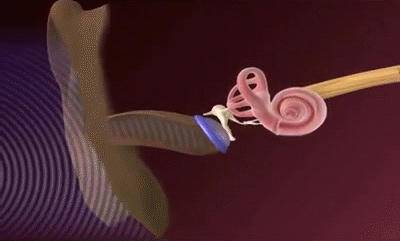
69
higher or lower wavelength penetrated deeper into cochlea?
higher wavelength, smaller frequency, travels further
70
what is the outer(visible) part of the ear known as?
pinna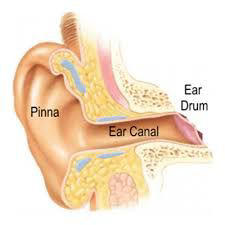
71
what are the 3 bones in the inner ear?
malleus, incus, stapes(hammer, anvil, stirrup). AKA ossicles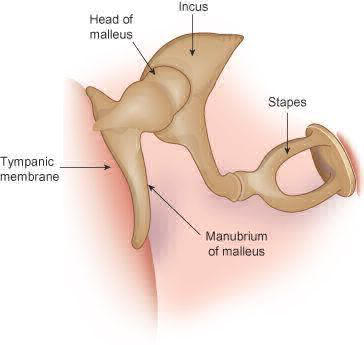
72
the stapes is attached to the ____
oval window, pushes in when vibrating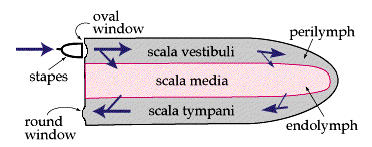
73
what is the function of the round window?
bulges out when fluid pushes against it
74
what is the organ of corti?
basilar membrane/tectonic membrane that divide cochlea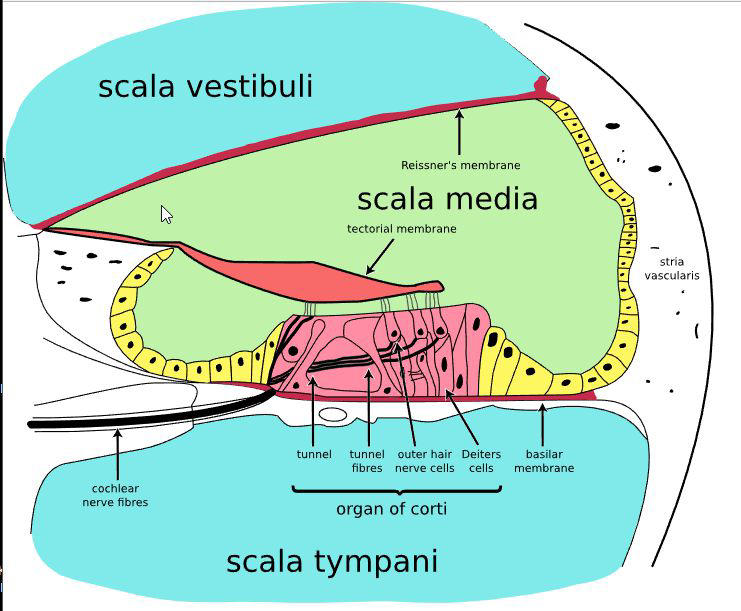
75
what portions of the ear are the outer ear?
from pinna --> TM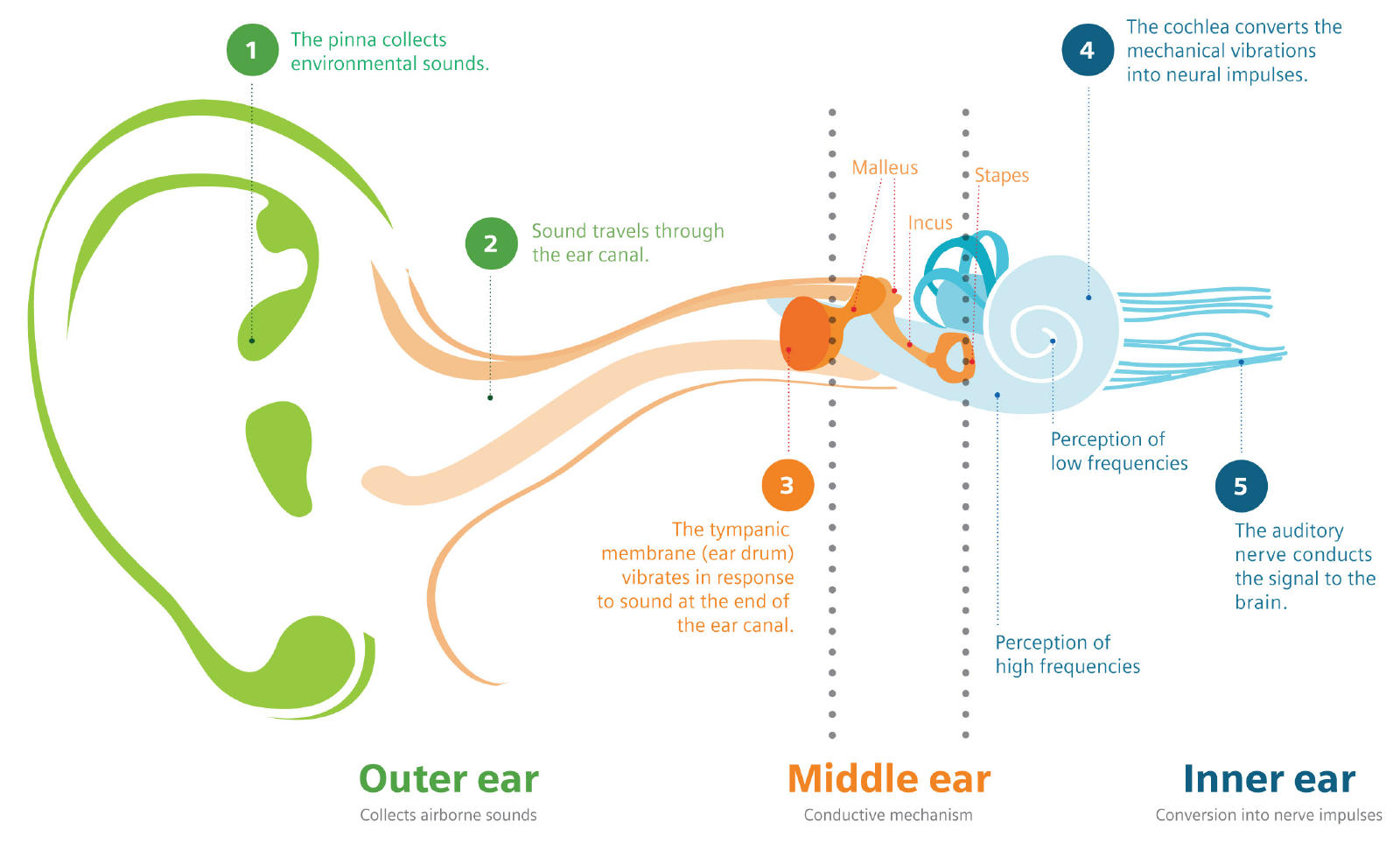
76
what portions of the ear are the middle ear?
where the ossicles are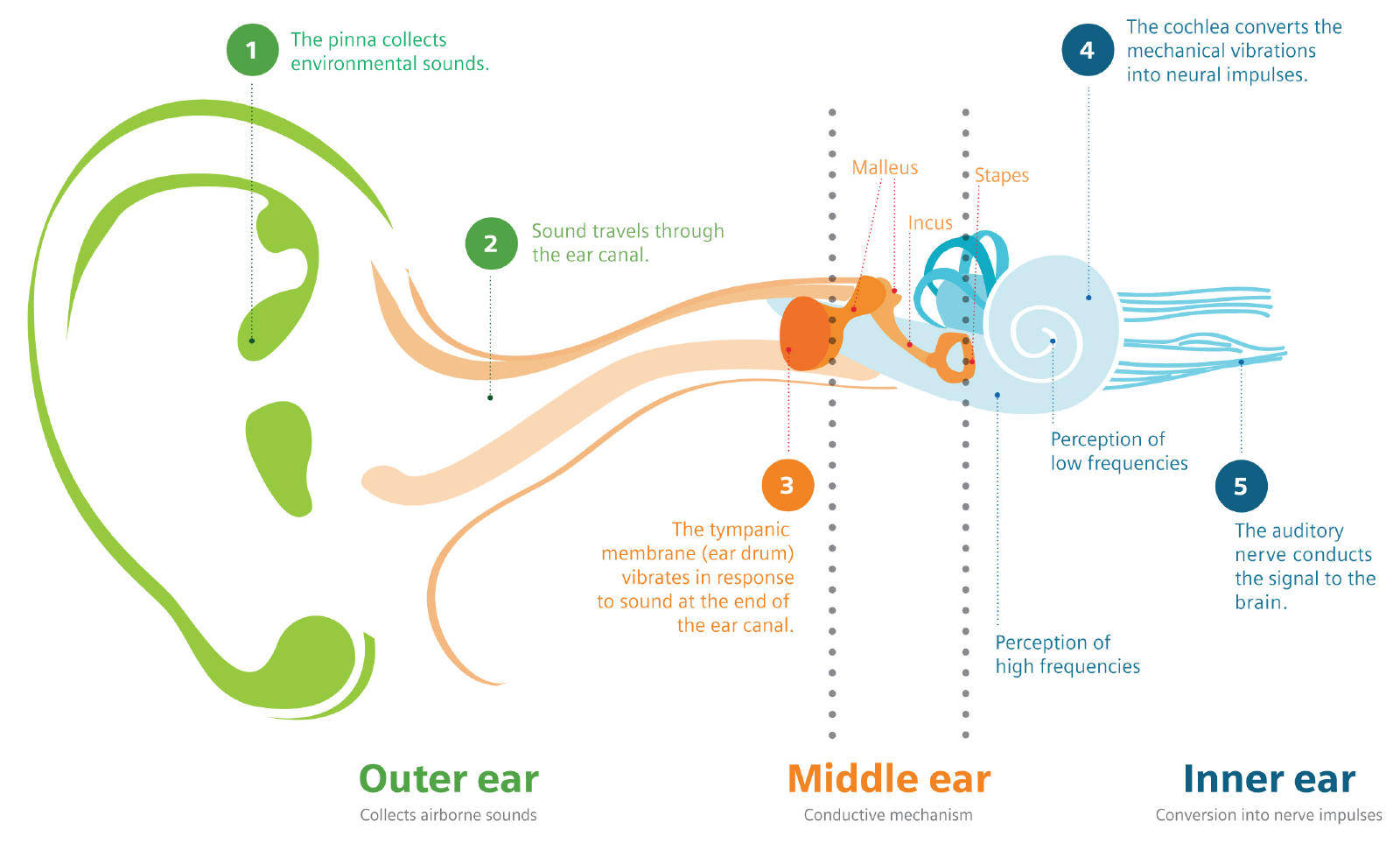
77
what portions of the ear are the inner ear?
the cochlea/semicircular canals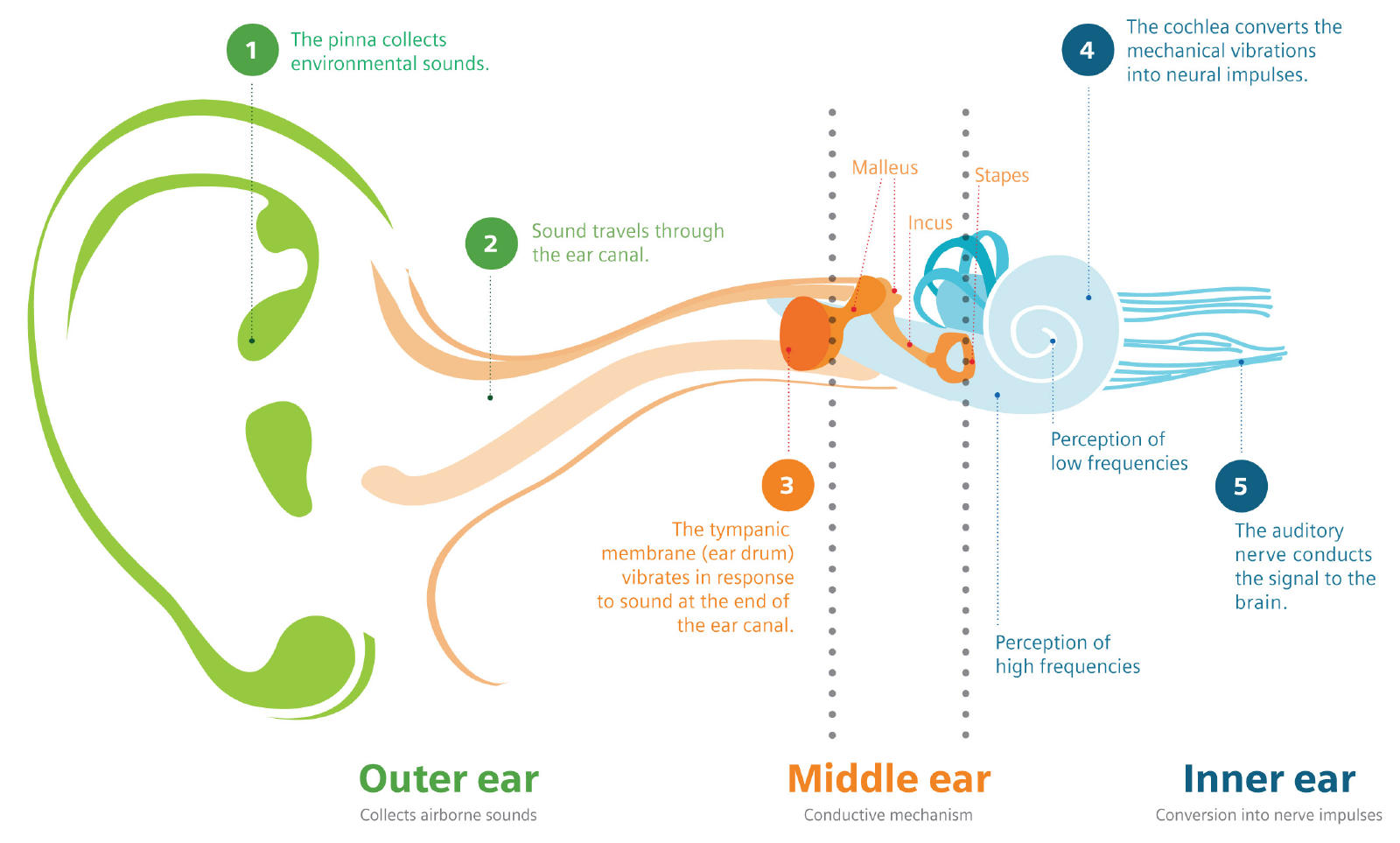
78
the fluid pushes on what part of the hair cell?
the hair bundle, composed of kinocilia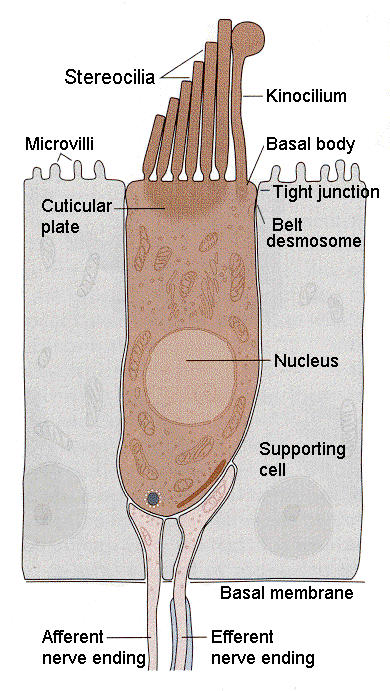
79
what causes the action potiential to be sent down the auditory nerve?
kinocilia within hair bundle move, connected to tip link, tip link movement allows K+ flow, K+ flow leads to Ca+2 flow, leading to AP sent to spiral ganglion cell which activates auditory nerve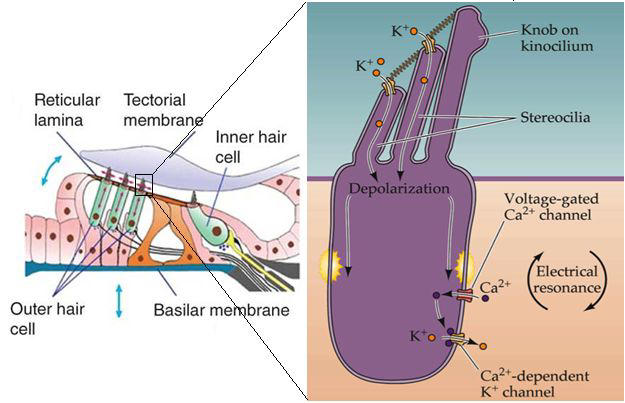
80
what frequencies can humans hear?
20Hz to 20kH
81
what is basilar tuning?
how brain differentiates between different frequencies. hair cells at base of cochlea activated by high freq and apex of chochlea are activated by low freq (think, low freq means high wavelength so it travels faster)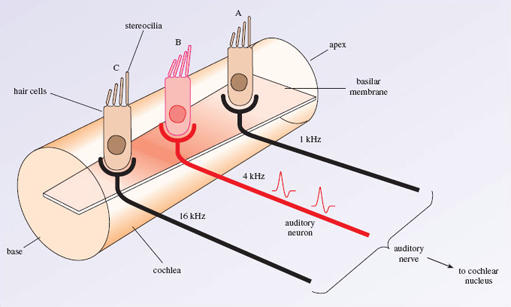
82
what is sensory adaptation and why is it important?
receptor changing over time due to stimulus. can downregulate or upregulate (think hand on table, no change in pressure so receptor will stop firing until it changes again). Important because too much stimulation can kill cell (Ex. consitently releasing capsaicin for pain)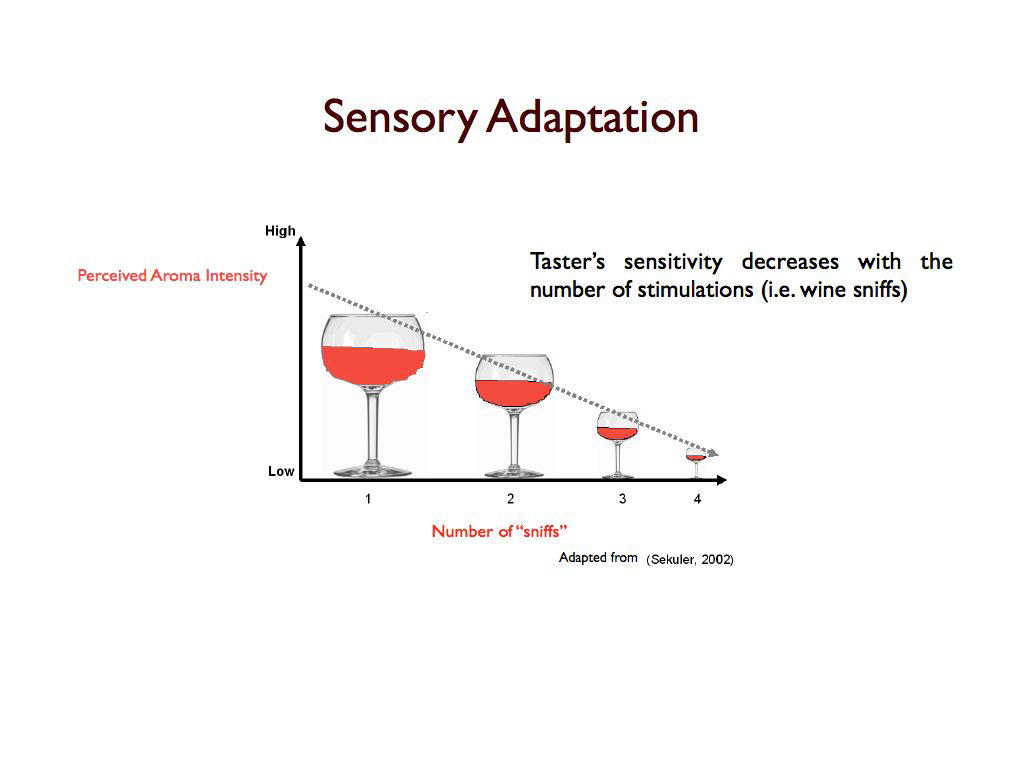
83
what is the somatosensory homunculus?
map of body in brain, specific region of body has specific region in cortex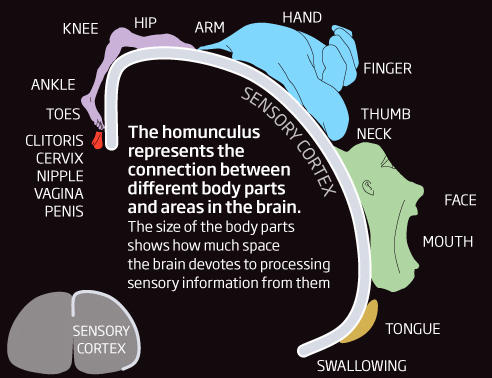
84
what is found in muscles that give us information about how they are stretched?
spindle fibers (allow for proprioception)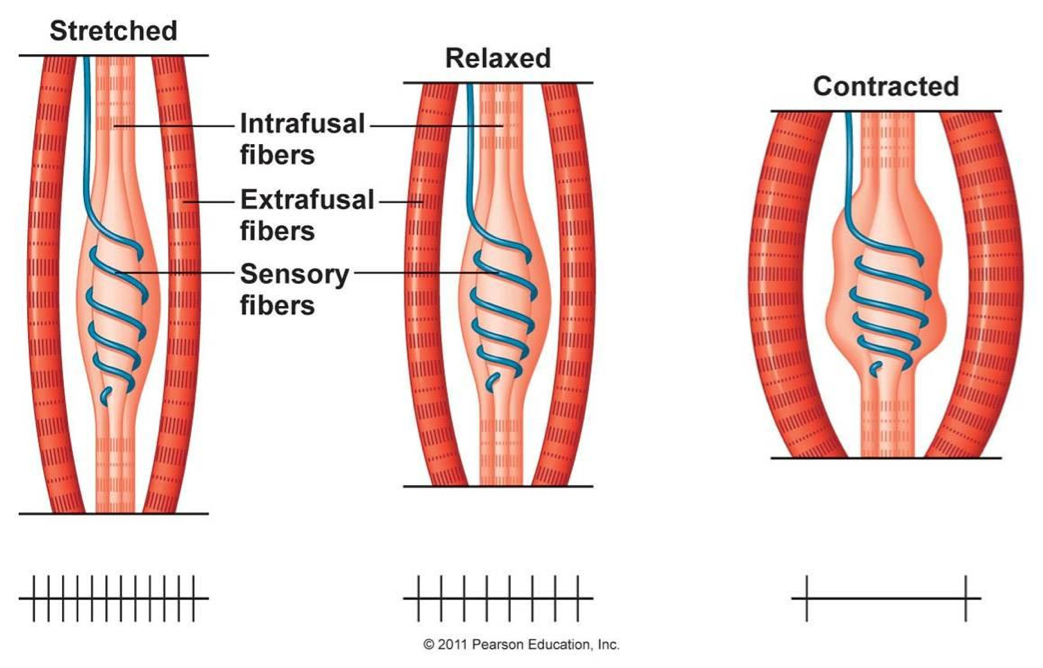
85
what is kinaesthesia and how is it different from proprioception?
kinaesthesia is more behavioral while proprioception is more subconcious/cognitive.
kinaesthesia more related to movement than sense of position in space
Ex. teaching yourself how to hit a ball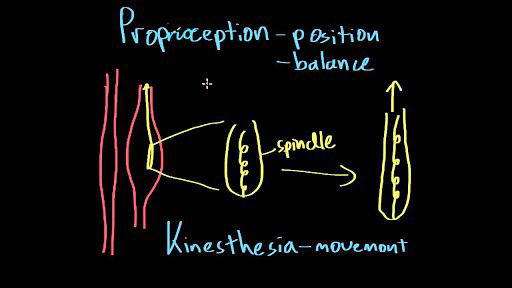
kinaesthesia more related to movement than sense of position in space
Ex. teaching yourself how to hit a ball
86
what is the the TrpV1 receptor and how does it function?
receptor that causes signaling for both heat and pain. Heat causes conformational change in the protein, poking disturbs thousands of cells which release molecules that activate the receptor (pain).
mnemonic: IMAGINE YOU TRIPPED ONTO LAVA (TRP), WOULDNT THAT SHIT HURT?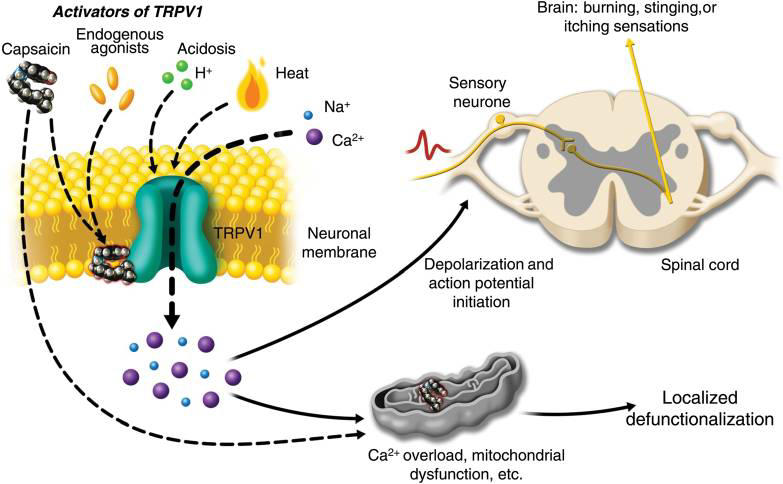
mnemonic: IMAGINE YOU TRIPPED ONTO LAVA (TRP), WOULDNT THAT SHIT HURT?
87
what are alpha-beta fibers
thick, lots of myelin. supah fast nerve conduction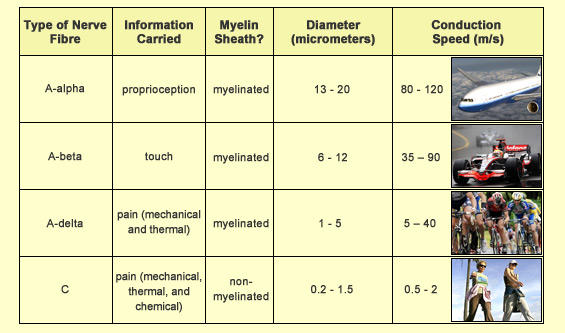
88
what are alpha-delta fibers
smaller than alpha-beta, less myelin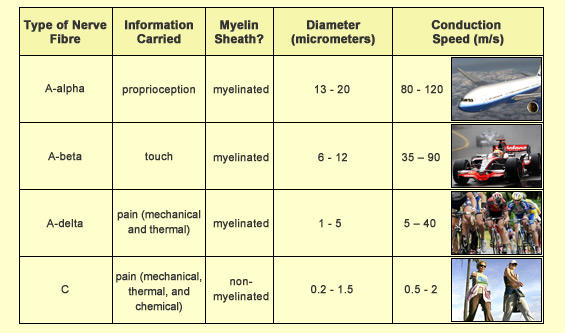
89
what are c fibers
small, unmyelinated - lingering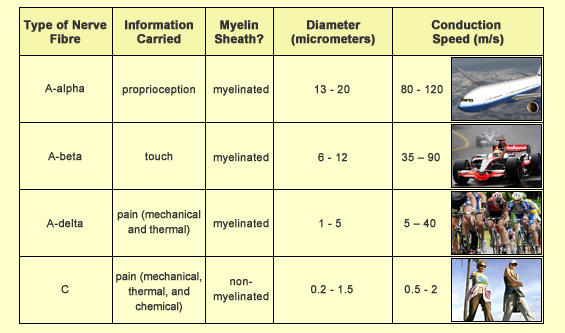
90
what is the collection of nerves, sitting above the cribiform plate, that allows olfaction?
olfactury bulb, projected down into olfactory epilthelium with receptors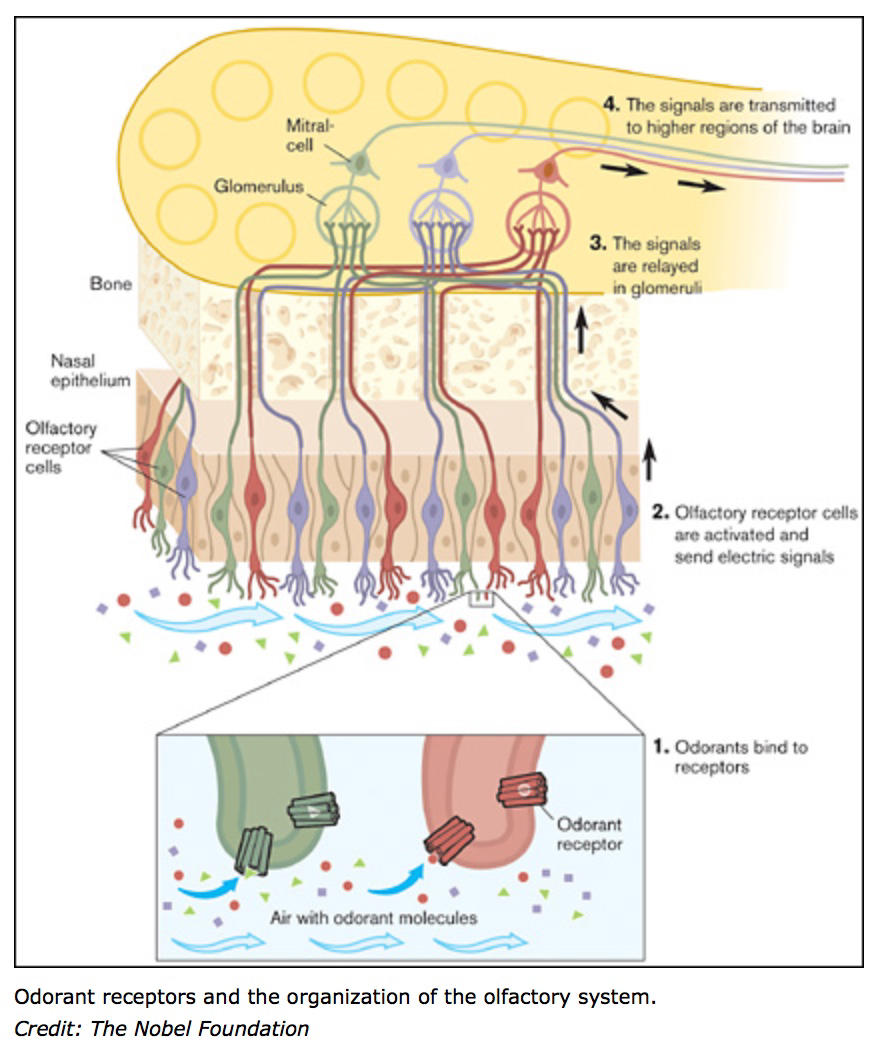
91
what are the 5 main tastes?
sweet, sour, bitter, salty, umami(glutamate)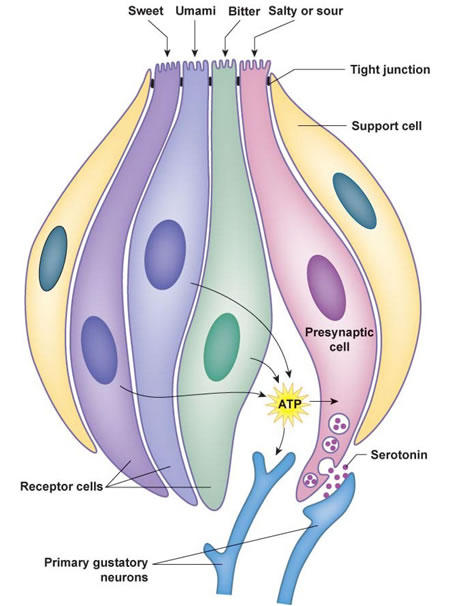
92
what is the labelled line model of gustatation?
Each taste bud receptor has 5 axons, all which send separate taste information to different parts of the gustatory (taste) cortex. Remain separate to the brain. And they all synapse on diff parts of the gustatory (taste) cortex..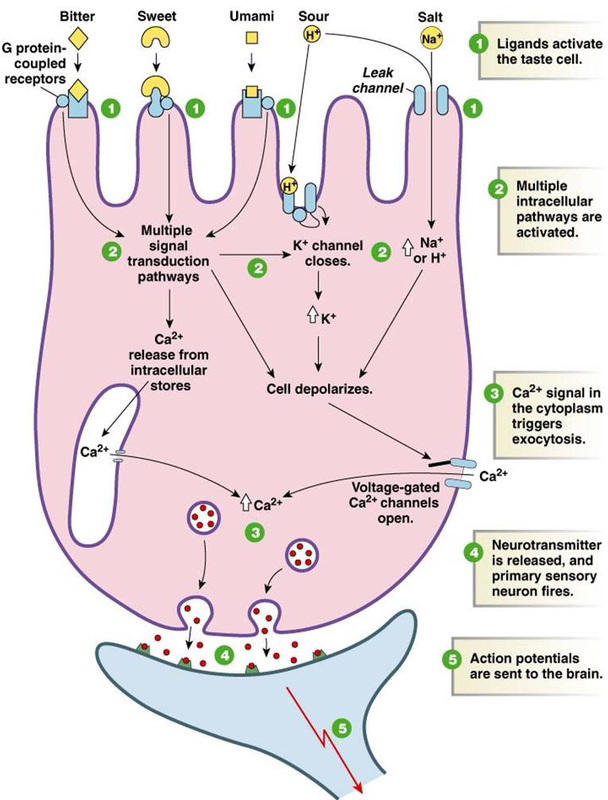
93
sour and salty molecules rely on __
ion channels
94
bitter, sweet, and umami rely on ___
GPCR
95
what is conciousness?
awareness of self and environment
ranges from alertness to sleep
ranges from alertness to sleep
96
what waves are alertness associated with?
beta waves12-30Hz
Busy waves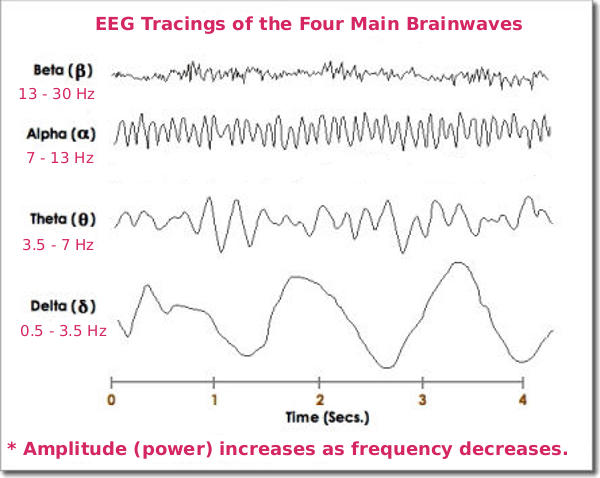
Busy waves
97
what waves are "daydreaming"\/relaxed state associated with?
alpha waves8-13 Hz
Aloof waves (slowing down)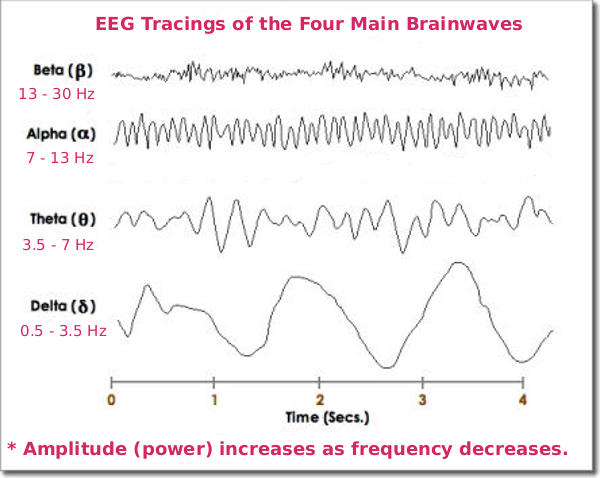
Aloof waves (slowing down)
98
what waves are drowsiness associated with?
stage 1 - theta waves
99
N1 stage of sleep is dominated by
Theta waves, hypnagonic hallucinations (Ex. Hearing doorbell, seeing flash of light), tetris effect (Ex. if playing tetris you may see blocks, if on boat you may feel rocking), hypnic jerks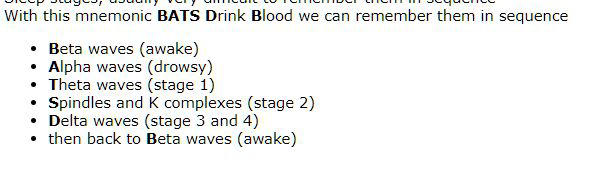
100
N2 stage of sleep
deeper than N1, precedes N3, see lots of theta waves, sleep spindles, and K complexes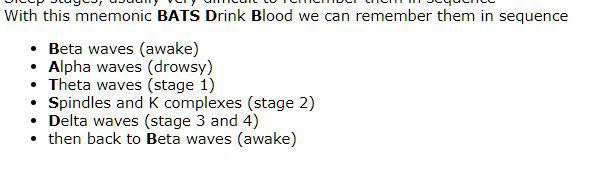
101
what is a sleep spindle?
burst of brain activity thought to suppress certain perceptions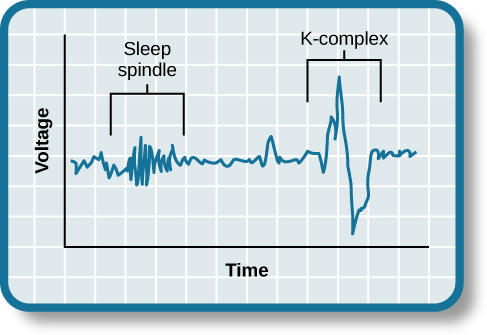
102
what is the N3 stage of sleep?
slow wave sleep, mostly composed of delta waves, also encodes declarative/explicit memory
SLEEP WALKING/TALKING
3 is FOR TREE - A WALKING TALKING TREE - DONT YOU FORGET THIS ONE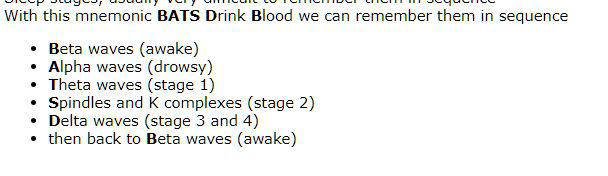
SLEEP WALKING/TALKING
3 is FOR TREE - A WALKING TALKING TREE - DONT YOU FORGET THIS ONE
103
what is freud's theory of dreams?
Dreams are our unconscious thoughts and desires that need to be interpreted.
Little scientific support.
Little scientific support.
104
what is the activation synthesis hypothesis of dreams?
frontal cortex tries to make sense of random impulses from brain stem firing during REM sleep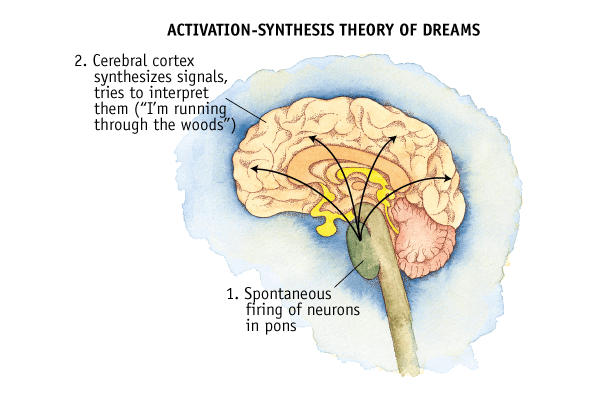
105
sleep deprivation can lead to
obesity, depression, mood disorders, poor memory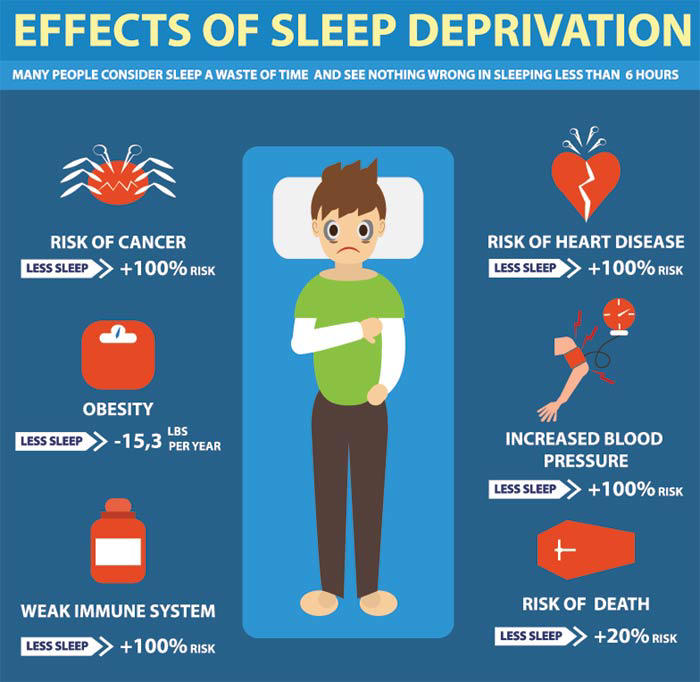
106
sleepwalking mostly occurs during __ stage of sleep
N3
107
breathing related disorders can take 3 forms:
obstruction related, brain related, hypoventilation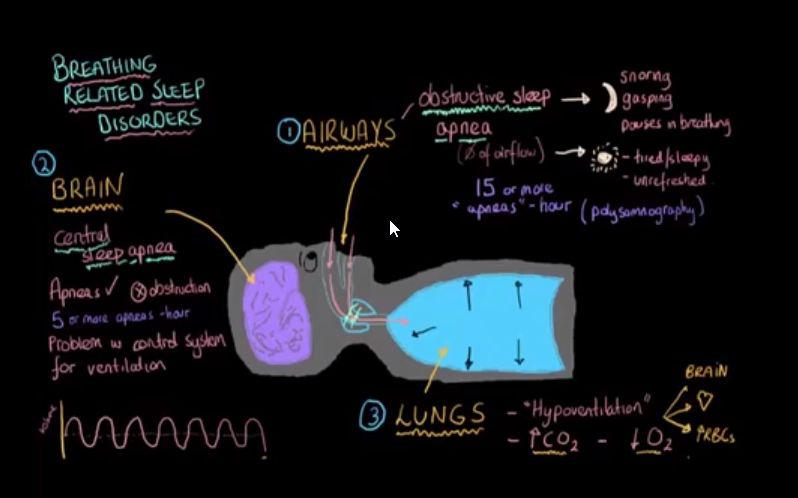
108
what is hypnosis?
induced altered state of conciousness. more susceptible to power of suggestion
can create false memories - memories that incorporate hypnotizers expectations even when not intended
can create false memories - memories that incorporate hypnotizers expectations even when not intended
109
what is meditation?
self induced altered stateincreased alpha and theta waves
regular practitioners have greater ability to control attention
regular practitioners have greater ability to control attention
110
what does a depressant do and what are the three catergories?
-suppresses CNS-lowers HR and BP
-Vasodilate at low-moderate concentrate and vasoconstrict at high
-alcohol, barbiturates, benzos
-Vasodilate at low-moderate concentrate and vasoconstrict at high
-alcohol, barbiturates, benzos
111
what does a stimulant do and what are some examples?
-stimulates CNS-increase HR and BP
-vasoconstrict
-nicotine, caffeine, amphetamines, cocaine, MDMA
-similar effect to stress
-vasoconstrict
-nicotine, caffeine, amphetamines, cocaine, MDMA
-similar effect to stress
112
what does a hallucinogen do?
causes altered perception, pupil dilation, feeling of connectedness and mood swings
113
what is an opioid?
synthetic derivative of poppy seed, decrease CNS function but also act as analgesic (reduces perception of pain), vasodilator
114
cannabis/marijuana/weed has characteristics of
stimulants, hallucinogens, and depressants
115
opiates act on ___ receptors
endorphin
116
depressants act on ___ receptors
GABA
117
what is nicotine's effect on the body?
increase BP/HR, can disrupt sleep and suppress appetite, acetylcholine receptor agonist (because CNS stimulant)
118
what is the effect of cocaine?
massive increase in dopamine (blocks reuptake), serotonin, and norepinephrine. causes crash afterward
119
what do amphetamines do?
trigger release of dopamine, and block its reuptake
120
Ecstasy/ Molly/ MDMA
synthetic hallucinogen, also has stimulant properties. increases dopamine and euphoria. increases HR and body temp
can damage serotonin receptors
can damage serotonin receptors
121
what neurotransmitter does LSD interfere with?
serotonin (5-HT2 receptor family)
122
what causes a crash/OD?
when you take a typical drug with same conditions every time, body starts preemptively preparing for it.
If you don't get the drug, your body already prepared for the high, so you crash
If you take the drug in a new situation, your body doesn't prepare so your typical dose can become lethal
"dont get the drugs after body has accomodated"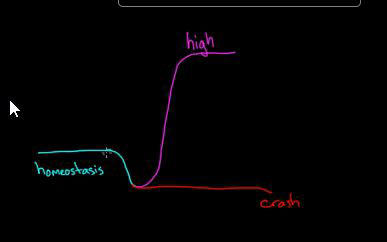
If you don't get the drug, your body already prepared for the high, so you crash
If you take the drug in a new situation, your body doesn't prepare so your typical dose can become lethal
"dont get the drugs after body has accomodated"
123
a faster route of entry means...
higher risk of addiction/dependence
124
dopamine is produced in the_____ region of the brain and released to the ____, ____, ____, and ____
ventral tegmental, amygdala, nucleus accumbens, prefrontal cortex, and hippocampus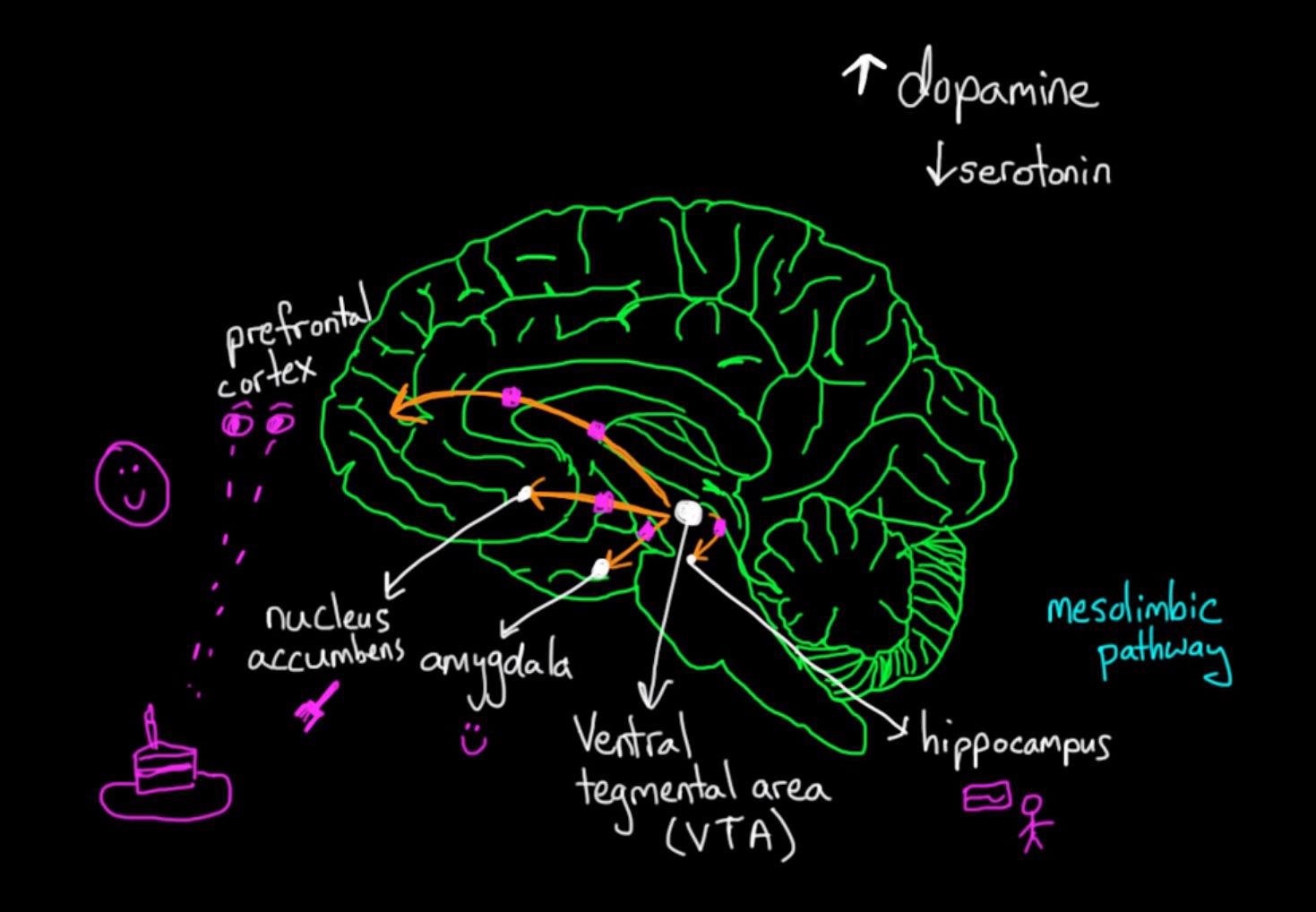
125
what is the role of the amygdala in reward pathway?
emotional control. ex. This cake is delicious, I love this cake. I am feeling so happy right now.
126
what is the role of the nucleus accumbens in the reward pathway?
motor function"Its function is to transfer relevant motivational information to the motor cells in order to obtain a certain reward or satisfaction"
ex. says let’s move hand to take another bite.
ex. says let’s move hand to take another bite.
127
what is the role of the prefrontal cortex in the reward pathway?
ex. puts attention to the cake.
128
what is the role of the hippocampus in the reward pathway?
memoryex. Where am I at? Where am I eating this cake? Who am I with? Let’s remember things about this experience
129
what happens to levels of dopamine and serotonin when the reward pathway is activated?
dopamine goes up, serotonin goes down
130
what is serotonin involved in?
feelings of satiation
131
what is tolerance?
brain gets used to drug stimulus, so it requires more of the drug to achieve same effect or just to feel "normal"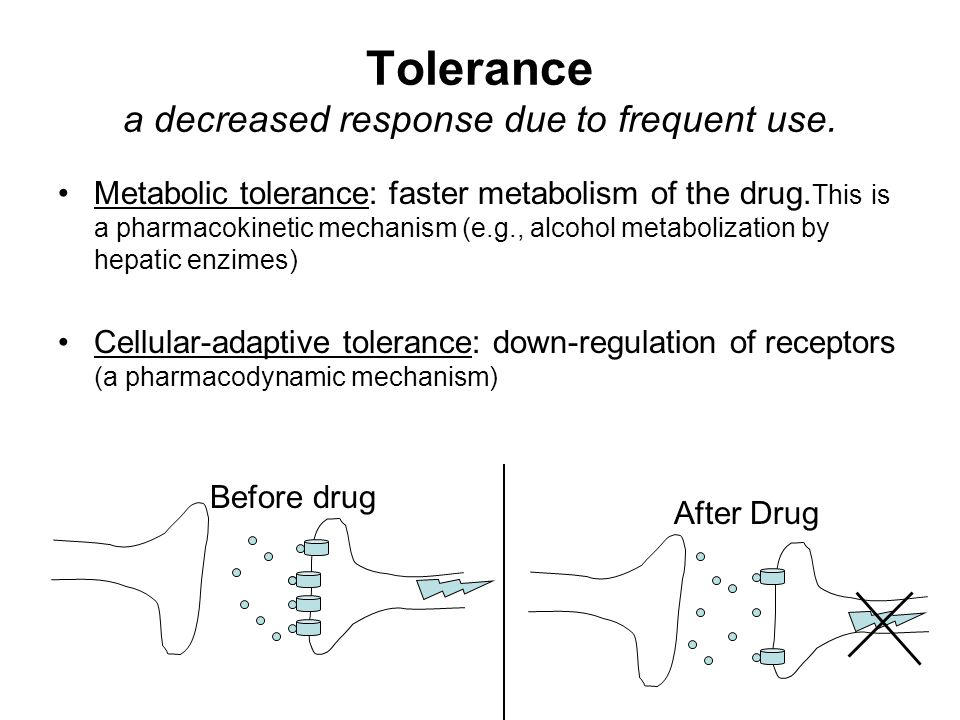
132
what are the telltale signs of a substance use disorder?
using higher dose, failing to meet (life) obligations, withdrawal,
133
what does methadone do?
activates opiate receptors but much more slowly and dampens the high. (treatment for opioid abuse)
134
how does cognitive behavioral therapy helps addicts?
addresses both cognitive thought processes (working toward more positive thought patterns) and helps identify behaviors to prevent relapse
135
what is motivational interviewing?
working with patient to find intrinsic motivation to change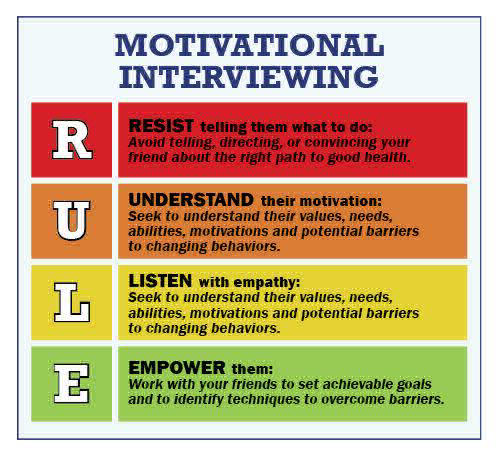
136
what is divided attention?
when doing more than one thing your brain quickly switches between things instead of multitasking
137
what is selective attention?
"flashlight beam", only focusing on one thing at a time
138
what is an exogenuous cue?
we dont have to tell ourselves to notice it. like a bright color or loud noise
(bottom-up processing)
(bottom-up processing)
139
what is an endogenous cue?
require internal\/background knowledge to understand the cue
cognitive aspect it attached to endogenous (top down processing)
example: cocktail party effect
cognitive aspect it attached to endogenous (top down processing)
example: cocktail party effect
140
what is inattentional blindness?
when we fail to notice something in our view because our attention is focused elsewhere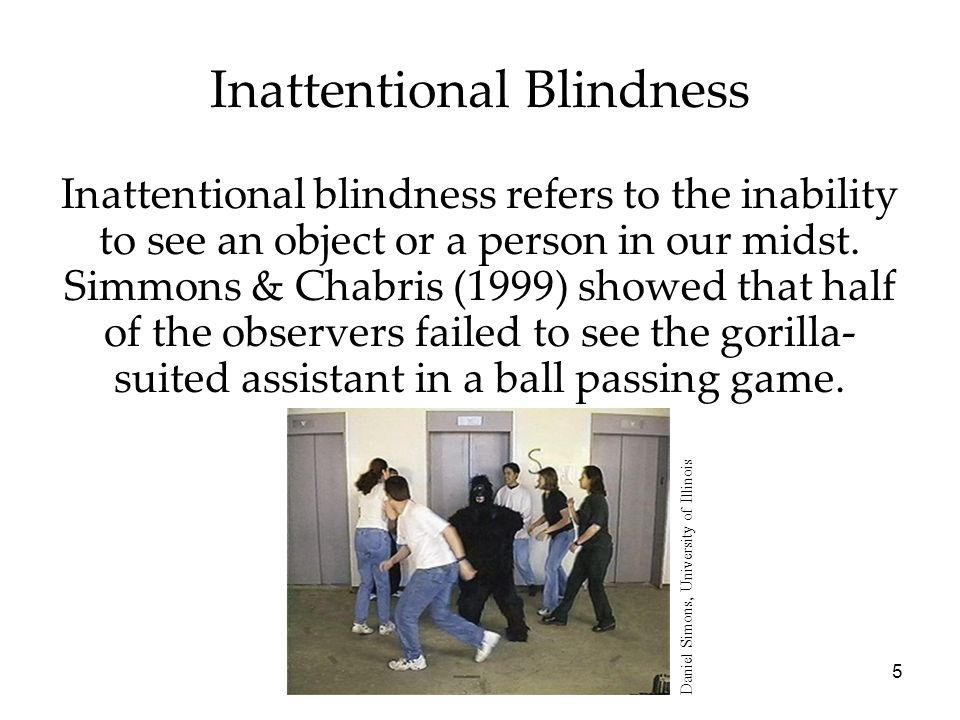
141
what is change blindness?
failure to notice a change in an environment due to selective attention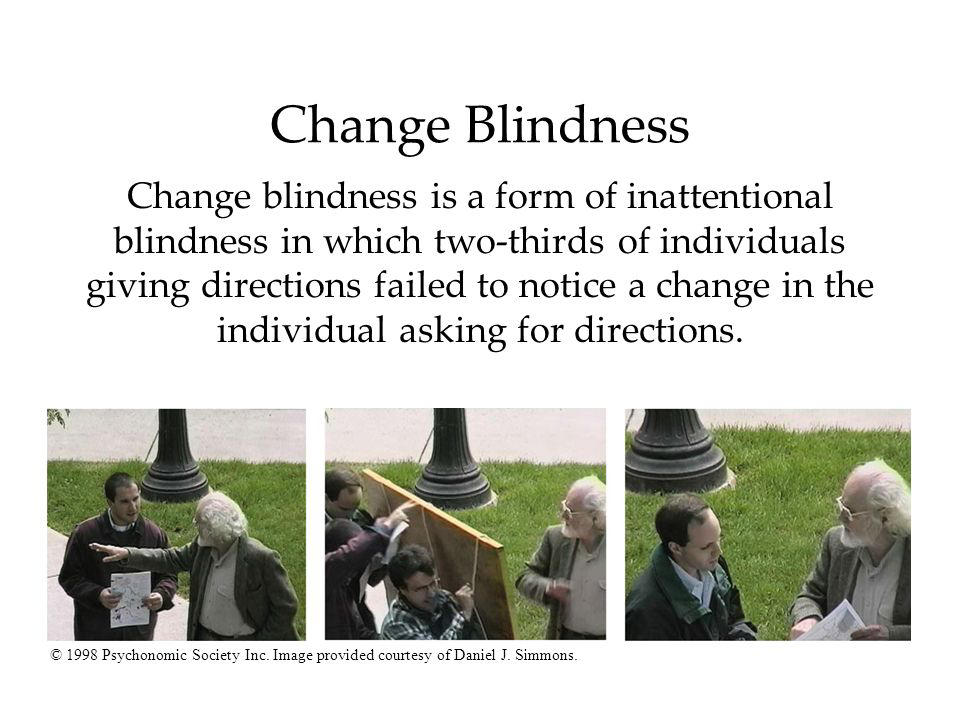
142
what does broadbent's theory state?
sensory register-->selective filter-->perceptual process(I recognize that voice as my friends)-->conscious (deciding how to respond)
problem? if you selectively filter everything then you wouldn't be able to hear your name in a crowded room.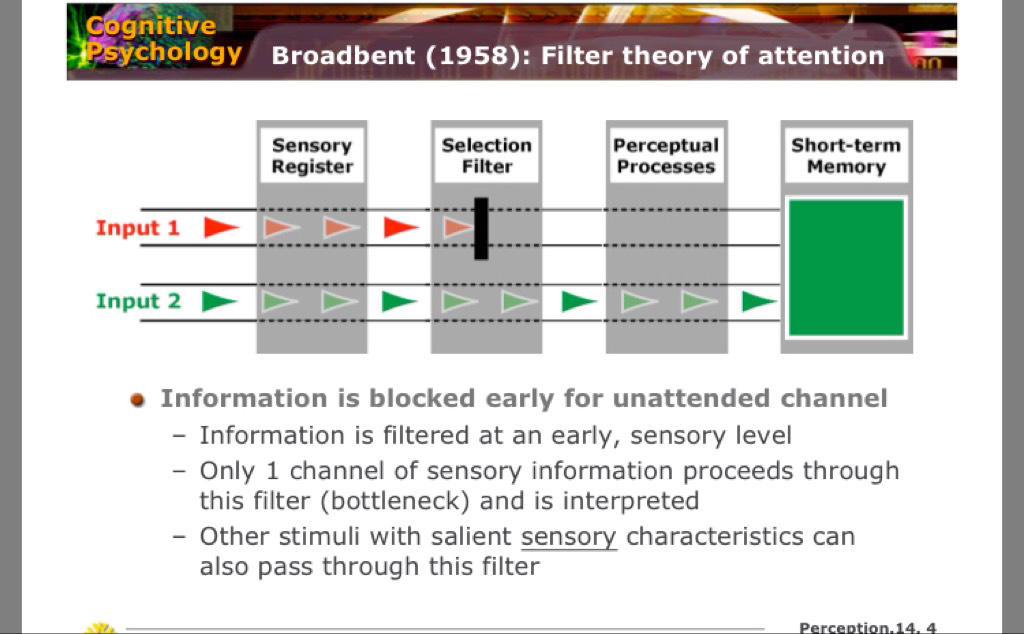
problem? if you selectively filter everything then you wouldn't be able to hear your name in a crowded room.
143
What does Deutch & Deutch’s Theory state?
Sensory register--> perceptual process->selective filter-->conscious
states that you do register and assign meaning to shit but that your selective filter decides what to send to your conscious
problem? too much energy required to assign meaning to everything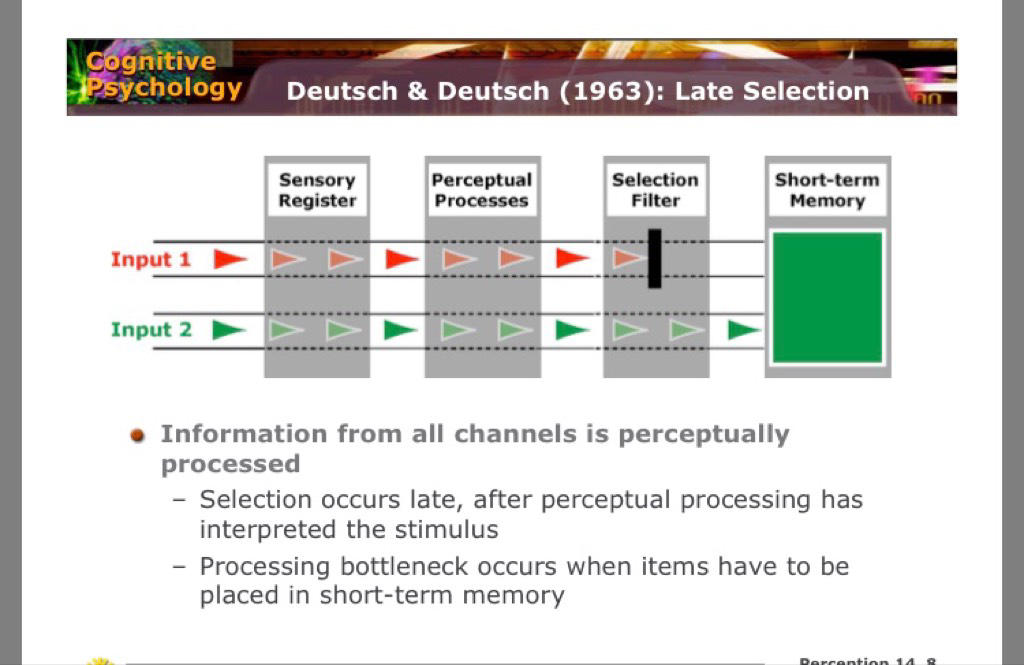
states that you do register and assign meaning to shit but that your selective filter decides what to send to your conscious
problem? too much energy required to assign meaning to everything
144
what is Treisman's theory?
instead of the selective filter we have an attenuator that weakens but doesn't eliminate something from the unattended ear.
Sensory register-->attenuator-->perceptual process-->conscious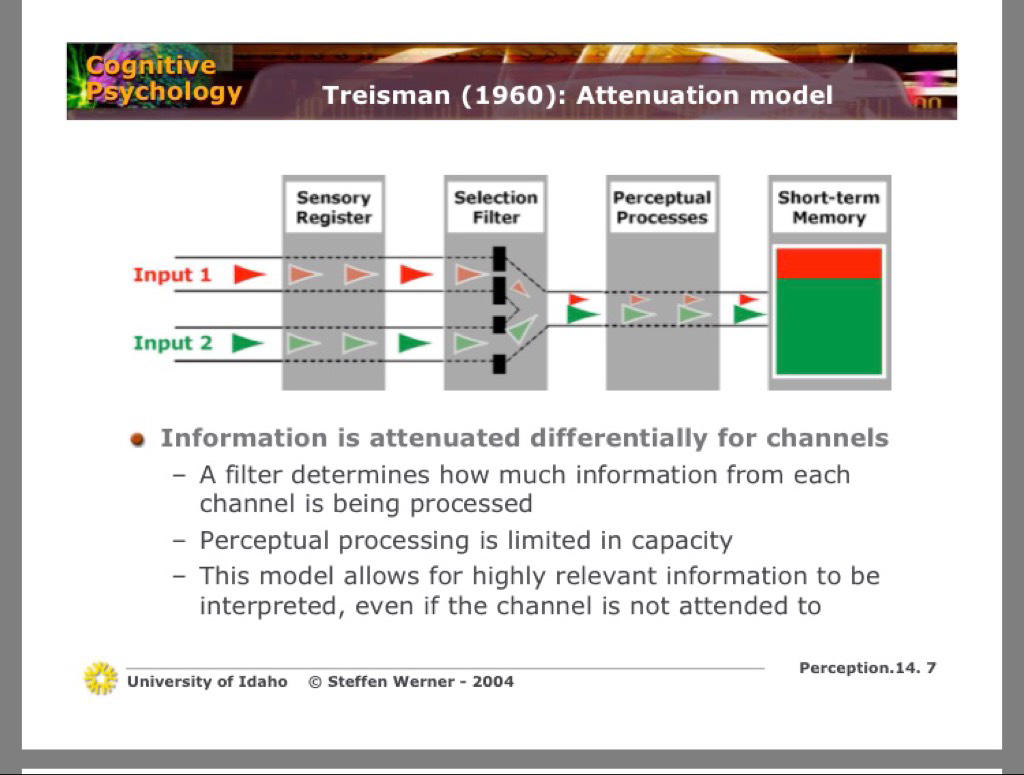
Sensory register-->attenuator-->perceptual process-->conscious
145
what is priming?
exposure to one stimulus can alter our perception of another or subsequent stimulus (due to implicit memory)
146
what is the resource model of attention?
states that attention is a limited resource and that we suck ass at multi-tasking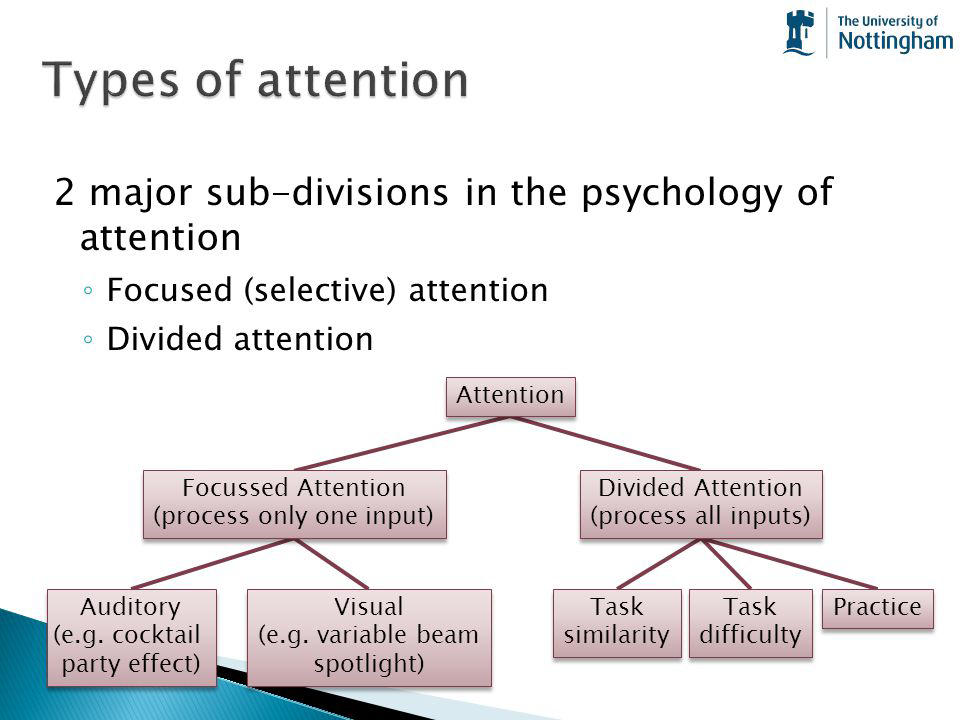
147
what are the 3 things that affect our ability to multitask?
task similarity (more similar is more difficult), task difficulty, practice(prior experience)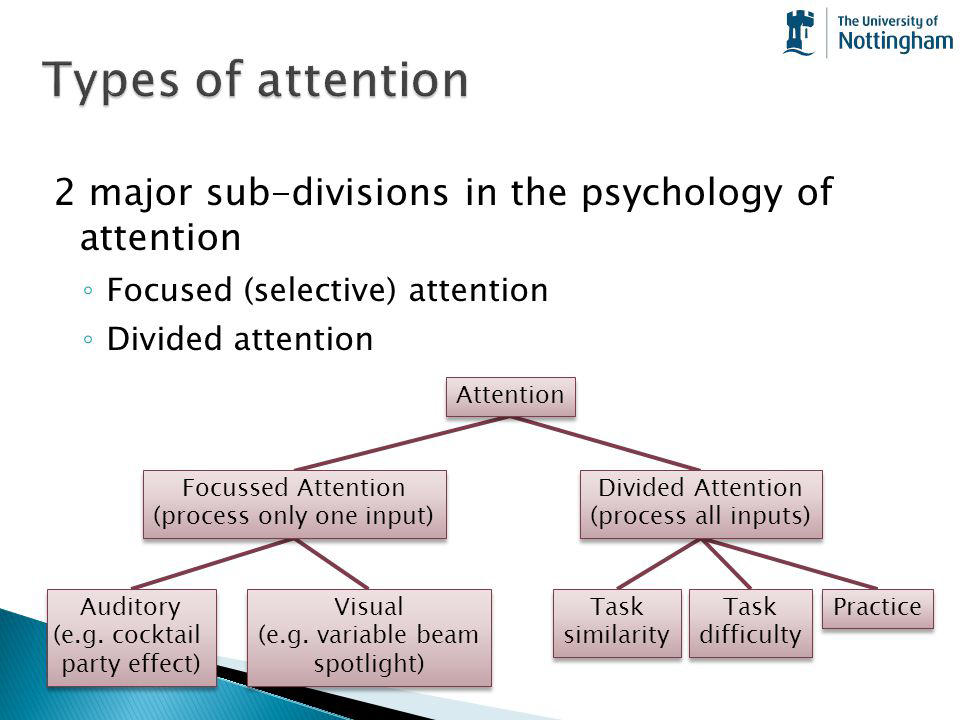
148
what does the information processing model postulate? Bottom up or top down?
input-->process-->output
Our senses are like computer: input (keyboard or sensory organs)->process (CPU or working memory)-> storage (hard drive or long term memory) -> output
bottom-up - why? because it is STIMULUS DRIVEN
Our senses are like computer: input (keyboard or sensory organs)->process (CPU or working memory)-> storage (hard drive or long term memory) -> output
bottom-up - why? because it is STIMULUS DRIVEN
149
what is sensory memory?
like the sensory register. composed of iconic and echoic. iconic is what you see, lasts a few seconds.
echoic is what you hear, lasting 3-4 seconds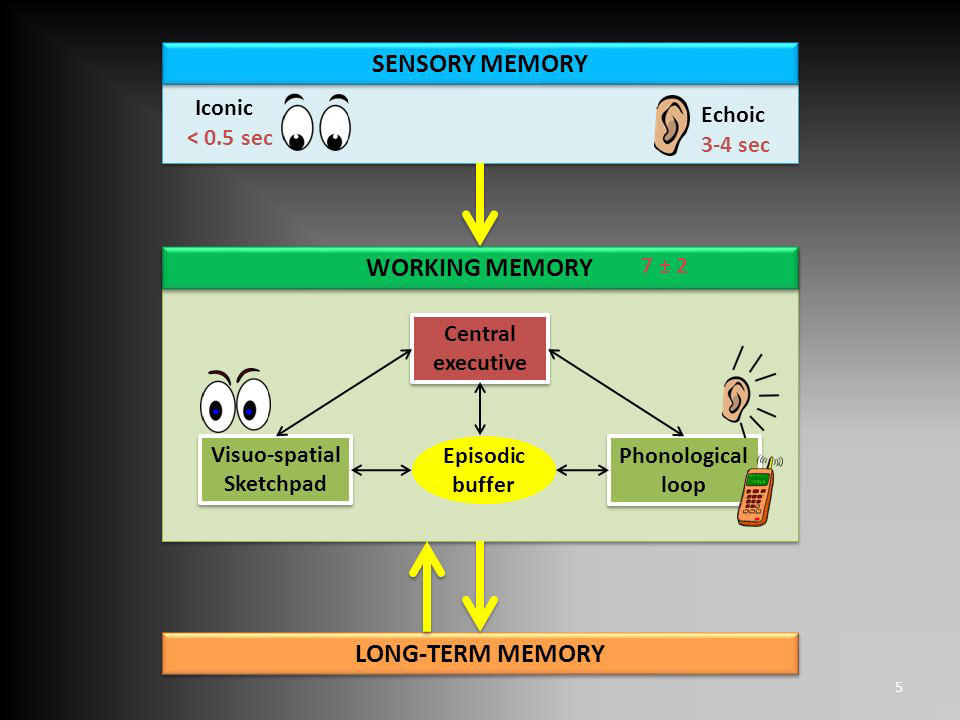
echoic is what you hear, lasting 3-4 seconds
150
what is working memory? What is it used for ?
AKA short term memory. consists of what you are thinking of in the exact moment. 7 units of information (+or- 2) available.
Helps with reasoning and comprehension. A breakdown prevents brain from properly processing and encoding info which could lead one to reach incorrect conclusions and remember things incorrectly.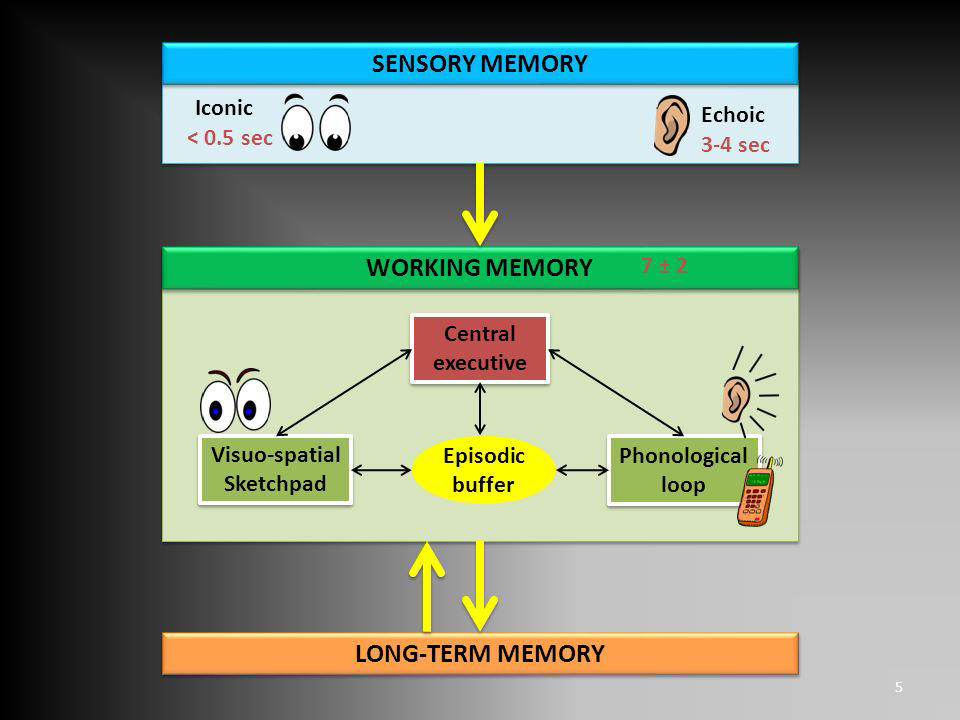
Helps with reasoning and comprehension. A breakdown prevents brain from properly processing and encoding info which could lead one to reach incorrect conclusions and remember things incorrectly.
151
what is the visuo-spatial sketchpad?
part of working memory involving processing visual and spatial info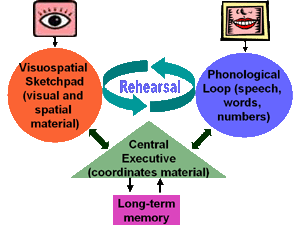
152
what is the phonological loop?
verbal info being processed (any words or numbers in iconic or echoic memory) (think: repeating something to yourself again to remember it)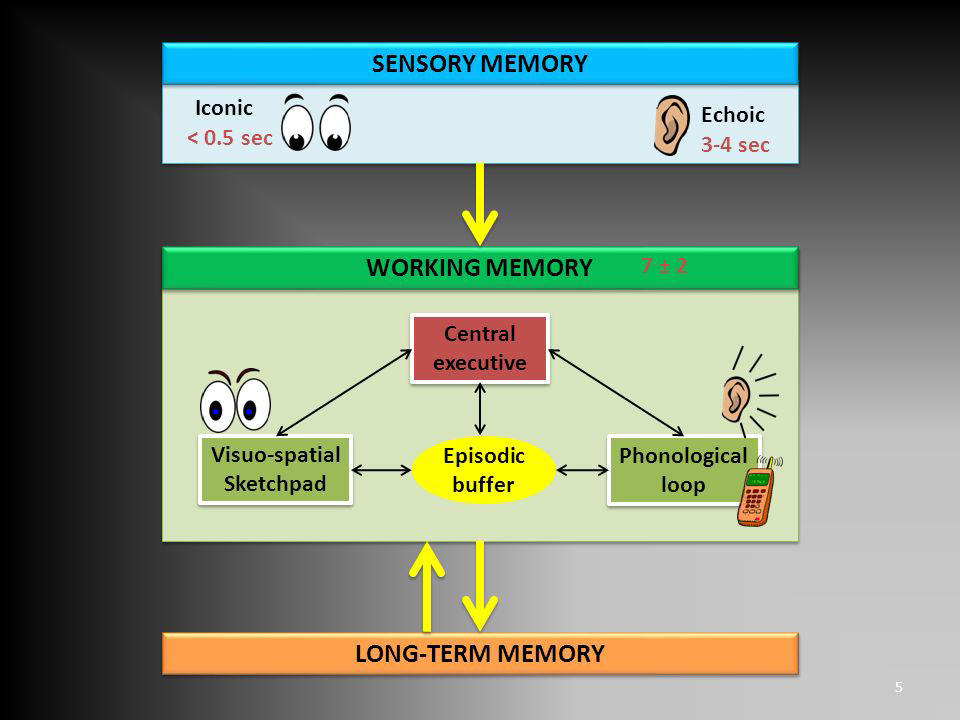
153
what does the central executive do?
coordinates the visuo-spatial, phonological loops, and episodic buffer to assist in coding long term memory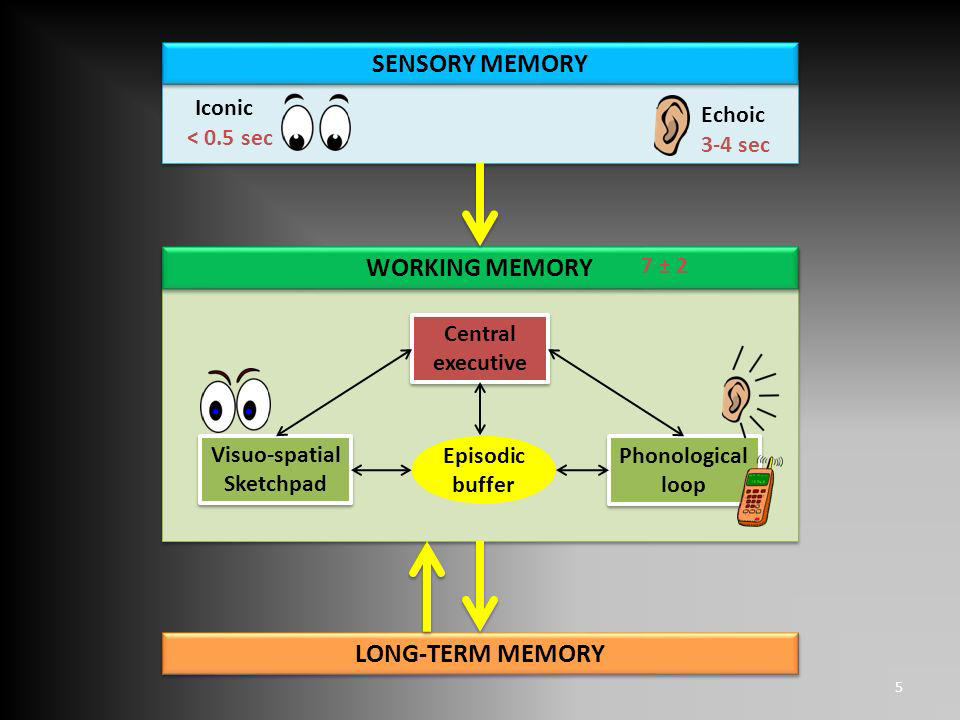
154
what is the episodic buffer?
theorized to integrate the other functions, known as the phonological loop (information heard) and visio-spatial sketchpad (information seen) with a sense of time, so that things occur in a continuing sequence, like a story from a book or movie.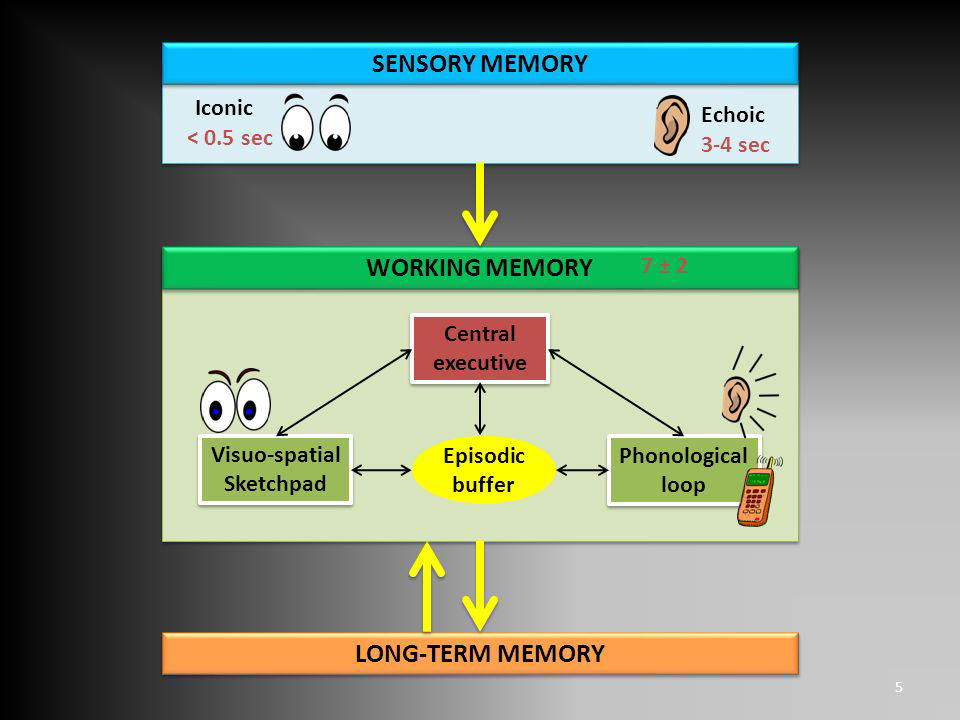
155
what is long term memory?
composed of explicit and implicit memories, theoretically unlimited
156
what is explicit memory?
aka declarative
facts/events you can clearly/explicitly describe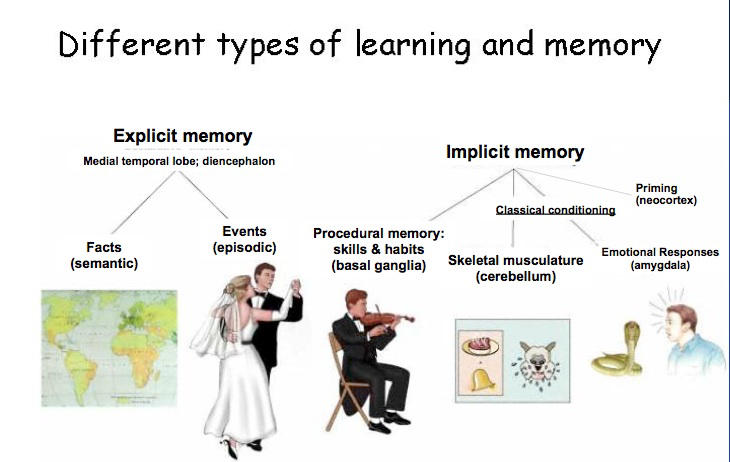
facts/events you can clearly/explicitly describe
157
what is implicit memory and the three types?
unconscious - priming, habits, conditioning (knowing how to ride a bike)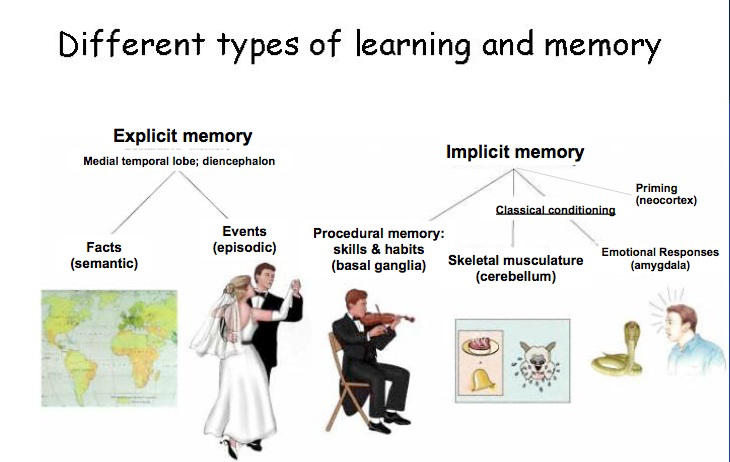
158
what is episodic memory?
its a part of explicit memory, specifically referring to birthdays/holidays and shit
159
riding a bicycle is a form of ____ memory
procedural
160
what is encoding?
processing info and transferring it into long-term memory
161
what is rote rehearsal?
saying the same shit again and again, is the least effective encoding technique
162
what is chunking?
grouping pieces of info together to improve encoding
163
what is the pegword system?
verbal "anchor" to a word or piece of info.
1 is a gun
2 is a shoe
3 is a tree
1 is a gun
2 is a shoe
3 is a tree
164
what is the method of loci?
useful for encoding things that need to be memorized in order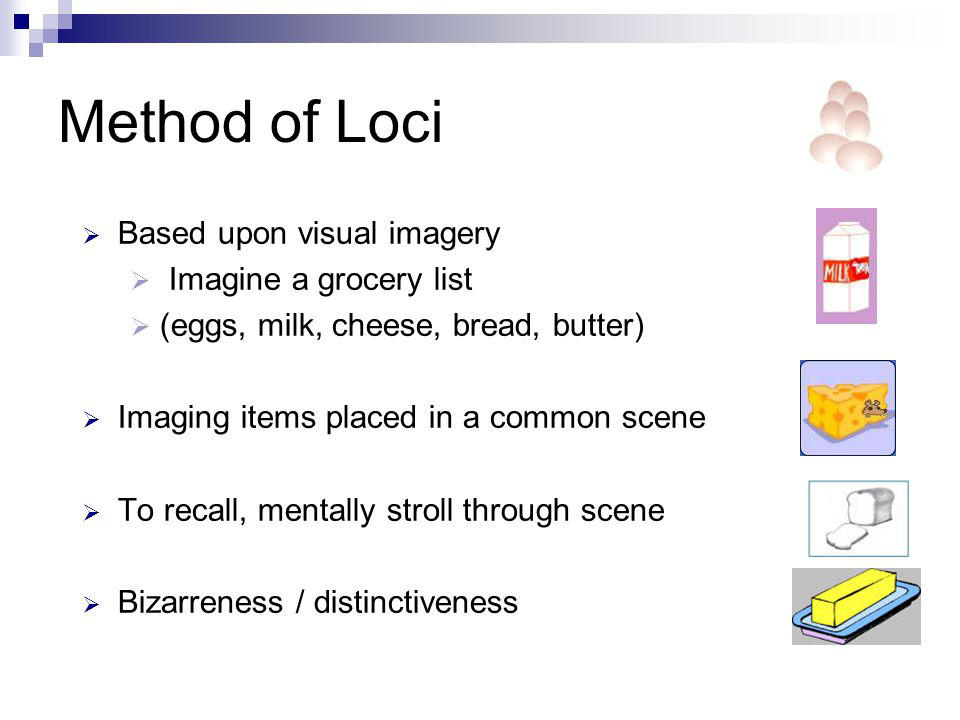
165
what is self referencing?
relating new info to yourself to help encoding
166
what is spacing?
spacing out study sessions instead of cramming
167
what is retrieval?
trying to bring back a memory from long term memory into working memory
168
what are the things that can affect retrieval?
-priming (– prior activation of nodes/associations, often without our awareness. Ex. hearing a story about apple and asked to name word starting with A.)-context (the environment you encode and take the test (retrieve the information) is
helpful)
-state-dependant (your state at the moment you encode. When you are in a certain
mood when you encode you can then remember it when you are in the same mood)
helpful)
-state-dependant (your state at the moment you encode. When you are in a certain
mood when you encode you can then remember it when you are in the same mood)
169
what is free recall?
recall without any cue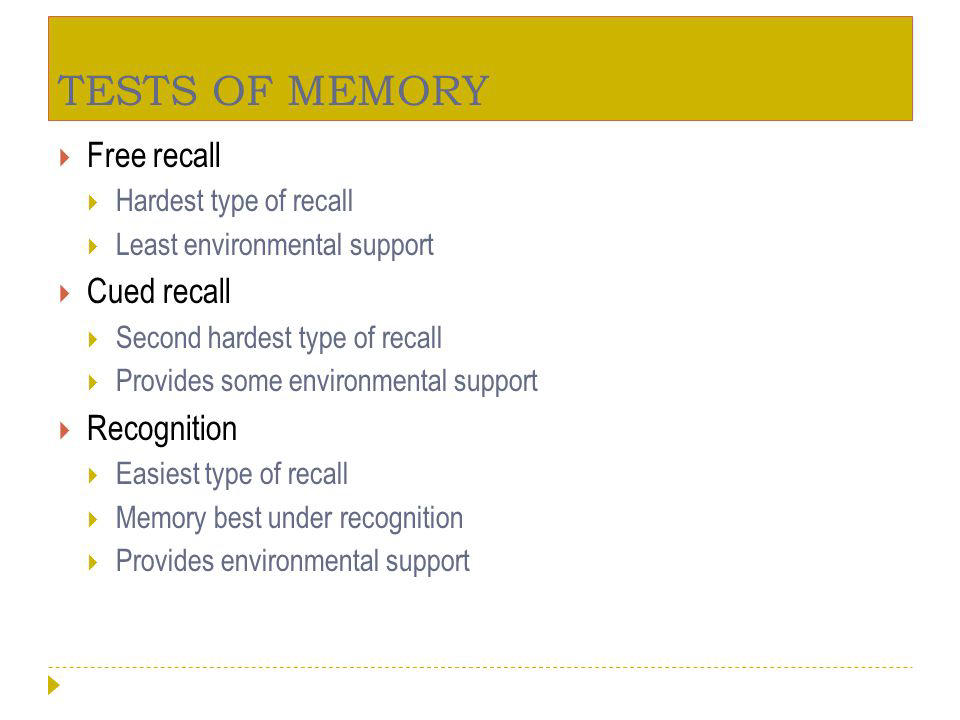
170
what is the serial position effect effect?
also known as primacy\/recency effects, remember things at beginning and end of list better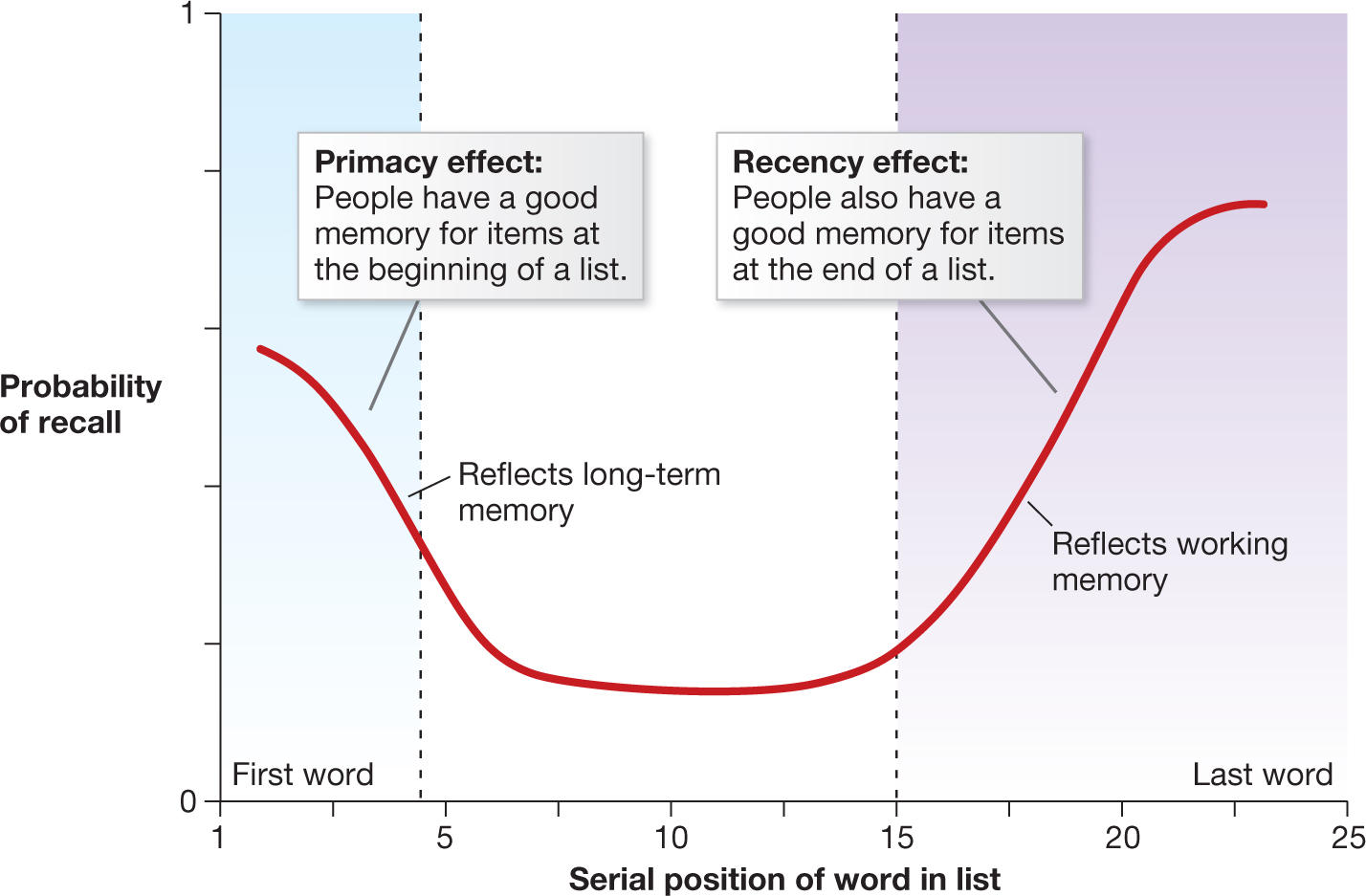
171
what is cued recall?
recall that follows a "cue" of some sort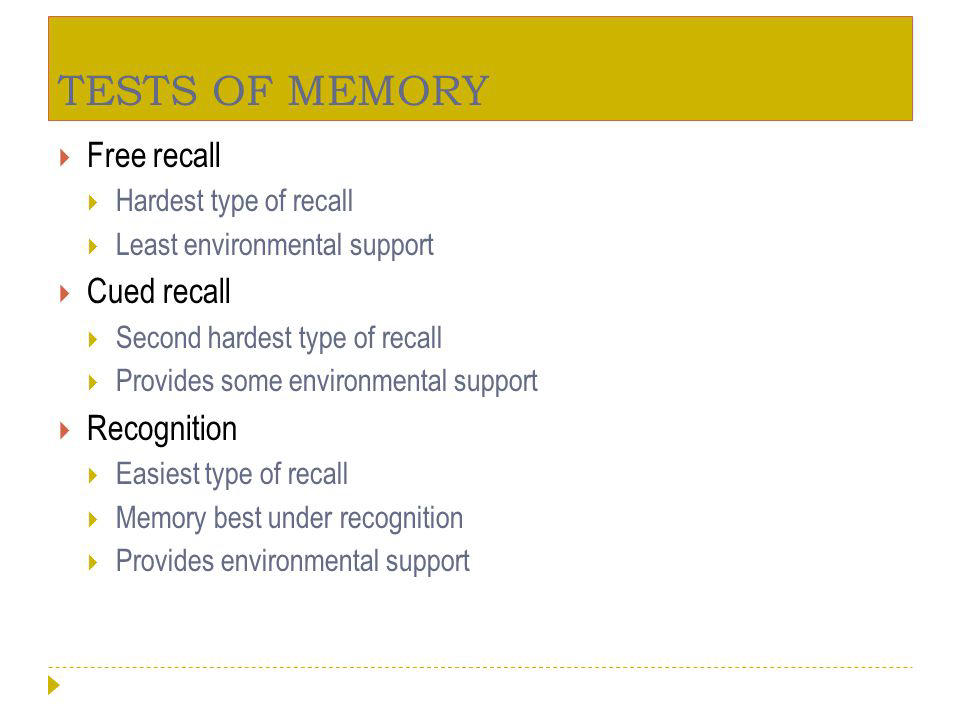
172
what is source monitoring?
keeping track of where a piece of information came from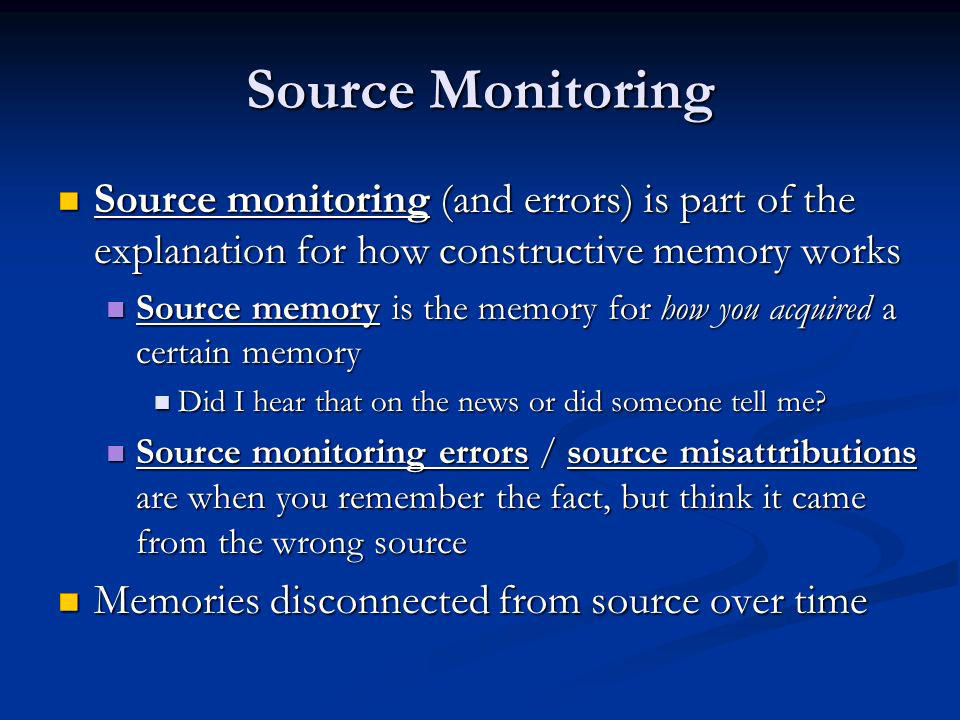
173
what is a flashbulb memory?
very vivid/strong memory created in moment of high emotion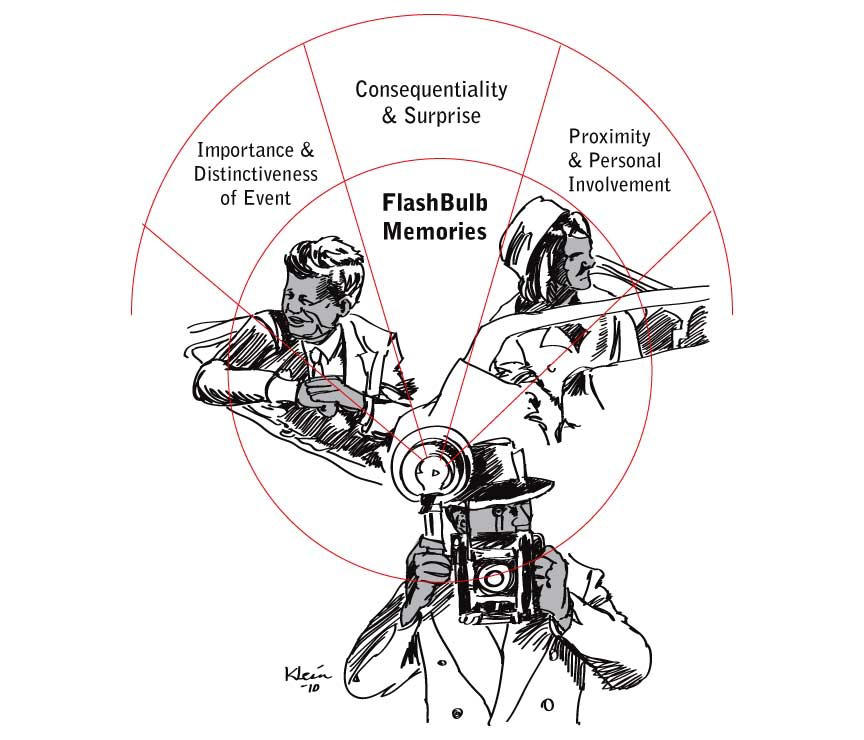
174
what is long term potentiation?
increase in synaptic plasticity/strength of synapse (connections between nuerons stengthen). key component of learning.
175
what is decay? psychologist associated with research on forgetting?
when a memory is unable to be retrieved. may still exist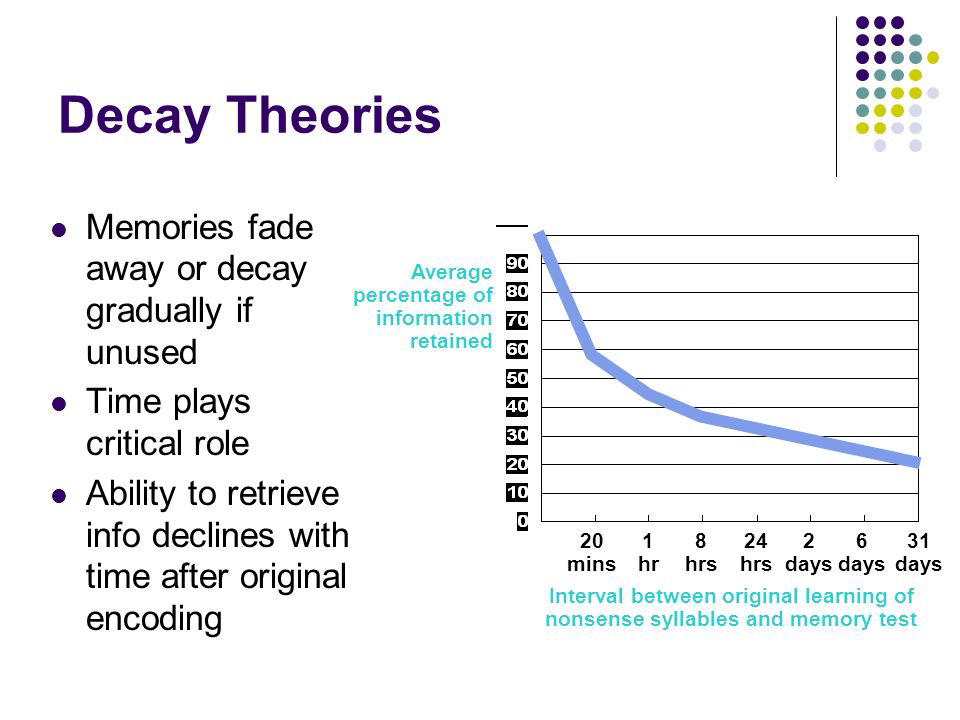
176
what is retroactive interference?
new learning impairs old information/memory.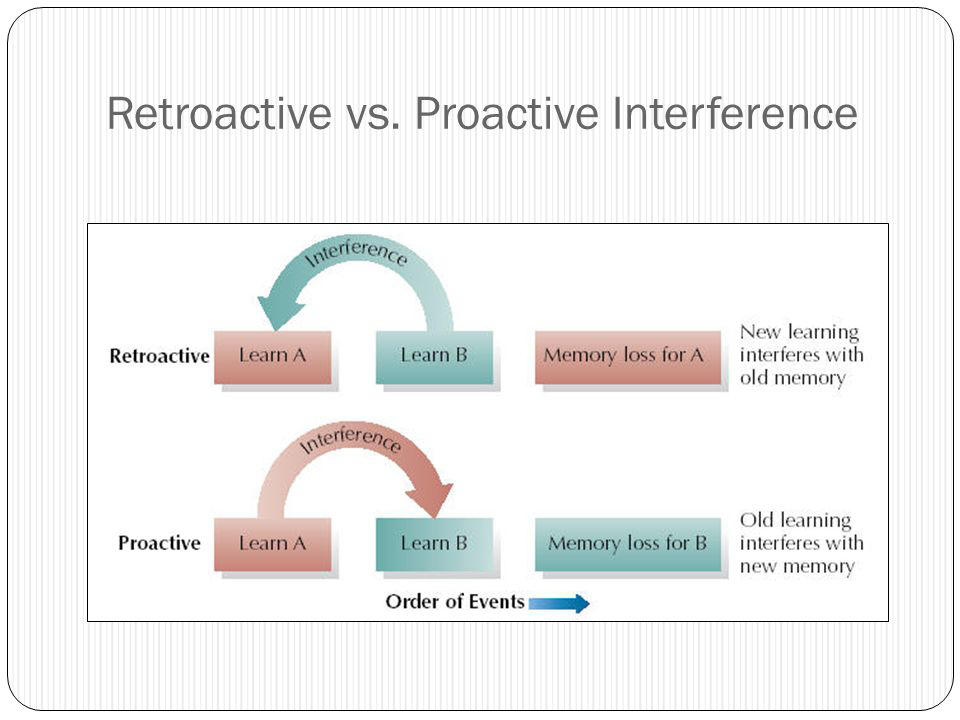
177
what is proactive interference?
something from prior memory affects new learning
E.g. writing down the old year after Jan 1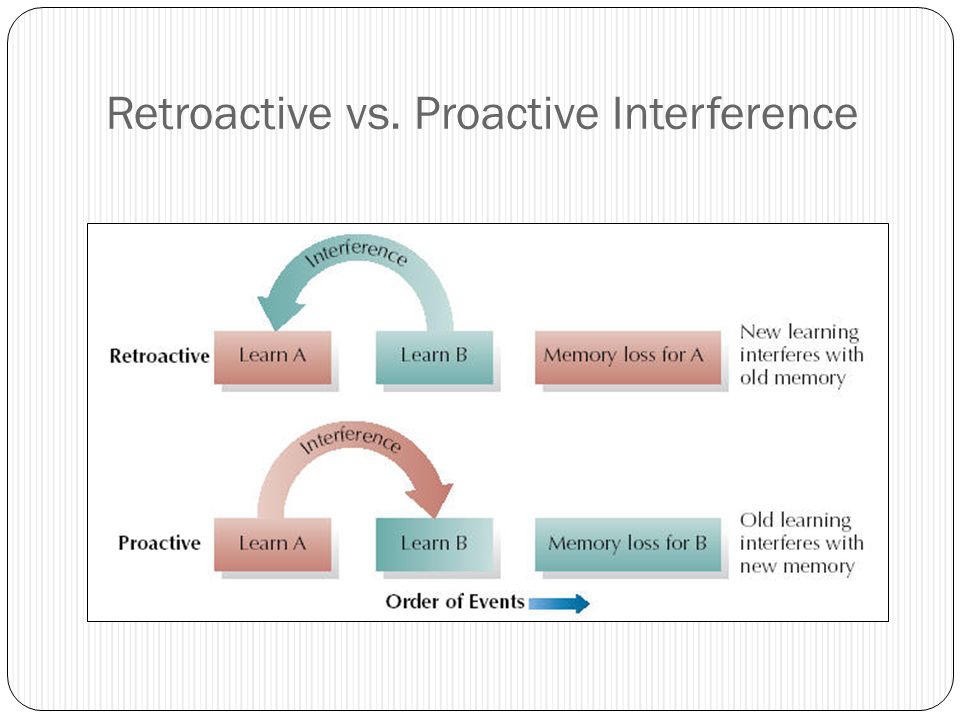
E.g. writing down the old year after Jan 1
178
what remains stable as people age?
implicit memory and recognition abilities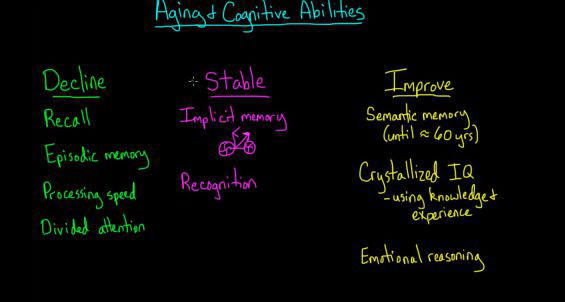
179
what abilities decline as people age?
free and cued recall, forming episodic memory, processing speed, divided attention, prospective memory (remembering to do things in future)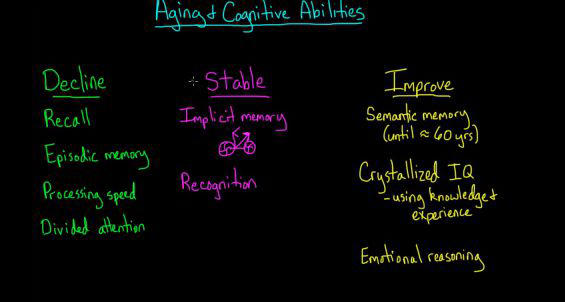
180
what skills improve as we age?
semantic memory, emotional reasoning, crystallized IQ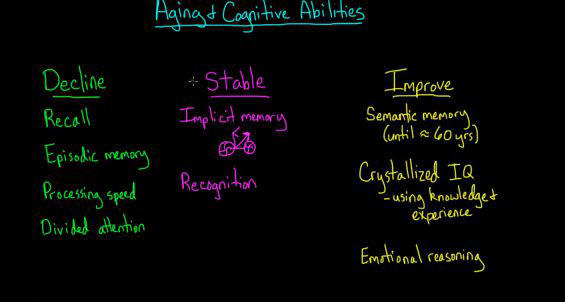
181
what is crystallized IQ/intelligence?
the ability to use skills, knowledge, and experience. It does not equate to memory, but it does rely on accessing information from long-term memory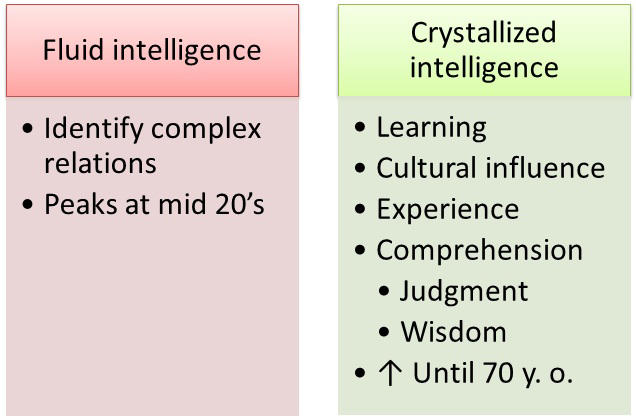
182
what is the main suspected cause of alzheimer's
buildup of amyloid plaques in brain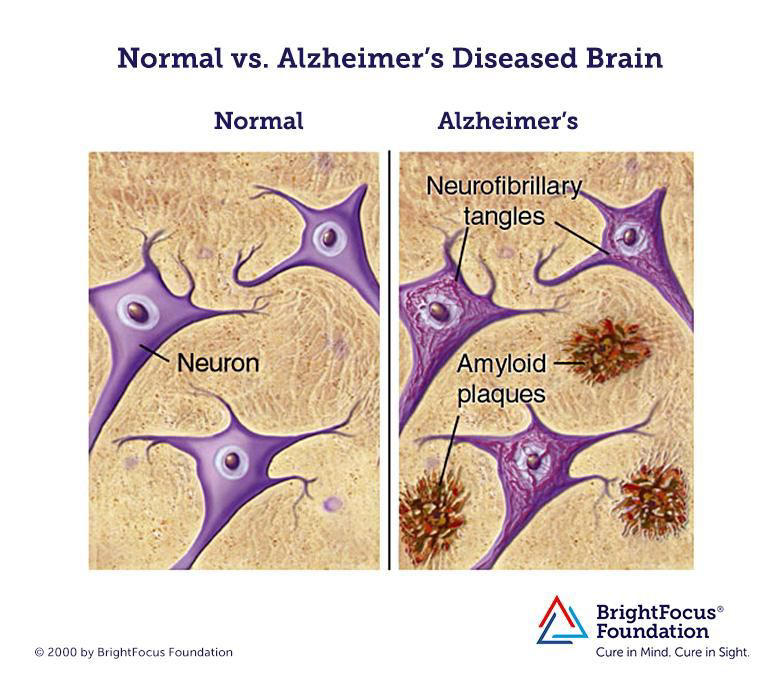
183
what is korsakoff's syndrome and two causes?
similar to AD, causes severe memory deficits, confabulation (mmaking up stories to fill memory gaps) however NOT progressive (treatment can make you better).
main cause is malnutrition/lack of thiamine or vitamin B1. common in alcoholics.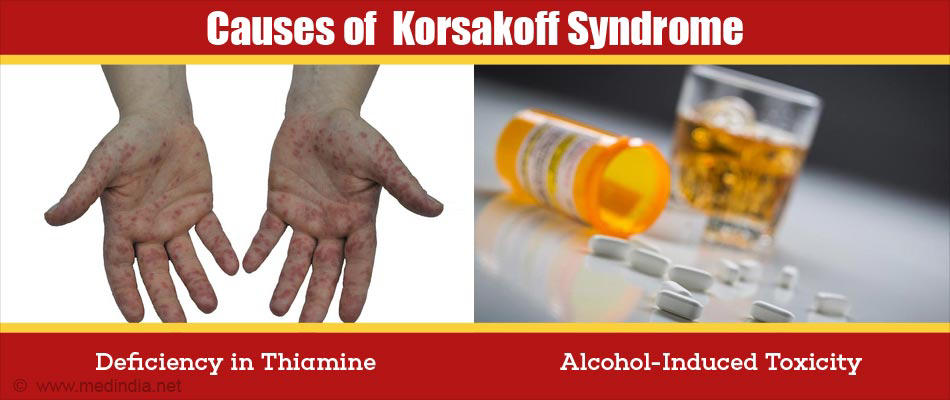
main cause is malnutrition/lack of thiamine or vitamin B1. common in alcoholics.
184
what is wernicke's encephalopathy?
precursor to Korsakoff's syndrome, left untreated it will progress to Korsakoff's. Symptoms are poor balance, abnormal eye movements, mild confusion, and/or memory loss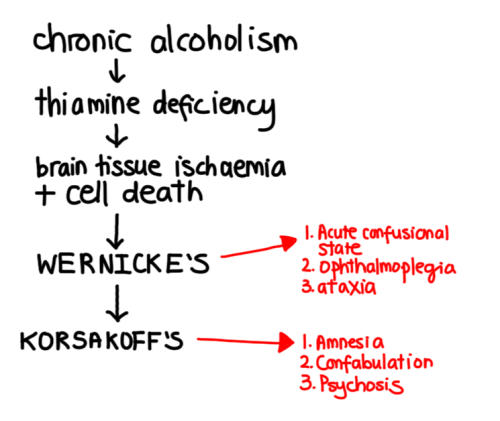
185
what is retrograde amnesia?
inability to recall previously encoded information
186
what is anterograde amnesia?
inability to encode new memories
187
what is a semantic model?
theoretical model of memory encoding in brain. consists of related "nodes"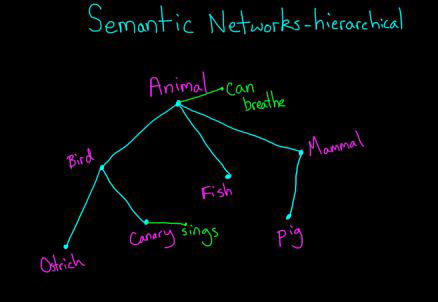
188
what is spreading activation?
one cue/memory stimulates retrieval of other related memories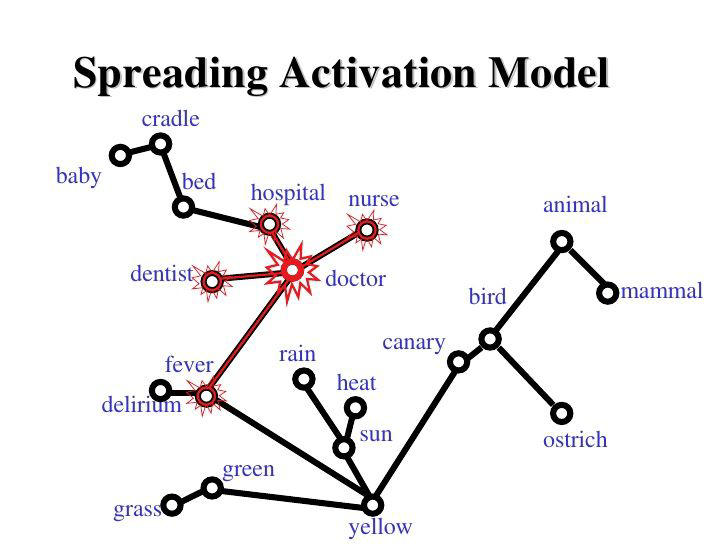
189
object permanence appears in
sensorimotor stage
190
1st stage piaget
-0-2 years
-sensorimotor
-Important aspects: development of object permanence and of stranger anxiety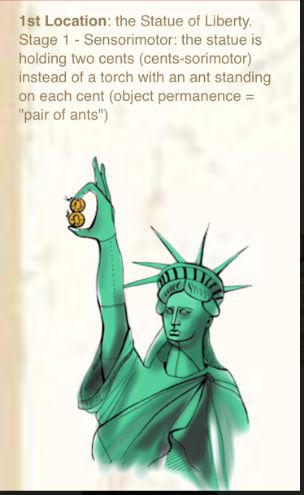
-sensorimotor
-Important aspects: development of object permanence and of stranger anxiety
191
2nd stage piaget and age range
2-6 years oldpreoperational
Important aspects: Engage in pretend play, egocentric (don't understand other people have different point of view)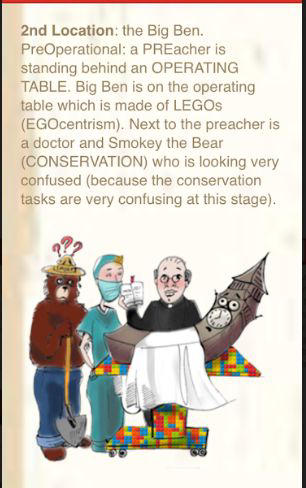
Important aspects: Engage in pretend play, egocentric (don't understand other people have different point of view)
192
3rd stage piaget and age range
7-11 yearsconcrete operational
Important aspects: develop conservation, empathy, math skills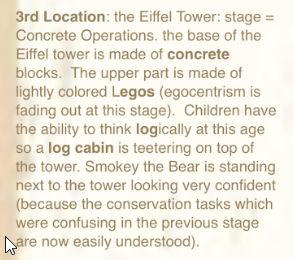
Important aspects: develop conservation, empathy, math skills
193
4th stage piaget and age range
11+formal operational
Important aspects: – reason abstract
consequences, and reason consequences; moral reasoning. At this point children
are reasoning more like adults and they continue to develop that overtime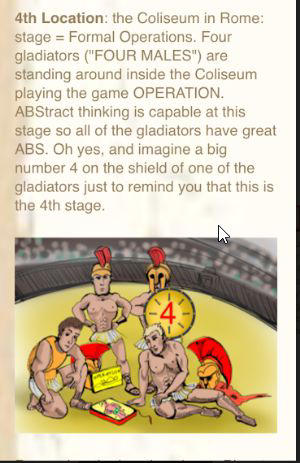
Important aspects: – reason abstract
consequences, and reason consequences; moral reasoning. At this point children
are reasoning more like adults and they continue to develop that overtime
194
a child that recognizes conservation of matter (the water glass test) is in what stage of development?
concrete operational
195
at what stage do children begin to engage in abstract thought and moral reasoning?
formal operational
196
what is a schema?
a mental model/framework for how we view the world
197
what is assimilation?
trying to fit things into an existing schema (ss=same schema)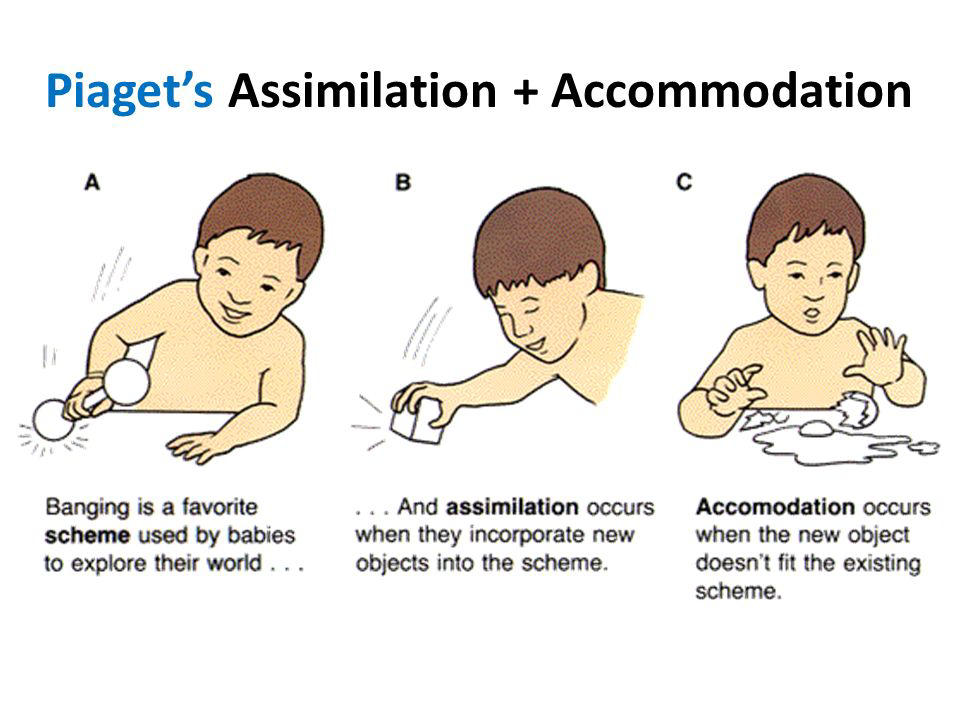
198
what is accomodation?
formulating a new schema to interpret new shit, or modifying existing schema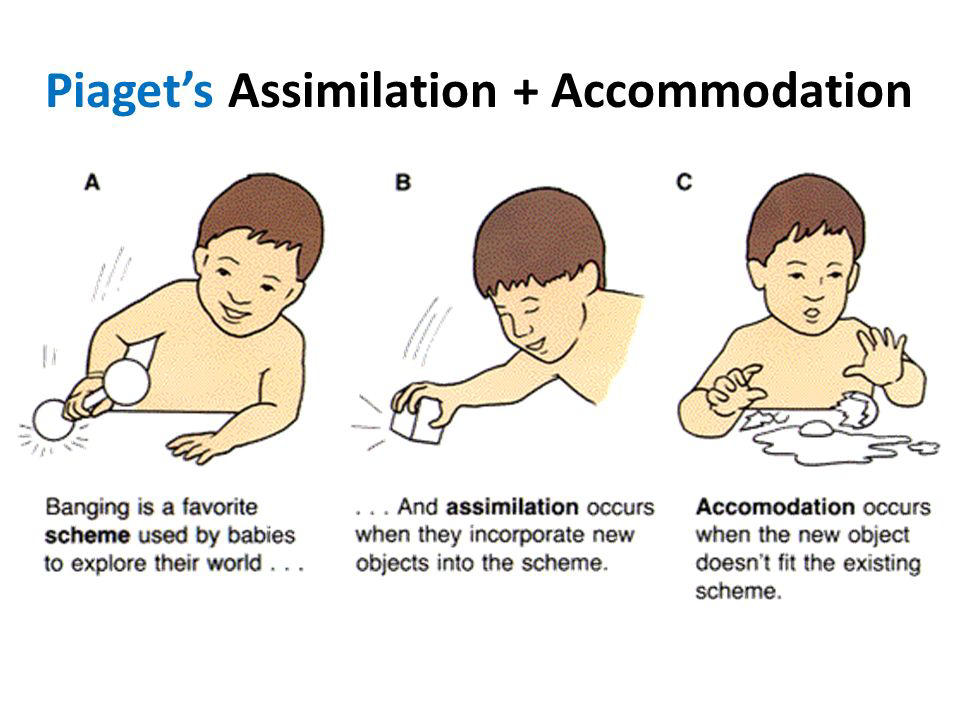
199
what is a well defined problem?
problem with a clear start and end point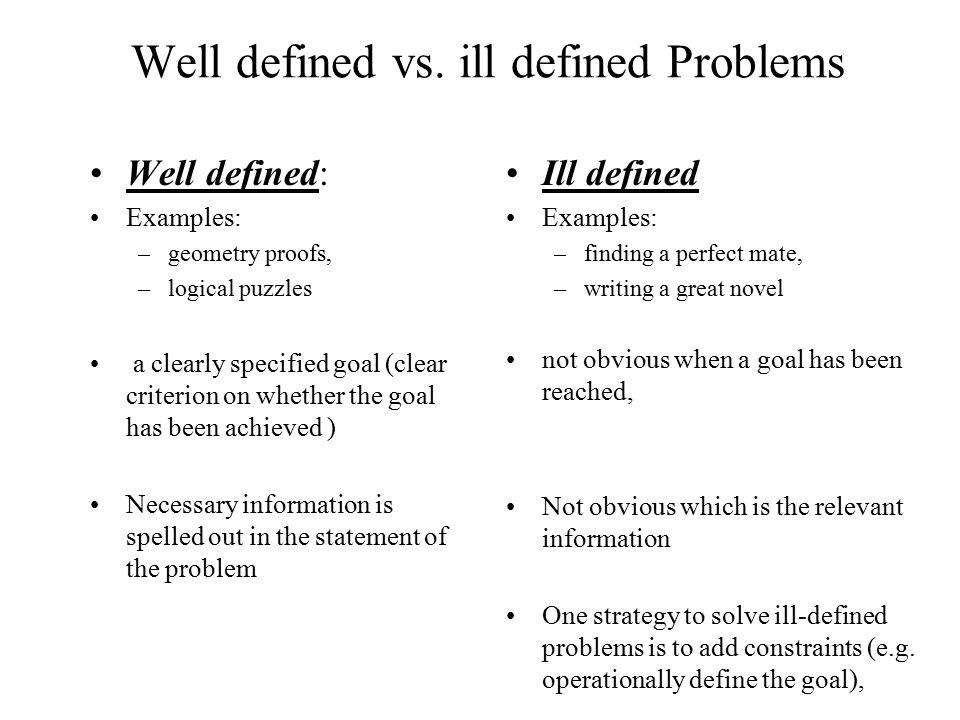
200
what is an ill defined problem?
has more ambiguous starting and ending point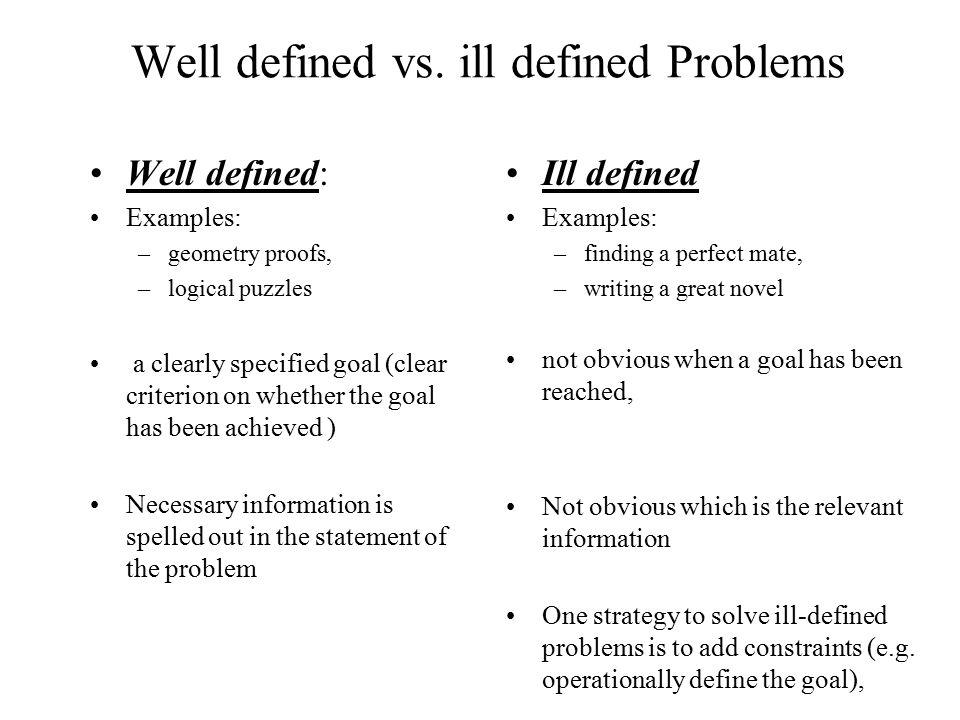
201
what is a heuristic?
a mental shortcut to find solution faster than trial&error or algorithmic (using your birthday to guess a password)
202
what is trial and error?
repeatedly trying all possible combinations to solve something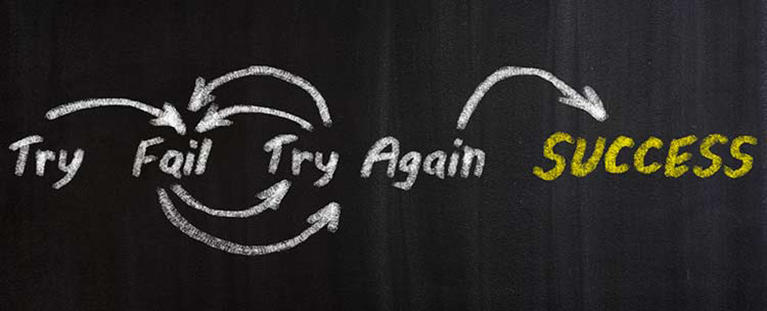
203
what is algorithmic problem solving?
solving problems using a set step by step method
204
what is means-end analysis?
a heuristic where you break a large problem down into smaller problems and attack the one that creates the greatest difference between your current state and desired state
ex: planning trip to another country - biggest problem - book a plane ticket to a new country
ex: planning trip to another country - biggest problem - book a plane ticket to a new country
205
what is intuition?
relying on instinct (high chance of error)
206
what is fixation?
getting stuck with the wrong approach to solving a problem
207
what is a type 1 error?
false positive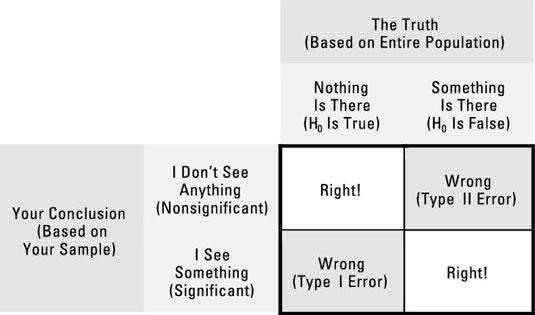
208
what is a type II error?
false negative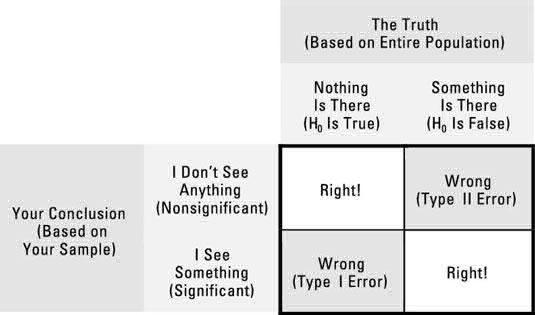
209
what is the availability heuristic?
using examples that come to mind (shark attacks vs fireworks example) Doesn't usually work since our easily memorable experiences don't usually match the real state of the world
ACTUAL MEMORIES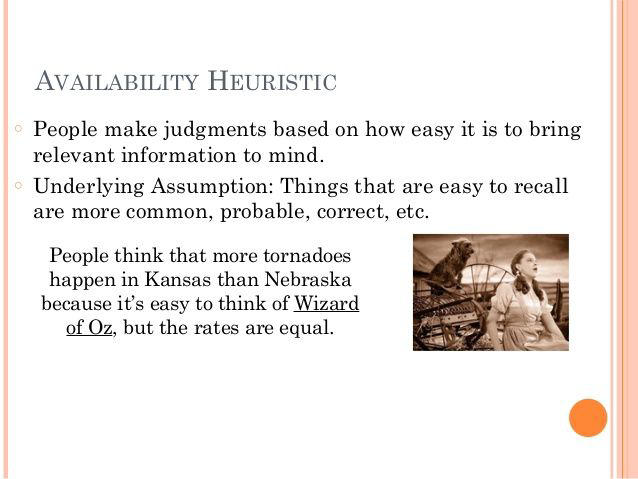
ACTUAL MEMORIES
210
what is the representativeness heuristic?
when you look for a representative prototype and use that to make decisions/inferences (Ex: Linda is outspoken and very bright, majored in philosophy and as a student she participated in antinuclear demonstrations and organizations that fought
discrimination. What is more likely? Linda is a Feminist bank teller or a bank
teller. Most people will say she is more like a feminist bank teller even if they
don’t know feminists or anyone like Linda. She fits you prototype of how a
feminist would act (she is representative of a feminist).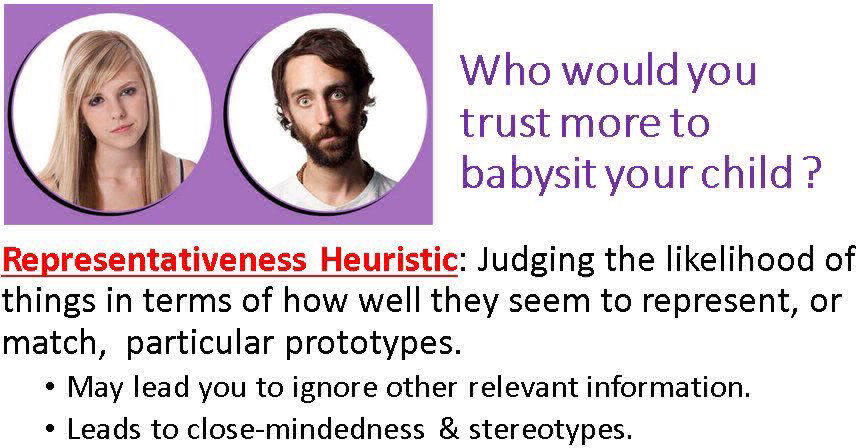
discrimination. What is more likely? Linda is a Feminist bank teller or a bank
teller. Most people will say she is more like a feminist bank teller even if they
don’t know feminists or anyone like Linda. She fits you prototype of how a
feminist would act (she is representative of a feminist).
211
what is a conjunction fallacy?
People tend to think the probability of 2 events
occurring together is higher than the probability of one alone (ex. Linda being a
bank teller and feminist is greater than just being a bank teller. However
statistically speaking there are more bank tellers than feminist bank tellers so it’s
more likely she is just a bank teller than a feminist + bank teller, which your
instincts might be telling you)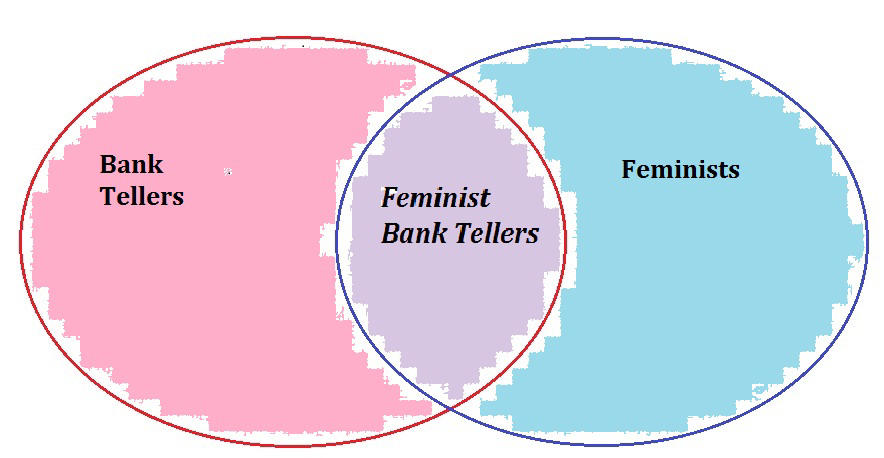
occurring together is higher than the probability of one alone (ex. Linda being a
bank teller and feminist is greater than just being a bank teller. However
statistically speaking there are more bank tellers than feminist bank tellers so it’s
more likely she is just a bank teller than a feminist + bank teller, which your
instincts might be telling you)
212
what is belief perserverance?
ignoring facts that challenge your beliefs, or go against what you believe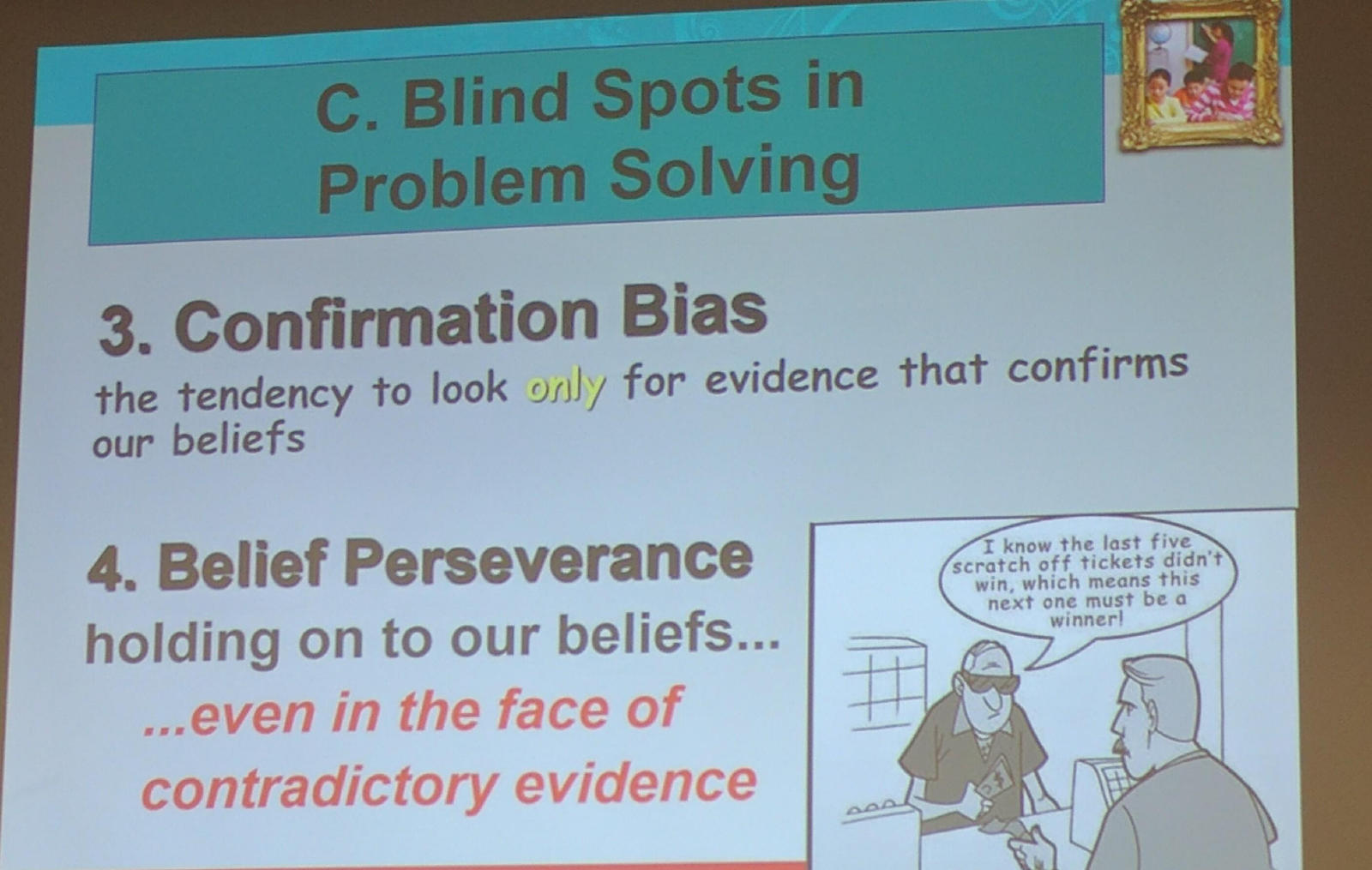
213
what is confirmation bias?
actively seeking out only things that confirm what you believe or only having confirmatory things available to you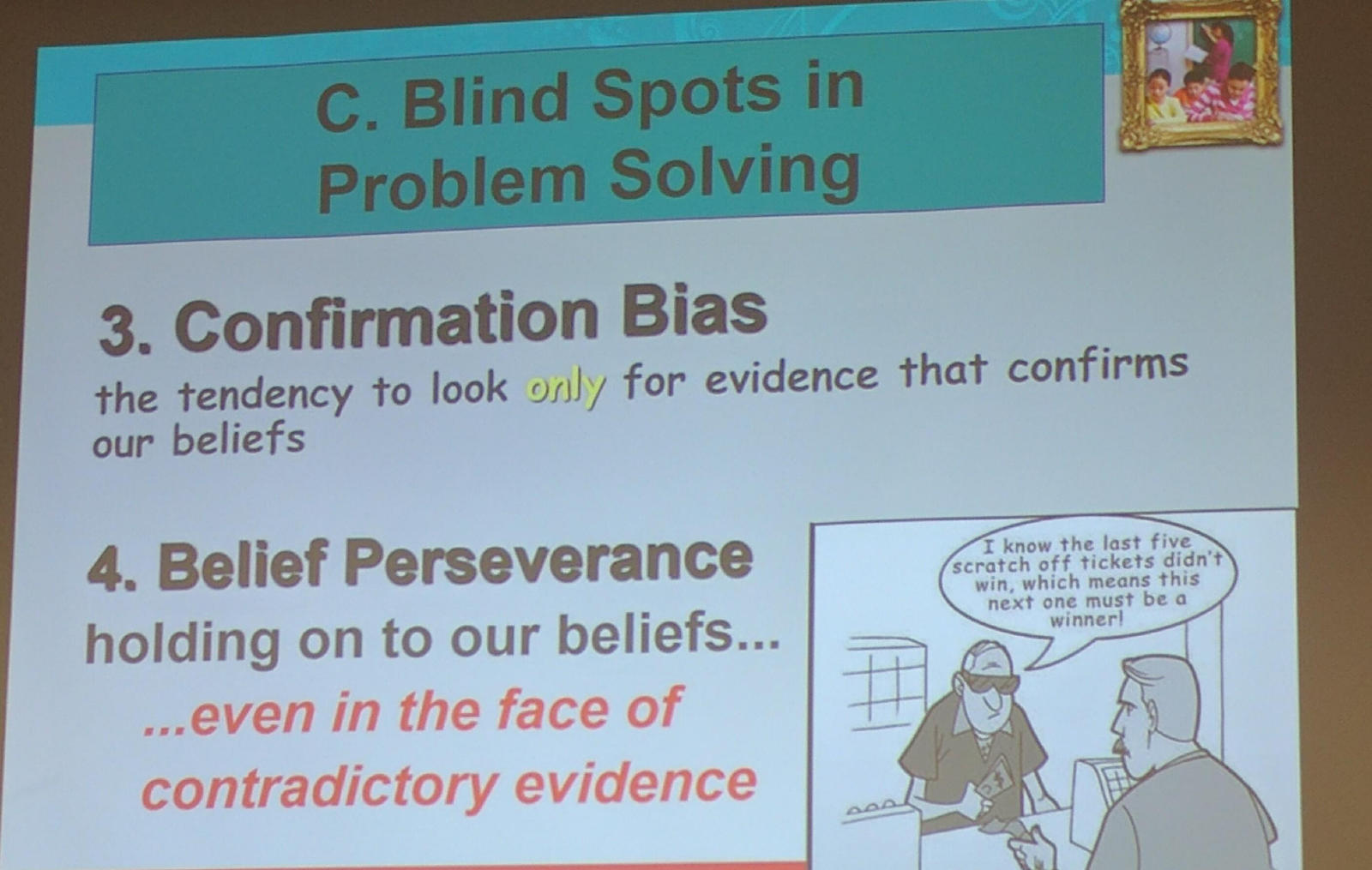
214
spearman's intelligence theory postulates
there is one underlying "g factor" that determines how intelligent people are at all tasks. person who scores high in one area will score high in another. Backed by research
215
what is analytical intelligence?
academic ability to solve well defined problemsability to take apart problems and see solutions not often seen (this is what IQ measures)
216
what is creative intelligence?
ability to adapt to new situations and generate new novel ideas to solve new problems
217
what is practical intelligence?
"street smarts" Ability to apply creative and analytical intelligence skills to everyday situations
218
what is fluid intelligence?
ability to reason quickly and abstractly "think on ones feet"the ability to analyze novel problems (using deductive and inductive reasoning), identify patterns and relationships that underpin these problems and the extrapolation of these using logic
219
what is crystallized intelligence?
ability to use acquired skills/knowledge over the years (includes reading comprehension)
220
who invented the theory of primary mental abilities and what does it state?
L.L Thurnstone-there are 7 factors to intelligence (word fluency, verbal comprehension, spatial reasoning, perceptual speed, numerical ability, inductive reasoning, and memory)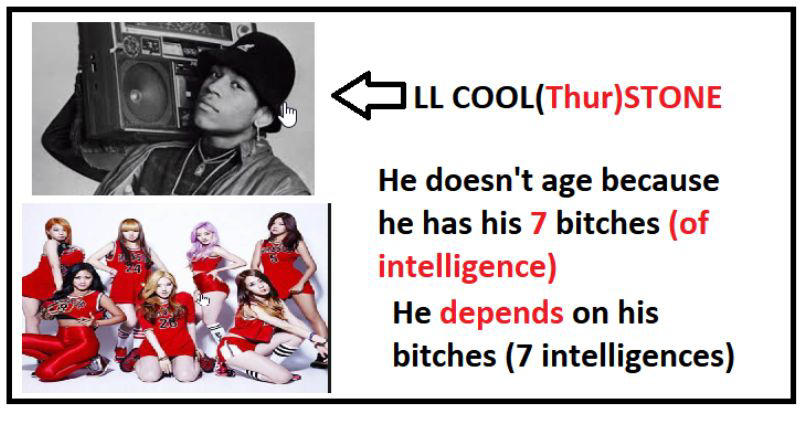
221
what does the theory of multiple intelligences state and who invented it?
Howard Gardner-7-9 very different types of intelligence that don't affect one another (logical-mathematical intelligence, verbal-linguistic, spatial-visual, bodily-kinesthetic, interpersonal, intrapersonal, musical. Later 2 added: naturalist, and existential intelligence)
222
what does the triarchic theory of intelligence state and who invented it?
Robert Sternberg-there are 3 independent intelligences that are based on real world success (analytical, creative, and practical)
"3 sides of same coin", inclusive of all other theories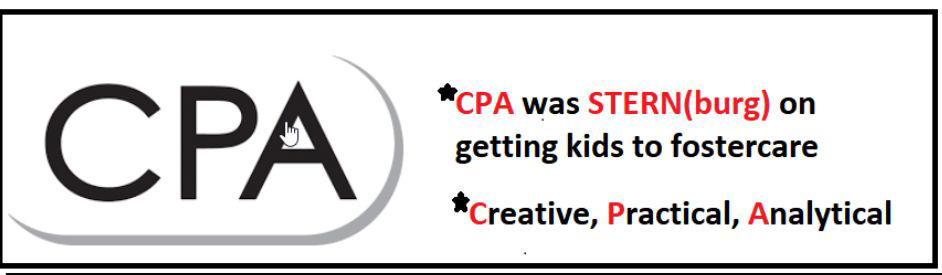
"3 sides of same coin", inclusive of all other theories
223
language is mostly localized to the __ hemisphere
left
224
what is aphasia?
any disorder involving language
225
what is broca's aphasia?
"broken speech", trouble speaking, halting/jarring speech but you can understand what people are saying
NON-FLUENT APHASIA (THEY CANT TALK FOR SHIT)
PICTURE BARACK OBAMA - GOOD AT SPEECHES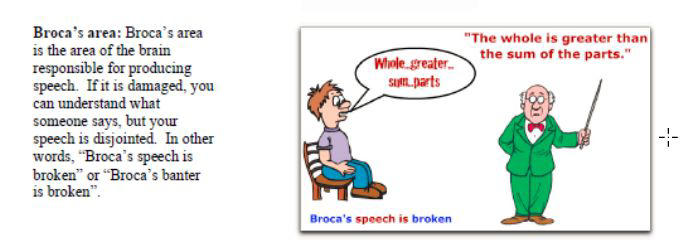
NON-FLUENT APHASIA (THEY CANT TALK FOR SHIT)
PICTURE BARACK OBAMA - GOOD AT SPEECHES
226
what is Wernicke's aphasia?
"fluent aphasia", nothing the person says makes logical sense and you have trouble understanding. receptive aphasia
(FLUENT APHASIA - THEY CAN TALK)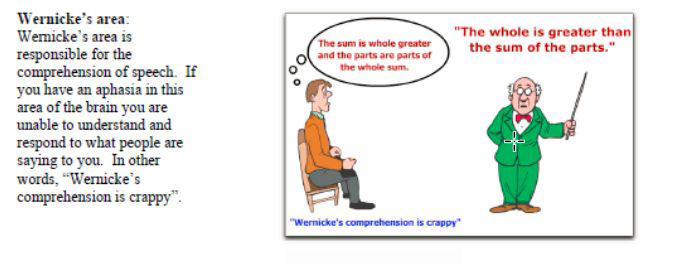
(FLUENT APHASIA - THEY CAN TALK)
227
what is global aphasia?
wernicke's and broca's aphasia put together
228
what connects Wernicke's and Broca's area?
the arcuate fasciculus
229
what is conduction aphasia?
when the arcuate fasciculus(connection between Wernicke's and Broca's) is broken, cannot connect the two things. difficult to repeat things that are said to you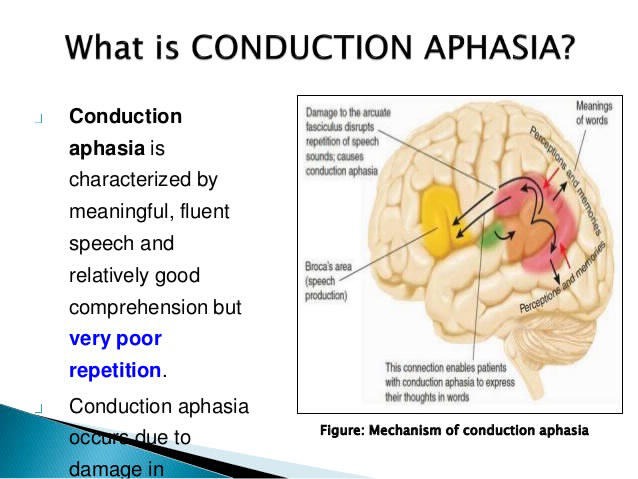
230
what is agraphia?
inability to write
231
what is anomia?
inability to name things
232
what does the linguistic universalism theory state?
thought determines language completely.
Ex: New Guinea only have 2 words for color because they only think about dark and light. If they had other thoughts, they would develop more words for color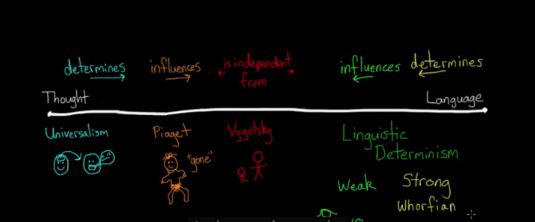
Ex: New Guinea only have 2 words for color because they only think about dark and light. If they had other thoughts, they would develop more words for color
233
what does Piaget think about language development?
when children learn to think in a certain way they develop language to explain those thoughts
Ex: When develop object permanence, create words like hide or hidden or away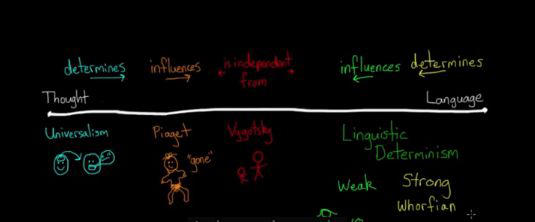
Ex: When develop object permanence, create words like hide or hidden or away
234
what is Vygotsky's theory of language development?
language and thought are both independent, but converge through
development. Eventually learn to use them at same time via socialization -
Believed children developed language through social interaction with adults who
already knew the language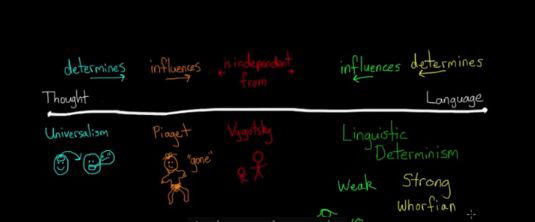
development. Eventually learn to use them at same time via socialization -
Believed children developed language through social interaction with adults who
already knew the language
235
what is the weak hypothesis of linguistic determinism?
aka relativism-language influences thought. makes it easier for us to think in ways our language is structured
Ex: language reads left to right so you draw something left to right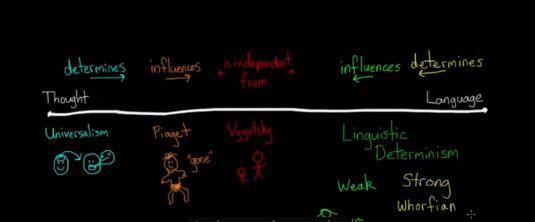
Ex: language reads left to right so you draw something left to right
236
what is the strong hypothesis of linguistic determinism? ( and other name)
aka Sapir-Whorfian hypothesis-language determines thought COMPLETELY.
Ex: tribe of ppl who don't have grammar for past tense dont think about time the same way we do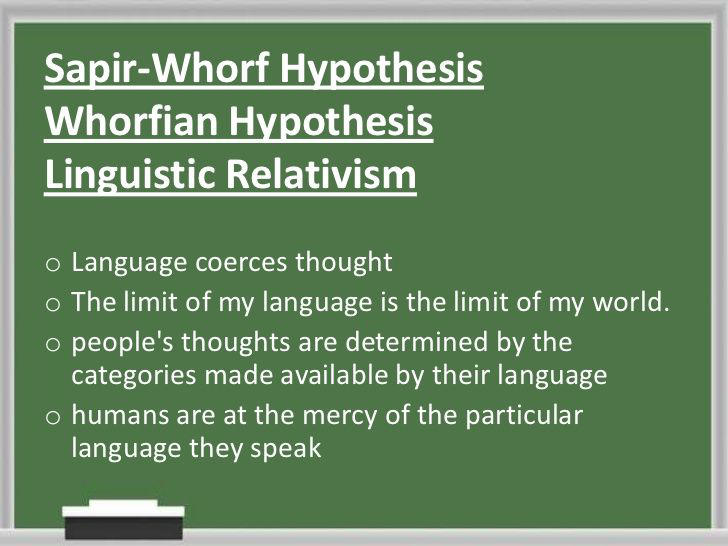
Ex: tribe of ppl who don't have grammar for past tense dont think about time the same way we do
237
what does the nativist theory of language development state and who is associated with it?
babies have "language acquisition device" that is most active during the "critical period" up until 8 years old. associated with Noam Chomsky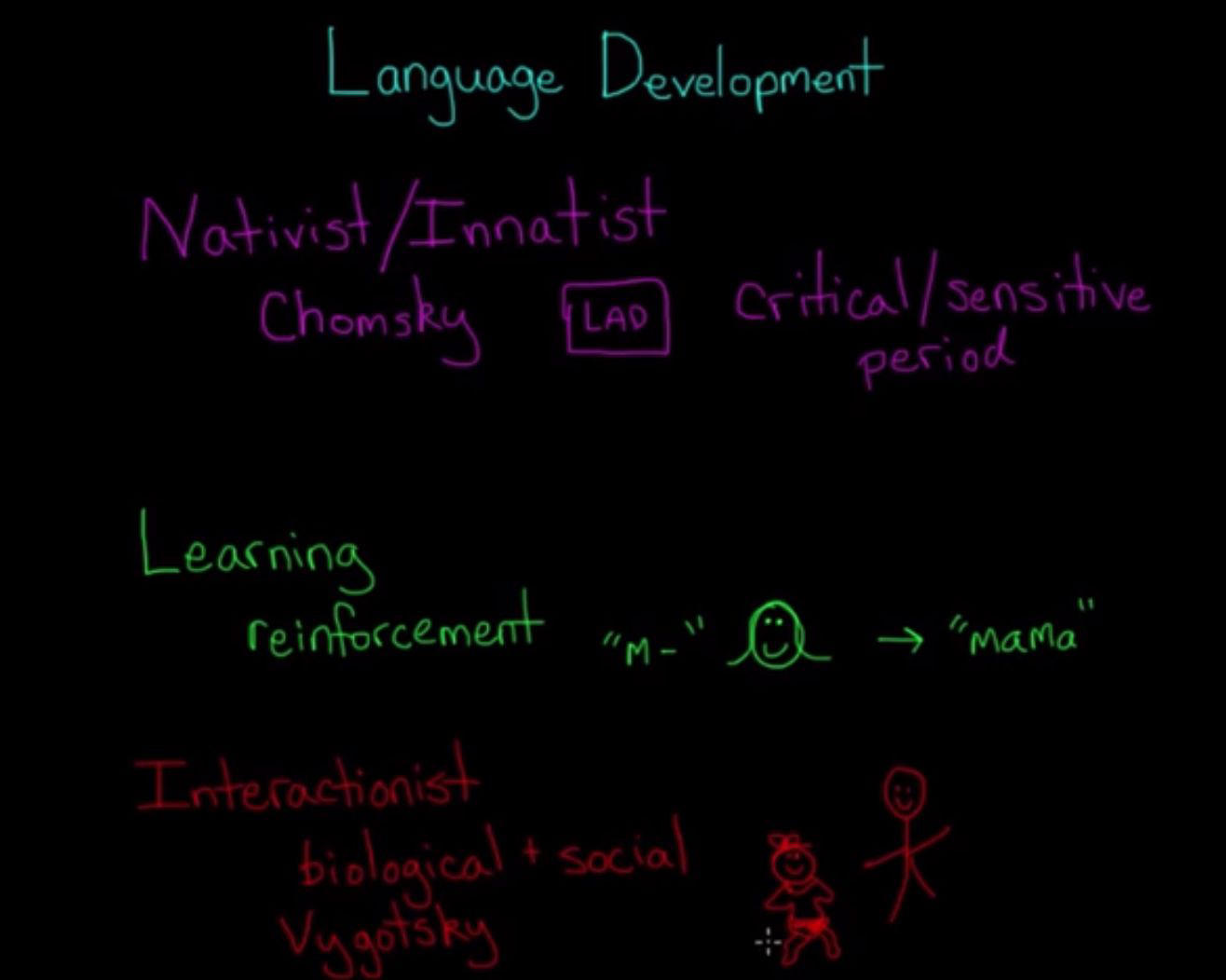
238
what does the learning\/behaviorist theory of language acquisition state and who is associated with it
babies learn language through operant conditioning from parents - BF skinner
ex. Child learns to say “mama” because every time they say that, mom reinforces child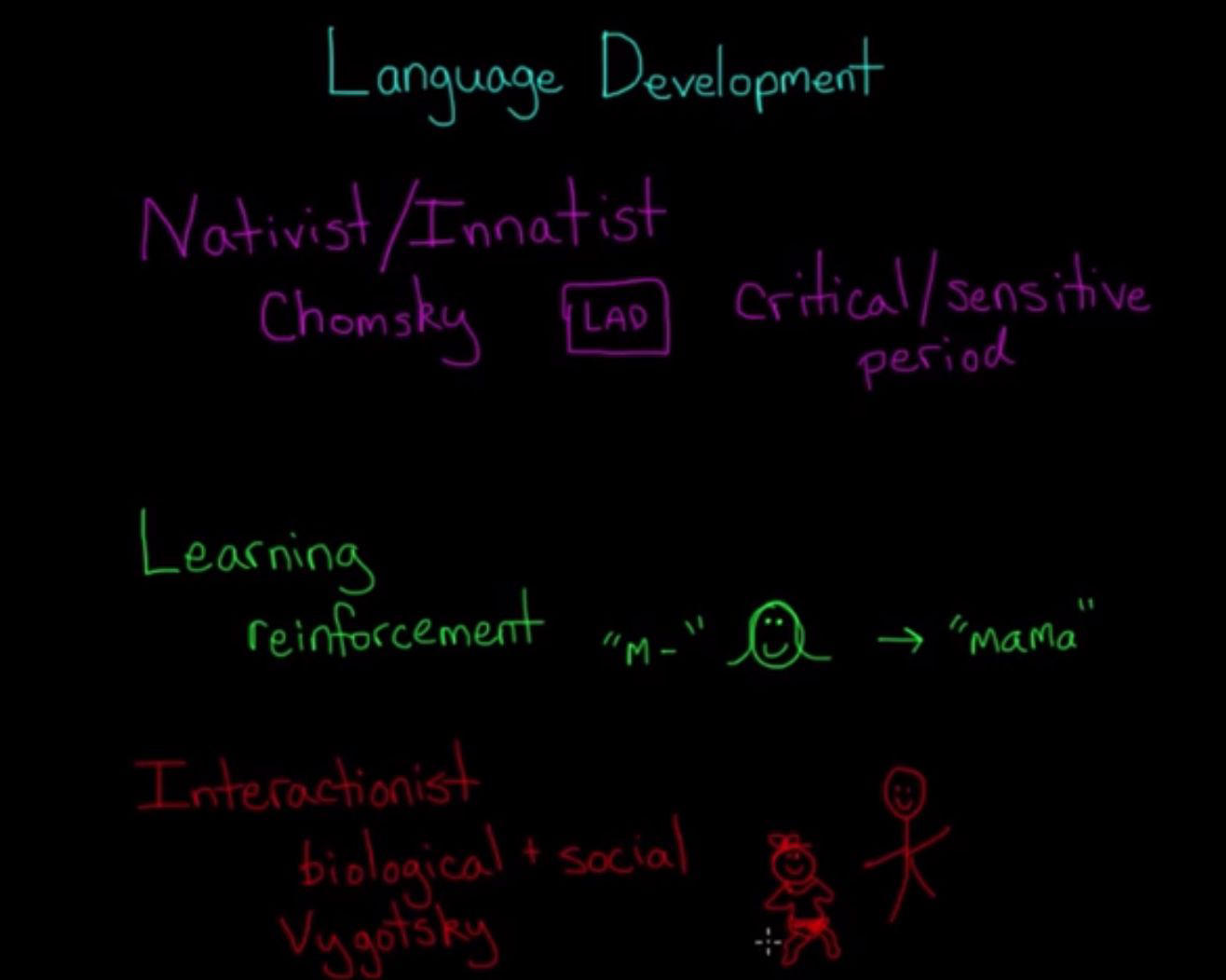
ex. Child learns to say “mama” because every time they say that, mom reinforces child
239
what does the interactionist/social interactionist theory of language acquisition state and who is associated with it?
associated with Vygotsky. states that childrens desire to communicate with others, such as adults in their life, leads them to develop language
Biological and social factors have to interact for children to learn language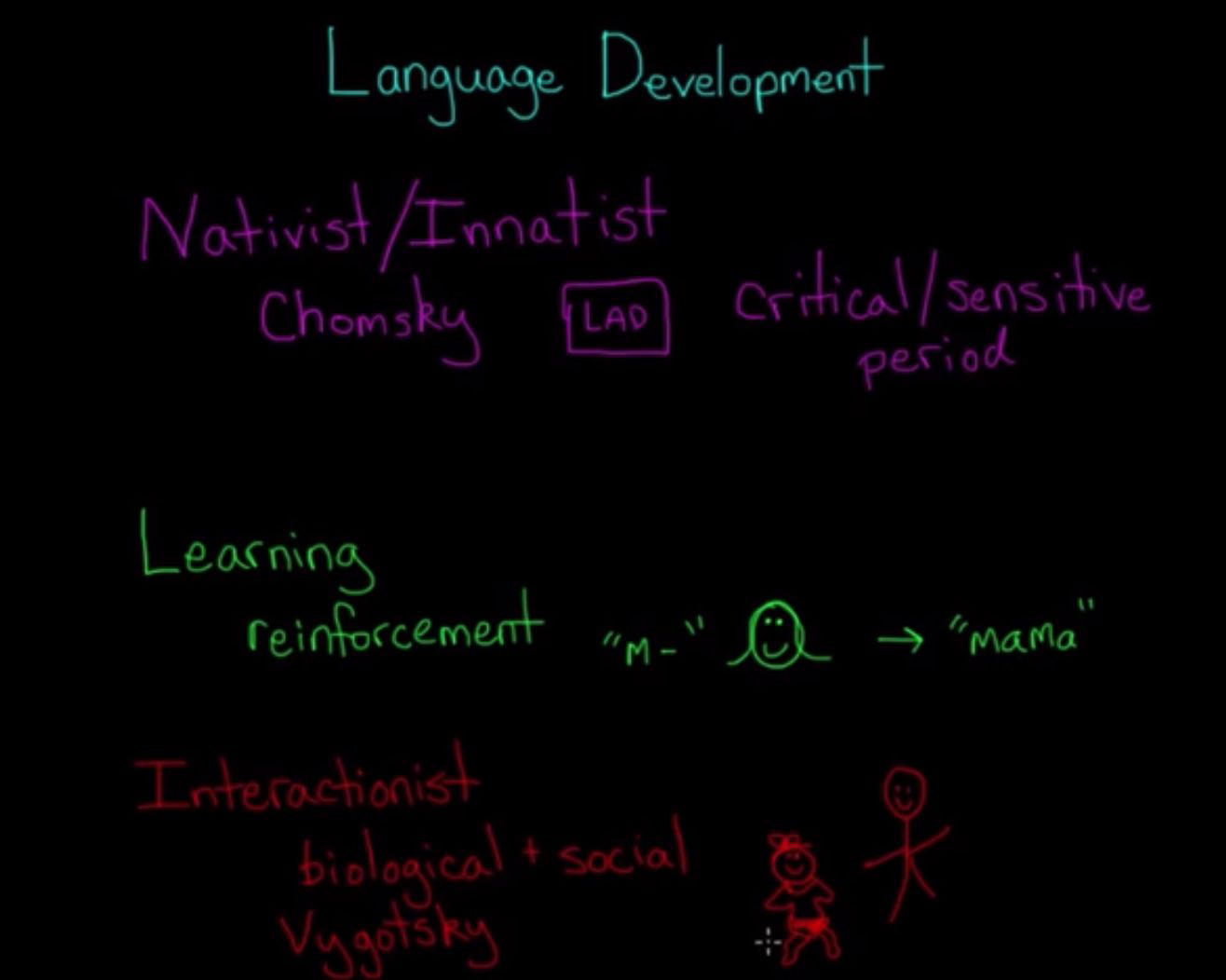
Biological and social factors have to interact for children to learn language
240
what are the basic structures that comprise the limbic system?
hypothalamus, thalamus, amygdala, hippocampus, cingulate gyrus, PFC
Ex: hippo(campus) wearing a HAT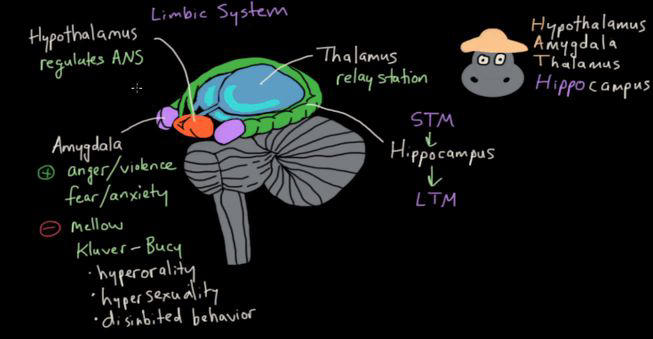
Ex: hippo(campus) wearing a HAT
241
what is the function of the thalamus?
sensory relay station. smell is the only sense that bypasses the thalamus
242
what is the function of the amygdala?
negative emotions, fear, stress anxiety, aggression. stimulating it produces above and destroying one gives mellowing affect
243
what is kluver-bucy syndrome?
destruction of the amygdala results in decreased inhibition, hyperorality, hypersexuality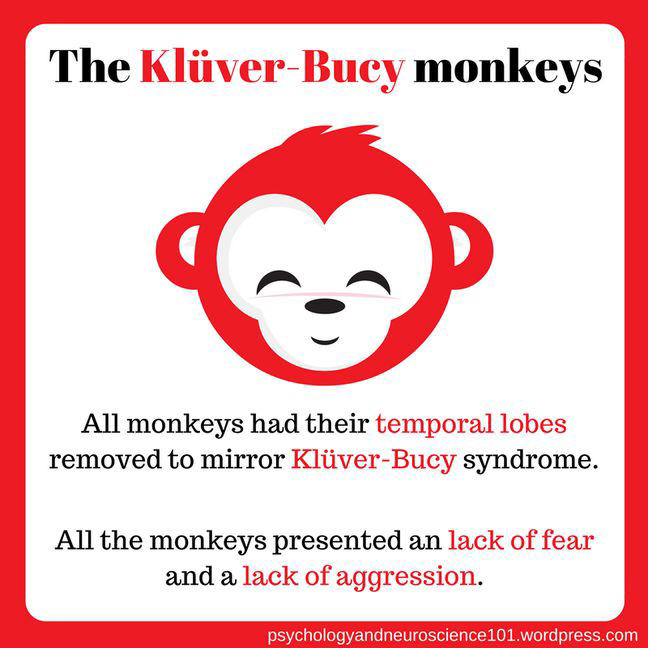
244
what is the function of the hippocampus?
converts short term memory into long term memory.
245
what is the function of the hypothalamus
control of autonomic nervous system and basic drives (food thirst sleep sex). Also controls pituitary gland
246
positive emotions are associated with the __ side of the brain and negative emotions are associated with the __ side
left
right
right
247
what is the function of the prefrontal cortex?
what makes us "human". higher level thinking, control over actions/emotions
248
what is the sympathetic nervous system?
"fight or flight"pupils dilate, increase HR, Respiration Rate, glucose level, adrenaline (epinephrine)
decrease digestion/salivation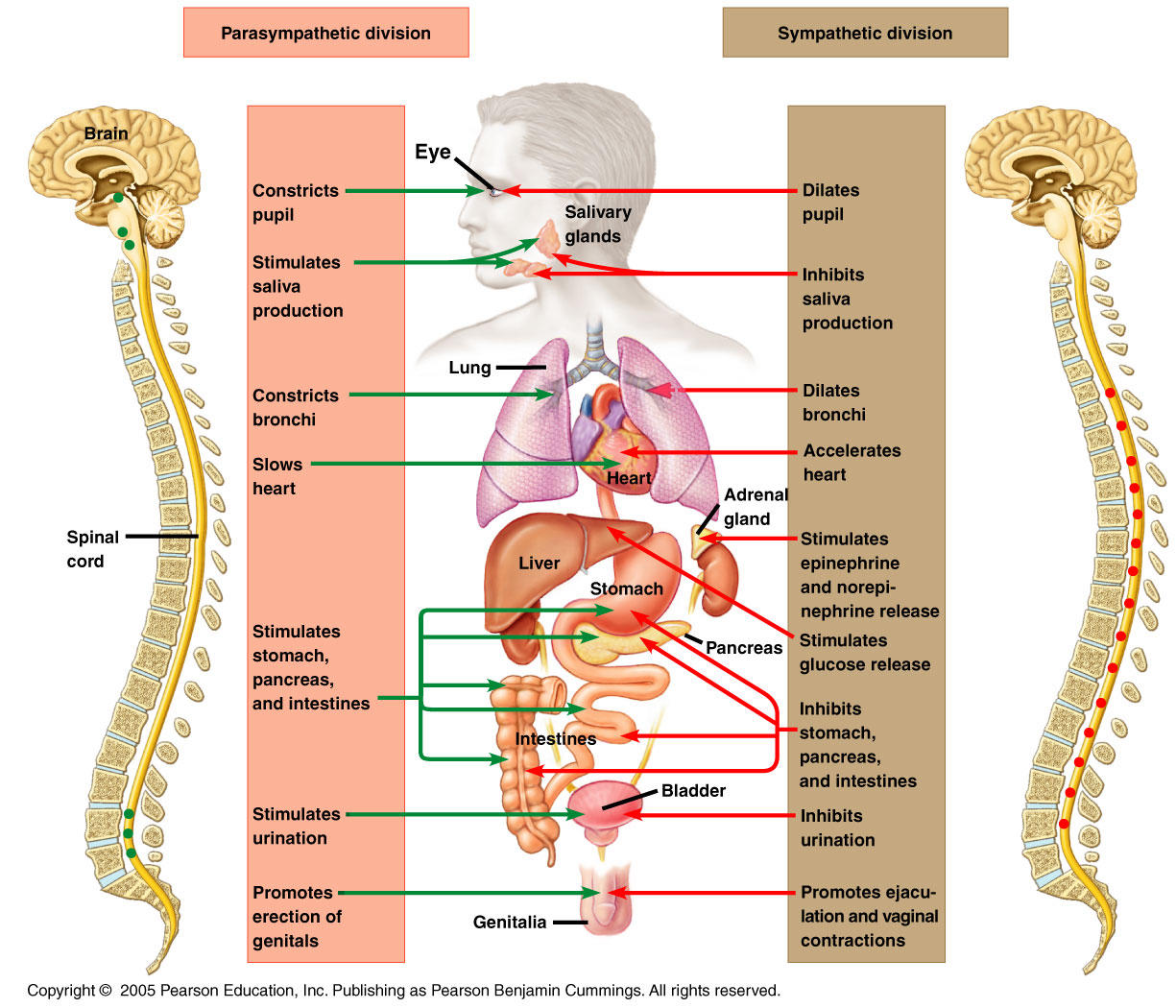
decrease digestion/salivation
249
what is the parasympathetic nervous system?
"rest and digest". pupils CONSTRICT, increase salivation, glucose STORAGE, digestion
decrease HR, RR, adrenaline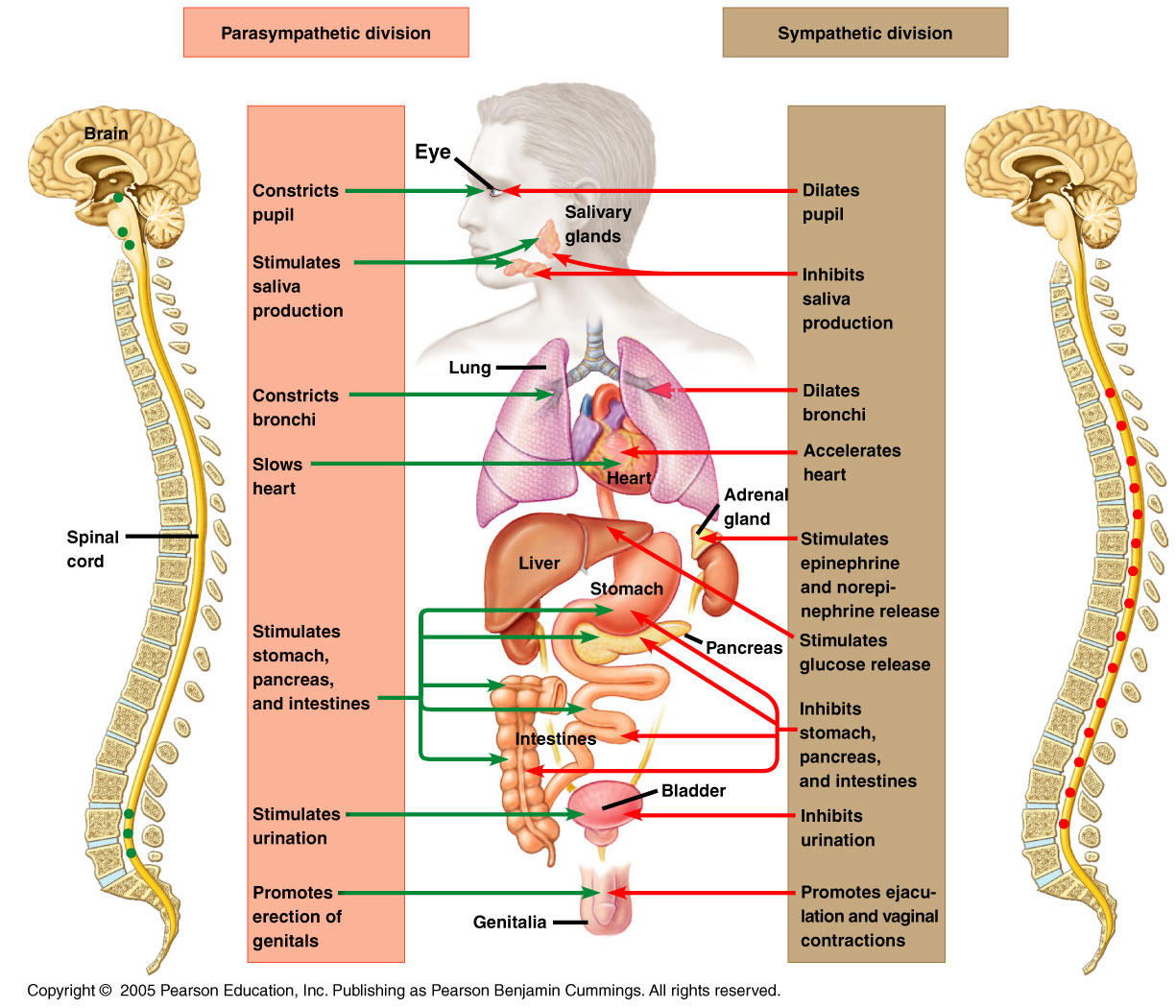
decrease HR, RR, adrenaline
250
what are the cognitive aspects of emotion?
how you are perceiving/thinking about the situation
251
what is the behavioral aspect of emotion?
body language/facial expressions
252
what are the 7 universal emotions and who came up with them?
EEEEEEEKman
Paul Ekman
happy, sad, surprised, fear, anger, disgust, New: contempt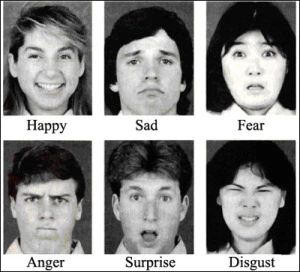
Paul Ekman
happy, sad, surprised, fear, anger, disgust, New: contempt
253
what is the James-Lange theory of emotion?
Event-->Physiologic Response-->Interpretation-->Emotion
Interpreting the physiological signs resulting from an event
Ex2: A man, who is allergic to bees, encounters a bee. The man’s heart
beat increases, he starts sweating, and he interprets these physiological
changes as the emotion fear.
MNEMONIC: JAMES BOND - he's all about action - when an event happens - our body has ACTION happen first (physiological response) - then we interpret
Interpreting the physiological signs resulting from an event
Ex2: A man, who is allergic to bees, encounters a bee. The man’s heart
beat increases, he starts sweating, and he interprets these physiological
changes as the emotion fear.
MNEMONIC: JAMES BOND - he's all about action - when an event happens - our body has ACTION happen first (physiological response) - then we interpret
254
what is the Cannon-Bard theory of emotion?
Event-->Physiologic Response+Emotion
Emotion+Physiologic response happens at same time
Ex: holding your cat (event) causes your heart rate (physiological
response) to increase and feel joy (emotion) at the same time.
mnemonic: picture a bad cannon splitting a cannonball into two (simultaneous)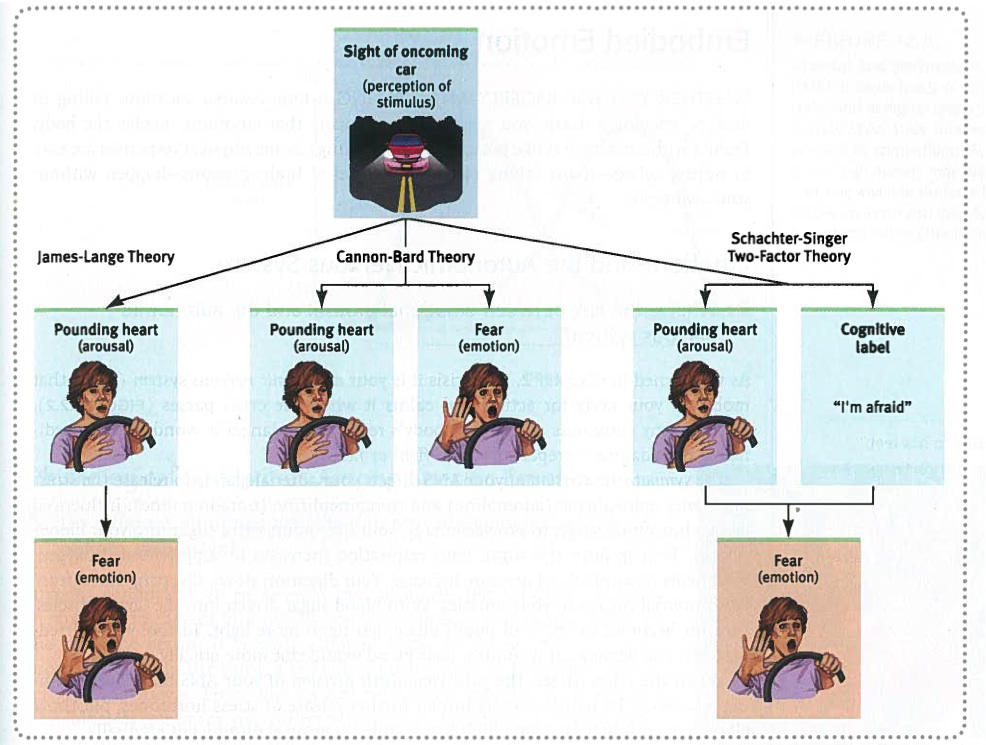
Emotion+Physiologic response happens at same time
Ex: holding your cat (event) causes your heart rate (physiological
response) to increase and feel joy (emotion) at the same time.
mnemonic: picture a bad cannon splitting a cannonball into two (simultaneous)
255
What is the Schacter-Singer theory of emotion?
Event-> PR + Identify reason for the situation
(PR) (consciously)-> Emotion
Ex: Holding your cat (event)-> Physiological response of increase HR/or
changes in NT level-> label the situation and identify reason for
physiological response and event (This is really nice, I like holding my cat,
this makes me happy)-> emotion (Happy)
Requires identifying reason for response
imagine a singer - doesn't know their voice is good - when she finished everyone is clapping for her. event first, which leads to a physiological arousal (clapping), and then she interpets the clapping and realizes that shes a good singer (labeling) then experiences the emotion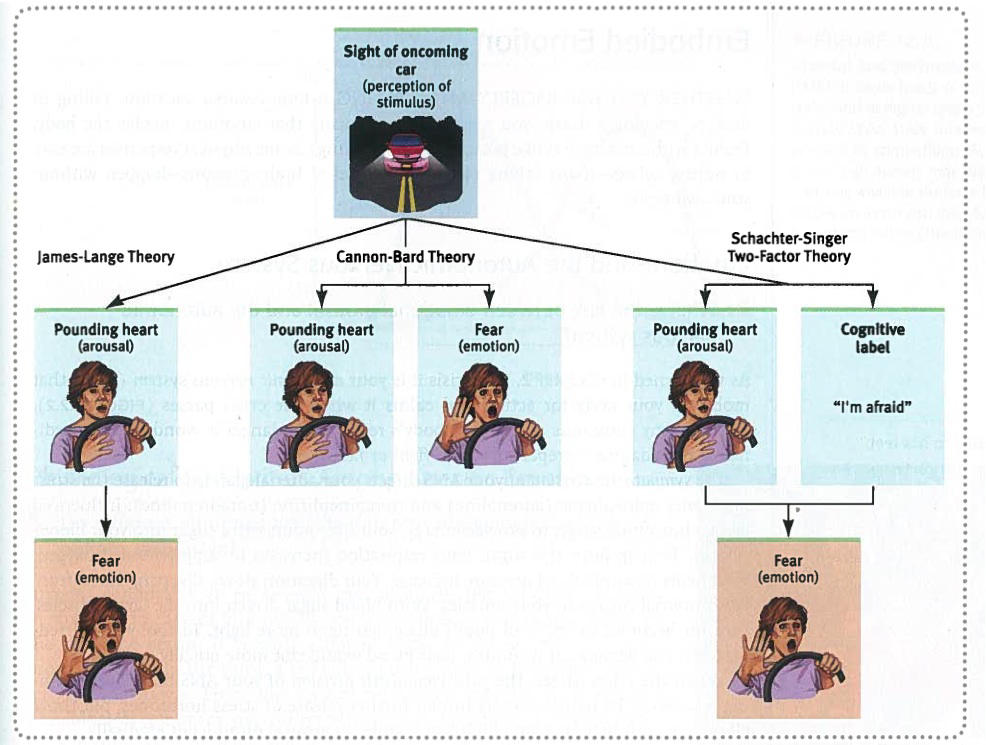
(PR) (consciously)-> Emotion
Ex: Holding your cat (event)-> Physiological response of increase HR/or
changes in NT level-> label the situation and identify reason for
physiological response and event (This is really nice, I like holding my cat,
this makes me happy)-> emotion (Happy)
Requires identifying reason for response
imagine a singer - doesn't know their voice is good - when she finished everyone is clapping for her. event first, which leads to a physiological arousal (clapping), and then she interpets the clapping and realizes that shes a good singer (labeling) then experiences the emotion
256
what is the Lazarus theory of emotion? and other name
Event-->label event(as good\/bad)-->emotion+physiologic response
Requires labeling of event before experiencing emotion and physiologic response at same time
Ex. Event (holding cat)-> labeling situation as good->emotion (joy) + physiological response.
Lazarus - Labeling
AKA cognitive appraisal theory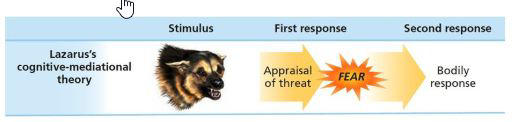
Requires labeling of event before experiencing emotion and physiologic response at same time
Ex. Event (holding cat)-> labeling situation as good->emotion (joy) + physiological response.
Lazarus - Labeling
AKA cognitive appraisal theory
257
what is stress?
process by which we appraise and cope with environmental threats/challenges.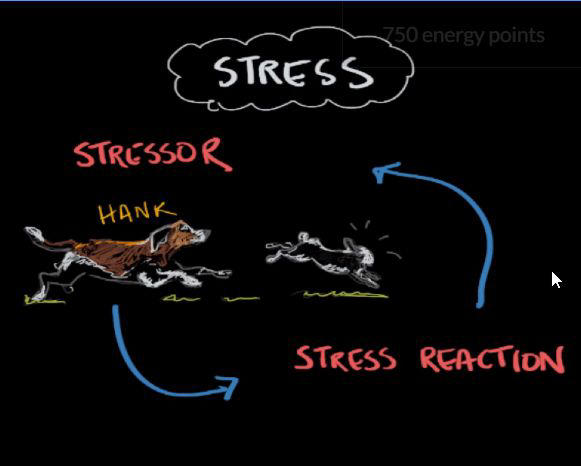
258
what is a stressor?
event that is threatening/challenging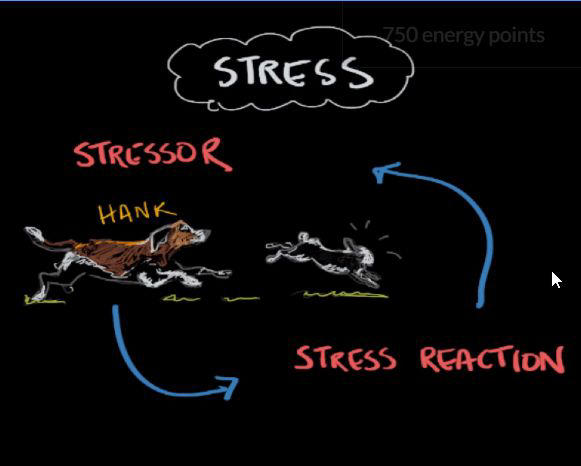
259
what is a stress reaction?
physical/emotional response to a stressor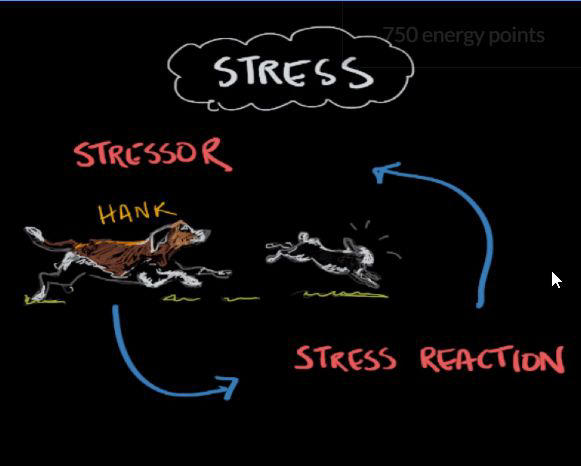
260
what is the appraisal theory of stress and who invented it?
Richard Lazarus- stress arises less from physical events but more from the assessment/interpretation of those stresses/events. Appraisal. There are two stages to the cognitive stages of stress – the primary
appraisal and the secondary appraisal.
appraisal and the secondary appraisal.
261
what is the primary appraisal of stress?
Initial assessment of stressor. Can be irrelevant, benign/helpful, or negative. If negative move to secondary appraisal. Nothing to do with intensity of it, just whether its negative or not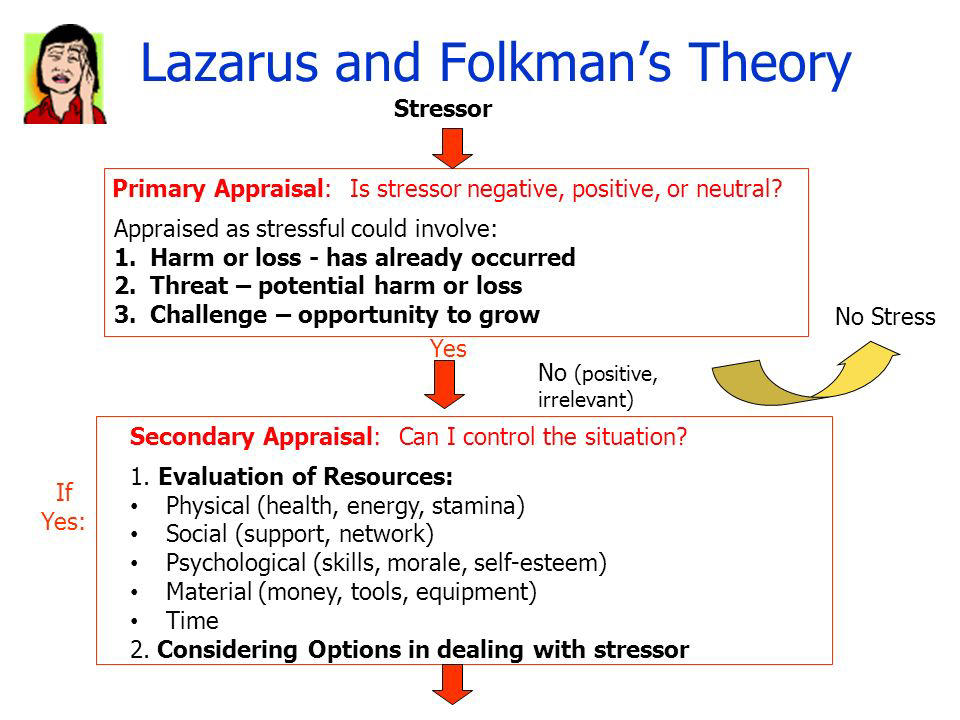
262
what is the secondary appraisal of stress?
evaluation of your ability to cope with the situation. Determine intensity and risk of sressor. Based on Harm, threat, and challenge of stressor
263
what are the 4 major categories of stressors?
(1) significant life changes - college, kids, married
(2) catastrophic events - war, tornadoes
(3) daily hassles(most harmful)
(4) ambient stressors (pollution, noise, crowding)
(2) catastrophic events - war, tornadoes
(3) daily hassles(most harmful)
(4) ambient stressors (pollution, noise, crowding)
264
what is the endocrine response to stress?
adrenal medulla releases catecholamines (norepi/epi), adrenal cortex releases cortisol (steroid hormone redistributes glucose energy in body and suppressing immune system)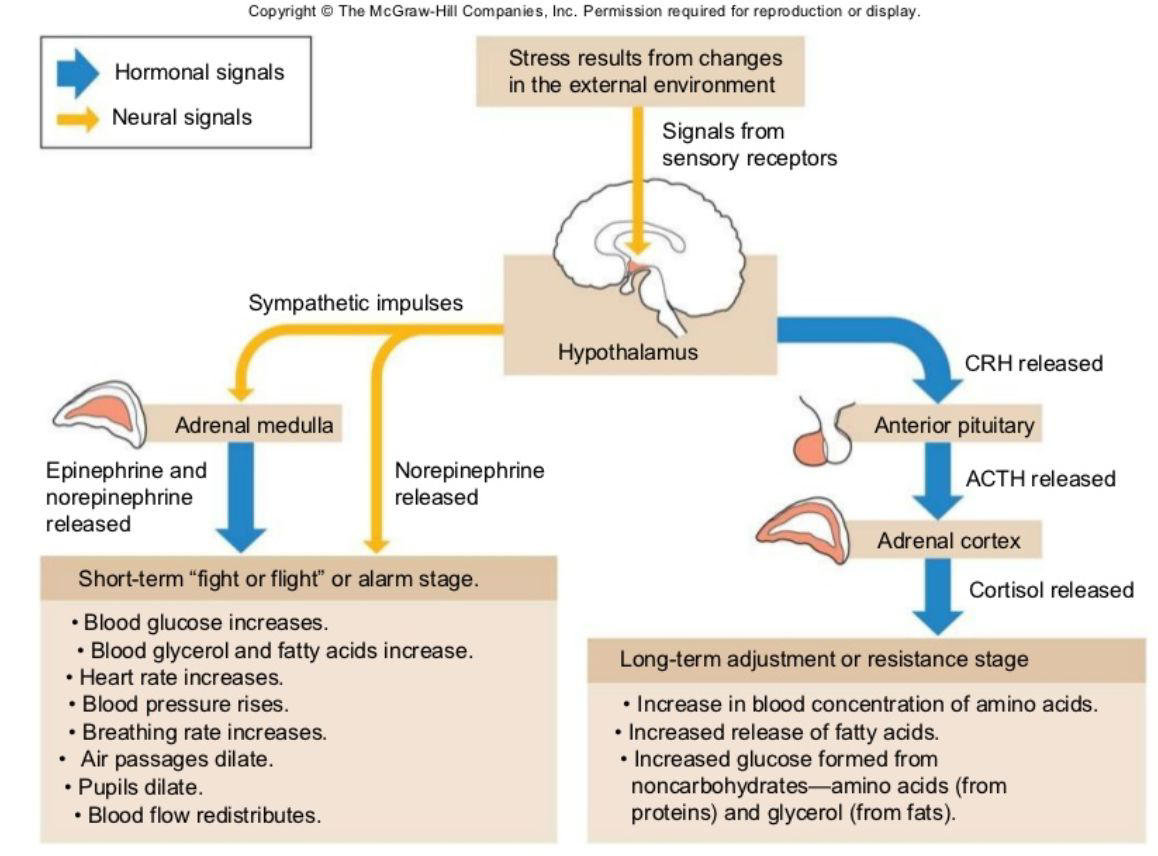
265
what is the tend and befriend response?
oxytocin, respond to stress using support system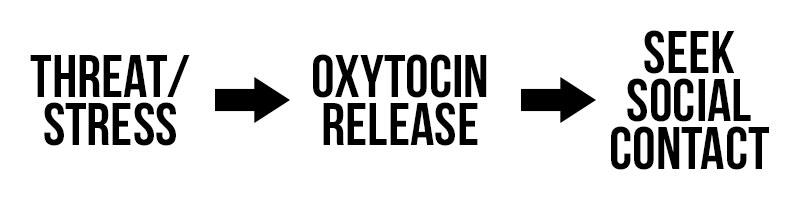
266
what are the 3 stages of the General Adaptation Syndrome and by who?
1) Alarm phase (stress rxn kicks in)2) Resistance (fleeing, huddling,cortisol high, BP and RR high)
3) Exhaustion (resources depleted, tired, dampered immune system)
Hans Selye
LOOK AT GRAPH as resistance to strss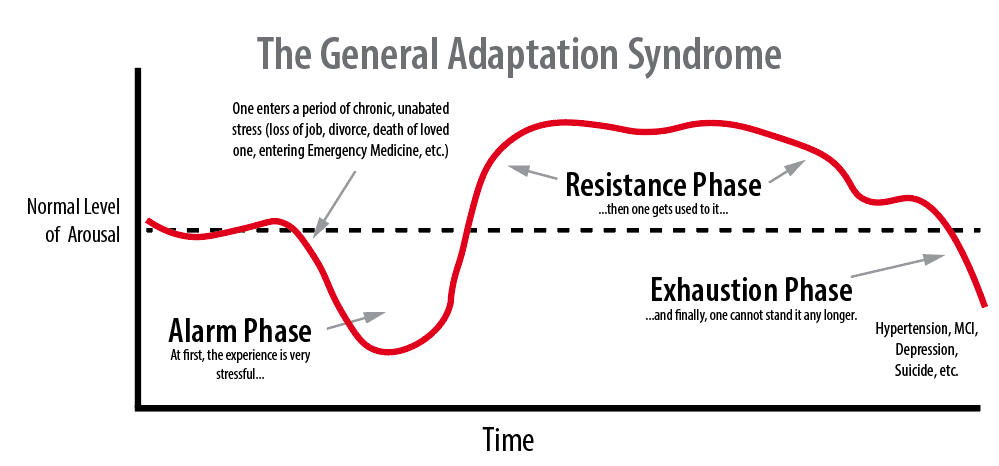
3) Exhaustion (resources depleted, tired, dampered immune system)
Hans Selye
LOOK AT GRAPH as resistance to strss
267
what is learned helplessness?
learn from having control taken from you that you have no control so you lose ability to identify and use coping mechanisms
268
what are some coping mechanisms for stress?
perceived control (low socioeconomic status)
optimism
social support
optimism
social support
269
the forebrain develops into
cerebrum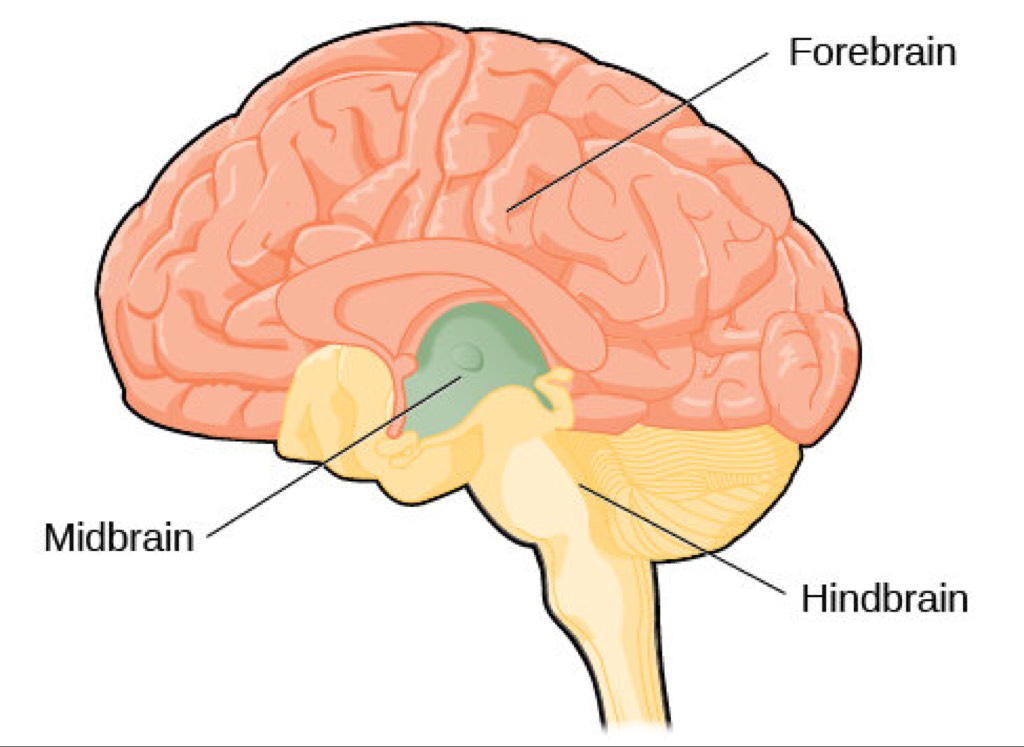
270
the midbrain develops into
midbrain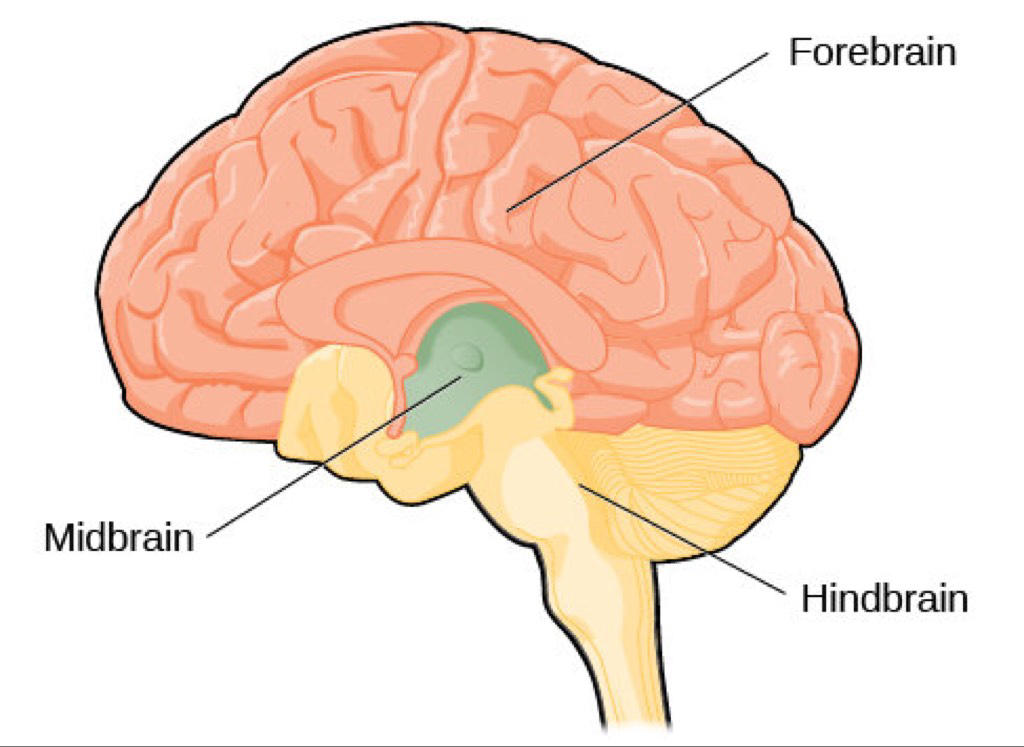
271
the hindbrain develops into
pons/medulla/cerebellum
272
basic neural function includes
motor, sensory, automatic(reflexes)
273
higher level neural function includes
cognition, consciousness, emotion
274
what is a lower motor neuron(LMN?)
efferent PNS neuron that synapses on motor unit for skeletal muscle contraction to form a neuromuscular junction
275
what is atrophy?
loss of muscle volume (lower motor neuron sign)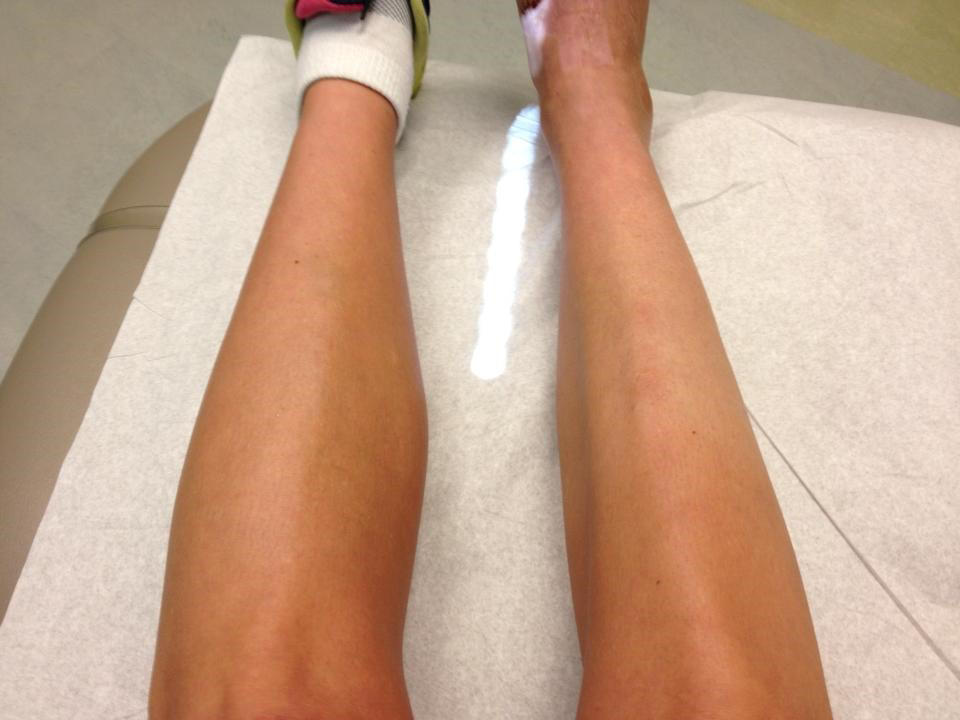
276
what is a fasciculation?
involuntary "twitch" of (lower motor neuron sign)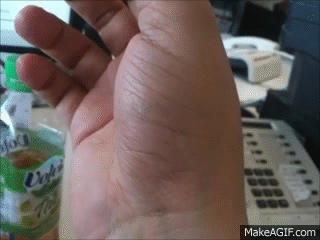
277
what is hypotonia?
decrease in tone of skeletal muscle – how much muscle is
contracted when person is relaxed (lower motor neuron sign)
contracted when person is relaxed (lower motor neuron sign)
278
what is hyporeflexia?
decreased reflexive response to stimulation (lower motor neuron sign)
279
what are the components of the muscle stretch reflex?
afferent (stimulus), efferent (response).
causes a muscle to contact after it’s stretched, as a protective response
Somatosensory neurons (afferent) in muscle spindles form excitatory synapse in
spinal cord with another neuron in the spinal cord, which sends axon out back to
same muscle that was stretched, and excite skeletal muscle cells to contract –
lower motor neurons (efferent)
knee jerk: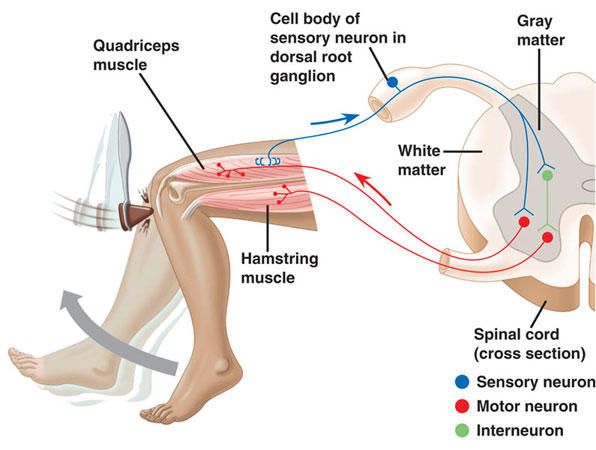
causes a muscle to contact after it’s stretched, as a protective response
Somatosensory neurons (afferent) in muscle spindles form excitatory synapse in
spinal cord with another neuron in the spinal cord, which sends axon out back to
same muscle that was stretched, and excite skeletal muscle cells to contract –
lower motor neurons (efferent)
knee jerk:
280
neurons in the autonomic nervous system control what? are they afferent or efferent neurons?
smooth muscle, cardiac muscle, gland cells
efferent neurons
efferent neurons
281
what is grey matter?
mostly neural soma
282
what is white matter?
mostly myelinated axons
283
where is grey matter located in the spinal cord?
inside. white is on outside
284
where is grey matter located in the brain?
on the outside, white is on inside
285
what do upper motor neurons do?
control lower motor neurons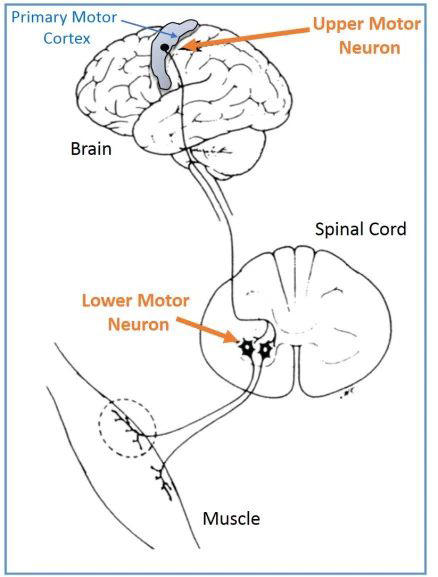
286
where are upper motor neurons located?
the cerebral cortex, synapse in spinal cord
287
what is the corticospinal tract?
when UMN from cerebral cortex synapses in spinal cord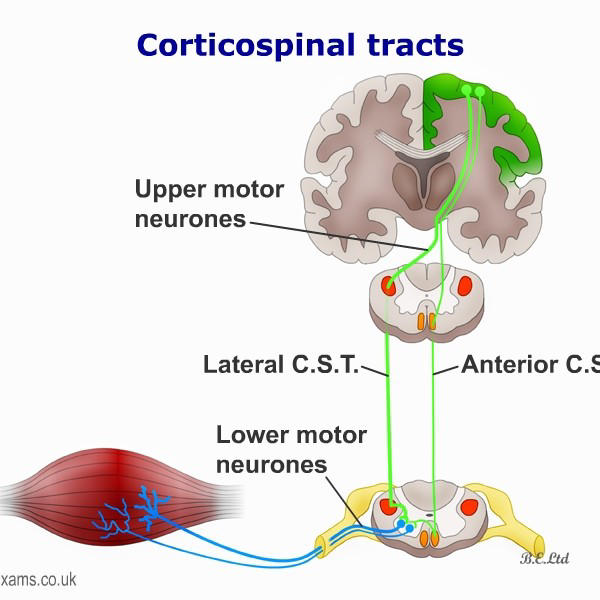
288
what is the corticobulbar tract?
when UMN from cerebral cortex synapses in brainstem
289
what are the upper motor neuron signs?
(1) hyperreflexia (increases in muscle stretch reflex, bigger reflexes)
(2) clonus (rhythmic contractions of muscles-repeated reflexes)
(3) hypertonia (– increased tone of skeletal muscles. Increase muscle tension, reduce muscle stretch)
(4) extensor plantar response (babinski!!)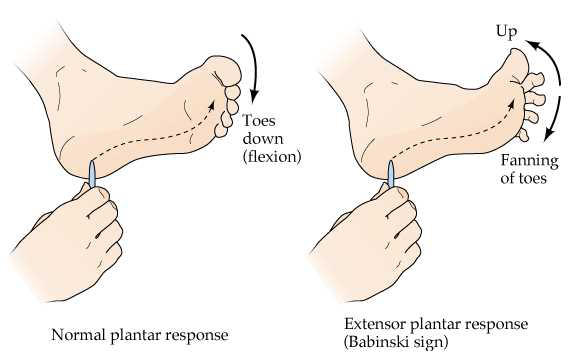
(2) clonus (rhythmic contractions of muscles-repeated reflexes)
(3) hypertonia (– increased tone of skeletal muscles. Increase muscle tension, reduce muscle stretch)
(4) extensor plantar response (babinski!!)
290
somatosensory tracts synapse on the (same side/opposite side) in the brain
opposite side
291
what are the function of the bumps\/grooves in the cerebral cortex?(gyri/sulci)
increase surface area
292
what is the function of the 3 parts of the frontal lobe?
prefrontal cortex (executive function, supervise/direct other areas of brain)
motor cortex (voluntary body movement)
Broca's area (speech production)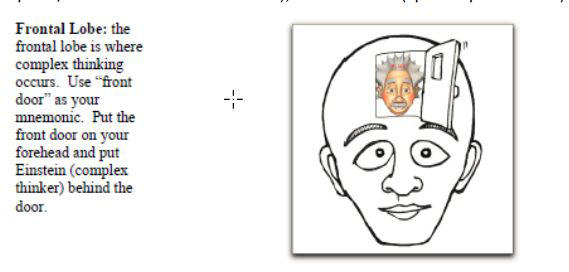
motor cortex (voluntary body movement)
Broca's area (speech production)
293
what are the 3 functions of the parietal lobe?
somatosensory cortex (touch/pressure/pain)
spacial manipulation (orient in 3D)
Proprioception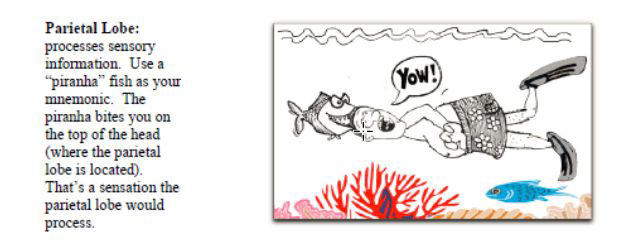
spacial manipulation (orient in 3D)
Proprioception
294
what is the function of the occipital lobe?
vision, AKA "striate" cortex
295
what are four functions of the temporal lobe?
hearing- Wernicke's area (primary auditory cortex) memory- hippo
emotion- amygdala
Learning as well
emotion- amygdala
Learning as well
296
what is contralateral control?
left side of brain controls right side of body & vice versa (applies to all senses but smell and taste)
297
what is the brainstem composed of and what is its function?
medulla, pons, midbrain, reticular formation. basic functions like HR and RR. connects cerebellum to cerebral cortex and spinal cord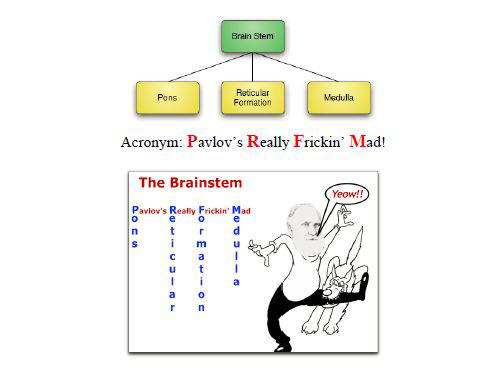
298
what is the function of the cerebellum?
fine motor control/voluntary movement. proprioception
The cerebellum is critical for motor learning, which occurs whenever an organism repeatedly practices a motor task, such as swimming, driving, or speaking. Motor learning is the foundation for procedural memory, the acquisition of which relies heavily on the cerebellum. Because the mice were tested in the Morris Water Maze each day for one week, the cerebellum would be involved in motor learning of this skill.
The cerebellum is also responsible for integrating information from the visual, vestibular, and somatosensory systems to maintain balance and posture, coordinate complex movements requiring multiple muscles, and control precision of fine motor movements. The cerebellum also receives feedback from the body regarding the position of body parts in space and relative to each other (proprioception)
FRONTAL LOBE IS VOLUNTARY MOVEMENT NOT MOTOR COORDINATION YOU IDIOT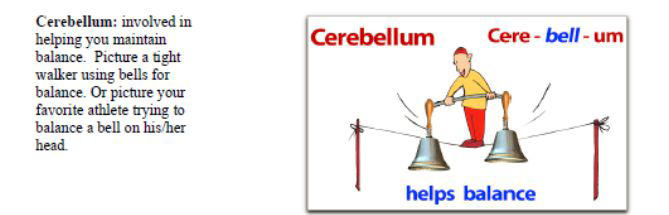
The cerebellum is critical for motor learning, which occurs whenever an organism repeatedly practices a motor task, such as swimming, driving, or speaking. Motor learning is the foundation for procedural memory, the acquisition of which relies heavily on the cerebellum. Because the mice were tested in the Morris Water Maze each day for one week, the cerebellum would be involved in motor learning of this skill.
The cerebellum is also responsible for integrating information from the visual, vestibular, and somatosensory systems to maintain balance and posture, coordinate complex movements requiring multiple muscles, and control precision of fine motor movements. The cerebellum also receives feedback from the body regarding the position of body parts in space and relative to each other (proprioception)
FRONTAL LOBE IS VOLUNTARY MOVEMENT NOT MOTOR COORDINATION YOU IDIOT
299
what is the function of the pons?
regulates sleep/waking and relaxing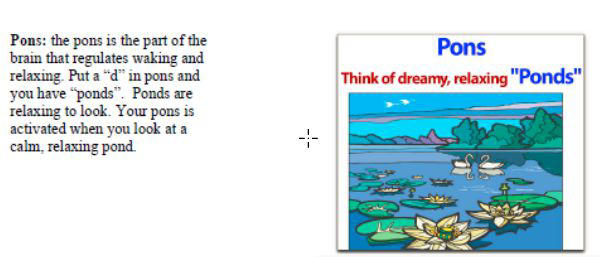
300
what is the function of the reticular formation?
motivation and alertness. filters info and sends important shit to the thalamus. sleep wake cycle/awareness(think: 'tickled')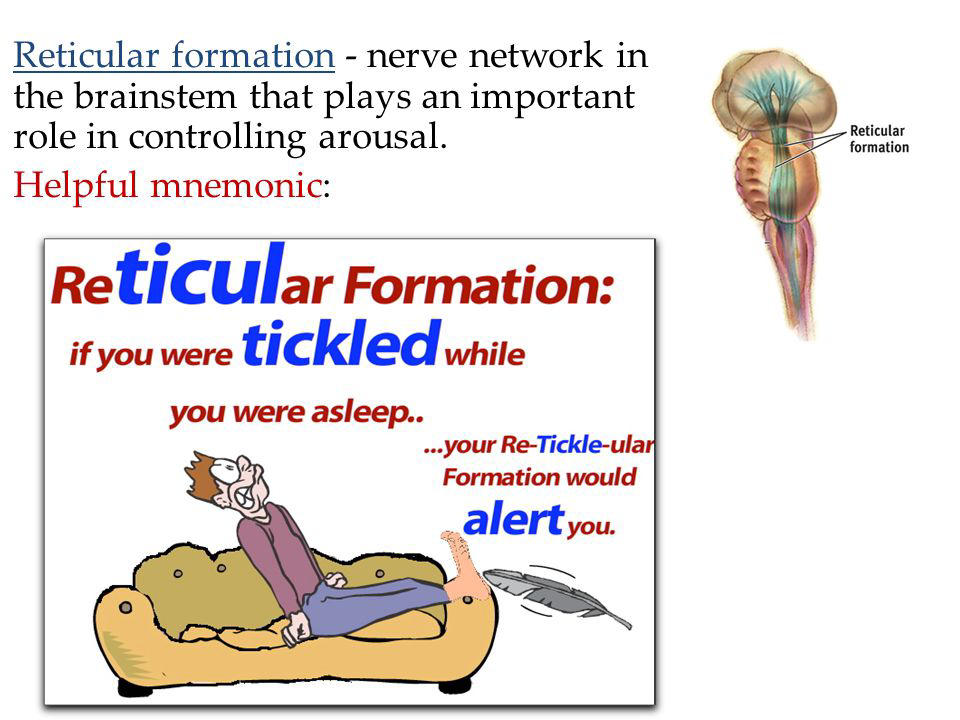
6000 more cards in OutLearn. Open the full deck