Dornbusch Model
Study these flashcardsFree · spaced repetition · iPhone, Android, Mac & web
All cards
1
What model is the basis of the Dornbusch model?
Mundell-Fleming model
- small open economy
- dynamic model
- sticky prices (prices adjust over time in the DB model)
- rational expectations as an extension of the MF model
- small open economy
- dynamic model
- sticky prices (prices adjust over time in the DB model)
- rational expectations as an extension of the MF model
2
Describe the goods market equilibrium in the Mundell Fleming model
Demand for domestic goods: $Z \equiv C(Y-T) + I(Y,r) + G + X - QIM$
- C (consumption) is increasing in Y-T (disposable income)
– I (investment) is increasing in Y (production) and decreasing in r (real interest rate)
– G is government spending
– X is export
– QIM (Q: real exchange rate) is the value of import in terms
of domestic goods
Net exports$NX = X(Y*,Q) - QIM(Y,Q)$
– X (export) is increasing in Y* and Q
– IM (import) is increasing in Y and decreasing in Q
– Q affects NX through three channels
- C (consumption) is increasing in Y-T (disposable income)
– I (investment) is increasing in Y (production) and decreasing in r (real interest rate)
– G is government spending
– X is export
– QIM (Q: real exchange rate) is the value of import in terms
of domestic goods
Net exports$NX = X(Y*,Q) - QIM(Y,Q)$
– X (export) is increasing in Y* and Q
– IM (import) is increasing in Y and decreasing in Q
– Q affects NX through three channels
3
What is the Marshall-Lerner condition + graph fpr the effects of real depreciation?
Real depreciation leads to an increase in net exports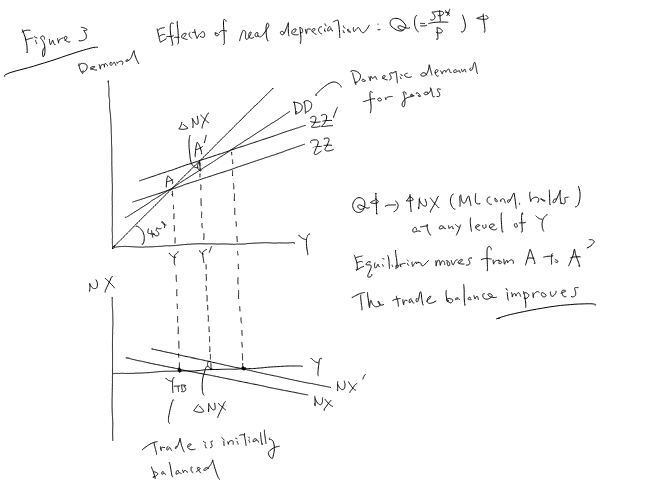
4
Graph of the J-curve in the case of real depreciation
- Takes time for the quantity of imports and exports to adjust
- NX initially declines
- Over time, exports increase and imports falls
- NX eventually exceeds the level before depreciation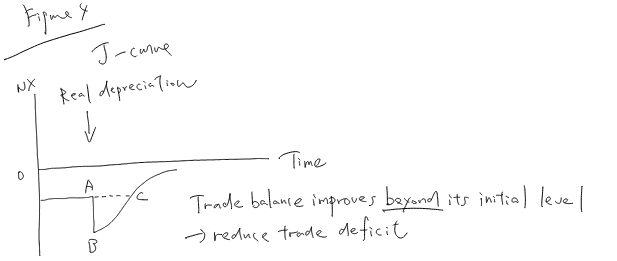
- NX initially declines
- Over time, exports increase and imports falls
- NX eventually exceeds the level before depreciation
5
What does the extension of the MF model to the DB model suggest?
- Dynamic model with sticky prices and rational expectations
- Suggests that exchange rate volatility could be driven by instability in the monetary policy
- Suggests that exchange rate volatility could be driven by instability in the monetary policy
6
Assumptions of the Dornbusch model
- Small open economy (foreign interest rate, i*, is exogenous)
- Output is determined by demand
- Perfect capital mobility
- Sticky prices (takes time to adjust)
- Rational expectations (perfect foresight when there's no random shocks)
- Output is determined by demand
- Perfect capital mobility
- Sticky prices (takes time to adjust)
- Rational expectations (perfect foresight when there's no random shocks)
7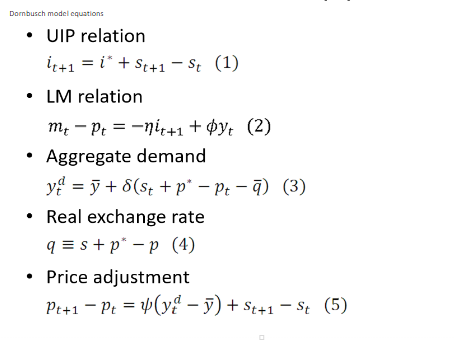
Image occlusion: name the hidden labels
8
Image occlusion: name the hidden labels
9
Image occlusion: name the hidden labels
10
Image occlusion: name the hidden labels
11
Image occlusion: name the hidden labels