Openness in financial markets
Study these flashcardsFree · spaced repetition · iPhone, Android, Mac & web
All cards
1
What is Absolute PPP?
Exchange rate equals relative price levels
- $P = SP*$
- Composite of the prices of all commodities entering into the reference basket
- If LOOP holds for every commodity, PPP must hold too as long as RBs are identical
- $P = SP*$
- Composite of the prices of all commodities entering into the reference basket
- If LOOP holds for every commodity, PPP must hold too as long as RBs are identical
2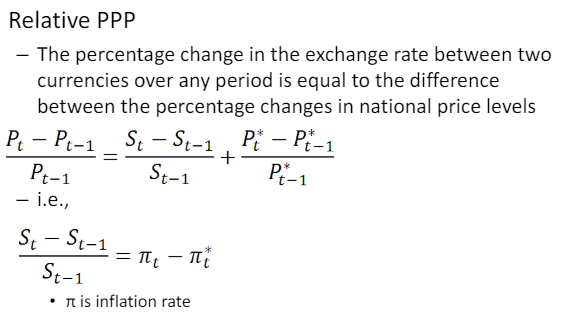
Image occlusion: name the hidden labels
3
What are some problems with PPP?
- Trade barriers, nontradables and pricing to market affect the accuracy of PPP
- LOOP does not perform well also
- LOOP does not perform well also
4
What happens in countries with price-inelastic demand?
Higher markup is likely to be put over the marginal cost
5
What is the nominal exchange rate (S)?
- Price of foreign currency in terms of domestic currency
- Appreciation of domestic currency means a decrease in S
- Depreciation of domestic currency means an increase in S
- Appreciation of domestic currency means a decrease in S
- Depreciation of domestic currency means an increase in S
6
What is the real exchange rate (Q)?
- Price of foreign goods in terms of domestic goods
- $Q=\frac{SP*}{P}$ where P and P* are price index of domestic and foreign goods
- Real appreciation corresponds to a decrease in Q
- Real depreciation corresponds to an increase in Q
- $Q=\frac{SP*}{P}$ where P and P* are price index of domestic and foreign goods
- Real appreciation corresponds to a decrease in Q
- Real depreciation corresponds to an increase in Q
7
What is the Uncovered Interest Parity (UIP) relation?
- Arbitrage Condition
- Assume financial investors want to hold the bond with the highest expected return
- For both UK and UK bonds to be held, they have to have the same expected rate of return
- $1 + i_{t+1} = \frac{S^e_{t+1}}{S_t}(1 + i^*_{t+1})$ (ignoring risks and transaction costs)
- Good assumption for countries with developed financial markets and few capital controls
- The expected rate of return for holding UK and US bonds must be equal.
- Assume financial investors want to hold the bond with the highest expected return
- For both UK and UK bonds to be held, they have to have the same expected rate of return
- $1 + i_{t+1} = \frac{S^e_{t+1}}{S_t}(1 + i^*_{t+1})$ (ignoring risks and transaction costs)
- Good assumption for countries with developed financial markets and few capital controls
- The expected rate of return for holding UK and US bonds must be equal.
8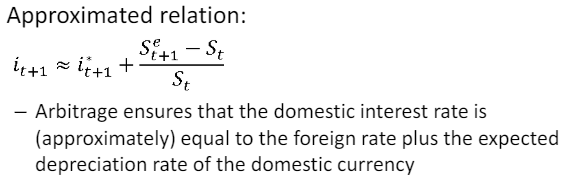
Image occlusion: name the hidden labels
9
Image occlusion: name the hidden labels
10
Image occlusion: name the hidden labels
11
Image occlusion: name the hidden labels
12
Image occlusion: name the hidden labels
13
Image occlusion: name the hidden labels
14
Image occlusion: name the hidden labels
15
Image occlusion: name the hidden labels
16
What is the implication of different demand conditions in different countries?
Price levels in different countries are not equal
17
What is the significance of different commodity baskets in different countries?
There is no reason to believe that price levels in different countries are equal
18
- Assume competitive market, free of transportation costs and trade barriers
- Identical goods sold in different contries must sell for the same price when prices are expressed in a common currency
- $P_i = SP^*_i$ where $P_i$ is the domestic price of good $i$ in domestic currency
- $P^*_i$ is the forein price of good $i*$ in foreign currency
Law of One Price
- Assume competitive market, free of transportation costs and trade barriers
- Identical goods sold in different contries must sell for the same price when prices are expressed in a common currency
- $P_i = SP^*_i$ where $P_i$ is the domestic price of good $i$ in domestic currency
- $P^*_i$ is the forein price of good $i*$ in foreign currency
19
What is the focus of Purchasing Power Parity (PPP)
Equalizing the purchasing power of different currencies
20
What are the implications of openness in financial markets?
- Financial investors choose whether to hold domestic assets or foreign assets
- People hold money to engage in transactions: the relevant choice is between domestic interest-paying assets and foreign interest-paying assets
- People hold money to engage in transactions: the relevant choice is between domestic interest-paying assets and foreign interest-paying assets