Macroeconomic Interdependence
Study these flashcardsFree · spaced repetition · iPhone, Android, Mac & web
All cards
1
Mundell's two country model considers...
- macroindependence both under flexible and fixed exchange rates
- in the face of monetary and fiscal policies
- in the face of monetary and fiscal policies
2
- marginal propensity to import
- interest rates
- exchange rates (under flexible rates)
Channels of interdependence
- marginal propensity to import
- interest rates
- exchange rates (under flexible rates)
3
Mundell's two country model assumes...
- two countries, home and foreign are symmetric
- perfect capital mobility, UIP holds (i=i*)
- adoptive expectations, expected change of exchange rates is zero
- prices are fixed, real and nominal ER move together (S=Q)
- marshall-lerner conditions are satisfied, real depreciation leads to a rise in net export ($\uparrow Q = \uparrow NX$)
- output is determined by demand
- perfect capital mobility, UIP holds (i=i*)
- adoptive expectations, expected change of exchange rates is zero
- prices are fixed, real and nominal ER move together (S=Q)
- marshall-lerner conditions are satisfied, real depreciation leads to a rise in net export ($\uparrow Q = \uparrow NX$)
- output is determined by demand
4
Home equations under the Flexible ER
Goods market EQ.: $y = -\gamma i + \delta s + gy^{*} + u$
y is AS (output determined by demand), the rest is AD/IS
i is real interest rates (fixed prices, no inflation)
s is nominal / real exchange rates
gy* where g is the openness of the economy (marginal propensity to import), g < 1
u as a residual, eg government spending
Money market EQ.: $M = ky - \lambda i$
M is money supply, LM
$M^S$ is fixed as no change in price so no change in M/P (assume P is 1)
y is AS (output determined by demand), the rest is AD/IS
i is real interest rates (fixed prices, no inflation)
s is nominal / real exchange rates
gy* where g is the openness of the economy (marginal propensity to import), g < 1
u as a residual, eg government spending
Money market EQ.: $M = ky - \lambda i$
M is money supply, LM
$M^S$ is fixed as no change in price so no change in M/P (assume P is 1)
5
Foreign equations under the Fixed ERepr
Goods market EQ.: $y^* = -\gamma i^* - \delta s + gy + u^*$
y* is AS (output determined by demand), the rest is AD/IS
i* is real interest rates (fixed prices, no inflation)
s is nominal / real exchange rates (negative as it is dom currency in terms of foreign currency)
gy where g is the openness of the economy (marginal propensity to import), g < 1
u* as a residual, eg government spending
Money market EQ.: $M^* = ky* - \lambda i*$
M* is money supply, LM
$M^S$ is fixed as no change in price so no change in M/P (assume P is 1)
y* is AS (output determined by demand), the rest is AD/IS
i* is real interest rates (fixed prices, no inflation)
s is nominal / real exchange rates (negative as it is dom currency in terms of foreign currency)
gy where g is the openness of the economy (marginal propensity to import), g < 1
u* as a residual, eg government spending
Money market EQ.: $M^* = ky* - \lambda i*$
M* is money supply, LM
$M^S$ is fixed as no change in price so no change in M/P (assume P is 1)
6
Endogenous and Exogenous variables under the Flexible ER
Endogenous:
y, y*, i, i*, s
Exogenous:
M, M*, u, u*
y, y*, i, i*, s
Exogenous:
M, M*, u, u*
7
Perform the transformation into a (y, y*) space for both the Home and Foreign equations under Floating ER
Sum IS world and combine with domestic or foreign
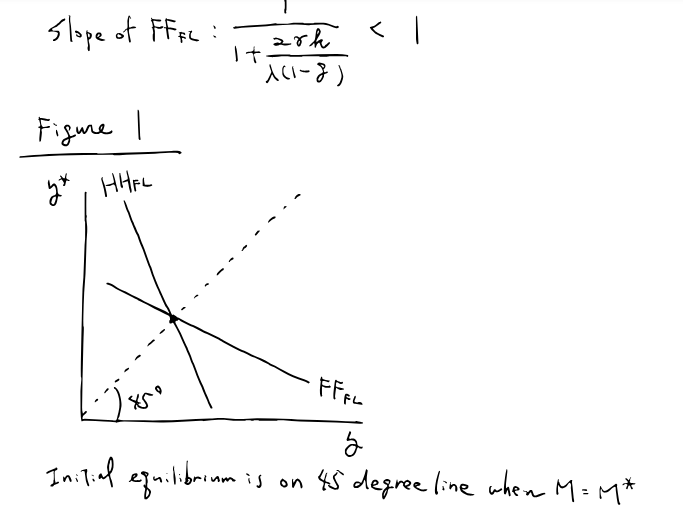
$y + y^{*} = \frac{1}{1 - g} \left( -2\gamma i + u + u^{*} \right)$
- IS world and domestic LM ($HH_FL$ curve)
$y = \frac{1}{1 + \frac{2\gamma k}{\lambda(1 - g)}} \left[ -y^{*} + \frac{1}{1 - g} \frac{2\gamma}{\lambda} M + \frac{1}{1 - g} (u + u^{*}) \right]$
- IS world and foreign LM ($FF_FL$ curve)
$y^{*} = \frac{1}{1 + \frac{2\gamma k}{\lambda(1 - g)}} \left[ -y + \frac{1}{1 - g} \frac{2\gamma}{\lambda} M^{*} + \frac{1}{1 - g} (u + u^{*}) \right]$
$y + y^{*} = \frac{1}{1 - g} \left( -2\gamma i + u + u^{*} \right)$
- IS world and domestic LM ($HH_FL$ curve)
$y = \frac{1}{1 + \frac{2\gamma k}{\lambda(1 - g)}} \left[ -y^{*} + \frac{1}{1 - g} \frac{2\gamma}{\lambda} M + \frac{1}{1 - g} (u + u^{*}) \right]$
- IS world and foreign LM ($FF_FL$ curve)
$y^{*} = \frac{1}{1 + \frac{2\gamma k}{\lambda(1 - g)}} \left[ -y + \frac{1}{1 - g} \frac{2\gamma}{\lambda} M^{*} + \frac{1}{1 - g} (u + u^{*}) \right]$
8
What happens when there is a decrease in the Money Supply (monetary policy) under a floating exchange rate assuming $ \frac{1}{1 + \frac{2\gamma k}{\lambda(1 - g)}} < 1$?
The slope of $FF_FL$ < 1 accounts for the flatness of the curve and hence, the degree of responsiveness to changes in the home economy. $HH_FL$ is exactly the inverse.
A decrease in M* means the money market is no longer in EQ so there is a decrease in money demand and y* + a shift downward of the $FF_FL$ to $FF_FL'$.
y* goes down so the marginal propensity to import also goes down --> contractionary effect in $gy^*$
i* needs to go down in order to restore the EQ in the money market and because UIP holds, i also goes down - expansionary effect
Positive spillover effects in home country as s increases (real depreciation), so Q increases and NX increases (ML condition holds) - y0 to y1, expansionsary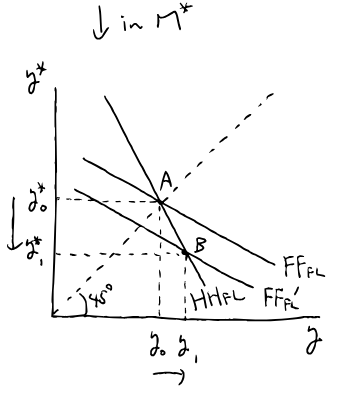
A decrease in M* means the money market is no longer in EQ so there is a decrease in money demand and y* + a shift downward of the $FF_FL$ to $FF_FL'$.
y* goes down so the marginal propensity to import also goes down --> contractionary effect in $gy^*$
i* needs to go down in order to restore the EQ in the money market and because UIP holds, i also goes down - expansionary effect
Positive spillover effects in home country as s increases (real depreciation), so Q increases and NX increases (ML condition holds) - y0 to y1, expansionsary
9
What happens when there is a increase in government spending (fiscal policy) under a floating exchange rate assuming $ \frac{1}{1 + \frac{2\gamma k}{\lambda(1 - g)}} < 1$?
The slope of $FF_FL$ < 1 accounts for the flatness of the curve and hence, the degree of responsiveness to changes in the home economy. $HH_FL$ is exactly the inverse.
An increase in u* means the foreign goods market is no longer in equilibrium and there is an increase in demand so y* $\uparrow$ which has a a expansionary effect on y through the marginal propensity to import channel
As y* increases, i* also needs to increase in order to restore the equilibrium in the foreign money market and because UIP holds, i also increases - contractionary effect
Positive spillover effects in home country as s increases (real depreciation), so Q increases and NX increases (ML condition holds) - y0 to y1, expansionsary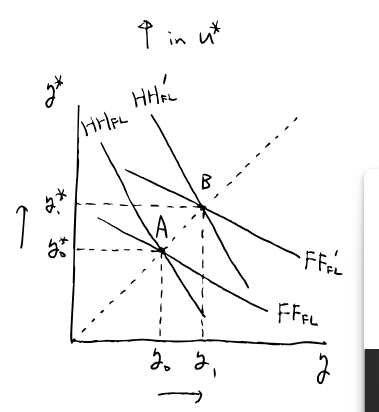
An increase in u* means the foreign goods market is no longer in equilibrium and there is an increase in demand so y* $\uparrow$ which has a a expansionary effect on y through the marginal propensity to import channel
As y* increases, i* also needs to increase in order to restore the equilibrium in the foreign money market and because UIP holds, i also increases - contractionary effect
Positive spillover effects in home country as s increases (real depreciation), so Q increases and NX increases (ML condition holds) - y0 to y1, expansionsary
10
Home equations under the Fixed ER
Goods market EQ.: $y = -\gamma i + \delta s + gy^{*} + u$
y is AS (output determined by demand), the rest is AD/IS
i is real interest rates (fixed prices, no inflation)
s is nominal / real exchange rates
gy* where g is the openness of the economy (marginal propensity to import), g < 1
u as a residual, eg government spending
Money market EQ.: $M = ky - \lambda i$
M is money supply, LM
$M^S$ is fixed as no change in price so no change in M/P (assume P is 1)
Current account balance: $ M \equiv F + D$
y is AS (output determined by demand), the rest is AD/IS
i is real interest rates (fixed prices, no inflation)
s is nominal / real exchange rates
gy* where g is the openness of the economy (marginal propensity to import), g < 1
u as a residual, eg government spending
Money market EQ.: $M = ky - \lambda i$
M is money supply, LM
$M^S$ is fixed as no change in price so no change in M/P (assume P is 1)
Current account balance: $ M \equiv F + D$
11
Foreign equations under Fixed ER
Goods market EQ.: $y^* = -\gamma i^* - \delta s + gy + u^*$
y* is AS (output determined by demand), the rest is AD/IS
i* is real interest rates (fixed prices, no inflation)
s is nominal / real exchange rates (negative as it is dom currency in terms of foreign currency)
gy where g is the openness of the economy (marginal propensity to import), g < 1
u* as a residual, eg government spending
Money market EQ.: $M^* = ky* - \lambda i*$
M* is money supply, LM
$M^S$ is fixed as no change in price so no change in M/P (assume P is 1)
Current account balance: $ M^* \equiv F^* + D^*$
y* is AS (output determined by demand), the rest is AD/IS
i* is real interest rates (fixed prices, no inflation)
s is nominal / real exchange rates (negative as it is dom currency in terms of foreign currency)
gy where g is the openness of the economy (marginal propensity to import), g < 1
u* as a residual, eg government spending
Money market EQ.: $M^* = ky* - \lambda i*$
M* is money supply, LM
$M^S$ is fixed as no change in price so no change in M/P (assume P is 1)
Current account balance: $ M^* \equiv F^* + D^*$
12
Endogenous and Exogenous variables under fixed ER
Endogenous:
y, y*, i, i*, M, M*
Exogenous:
s, D, D*, $F^W$, u, u*
y, y*, i, i*, M, M*
Exogenous:
s, D, D*, $F^W$, u, u*
13
Perform the transformation into a (y, y*) space for both the Home and Foreign equations under Fixed ER
Sum LM world and combine with domestic or foreign IS
$M+M* = D + D* + F^W = k(y+y^*) - 2\lambda i$
- LM world and domestic IS ($HH_FX$ curve)
$y = \frac{1}{k + \frac{2\lambda}{\gamma}} \left[ \left( -k + \frac{2\lambda}{\gamma} g \right) y^{*} + (D + D^{*} + F^{w}) + \frac{2\lambda \delta}{\gamma} s + \frac{2\lambda}{\gamma} u \right]$
- LM world and foreign IS ($FF_FX$ curve)
$y^{*} = \frac{1}{k + \frac{2\lambda}{\gamma}} \left[ \left( -k + \frac{2\lambda}{\gamma} g \right) y + (D + D^{*} + F^{w}) - \frac{2\lambda \delta}{\gamma} s + \frac{2\lambda}{\gamma} u^{*} \right]$
$M+M* = D + D* + F^W = k(y+y^*) - 2\lambda i$
- LM world and domestic IS ($HH_FX$ curve)
$y = \frac{1}{k + \frac{2\lambda}{\gamma}} \left[ \left( -k + \frac{2\lambda}{\gamma} g \right) y^{*} + (D + D^{*} + F^{w}) + \frac{2\lambda \delta}{\gamma} s + \frac{2\lambda}{\gamma} u \right]$
- LM world and foreign IS ($FF_FX$ curve)
$y^{*} = \frac{1}{k + \frac{2\lambda}{\gamma}} \left[ \left( -k + \frac{2\lambda}{\gamma} g \right) y + (D + D^{*} + F^{w}) - \frac{2\lambda \delta}{\gamma} s + \frac{2\lambda}{\gamma} u^{*} \right]$
14
What does this parameter represent under the Fixed ER?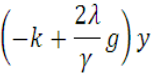
- $\frac{2 \lambda}{\gamma}$ is always positive
- the slope of curve depends on whether g is high or low making $\frac{2 \lambda}{\gamma} g$ greater than $-k$ so its positive or negative
- g is the marginal propensity to import
- the slope of curve depends on whether g is high or low making $\frac{2 \lambda}{\gamma} g$ greater than $-k$ so its positive or negative
- g is the marginal propensity to import
15
This is the slope when $-k + \frac{2 \lambda}{\gamma} > 0$ and $\left| \frac{-k + \frac{2\lambda}{\gamma} g}{k + \frac{2\lambda}{\gamma}} \right| <1$. What is the slope when $-k + \frac{2 \lambda}{\gamma} < 0$ and $\left| \frac{-k + \frac{2\lambda}{\gamma} g}{k + \frac{2\lambda}{\gamma}} \right| <1$?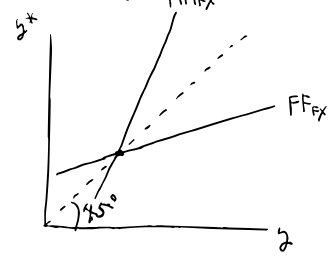
When $-k + \frac{2 \lambda}{\gamma} > 0$ , $g$ is large ie the economy is more open
When $-k + \frac{2 \lambda}{\gamma} < 0$, $g$ is relatively small ie the economy is less open so PARAMETER IS NOW NEGATIVE, DOWNWARD SLOPING.
The absolute value is still less than 1 so the slope is still flat.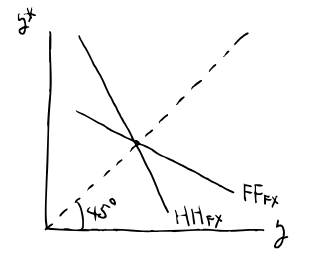
When $-k + \frac{2 \lambda}{\gamma} < 0$, $g$ is relatively small ie the economy is less open so PARAMETER IS NOW NEGATIVE, DOWNWARD SLOPING.
The absolute value is still less than 1 so the slope is still flat.
16
POSITIVE SLOPE MEANS...
POSITIVE SPILLOVER
17
What happens when there is a decrease in the holding of Domestic Bonds (contractionary monetary plolicy) under a fixed exchange rate assuming $-k + \frac{2 \lambda}{\gamma} > 0$?
INTERCEPT OF BOTH CURVES CHANGE AS D* IS IN BOTH
Decrease in D means a decrease in M and therefore y* $\downarrow$ due to a lower demand so there's a contractionary effect through the marginal propensity to import channel, downward shift to $y^*_1$
y decreases a result (MPI)
In accordance, i increases - contractionary effect to return to the money mrkt EQ. without changing the ER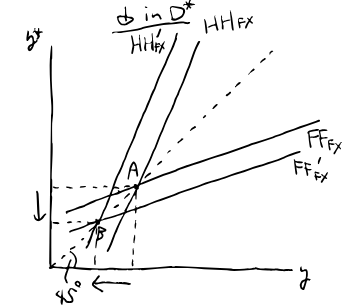
Decrease in D means a decrease in M and therefore y* $\downarrow$ due to a lower demand so there's a contractionary effect through the marginal propensity to import channel, downward shift to $y^*_1$
y decreases a result (MPI)
In accordance, i increases - contractionary effect to return to the money mrkt EQ. without changing the ER
18
What happens when there is a increase in Government Spending (expansionary fiscal policy) under a fixed exchange rate assuming $-k + \frac{2 \lambda}{\gamma} > 0$?
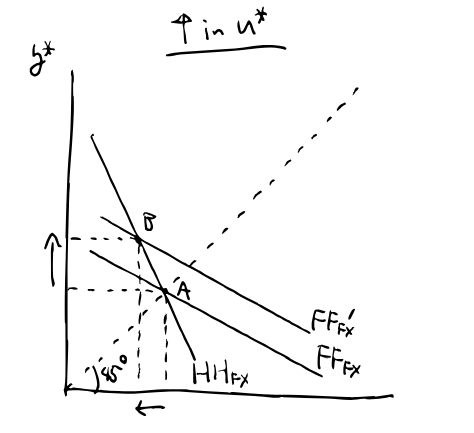
ONLY INTERCEPT OF $FF_FX$ CURVE CHANGES AS u* IS ONLY IN THAT EQUATION
- increase in AD
- increase in output in foreign (y*) AND also in home (y)
- i increases to offset this in the money market but because of the STRONG MPI channel, y in home tends to be higher - expansionary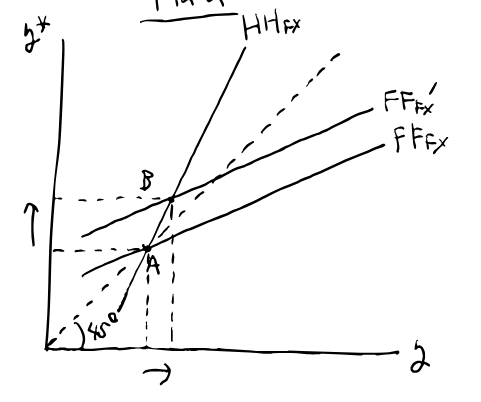
- increase in AD
- increase in output in foreign (y*) AND also in home (y)
- i increases to offset this in the money market but because of the STRONG MPI channel, y in home tends to be higher - expansionary
19
What happens when there is a decrease in the holding of Domestic Bonds (contractionary monetary plolicy) under a fixed exchange rate assuming $-k + \frac{2 \lambda}{\gamma} < 0$?
- y* down through MPI, contractionary effect so y also goes down but g<1 so the drop is small
- there's also an increase in i to offset, contractionary effect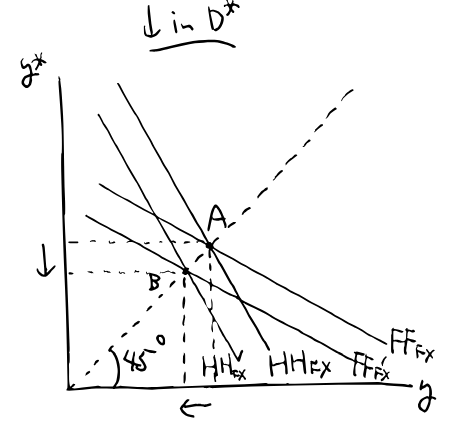
- there's also an increase in i to offset, contractionary effect
20
What happens when there is a increase in Government Spending (expansionary fiscal policy) under a fixed exchange rate assuming $-k + \frac{2 \lambda}{\gamma} < 0$?
contractionary for y due to slope