Monetary Model
Study these flashcardsFree · spaced repetition · iPhone, Android, Mac & web
All cards
1
What are the different exchange rate regimes discussed in the monetary model?
Floating and fixed ER
2
What does the AD relation depend on?
$M^S = kPY$
- Real income
- Demand for real money balance
- For a given P, an increase in M increase Y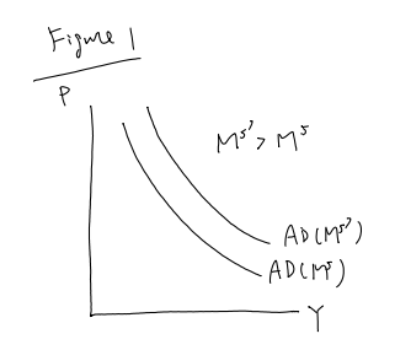
- Real income
- Demand for real money balance
- For a given P, an increase in M increase Y
3
What are the predictions under a floating exchange rate regarding money supply, output, and foreign price?
$S = \frac{M^S}{kP^*Y}$
- Money supply rise leads to depreciation
- Output rise leads to appreciation
- Foreign price rise leads to S fall
- Money supply rise leads to depreciation
- Output rise leads to appreciation
- Foreign price rise leads to S fall
4
What happens when there is a money supply increase under a floating exchange rate regime?
- Excess demand for goods at inital price
- Price of goods rises
- Domestic currency depreciates to maintain competitiveness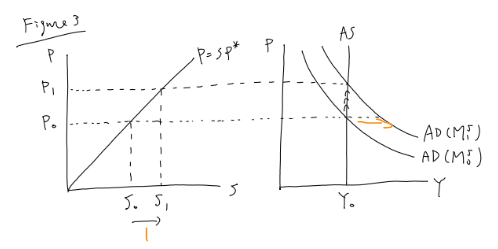
- Price of goods rises
- Domestic currency depreciates to maintain competitiveness
5
What happens when there is an income increase under a floating exchange rate regime?
- Excess supply of goods at original price
- Price falls to regain money market equilibrium condition
- Exchange rate appreciates to restore competitiveness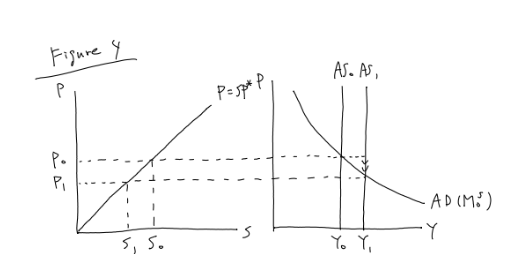
- Price falls to regain money market equilibrium condition
- Exchange rate appreciates to restore competitiveness
6
What is the difference in handling money supply between fixed and floating exchange rate regimes?
Money supply is exogenous in floating ER, Central bank adjusts reserves in fixed ER to preserve rate in the face of changes to exogenous variables
7
How does the central bank intervene when there is a money supply increase in a fixed exchange rate regime?
PPP holds, $P = SP^*$
AD relation where $M^S = M^D$ and $M^D = kPY$, $S = \frac{M^S}{kP^*Y}$
Under the central bank, $M^S = F + D$ so $kSP^*Y$
- An increase in D shifts up AD curve and domestic goods become undercompetitive
- Without the CB's intervention, domestic currency would depreciate
- CB buys domestic currency (D) using foreign reserves (F) to preserve the fixed ER
- F falls till competitiveness is restored
- An increase in D is exactly offset by a decrease in F - A CHANGE IN COMPOSITION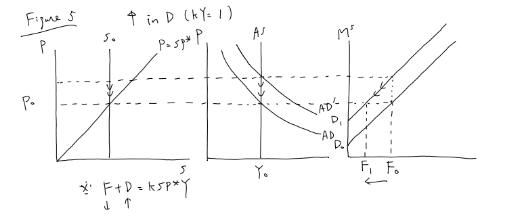
AD relation where $M^S = M^D$ and $M^D = kPY$, $S = \frac{M^S}{kP^*Y}$
Under the central bank, $M^S = F + D$ so $kSP^*Y$
- An increase in D shifts up AD curve and domestic goods become undercompetitive
- Without the CB's intervention, domestic currency would depreciate
- CB buys domestic currency (D) using foreign reserves (F) to preserve the fixed ER
- F falls till competitiveness is restored
- An increase in D is exactly offset by a decrease in F - A CHANGE IN COMPOSITION
8
What happens when there is an income increase in a fixed exchange rate regime?
PPP holds, $P = SP^*$
AD relation where $M^S = M^D$ and $M^D = kPY$, $S = \frac{M^S}{kP^*Y}$
Under the central bank, $M^S = F + D$ so $M^S = kSP^*Y$
- Income increases (Y increases)
- AS shifts out
- Without CB intervention,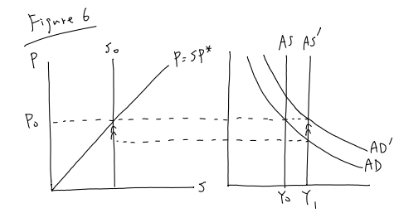
AD relation where $M^S = M^D$ and $M^D = kPY$, $S = \frac{M^S}{kP^*Y}$
Under the central bank, $M^S = F + D$ so $M^S = kSP^*Y$
- Income increases (Y increases)
- AS shifts out
- Without CB intervention,
9
In the fixed ER model, nominal exchange rate (S) is seen as
an asset price ie money demand as a function of the interest rate
10
What variables are included in the revised money demand function in the model?
$m_t - p_t = -\eta i_{t+1} + \varphi y_t$ all in logs!
- Money supply (m)
- Price level (p)
- Gross domestic nominal interest rate (i)
- Real income/output (y)
PPP in logs is now $p_t = s_t + p^*_t$
- Money supply (m)
- Price level (p)
- Gross domestic nominal interest rate (i)
- Real income/output (y)
PPP in logs is now $p_t = s_t + p^*_t$
11
What is meant by rational expectations
$x_{t+1}^e = E(x_{t+1} \mid I_t) (\equiv E_t x_{t+1})$
Individuals' subjective expectations equal the mathematical expectation based on all available information, $I$, at a given time t
Individuals' subjective expectations equal the mathematical expectation based on all available information, $I$, at a given time t
12
Purchasing power parity graph
$P = SP^*$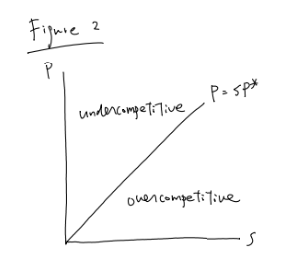
13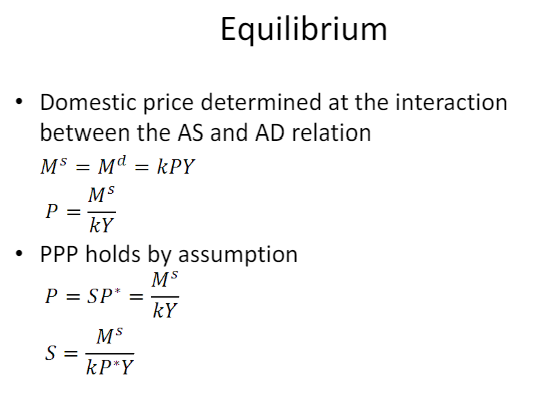
Image occlusion: name the hidden labels
14
Image occlusion: name the hidden labels
15
Image occlusion: name the hidden labels
16
Image occlusion: name the hidden labels
17
Foreign price increase under floating ER?
When PPP holds, $S = \frac{M^S}{kPY}$
So when P* increases, S decreases (appreciation)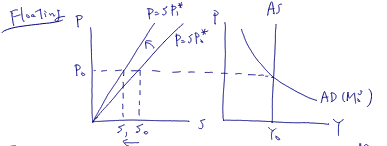
So when P* increases, S decreases (appreciation)
18
Balance of the Central Bank (fixed ER regime)
Assets
- Domestic-currency bonds (D)
- Foreign exchange reserves (F)
Liabilities
- High powered money (H)
- Domestic-currency bonds (D)
- Foreign exchange reserves (F)
Liabilities
- High powered money (H)
19
Foreign price increase under fixed ER?
PPP holds, $P = SP^*$
AD relation where $M^S = M^D$ and $M^D = kPY$, $S = \frac{M^S}{kP^*Y}$
Under the central bank, $M^S = F + D$ so $M^S = kSP^*Y$
- PPP tilts leftward
- Without CB intervention, S would fall (appreciation and overcompetitive)
- CB increases reserves by issuing domestic currency
- $M^S$ so P increases at a fixed Y.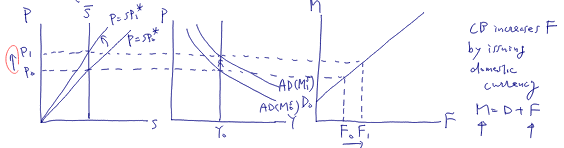
AD relation where $M^S = M^D$ and $M^D = kPY$, $S = \frac{M^S}{kP^*Y}$
Under the central bank, $M^S = F + D$ so $M^S = kSP^*Y$
- PPP tilts leftward
- Without CB intervention, S would fall (appreciation and overcompetitive)
- CB increases reserves by issuing domestic currency
- $M^S$ so P increases at a fixed Y.
20
Asset approach to the exchange rate
$s_t = \frac{1}{1 + \eta} \sum_{j=t}^{\infty} \left( \frac{\eta}{1 + \eta} \right)^{j-t} E_t \left( m_j - \varphi y_j + \eta i_{j+1}^* - p_j^* \right)$
- Dynamic version of the model with nominal interest rate
- People's expectation of higher money supply increases today's price --> demand for domestic currency falls, and this determines today's exchange rate.
- Dynamic version of the model with nominal interest rate
- People's expectation of higher money supply increases today's price --> demand for domestic currency falls, and this determines today's exchange rate.