Representative Democracy - The Downsian Model
Study these flashcardsFree · spaced repetition · iPhone, Android, Mac & web
All cards
1
What do political parties receive from being in power?
Utility or rent
2
In a political race, what do both Party A and Party B want to maximize?
Probability of coming to power
3
How are political parties modelled in the Downsian Model?
- Two parties A and B, announce a policy platform simultaneously and commit to it
- Both compete for political office and would like to come to power
- Do not have any ideological bias
- Recieve rent or utility from being in power
- Both compete for political office and would like to come to power
- Do not have any ideological bias
- Recieve rent or utility from being in power
4
What does the Downsian Policy Convergence Theory assume?
Assumes Condorcet winner and Median Voter Theorem applies
5
What do Party A and Party B converge to in the Downsian Policy Convergence Theorem?
Median voter's bliss point, selecting it as their policy platform
6
What happens if parties deviate from the median voter's bliss point in the Downsian Policy Convergence Theorem?
7
What does Representative Democracy require modeling of?
8
What is the most common form of Democracies?
Representative Democracy
9
What is the Median Voter Theorem?
Under specific assumptions, a Condorcet winner exists and coincides with the median-ranked bliss point.
10
Which assumption(s) can we relax in the Median Voter Theorem?
Strategic voting
11
What is a weakly-dominant strategy in voting?
A strategy that gives a weakly higher/the same payoff than any other strategy regardless of others' choices.
12
What is the Downsian model in Representative Democracy?
A model where two parties compete for political office with announced policy platforms.
13
What is an example of an extreme form of Direct Democracy?
Open agenda decision choice
14
In Representative Democracy, how are policies chosen?
Citizens elect politicians who offer policy alternatives and make the policy choice.
15
How can the quality of democracy be measured?
Via the Democratic Index.
16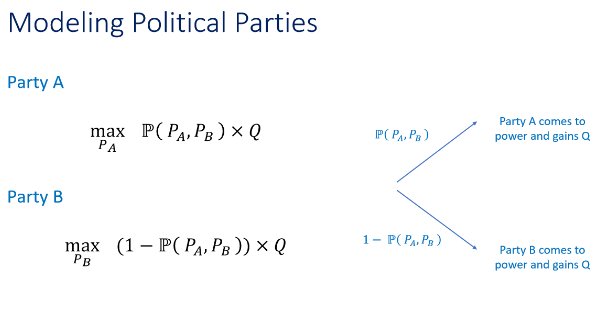
Image occlusion: name the hidden labels
17
Assume there is a Condorcet winner and the Median Voter Theorem applies. What is the probability that Party A or B comes to power when:
- $P_a = P_m$?
- $P_b = P_m$?
- $P_a = P_b = P_m$?
- $P_a = P_m$?
- $P_b = P_m$?
- $P_a = P_b = P_m$?
- A = 1 B = 0
- A = 0 B = 1
- A = 0.5 B = 0.5 (assuming that voters vote for one of the two parties indifferently, randomising btwn two parties if they have the same policy, there is single-peaked policy preferences, median-rankd bliss point by $P_m$)
- A = 0 B = 1
- A = 0.5 B = 0.5 (assuming that voters vote for one of the two parties indifferently, randomising btwn two parties if they have the same policy, there is single-peaked policy preferences, median-rankd bliss point by $P_m$)
18
Prove the Downsian Policy Convergence Theorem
- Suppose A and B want to deviate from $p_m$
- Assume arbitrarily that $p_a > p_b > p_m$
- One party can announce $p_m$. If party A does that, then $\mathbb{P}(P_A, P_B) = 1$
- Party B cannot win $(1 - \mathbb{P}(P_A, P_B) = 0)$ as long as $\mathbf{p}_b \neq \mathbf{p}_m$
- Hence, both parties converge to the bliss point of the median voter
- Indifference and random voting means $\mathbb{P}(P_A, P_B)' = 1 - \mathbb{P}(P_A, P_B) = \frac{1}{2}$ using the law of large numbers as long as parties offer the same policy
- Assume arbitrarily that $p_a > p_b > p_m$
- One party can announce $p_m$. If party A does that, then $\mathbb{P}(P_A, P_B) = 1$
- Party B cannot win $(1 - \mathbb{P}(P_A, P_B) = 0)$ as long as $\mathbf{p}_b \neq \mathbf{p}_m$
- Hence, both parties converge to the bliss point of the median voter
- Indifference and random voting means $\mathbb{P}(P_A, P_B)' = 1 - \mathbb{P}(P_A, P_B) = \frac{1}{2}$ using the law of large numbers as long as parties offer the same policy