Voter Participation
Study these flashcardsFree · spaced repetition · iPhone, Android, Mac & web
All cards
1
Contrary to single-peaked preferences, single-crossing preferences rely on...
an ordering of individuals along the policy space.
Imagine there are two policies. One of them (p) is more to the right than the other (p’) and let’s say the axis is going from the extreme left to the extreme right. So p > p’ (more right = higher).
Then, consider individuals depending on how rightist or leftist they are based on their preferences and order them according to their $\alpha_i$.
It means that an individual who is considered more on the right respective to another individual will also prefer the right-wing policy over the left-wing one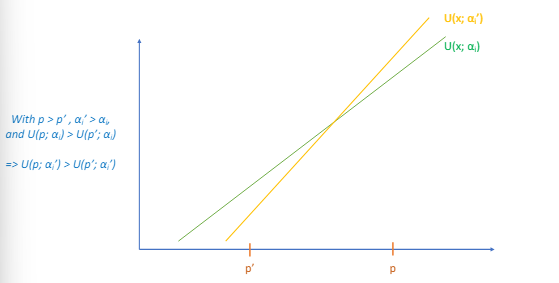
Imagine there are two policies. One of them (p) is more to the right than the other (p’) and let’s say the axis is going from the extreme left to the extreme right. So p > p’ (more right = higher).
Then, consider individuals depending on how rightist or leftist they are based on their preferences and order them according to their $\alpha_i$.
It means that an individual who is considered more on the right respective to another individual will also prefer the right-wing policy over the left-wing one
2
What does Lee, Moretti, and Butler (2004) evidence?
- SIMILAR CONSTITUENCIES: Electing a Democrat or a Republican is random
- SAME MEDIAN VOTER: D. and R. representatives should vote similarly in Congress in that case
The authors use Regression Discontinuity Design via Close Election to test this
assumption. They study the causal impact of electing a Democratic (vs Republican)
Representative on their vote in Congress, holding other variables constant.
No median voter.
There is only one dimension of the political spectrum that is common to every
constituency in the United States.
If two constituencies vote similarly, then, as their demographic characteristics
are perfectly similar, every constituency shares the same median voter or in
other words, the same ideology.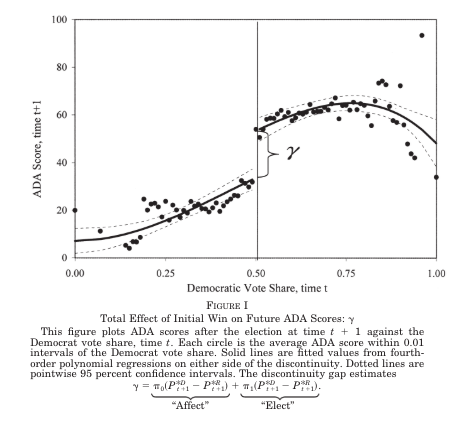
- SAME MEDIAN VOTER: D. and R. representatives should vote similarly in Congress in that case
The authors use Regression Discontinuity Design via Close Election to test this
assumption. They study the causal impact of electing a Democratic (vs Republican)
Representative on their vote in Congress, holding other variables constant.
No median voter.
There is only one dimension of the political spectrum that is common to every
constituency in the United States.
If two constituencies vote similarly, then, as their demographic characteristics
are perfectly similar, every constituency shares the same median voter or in
other words, the same ideology.
3
What is the material benefit vs material cost dilemma?
Individuals will vote if the expected material benefit of doing so exceeds the expected cost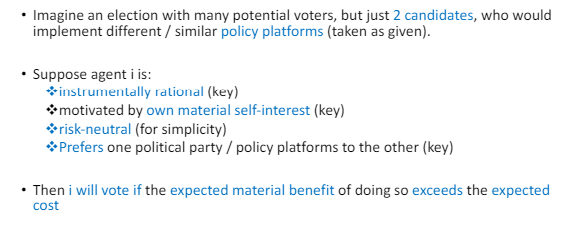
4
What are the other types of benefit that aren't considered usually?
Non material social benefit
Monetary benefit
Monetary benefit
5
What is the rational participation rule? (1)
$p_i B_i >= C_i$
Key words: pivot probability, material benefit, cost of voting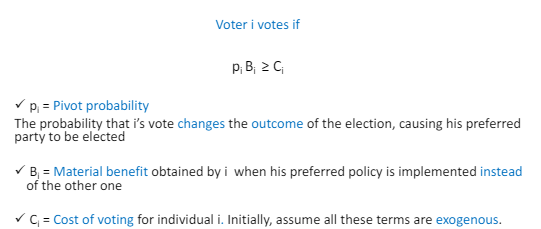
Key words: pivot probability, material benefit, cost of voting
6
Why does the rational participation rule (1) not explain voter turnout?
For elections with large electorates (many voters), $p_i$ is tiny and the cost of voting is never zero even in advanced economies (transport, missing work etc). Therefore, the conditions determining voter participation may be rarely met and yet the average turnout in the UK is 60%
The issue would remain for plausible levels of altruism also (ie if $B_i$ included caring about her material benefit and the one of others)
The issue would remain for plausible levels of altruism also (ie if $B_i$ included caring about her material benefit and the one of others)
7
How can the rational participation rule (1) be amended to explain high turnout in large elections?
- Solution 1: Add extra terms
- Solution 2: Vary the rationality assumption
- Solution 3: Endogenise some terms.
- Solution 2: Vary the rationality assumption
- Solution 3: Endogenise some terms.
8
What is the rational participation rule? (2)
$p_i B_i + D_i>= C_i$
Key words: pivot probability, material benefit, direct benefit, cost of voting
Material benefit perceived by i from i’s preferred policy being implemented instead of another one. Note that it can be defined more broadly than i’s own material self-interest
Direct benefit not multiplied by p - achieved just by the act of voting (e.g., being a « good » citizen), not associated with the result.
Citizens obtain Di whether their vote is pivotal (with likelihood pi) or not (with likelihood 1- pi )
If Ci is small, even modest Di would explain why i votes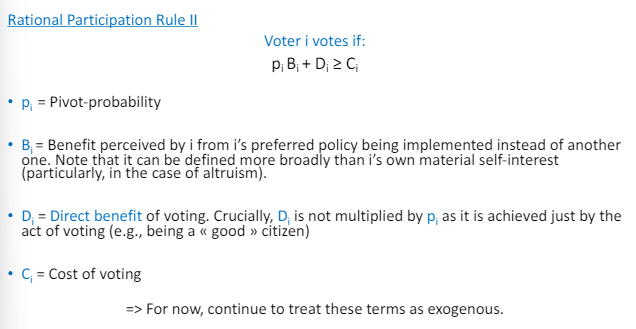
Key words: pivot probability, material benefit, direct benefit, cost of voting
Material benefit perceived by i from i’s preferred policy being implemented instead of another one. Note that it can be defined more broadly than i’s own material self-interest
Direct benefit not multiplied by p - achieved just by the act of voting (e.g., being a « good » citizen), not associated with the result.
Citizens obtain Di whether their vote is pivotal (with likelihood pi) or not (with likelihood 1- pi )
If Ci is small, even modest Di would explain why i votes
9
Explain the concept of the Pivotal voter
The DPCT theorises two competing candidates converging towards the preferences of the median voter. In the swing voter theory, voters attempt to make elections close to be decisive in the vote and to potentially, threaten their preferred party if it does not commit to their preferred policy.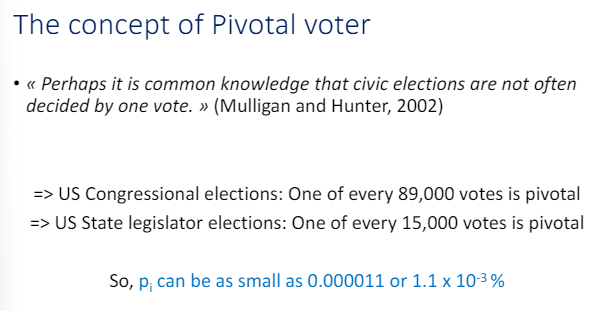
10
How does the pivotal voter model endogenise terms in the rational participation rule (2)?
Endogenise $p_i$ and $C_i$ --> $p_i$(Turnout) and $C_i$(Turnout)
1) The more citizens turn out to vote, the less likely one individual is the Pivotal voter (i.e., changing the outcome of the vote)
2) In a society, everyone has a different marginal cost to vote. So when turnout increases, people with higher marginal costs vote as well
Equilibrium turnout a T* --> $p_pivotal-voter^*$ and $C_pivotal-voter^*$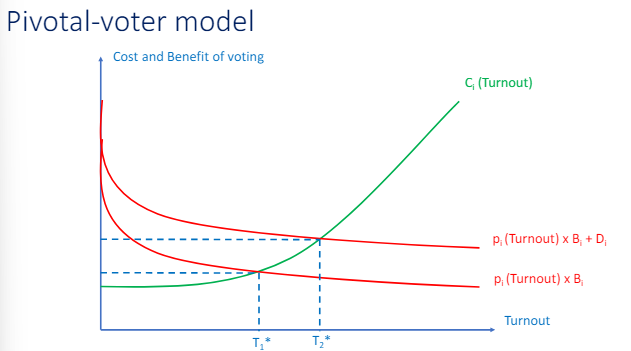
1) The more citizens turn out to vote, the less likely one individual is the Pivotal voter (i.e., changing the outcome of the vote)
2) In a society, everyone has a different marginal cost to vote. So when turnout increases, people with higher marginal costs vote as well
Equilibrium turnout a T* --> $p_pivotal-voter^*$ and $C_pivotal-voter^*$
11
How does the pivotal voter model explain high turnout?
- Add $D_i$ or increase $D_i$
- The marginal cost of voting decreases: the $C_i$ (Turnout) moves downward (e.g., Good weather)
- The marginal benefit $B_i$ increases (e.g., when the platforms are polarized)
- The Pivot-probability increases: the $p_i$(Turnout) shifts upward (e.g., a
higher likelihood of close elections)
In large elections, the observed turnout can still be plausibly explained
by adding Di
To endogenise p and C is not enough, it is better to rethink rationality (ie. include all three solutions)
- The marginal cost of voting decreases: the $C_i$ (Turnout) moves downward (e.g., Good weather)
- The marginal benefit $B_i$ increases (e.g., when the platforms are polarized)
- The Pivot-probability increases: the $p_i$(Turnout) shifts upward (e.g., a
higher likelihood of close elections)
In large elections, the observed turnout can still be plausibly explained
by adding Di
To endogenise p and C is not enough, it is better to rethink rationality (ie. include all three solutions)
12
How does Coate and Conlin (2004) combine the Ethical Voter Model and Rationality?
- Introduces a non-standard view of rationality where individuals belong to groups
Suppose individuals vote for a referendum (or btwn two different political parties)
- Group 1 (supporters) and Group 2 (opponents)
- The group agrees on which electoral outcome is the best. Ex : Every voter in a group could share the same preferences over two alternatives YES or NO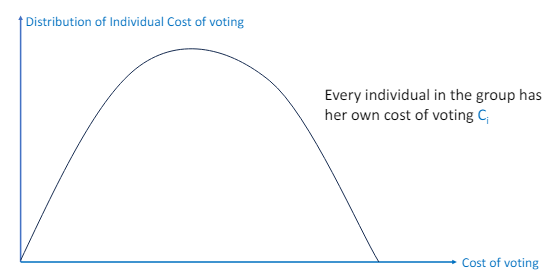
Suppose individuals vote for a referendum (or btwn two different political parties)
- Group 1 (supporters) and Group 2 (opponents)
- The group agrees on which electoral outcome is the best. Ex : Every voter in a group could share the same preferences over two alternatives YES or NO
13
How does the Ethical Voter Model and Rationality justify $D_i$?
Every individual in the group 'does their part' by voting
They want to maximise their group's aggregate utility and voting is therefore, a CIVIC DUTY for the group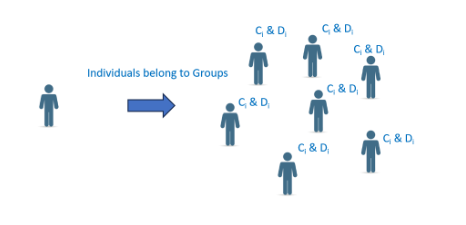
They want to maximise their group's aggregate utility and voting is therefore, a CIVIC DUTY for the group
14
What is the rule determination?
Each individual in the group receives a benefit from seeing their preferred proposition elected BUT there is also an individual cost of voting
As every individual in a group follows to the same rule, individuals should know whether or not they have to vote to maximise the aggregate group utility
Every voter with an individual cost below $C_G$ votes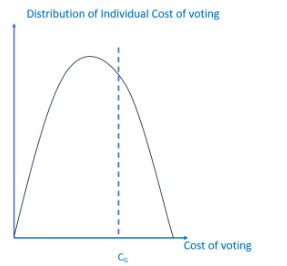
As every individual in a group follows to the same rule, individuals should know whether or not they have to vote to maximise the aggregate group utility
Every voter with an individual cost below $C_G$ votes
15
How is $C_G$ determined?
Such that the rule followed by the other group is taken as given and that all members of Group G follow the same rule (i.e will vote for the group's preferred option as long as their $C_i <= C_G$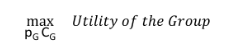
16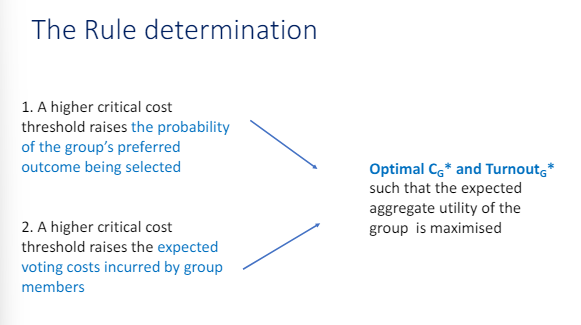
Image occlusion: name the hidden labels
17
Image occlusion: name the hidden labels
18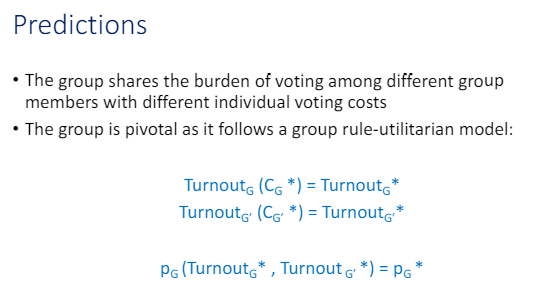
Image occlusion: name the hidden labels
19
Image occlusion: name the hidden labels
20
Image occlusion: name the hidden labels
21
$p_G$ is large when...
when the entire group follows the same rule
22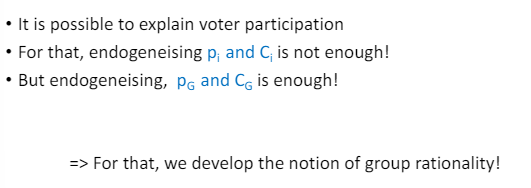
Image occlusion: name the hidden labels