RD - DM II
Study these flashcardsFree · spaced repetition · iPhone, Android, Mac & web
All cards
1
What is the Downsian Policy Convergence Theorem (DPCT)?
The DPCT states that when certain assumptions are met, two political parties will converge to a policy platform.
2
The DPCT states that when certain assumptions are met, two political parties will converge to a policy platform.
1. Two parties, A and B.
2. Parties announce a policy platform and commit to it.
3. Equal probabilities when voters randomize between parties.
4. Voters have single-peaked preferences.
2. Parties announce a policy platform and commit to it.
3. Equal probabilities when voters randomize between parties.
4. Voters have single-peaked preferences.
3
How do parties converge in the DPCT?
Parties converge to the median voter's bliss point.
4
What happens if a party deviates from the median voter's bliss point in the DPCT?#
If a party deviates, the other party can win by announcing the median voter's bliss point
5
What happens if there are three or more political parties in the DPCT?
There is always an incentive to move in response to opponents' positions.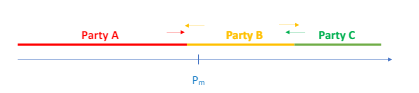
6
What defines voters having intermediate preferences?
$U(p; \alpha_i) = J(p) + K(\alpha_i) H(p)$
where $K(\alpha_i)$ is monotonic and H(p) and J(p) are common to all voters
where $K(\alpha_i)$ is monotonic and H(p) and J(p) are common to all voters
7
What is a monotonic function in the context of intermediate preferences?
A function between ordered sets that preseves or reverses the given order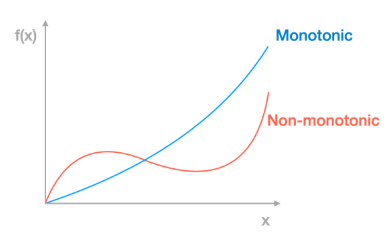
8
How does the DPCT still apply with intermediate preferences?
Assuming sincere voting also, a Condorcet winner always exists and coincides with the bliss point of the voter with the median value $alpha_i, p(alpha_m)$
- The party’s competition leads to the median voter’s choice. Thus, political
parties select the policy $p = (p_1, p_2)$ such that
$\max_{p_1, p_2} U(p_1, p_2; \alpha_m)$
- The party’s competition leads to the median voter’s choice. Thus, political
parties select the policy $p = (p_1, p_2)$ such that
$\max_{p_1, p_2} U(p_1, p_2; \alpha_m)$
9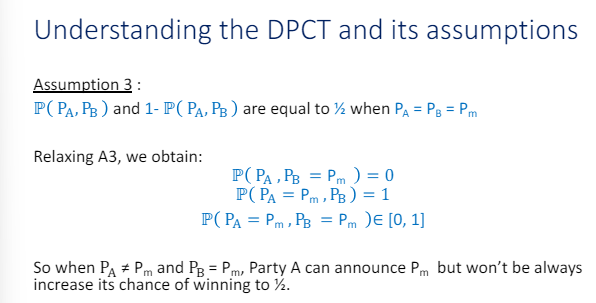
Image occlusion: name the hidden labels
10
If the assumption that $\mathbb{P}(P_A, P_B)' = 1 - \mathbb{P}(P_A, P_B) = \frac{1}{2}$, how does that change the outcome of the theory?
- There is no longer a need to have convergence btwn the two parties
- The policy implemented is still that of the median-ranked voter's bliss point
- The policy implemented is still that of the median-ranked voter's bliss point
11
What other preferences can be used in place of single-peaked preferences so that the MVT would still be satisfied?
Intermediate preferences and preferences with single crossing
If it's none of those then, in the case of cycling, there is not pure strategy equilibrium for the political parties (e.g Condorcet paradox)
If it's none of those then, in the case of cycling, there is not pure strategy equilibrium for the political parties (e.g Condorcet paradox)
12
What do Single-peaked preferences imply in terms of utility function?
They imply the existence of a concave indirect utility function.
13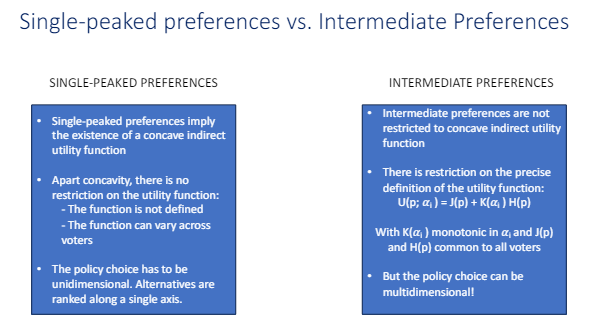
Image occlusion: name the hidden labels
14
Image occlusion: name the hidden labels
15
Image occlusion: name the hidden labels
16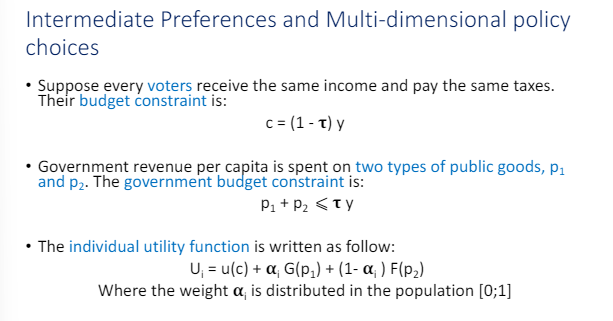
Image occlusion: name the hidden labels
17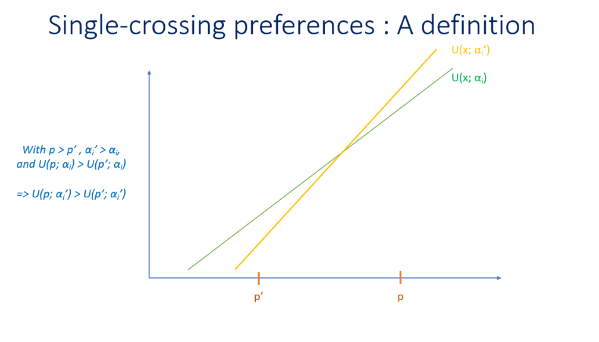
Image occlusion: name the hidden labels
18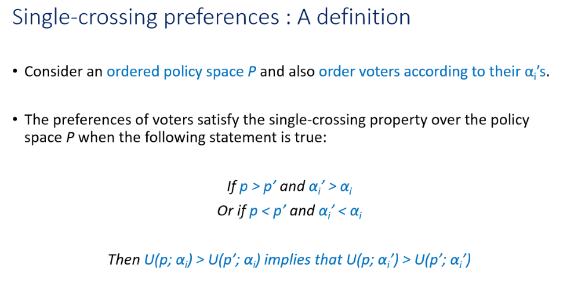
Image occlusion: name the hidden labels
19
Extended Median Voter Theorem: When there is direct democracy, sincere voting, and single crossing preferences...
Then a Condorcet winner always exists and coincides with the bliss point of the median voter.
Consider $p' > p_m, U(p_m;alpha_m) > U(p';alpha_m$. By definition of single-crossing preferences, for all $alpha_i > alpha_m, U(p_m;alpha_i) > U(p';alpha_i$
Consider $p' > p_m, U(p_m;alpha_m) > U(p';alpha_m$. By definition of single-crossing preferences, for all $alpha_i > alpha_m, U(p_m;alpha_i) > U(p';alpha_i$
20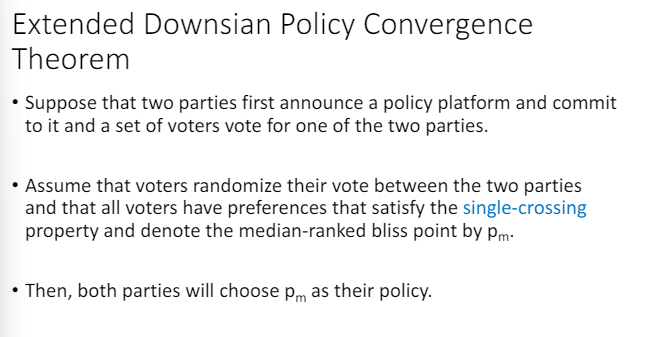
Image occlusion: name the hidden labels
21
Image occlusion: name the hidden labels
22
Image occlusion: name the hidden labels