All cards
1
Dates?
2008-2009, looking at the transmission of international shocks to emerging market economies
2
Assumptions of the model
Variation of MF
- small open economy
- static model
- fixed pice
- imperfect capial mobility
- potentially contractionary effects of currency depreciation due to foreign debt exposure ie ML condition does not necessarily hold
- small open economy
- static model
- fixed pice
- imperfect capial mobility
- potentially contractionary effects of currency depreciation due to foreign debt exposure ie ML condition does not necessarily hold
3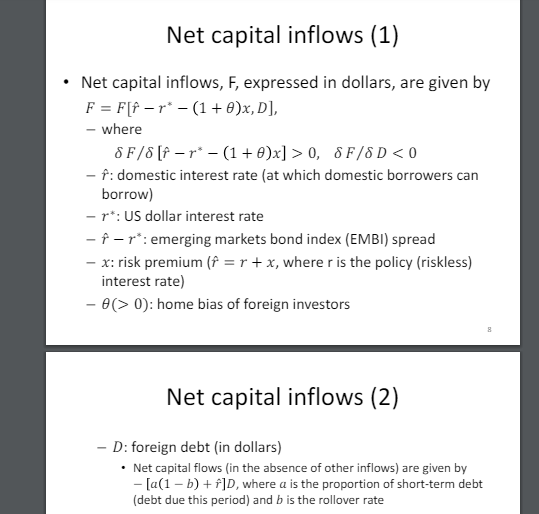
Image occlusion: name the hidden labels
4
Image occlusion: name the hidden labels
5
Image occlusion: name the hidden labels
6
Image occlusion: name the hidden labels
7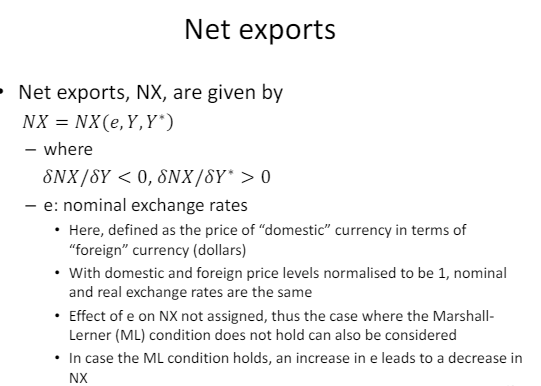
Image occlusion: name the hidden labels
8
Image occlusion: name the hidden labels
9
Image occlusion: name the hidden labels
10
Image occlusion: name the hidden labels
11
Image occlusion: name the hidden labels
12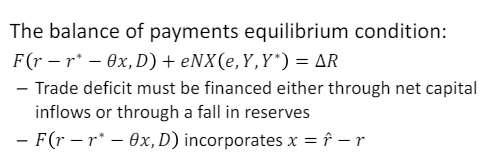
Image occlusion: name the hidden labels
13
Image occlusion: name the hidden labels
14
Image occlusion: name the hidden labels
15
Image occlusion: name the hidden labels
16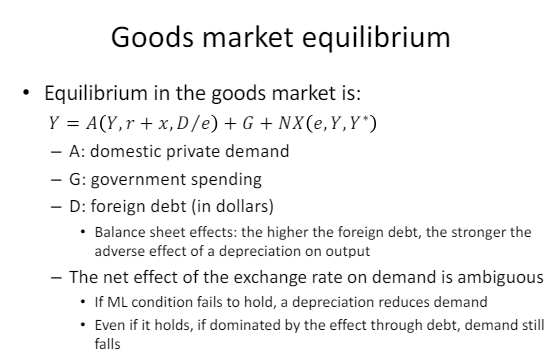
Image occlusion: name the hidden labels
17
Image occlusion: name the hidden labels
18
Image occlusion: name the hidden labels
19
Image occlusion: name the hidden labels
20
Draw the IS-BP equilibrium. Assume that the ML condition holds, but the net effect of a depreciation is contractionary.
Output and ER in equilibrium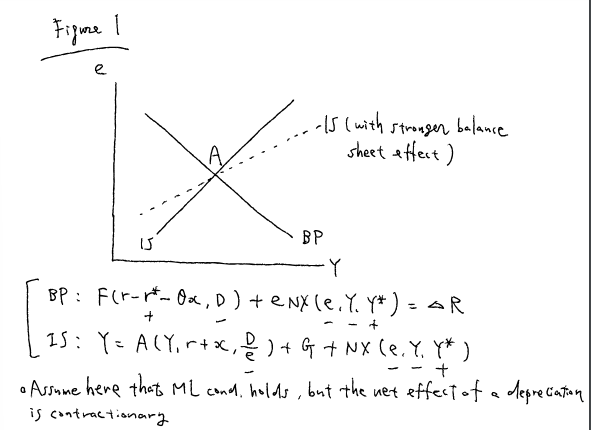
21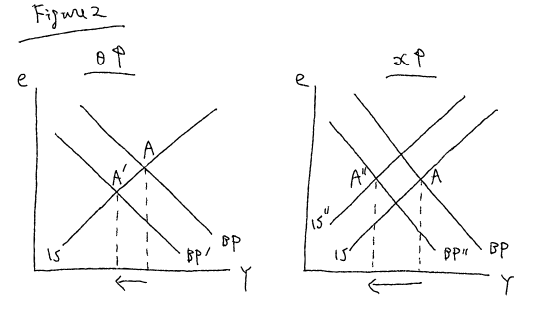
Show the effects of an adverse financial shock
22
Show the effects of a trade shock
balance sheet effect is stronger as D is larger
- Larger foreign debt is likely to amplify the effects so shift in Y is larger than in e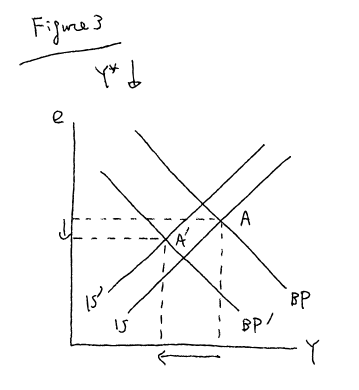
- Larger foreign debt is likely to amplify the effects so shift in Y is larger than in e
23
What does Blanchard et al. (2010) evidence?
- Empirical analysis to shed light on heterogeneity in country outcomes
- Based on 29 emerging market countries (from Central and Eastern Europe, Asia, Latin America, and Africa)
- Highlight unexpected growth - All 29 EMCs in the sample had negative unexpected growth over 2008Q4 and 2009Q1, but with substantial variations across them
- Financial shocks: foreign debt to GDP ratio and current acount
- Trade shocks: export share of GDP (more open = larger shock) and unexpected partner growth (more negative if growth is slower)
- Heterogeneity in the output impact: Lithuania (almost 30% negative growth over the 2 quarters) and China (less than 5%) depends on the compostion of GDP growth
- constrained by data availability on quarterly GDP data and quarterly IMF forecast of GDP
- Based on 29 emerging market countries (from Central and Eastern Europe, Asia, Latin America, and Africa)
- Highlight unexpected growth - All 29 EMCs in the sample had negative unexpected growth over 2008Q4 and 2009Q1, but with substantial variations across them
- Financial shocks: foreign debt to GDP ratio and current acount
- Trade shocks: export share of GDP (more open = larger shock) and unexpected partner growth (more negative if growth is slower)
- Heterogeneity in the output impact: Lithuania (almost 30% negative growth over the 2 quarters) and China (less than 5%) depends on the compostion of GDP growth
- constrained by data availability on quarterly GDP data and quarterly IMF forecast of GDP
24
What does Berkmen et al. (2012) evidence?
- Use forecasting errors to measure the impact of the crisis
- Forecasts prior to Lehman collapse from Consensus Forecast and WEO Forecast
- Trade linkages: sharp fall in advanced economy demand, spillover effects greater for those wth strong trade links with them
- Financial linkages: global crisis originated in the financial sector in advanced economies, countries with close financial ties with advanced economies are expected to have been affected severely
- Underlying vulnerabilities and financial structure: if prior to the crisis there was rapid credit growth in emerging countries based on foreign borrowing, the reversal of capital flows during the crisis can cause severe balance sheet problems
- Overall policy and institutional framework: whether there is room for countercyclical fiscal policies, countries with more flexible exchange
rates may manage external shocks more easily
- Forecasts prior to Lehman collapse from Consensus Forecast and WEO Forecast
- Trade linkages: sharp fall in advanced economy demand, spillover effects greater for those wth strong trade links with them
- Financial linkages: global crisis originated in the financial sector in advanced economies, countries with close financial ties with advanced economies are expected to have been affected severely
- Underlying vulnerabilities and financial structure: if prior to the crisis there was rapid credit growth in emerging countries based on foreign borrowing, the reversal of capital flows during the crisis can cause severe balance sheet problems
- Overall policy and institutional framework: whether there is room for countercyclical fiscal policies, countries with more flexible exchange
rates may manage external shocks more easily