Intertemporal Trade and Current Account Balance
Study these flashcardsFree · spaced repetition · iPhone, Android, Mac & web
All cards
1
What does this model consider that the Dornbusch, Monetary and Mundell model don't?
- inviduals, households and firms
- individuals + macro relations
- welfare after a macro shock
- justify demand-determined output
- individuals + macro relations
- welfare after a macro shock
- justify demand-determined output
2
What is intertemporal trade?
Resource exchanges across time
- Measured by current account of balance of payments
- Model is entirely real (no money
- Measured by current account of balance of payments
- Model is entirely real (no money
3
What are the assumptions of the two-period endowment economy model?
1) small open economy
2) SINGLE GOOD
3) agents have perfect foresight
4) agents are identical and population size is unity
5) no investment
2) SINGLE GOOD
3) agents have perfect foresight
4) agents are identical and population size is unity
5) no investment
4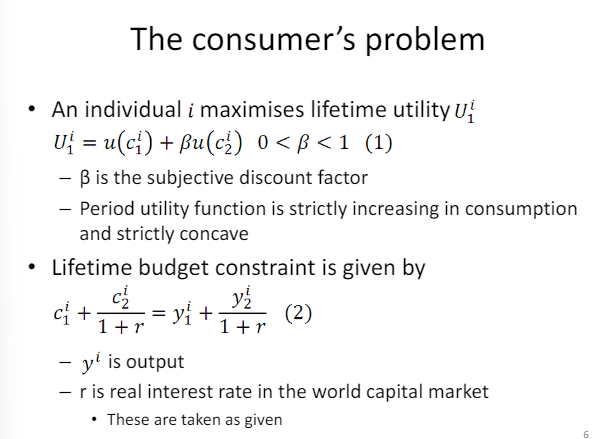
Image occlusion: name the hidden labels
5
Image occlusion: name the hidden labels
6
What is the intertemporal Euler equation?
_ Marginal rate of substitution equals price of future consumption in terms of present consumption
OR $u'(c_1^i) = (1 + r) \beta u'(c_2^i)$
- At maximum utility, the consumer cannot gain from feasible shifts of consumption between periods
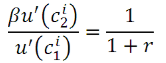
OR $u'(c_1^i) = (1 + r) \beta u'(c_2^i)$
- At maximum utility, the consumer cannot gain from feasible shifts of consumption between periods
7
What is the individual's optimal consumption plan in terms of $\frac{1}{1 + r}$ ?
If $\beta < \frac{1}{1 + r}$ --> $c_1^i > c_2^i$ ie discount factor is less than the price of future consumption
If $\beta > \frac{1}{1 + r}$ --> $c_1^i < c_2^i$
If $\beta = \frac{1}{1 + r}$, the consumer chooses a flat consumption path $c_1^i = c_2^i$ and there is common consumption in both periods
If $\beta > \frac{1}{1 + r}$ --> $c_1^i < c_2^i$
If $\beta = \frac{1}{1 + r}$, the consumer chooses a flat consumption path $c_1^i = c_2^i$ and there is common consumption in both periods
8
Since all individuals are identical and population size is unity...
We can identify per capita quantity variables with national aggregate quantities, thus $c^i = C$ and $y^i = Y$
The representative agent model
The representative agent model
9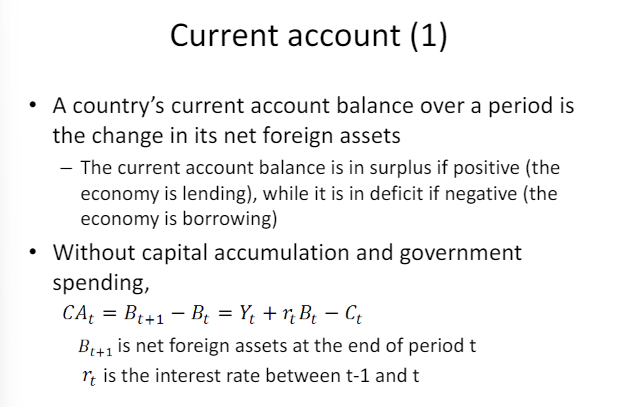
Image occlusion: name the hidden labels
10
The lifetime budget constraint entails zero initial and terminal assets ie $B_1 = 0$ and $B_3 = 0$. What does this imply?
That $CA_2 = -CA_1$
- Net foreign debt cannot be positive at the end of period 2 because of the foreign agent maximisation problem
- Net foreign assets cannot be positive as it needs to be maximised within the two-period time frame
$CA_2 = B_3 - B_2 = -B_2$
$CA_1 = B_2 - B_1 = B_2$
so $CA_2 = -CA_1$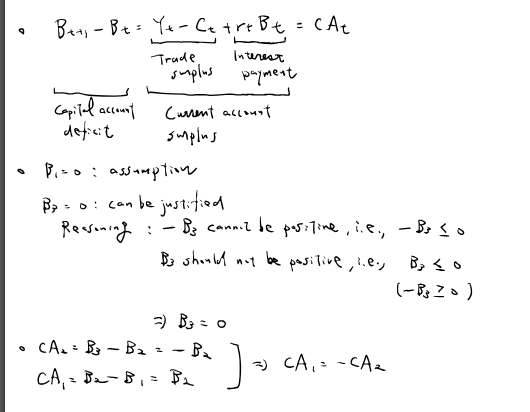
- Net foreign debt cannot be positive at the end of period 2 because of the foreign agent maximisation problem
- Net foreign assets cannot be positive as it needs to be maximised within the two-period time frame
$CA_2 = B_3 - B_2 = -B_2$
$CA_1 = B_2 - B_1 = B_2$
so $CA_2 = -CA_1$
11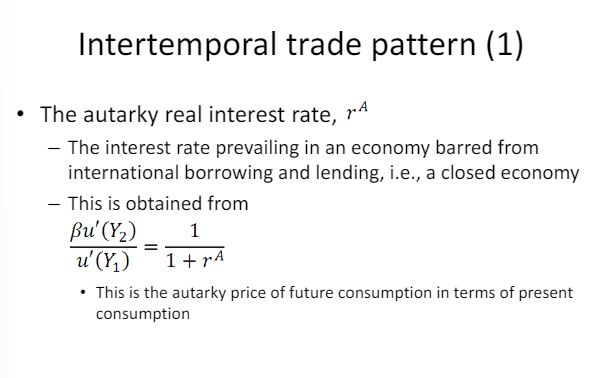
Image occlusion: name the hidden labels
12
Explain the intertemporal trade pattern when $r^A > r$
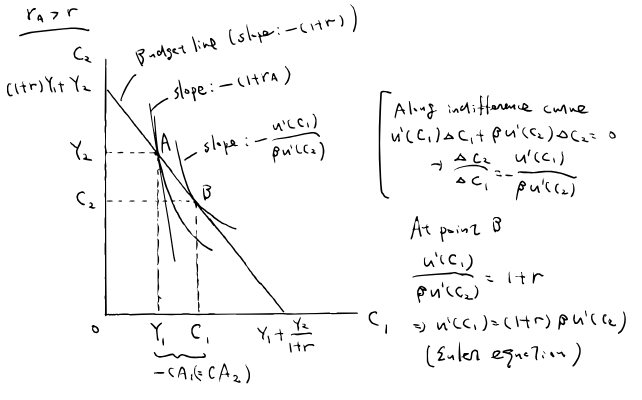
Along the indifference curve, utility is maximised and there would be no consumer gain from feasible shifts of consumption between periods. So following $u'(C_1) \Delta C_1 + \beta u'(C_2) \Delta C_2 = 0)$, $\frac{\Delta C_2}{\Delta C_1} = -\frac{u'(C_1)}{\beta u'(C_2)}$.
At point B, $\frac{u'(C_1)}{\beta u'(C_2)}$ = $1+r$ (both usually in minus) (hitting the budget line) so $u'(c_1^i) = (1 + r) \beta u'(c_2^i)$ (EULER EQUATION)
- Future consumption is relatively cheap in the home economy (present consumption is relatively expensive)
- Therefore, the home will “import” present consumption from abroad in the first period by running a current account deficit, and “export” future consumption later by repaying its debt
At point B, $\frac{u'(C_1)}{\beta u'(C_2)}$ = $1+r$ (both usually in minus) (hitting the budget line) so $u'(c_1^i) = (1 + r) \beta u'(c_2^i)$ (EULER EQUATION)
- Future consumption is relatively cheap in the home economy (present consumption is relatively expensive)
- Therefore, the home will “import” present consumption from abroad in the first period by running a current account deficit, and “export” future consumption later by repaying its debt
13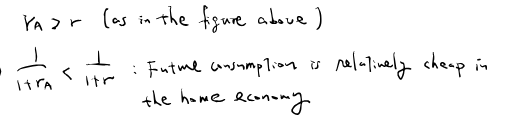
Image occlusion: name the hidden labels
14
Explain the intertemporal trade pattern when $r^A < r$
- The home will “export” present consumption and “import” future consumption
- Still gains from intertemporal trade --> Regardless of the sign of the initial current account balance, there is a utility gain
- If $r^A = r$, there is no gain
- Still gains from intertemporal trade --> Regardless of the sign of the initial current account balance, there is a utility gain
- If $r^A = r$, there is no gain
15
What does adding investment do to the model?
Countries can borrow to finance investments
Output is now a function of capital $Y = F(K)$ where F'(K) > 0
Capital good is created from consumption and vice versa, relative price of K goods in terms of C goods is unity
Output is now a function of capital $Y = F(K)$ where F'(K) > 0
Capital good is created from consumption and vice versa, relative price of K goods in terms of C goods is unity
16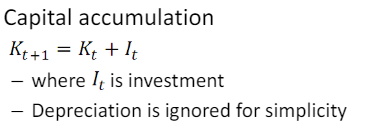
State the equation for capital accumulation
17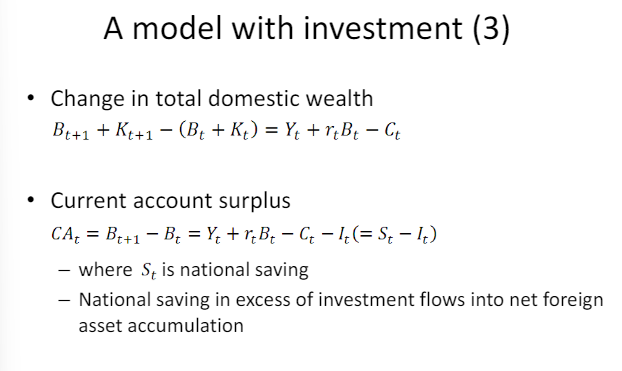
Image occlusion: name the hidden labels
18
Image occlusion: name the hidden labels
19
National saving in excess of investment flows into...
net foreign asset accumulation
20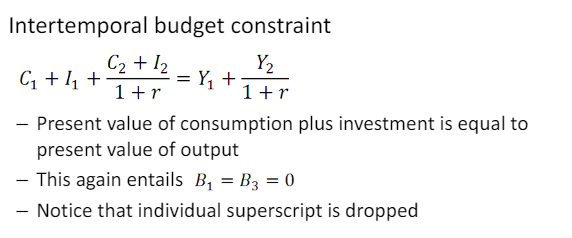
Image occlusion: name the hidden labels
21
Image occlusion: name the hidden labels
22
Image occlusion: name the hidden labels
23
Image occlusion: name the hidden labels
24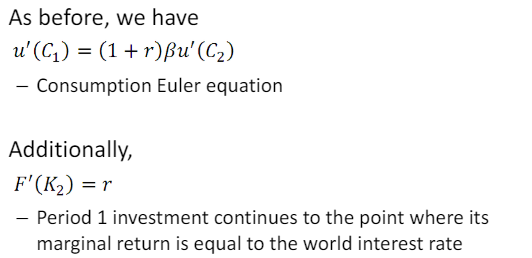
First order conditions with investment in the model
25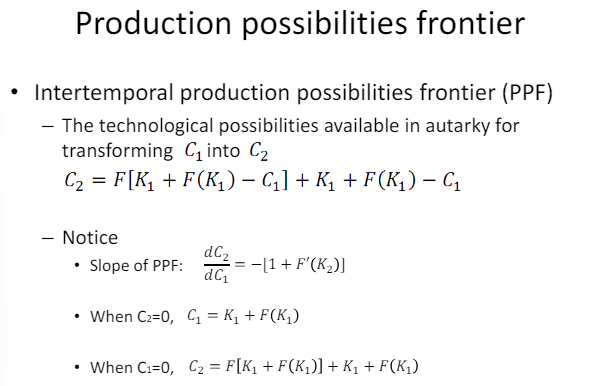
Image occlusion: name the hidden labels
26
Image occlusion: name the hidden labels
27
Image occlusion: name the hidden labels
28
Image occlusion: name the hidden labels
29
Image occlusion: name the hidden labels
30
What occurs in the autarky equilibrium?
The PPF is tangent to the highest indifference curve reached without intertemporal trade. The common slope at the equilibrium is $-(1+r^A)$ where $r^A$ is the real autarky interest rate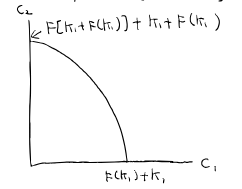
31
Explain the intertemporal trade pattern when $r^A > r$ when there is invesment in the model
A: autarky EQ, Euler equation satisfied in terms of $r^A$
- marginal product of investment > world interest rate
- I1 goes up corresponding to the horizontal disztance between A and B; Notice F(K1) = C1 + I1 so that fall in C1 corresponds to the rise in I1
- Horizontal difference between B and C; current account deficit in period 1.
- UTILTY GAIN - There is an additional source of gain (i.e., not only smoothing the time path of consumption but also changing the production point)
- also a gain when $r^A < r$, but a first-period current account surplus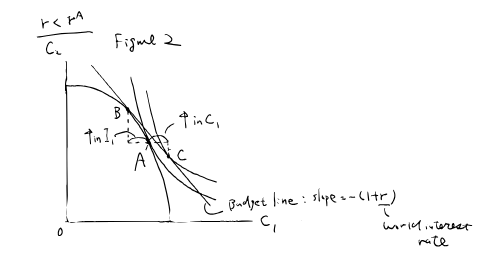
- marginal product of investment > world interest rate
- I1 goes up corresponding to the horizontal disztance between A and B; Notice F(K1) = C1 + I1 so that fall in C1 corresponds to the rise in I1
- Horizontal difference between B and C; current account deficit in period 1.
- UTILTY GAIN - There is an additional source of gain (i.e., not only smoothing the time path of consumption but also changing the production point)
- also a gain when $r^A < r$, but a first-period current account surplus
32
Government consumption?