Genetics and Embryo S1 U2
Study these flashcardsFree · spaced repetition · iPhone, Android, Mac & web
All cards
1
Traits in which variation is thought to be caused by the combined effects of multiple genes
polygenic
2
environmental factors are also believed to cause variation in the trait as well as the underlying genetics
multifactoral
3
The loci underlying variation in a quantitative trait such as height
quantitative trait loci (QTL)
4
For multifactorial diseases that are either present or absent, a ______________ must be crossed before the disease is expressed.
threshold of liability
5
risks based on direct observation of data
empirical risks
6
how do you estimate empirical risks, what is used most often for multifactoral diseases
To estimate empirical risks, a large series of families is examined in which one child (the proband) has developed the disease.
-The relatives of each proband are surveyed in order to calculate the percentage who have also developed the disease.
-The relatives of each proband are surveyed in order to calculate the percentage who have also developed the disease.
7
multifactoral inheritence: the reccurent risk is (lower/higher) if more than one family member is affected
higher
8
multifactoral inheritance: If the expression of the disease in the proband is more severe, the recurrence risk is (higher/lower)
higher
9
multifactoral inheritance: The recurrence risk is _____ if the proband is of the less commonly affected sex
hugher
10
multifactoral inheritance: If the prevalence of the disease in a population is f (which varies between zero and one), the risk for offspring and siblings of probands is approximately _______
square rt f
11
originate when the developing embryo divides to form two separate but genetically identical embryos.
monozygotic twins
12
the result of a double ovulation followed by the fertilization of each egg by a different sperm
dizygotic twins
13
If both members of a twin pair share a trait (e.g., cleft lip), they are said to be....
concordant
14
if both members of a twin pair dont share a trait they atre said to be
discordant
15
the percentage of population variation in a trait that is due to genes (statistically, it is the proportion of the total variance of a trait that is caused by genes).
heritability
16
If a sufficiently large ________ score (see Chapter 8) is obtained with a polymorphism, it is assumed that the region around this polymorphism might contain a disease-causing gene.
LOD
17
multifactoral inheritance: Disease families are collected, a single-gene mode of inheritance is assumed, and linkage analysis is undertaken with a large series of marker polymorphisms that span the genome (this is termed a _____________)
genome scan
18
DNA variants associated with variation in mRNA expression of a gene are termed
expression quantitative trait loci (eQTLs)
19
heteroygosity mutation in the LDL receptor gene roughly doubles LDL cholesterol levels and is seen in approximately 1 in 500 persons. (This condition, known as.....
familial hypercholesterolemia
20
fx of Apo B-100 (on LDL)
a component of LDL, and it acts as a recognition signal that allows LDL to be internalized into hepatocytes
21
what does a mutation on the APOB gene cause
defective binding of APOb and LDL receptor, increased circulating LDL cholesterol levels to 50% to 100%
22
describes the characteristically elongated QT interval in the electrocardiogram of affected individuals, indicative of delayed cardiac repolarization.
LQT syndrome
23
what is the cause of long QT syndrome
onherited mutations or exposure to drugs that lock potassium chjannels
24
autosomal dominant form of long QT sydrome that can be caused by a loss of function mutation in genes that encode potassium channels
Romano-Ward syndrome
25
autosomal recessive forms of LQT syndrome that are less cpommon and associated with longer QT interval and hjigher incidence of suffen cardiac death and sensorineural deafness (x2)
Jervell and Lange-Nielsen syndrome
26
what is the mutation in Jervell and Lange-Nielsen syndrome
mutations in KCNQ1 or KCNE1
27
distinctive cholesterol deposits seen oin the skin of people with familial hypercholesterolemia
xanthomas
28
what are class 1 LDLR mutations
result in no detectable protein product.
-Thus heterozygotes would produce only half the normal number of LDL receptors.
-Thus heterozygotes would produce only half the normal number of LDL receptors.
29
what are class II LDLR mytations
production of the LDL receptor, but it is altered to the extent that it cannot leave the endoplasmic reticulum. It is eventually degraded.
30
what are class III LDLr mutations?
produce an LDL receptor that is capable of migrating to the cell surface but is incapable of normal binding to LDL.
31
what is a class IV LDLR mutation
produce receptors that are normal except that they do not migrate specifically to coated pits and thus cannot carry LDL into the cell.
32
what are class V LDLR mutations
LDL receptor that cannot disassociate from the LDL particle after entry into the cell. The receptor cannot return to the cell surface and is degraded.
33
familial hypercholesterolemia LDLR mutation causes
elevated LDL level
34
familial hypercholesterolemia mutation apolipoprotein B results in
elevated LDl level
35
Gain-of-function mutations elevate LDL; loss-of-function mutations reduce LDL
36
Tangier disease: ATP binding cassette 1 (ABC1) mutation causes
reduced HDL levels
37
familial dialated cardiomyopathy: TNNT2 mutation causes
reduced force generaton by sarcomere
38
familial dialated cardiomyopathy titin (TTN) mutation causes
destabilized sacromere
39
familial dialated cardiomyopathy: MYH7 mutation causes
reduced force generation by sarcomere
40
familial dialated cardiomyopathy: SGCB mutation causes
destabiliazed sarcolemma and signal transduction
41
familial dialated cardiomyopathy: SGCD myutation causes
destabilized sarcolemma signal transduction
42
familial dialated cardiomyopathy: dystrophin mutation causes
destabilized sarcolemma in cardiac myocytes
43
familial hypertrophic cardiomyopathy: MYH7 mutation causes
reduced force generated by sarcomere
44
familial hypertrophic cardiomyopathy TNNT2 mutation causes r
reduced force generation by sarcomere
45
long qt syndrome LQT1 and KCNQ1 mutations cause
prolongued qt interval om elevtrocardiogram arrhythmia
46
long qt syndrome LQT2 and KCNH2 mutation cause
prolongued QT interval on electrocardiogram arrthymia
47
long qt syndrome LQT3 and SCN5A mutation cause
prolongued QT interval on electrocardiogram arrhythmia
48
long QT syndrome: Ankyrin B anchoring protein (LQT4, ANK2) mutations cause
Prolonged QT interval on electrocardiogram, arrhythmia
49
long qt syndrome: Cardiac potassium channel β subunit (LQT5, KCNE1) and Cardiac potassium channel subunit (LQT6, KCNE2) cause
Prolonged QT interval on electrocardiogram, arrhythmia
50
liddle syndrome: Renal epithelial sodium channel subunits (SCNN1B, SCNN1G) mutation causes
Severe hypertension, low renin and suppressed aldosterone
51
gordon syndrome: WNK1 or WNK4 kinase genes mutations cause
High serum potassium level and increased renal salt reabsorption
52
Glucocorticoid-remediable aldosteronism: Fusion of genes that encode aldosterone synthase and steroid 11β-hydroxylase mutation causes
Early-onset hypertension with suppressed plasma renin and normal or elevated aldosterone levels
53
Syndrome of apparent mineralocorticoid excess: 11 β-Hydroxysteroid dehydrogenase (11β-HSD2) mutation causes
Early-onset hypertension, low potassium and renin levels, low aldosterone
54
diabetes MODY1: Hepatocyte nuclear factor-4α (HNF4A) mutation causes
Decreased insulin secretion
55
diabetes MODY2: GCK mutation leads to
Impaired glucose metabolism, leading to mild nonprogressive hyperglycemia
56
diabetes MODY3 Hepatocyte nuclear factor-1α (HNF1α) mutation cayuses
Decreased insulin secretion
57
diabetes MODY4: nsulin promoter factor-1 (IPF1) mutation causes
factor-1 (IPF1) Decreased transcription of insulin gene
58
diabetes MODY 5: Hepatocyte nuclear factor-1β (HNF1β) mutation
β-cell dysfunction leads to decreased insulin secretion
59
Germline mutations in the ____(x2) genes can cause Li–Fraumeni syndrome, which also predisposes to breast cancer.
TP53 and CHK2
60
Cowden disease, a rare autosomal dominant condition that includes multiple hamartomas and breast cancer, is caused by mutations in the
PTEN tumor supresor gene
61
familial colorectal cancer can be the result of mutations in the ______- tumor suppressor gene or in one of several DNA mismatch-repair genes (Lynch syndrome).
APC
62
characterized by T-cell infiltration of the pancreas and destruction of the insulin-producing beta cells, usually manifests before 40 years of age
type 1 diaetes
63
type 1 diabetes: estimated that the HLA loci account for about 40% to 50% of the genetic susceptibility to type 1 diabetes. 95% of people have one of these alleles
HLA DR3 or 4
64
where is the insulin gene located
short arm chromosome 11
65
most significant gene identiied to contribute to type II diabetes risj
TCF7L2
66
which accounts for 1% to 5% of all diabetes cases, typically occurs before 25 years of age and follows an autosomal dominant mode of inheritance. In contrast to type 2 diabetes, it is not associated with obesity.
MODY
67
alcoholism characterized by a later age of onset (after 25 years of age), occurrence in both males and females, and greater psychological dependency on alcohol.
-more likely to be introverted, solitary drinkers. This form of alcoholism is less likely to cluster in families (
-more likely to be introverted, solitary drinkers. This form of alcoholism is less likely to cluster in families (
type I alcoholics
68
seen predominantly in males, typically occurs before 25 years of age, and tends to involve persons who are extroverted and thrill-seeking.
-clusters more strongly in families
-clusters more strongly in families
type II alcoholiucs
69
this allele makes alcohol unplesant
ALDH2*2
70
refers to earlier age-of-onset of some genetic diseases in more recent generations of families.
anticipation
71
refers to the fact that some genes are expressed only on paternally transmitted chromosomes and others are expressed only on maternally transmitted chromosomes
imprinting
72
states that one X chromosome in each cell is randomly inactivated early in the embryonic development of females. This ensures that females, who have two copies of the X chromosome, will produce X-linked gene products in quantities roughly similar to those produced in males (dosage compensation).
lyon hypothesis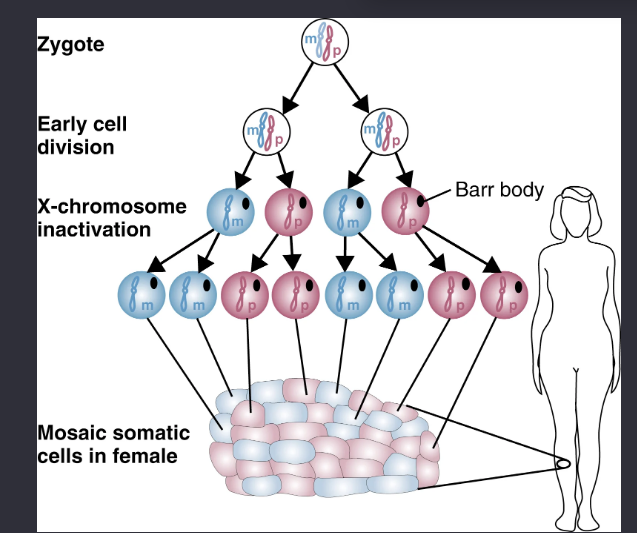
73
what eidence supports the lyon hypothesis?
cytogenetic evidence: Barr bodies, which are inactive X chromosomes, are seen only in cells with two or more X chromosomes. It is also supported by biochemical and animal studies that reveal mosaicism of X-linked traits in female heterozygotes.
74
what region is inactivation initiated in X chromosomes
1-MB region on the X cromosome long arm (X inactivation center)
75
this gene is located in the X inactivaton center and required for x inactivation
-encodes a lncRNA product that coats the inactive X chromosome.
-encodes a lncRNA product that coats the inactive X chromosome.
XIST
76
Hemophillia A is caused by mutations in the gene that encode _________
clotting factor VIII
77
Fibrin formation is affected, resulting in prolonged and often severe bleeding from wounds and hemorrhages in the joints and muscles (Fig. 5.3). Bruising is often seen. Hemarthroses (bleeding into the joints) are common in the ankles, knees, hips, and elbows.
hemophillia A
78
how do you treat hemophillia A
administer factor VIII at first ign of bleeding episode
79
these mutations usually lead to severe heophillia A
frameshift r nonsense
80
these mutations usually lead to less severe hemophilia A
missense
81
where do many hemophilia A mutations take place?
methylated CG sequences
82
what is hemophilia B a deficiency inc
clotting factor IX
83
defined as a progressive weakness and loss of muscle, exists in dozens of different forms.
muscular dystophy
84
parents begin to notice unusual clumsiness and muscle weakness. Pseudohypertrophy of the calves, the result of infiltration of muscle by fat and connective tissue, is often seen early in the course of the disease. All skeletal muscle degenerates eventually, and most patients with DMD are confined to a wheelchair by 11 years of age. The heart and respiratory musculature become impaired, and death usually results from respiratory or cardiac failure.
duchene muscular dystrophy
85
when muscle cells die in muscular dystrophy, this leaks into the blood stream, leading to levels evelated at least 20 times above the upper limot of the normal range
Creatine kinase (CK)
86
gene covers approximately 2.4 Mb of DNA, making it the largest gene known in the human. It contains 79 exons that produce a 14-kb mRNA transcript.
DMD gene
87
what does the amino terminus of the Dystrophin bind to
F actin
88
what does the carboxyl terminus of dystrophin bind to
ystroglycan–sarcoglycan complex, which spans the cell membrane and binds to extracellular proteins.
89
dystrophin fx
plays a key role in maintaining the structural integrity of the muscle cell.
90
Although dystrophin is __________ in almost all DMD patients, it is usually present in reduced quantity (or as a shortened form of the protein) in ________ patients.
absent; BMD
91
unable to perceive one of the primary colors, usually red or green.
dichromatic
92
inability to perceive green
deuteranopia
93
inability to perceive red
protanopia
94
abilkity to perceive only one color
monocromacy
95
an autosomal recessive condition in which all visual function is carried out by rod cells.
rod monochromacy
96
an X-linked recessive condition in which both the red and green cone cells are absent.
blue cone monochromacy
97
where is the human rhodopsin gene?
chromosome 3
98
where is the human gene for blue sensitive opsin
chrosmsone 7
99
where are the genes for red and green opsins
x chromsome
100
what gene is responsible for juvenile retinoschisis
x linked RS1
-recessive
-recessive
101
Progressive visual impairment caused by splitting of the nerve fiber layer of the retina; begins in the first or second decade of life; impairment typically 20/60 to 20/120
juvenile retinoschisis
102
Madelung deformity of the radius and ulna; mesomelia (shortening of the forearms and lower legs); short stature
Leri–Weill dyschondrosteosis
103
genetic defect Leri–Weill dyschondrosteosis
recessive x linked
SHOX
SHOX
104
Mental retardation; genital anomalies; and α-thalassemia without abnormalities of the α-globin gene complex
ATR-X
105
Diminished sweating and heat intolerance; sparse and light-colored hair, eyelashes, and eyebrows; abnormal and/or missing teeth; recurrent upper airway infections
Hypohidrotic ectodermal hypoplasia
106
Hypohidrotic ectodermal hypoplasia genetics
recessive x linked
gene: EDA
gene: EDA
107
vitamin de resistant rickets genetics
recessive x linked
gene: PHEX
gene: PHEX
108
Hypophosphatemia due to reduced renal phosphate reabsorption; short stature; bowed legs; poor teeth formation
vitamin d resistant rickets
109
Aarskog–Scott syndrome (faciogenital dysplasia) GENETICS
recessive x linked
Gene: FGD1
Gene: FGD1
110
Short stature; hypertelorism; genital anomalies
Aarskog–Scott syndrome (faciogenital dysplasia)
111
Cleft palate with or without ankyloglossia (tongue tie)
Cleft palate with ankyloglossia
112
genetics Cleft palate with ankyloglossia
recessive x linked
gene: TBX22
gene: TBX22
113
Defect of myelination; typically manifests in infancy or early childhood; characterized by nystagmus, hypotonia, spasticity, early death
Pelizaeus–Merzbacher disease
114
genetics Pelizaeus–Merzbacher disease
recesssive x linked
Gene: PLP1
Gene: PLP1
115
Nephrogenic diabetes insipidus genetics
recessive x linked
gene: AVPR2
gene: AVPR2
116
Impaired response to antidiuretic hormone that leads to inability to concentrate urine, polydipsia (excessive thirst), polyuria (excessive urine production)
Nephrogenic diabetes insipidus
117
Skeletal dysplasia ranging from mild to lethal; males more severely affected than females
Otopalatodigital spectrum disorders
118
genetics Otopalatodigital spectrum disorders
RECESSIVE X LINKED
GENE: FLNA
GENE: FLNA
119
an individual who is heterozygous for a genetic trait but displays physical symptoms of the condition, which is usually recessive
manifesting heterozygote
120
About 95% of classic Rett syndrome cases are caused by mutations in the _____ gene, and most of these mutations are de novo events that occur in the paternal germline
MECP2
121
Organ systems with large ATP requirements and high thresholds tend to be the ones most seriously affected by ________ diseases
mitocondria
122
characterized by rapid loss of vision in the central visual field as a result of optic nerve death. Vision loss typically begins in the third decade of life and is usually irreversible.
leber hereditary optic neuropathy
123
what causes ;leber hereditary optic neuropathy
missense mutation in protein coding mtDNA
124
a disorder characterized by epilepsy, dementia, ataxia (uncoordinated muscle movement), and myopathy (muscle disease).
myclonic epilepsyu with ragged red fiber syndrome (MERRF)
125
What mutation causes merrf
single base mutations in trna
126
what causes angleman and prader willi
mb deletion of the long arm of chrpmosome 15
127
when you inherate a chjromosome 15 mb de;letion frpm dad
prader willi
128
when you inheroit a chromosome 15 mb deletion frpm mom
angleman syndrome
129
which an individual inherits two copies of a chromosome from one parent and none from the other
unpaired disomy
130
When two copies of the maternal chromosome 15 are inherited, ______ rresults because no active paternal genes are present in the critical region.
PWS
131
In ______, the gene that encodes insulin-like growth factor 2 (IGF2) is normally inactive on the maternally transmitted chromosome and active on the paternally transmitted chromosome.
DMR1
132
Beckwith–Wiedemann syndrome is caused by...
loss of methylation or other alterations of DMR2.
133
a clinically heterogeneous group of disorders characterized by growth retardation, proportionate short stature, leg length discrepancy, and a small, triangular-shaped face.
silver russel syndrome
134
what cxauses silver russel syndrome
loss of methylation of DMR1 on chromosome 11p15.5, leading to down-regulation of IGF2 and diminished growth.
135
when are large expansion repeats most likely to be transmitted?
by females to their offspring
136
large-scale testing of populations for disease in an effort to identify persons who probably have the disease and those who probably do not.
population screening
137
population screening for genetic variants that can cause the disease in the person carrying the variant or in the descendants of the carrier.
genetic screening
138
reflects the ability of the test to correctly identify those with the disease.
sensitivity
139
the ability of the test to correctly 251identify those without the disease.
specificity
140
what pop is Tay sachs most common in
ashkenazi jewish pop
141
what pop is sickle cell doisease most common in
african american pop
142
what pop is cystic fibrosis most common in
european and ashkenazi jews
143
when sensitivity is increased, specifocoty (increase/decreased)
decreased
144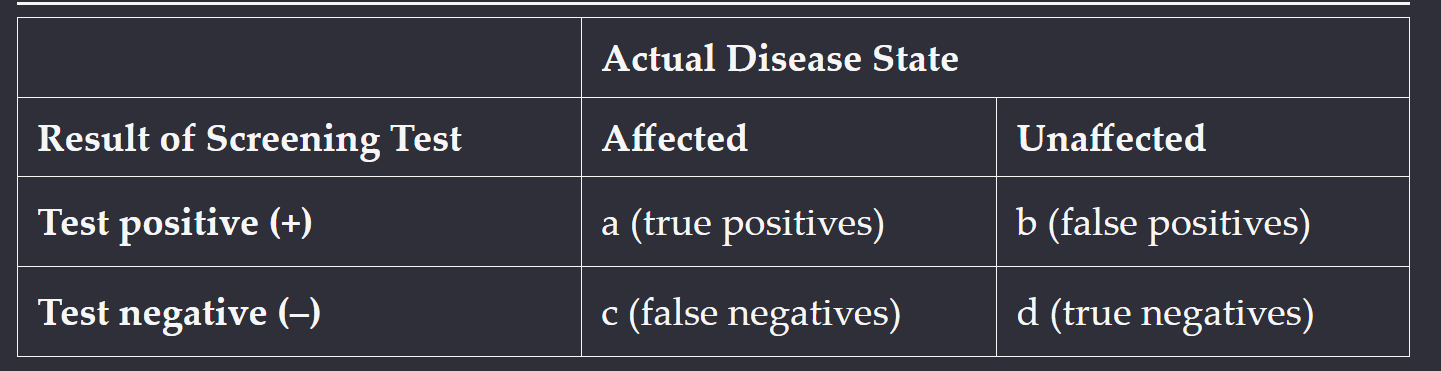
Image occlusion: name the hidden labels
145
Image occlusion: name the hidden labels
146
Image occlusion: name the hidden labels
147
Image occlusion: name the hidden labels
148
For a given level of sensitivity and specificity, the positive predictive value of a test increases as the prevalence of the disease (incrases/decreases)
increases
149
an autosomal recessive lysosomal storage disorder in which the lysosomal enzyme β-hexosaminidase A (HEX A) is deficient (see Chapter 7), causing a buildup of the substrate, GM2 ganglioside, in neuronal lysosomes.
tay sachs disease
150
screening test fore pku
tandem mas specxtrometry
151
pku treatment
dietary restriction of phenylalanine
152
galactosemia screening test
transferase assay
153
galacrosemia tratment
disetary restriction if galactose
154
sickle cell anemia screening test
isoelectric focusing on DNA diagnosis
155
sickle cell anemia treatment
prophylactic penicillin
156
cystic fibrsis screening test
immunoreactive trypsinogen confirmed by dna dagnosis
157
what is the most common mutation to cause CF
F508del
158
DNA polymorphisms such as single nucleotide polymorphisms (SNPs) or short tandem repeats (STRs) can be used as markers in
linkage analysis
159
which the disease-causing mutation itself is detected, has become the approach used most commonly in genetic diagnosis.
doirect diagnosis
160
used to detect deletions or duplications of chromosome regions
fluorescence in situ hybridization (FISH) or array comparative genomic hybridization (array CGH
161
can be used to detect copy number variants or large repeat expansions
Southern blotting or multiplex ligation-dependent probe amplification (MLPA)
162
genetic testing that equires that the disease-causing gene has been identified and sequenced. In addition, each disease-causing mutation requires a different oligonucleotide probe.
ASO probe testing
163
large numbers of oligonucleotide probes on a silicon chip are hybridized with labeled patient DNA
microarrays
164
It carries out its binding and inhibitory role primarily in the lower respiratory tract, where it prevents neutrophil elastase from digesting the alveolar septa of the lung.
AAT
165
DNA mutation in AAT deficiency
more than 120 identified
SERPINA1 missense variant
SERPINA1 missense variant
166
when is amniocentesis performed
15-17wks
167
performed by aspirating fetal trophoblastic tissue (chorionic villi) by either a transcervical or transabdominal approach
chorionic villus sampling
168
when is chorionic villus sampling perfpormed
10-11wks
169
(mosaicism in the placenta but not in the fetus itself)
confined placental mosaicism
170
measuruable enzyme maple syreup urine disease
branched chain ketoacid decarboxylase
171
measurable enzyme methylmalonic acoidemia
Methylmalonic coenzyme A mutase
172
measureable enzyme in multiple carboxylase deficiencies
biotin responsive carboxylase
173
measurable enzyme in glycogen storage disease type 2
a-glycosidase
174
measurable enztme in galactosemia
galactose-1-uridyltransferase
175
measureable enzymes in gangliosidosis disorders
B-galactosidases
176
measurable enzyme in lesch-nyhan syndrome
hypoxanthine guanine phosphribosyl transferase
177
when does the respiratory diverticulu appear in development
4wks old embryo
178
what determines the location and appearance of lung bud
retinoic acid (RA)
179
an increase in retinoic acid upregulates this TF
TBX4
180
what does TBX4 do?
indices formation of the bud and continued grpowth and differentiation of the lungs
181
this seperates the respiratory diverticukum from the foregut
tracheoesophageal ridges
182
Abnormalities in partitioning of the esophagus and trachea by the tracheoesophageal septum result in
esophageal atresia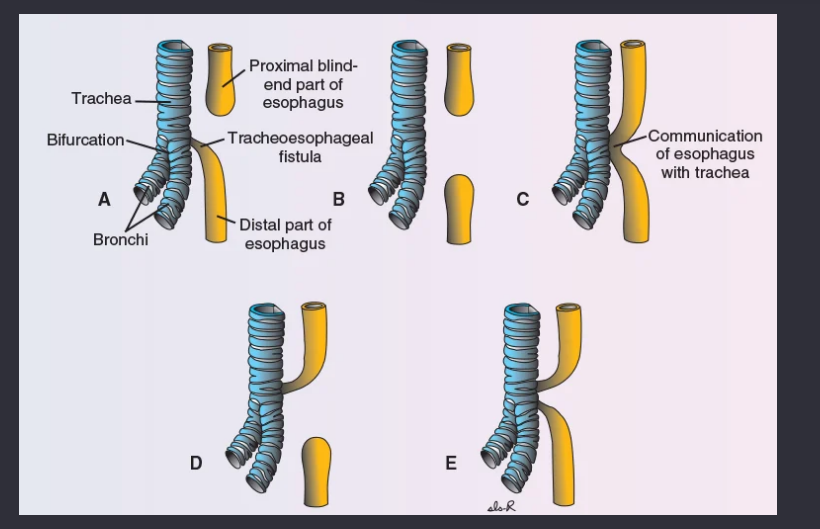
183
VACTERL association
Vertebral anomalies, Anal atresia, Cardiac defects, Tracheoesophageal fistula, Esophageal atresia, Renal anomalies, and Limb defects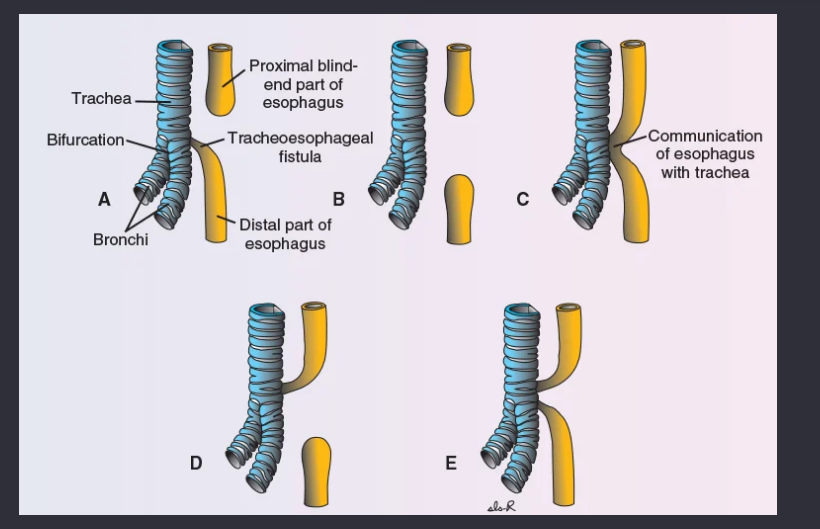
184
origin intrenal lining of larynx
endoderm
185
origin cartilage and muscles of larynx
4th and 6th pharyngeal arches
186
innervates the derrivitives of the 4th pharyngeal arch
superior laryngeal n
187
innervates the derivities of the 6th pharygeal arch
reccurent laryngeal n
188
what forms from the lung buds? (x3)
trachea, primary bronchial buds (x2)
189
Branching has continued to form terminal bronchioles. No respiratory bronchioles or alveoli are present.
pseudoglandular period
190
Each terminal bronchiole divides into two or more respiratory bronchioles, which in turn divide into three to six alveolar ducts.
canalicular period
191
Terminal sacs (primitive alveoli) form, and capillaries establish close contact.
terminal sac period
192
Mature alveoli have well-developed epithelial–endothelial (capillary) contacts.
alveolar period
193
begin before birth and cause aspiration of amniotic fluid. These movements are important for stimulating lung development and conditioning respiratory muscles.
fetal breathing movements
194
When surfactant is insufficient, the air–water (blood) surface membrane tension becomes high, causing great risk that alveoli will collapse during expiration. As a result, the infant develops
respiratory distress syndrome (RDS)
195
what causes ectopic lung lobes
additional respiratory buds of the foregut that develop independent og the main respiratory system
196
what causes congenital cysts of the lung
dialatrion of terminal or larger bronchi