H&P Semester 1
Study these flashcardsFree · spaced repetition · iPhone, Android, Mac & web
All cards
1
How the patient experiences all
aspects of a condition
aspects of a condition
patient perspective
2
How we organize our interview,
elicit important information and
interpret what the patient tells us
elicit important information and
interpret what the patient tells us
physician perspecitive
3
● allows you to mentally tick off the pieces of information you need as the
patient tells their story
● this information will not come from the patient in the order you need to
document (SOAP note) or present it (Oral Case Presentation
patient tells their story
● this information will not come from the patient in the order you need to
document (SOAP note) or present it (Oral Case Presentation
attentive listening
4
● paying attention to the patient’s story/message/perspective
● an active awareness/integration of verbal and non-verbal clues
● asking questions that ensure you understand the message
● mentally juggling the aspects of the conversation, so that your
comments/questions uniquely reflect what you’ve been hearing and
listening throughout the conversation
● what the patient says should influence what you say*
● an active awareness/integration of verbal and non-verbal clues
● asking questions that ensure you understand the message
● mentally juggling the aspects of the conversation, so that your
comments/questions uniquely reflect what you’ve been hearing and
listening throughout the conversation
● what the patient says should influence what you say*
active listening
5
parts of the sequence of the interview
Greeting
● Establish Rapport
● Establish Agenda
● Invite the Patient’s Story
● Identify and Respond to Emotional Cues
● Expand and Clarify the Patient’s Story
● Generate and Test Diagnostic Hypothesis
● Create a Shared Understanding of the Problem
● Negotiate a Plan
● Planning for Follow-Up and Closing
● Establish Rapport
● Establish Agenda
● Invite the Patient’s Story
● Identify and Respond to Emotional Cues
● Expand and Clarify the Patient’s Story
● Generate and Test Diagnostic Hypothesis
● Create a Shared Understanding of the Problem
● Negotiate a Plan
● Planning for Follow-Up and Closing
6
(NURSE)
Name Emotion – so the patient knows you heard
I.e. “I wonder if you are feeling ...?”
Understanding – what they are experiencing
I.e. “I can understand how that might upset you.”
Respect – respect the patient’s challenge
I.e. I am impressed with how well you handled this.”
Support (Reassurance) – will support patient through the challenge
I.e. “Please let me know how I can help you.”
Explore – any other confounding emotions/feelings
explain NURSE
(NURSE)
Name Emotion – so the patient knows you heard
I.e. “I wonder if you are feeling ...?”
Understanding – what they are experiencing
I.e. “I can understand how that might upset you.”
Respect – respect the patient’s challenge
I.e. I am impressed with how well you handled this.”
Support (Reassurance) – will support patient through the challenge
I.e. “Please let me know how I can help you.”
Explore – any other confounding emotions/feelings
7
types of patient histories
focused and comprehensive
8
• New patients
• Provides fundamental and personalized
knowledge about the patient
• Strengthens the clinician-patient
relationship
• Helps identify or rule out physical
causes related to the patient concerns
• Provides baseline for future
assessments
• Creates a platform for health promotion
through education and counseling
• Develops proficiency in the essential
skills of physical examination
• Provides fundamental and personalized
knowledge about the patient
• Strengthens the clinician-patient
relationship
• Helps identify or rule out physical
causes related to the patient concerns
• Provides baseline for future
assessments
• Creates a platform for health promotion
through education and counseling
• Develops proficiency in the essential
skills of physical examination
comprehensive history
9
• Is appropriate for established patient,
especially during routine or urgent
care visits –”problem-orientated”.
• Addresses focused concerns or
symptoms
• Assesses symptoms restricted to a
specific body systems
• Applies examination methods
relevant to assessing the concern or
problem as precisely and carefully as
possible
especially during routine or urgent
care visits –”problem-orientated”.
• Addresses focused concerns or
symptoms
• Assesses symptoms restricted to a
specific body systems
• Applies examination methods
relevant to assessing the concern or
problem as precisely and carefully as
possible
focused history
10
the seven components of adult health history
• Identifying Data and Source of the history
• Chief Complaint(s)
• History of Present Illness
• Past Medical History
• Medications, Allergies, Hospitalizations, Surgical History, OB/Gyn
• Social History
• Family History
• Review of Systems
• Chief Complaint(s)
• History of Present Illness
• Past Medical History
• Medications, Allergies, Hospitalizations, Surgical History, OB/Gyn
• Social History
• Family History
• Review of Systems
11
parts of a cage questionnaire?
Cut down: Have you ever felt you needed to Cut down on your drinking?
Annoyed: Have you ever been Annoyed by people criticizing your drinking?
Guilty: Have you ever felt Guilty about your drinking?
Eye-opener: Have you ever had a drink first thing in the morning (an Eye-opener) to steady your nerves or to get rid of a hangover?
Annoyed: Have you ever been Annoyed by people criticizing your drinking?
Guilty: Have you ever felt Guilty about your drinking?
Eye-opener: Have you ever had a drink first thing in the morning (an Eye-opener) to steady your nerves or to get rid of a hangover?
12
ringing in ears
tinnitus
13
runny nose
rhinorrhea
14
nose bleeds
epistaxis
15
dysphagia
difficulty swallowing
16
shortness of breath
dyspnea
17
how to ask dyspnea on exertion
Do you ever get short of breath with
activity?
activity?
18
how to ask orthopnea
“Do you have difficulty breathing when laying flat?”
19
how do you ask paroxymal noctrnal dysnea
“Do you have difficulty breathing when laying flat?”
20
bloody stool
hematochezia
21
dark tarry stools
melena
22
pain with urination
dysuria
23
blood in urine
hematuria
24
making at ight to urinate
nocturia
25
joint pain
arthralgias
26
muscle pain
myalgias
27
itching of your skin
pruritis
28
frail build - thin, poor muscle development, small bone structure
ectomorphic (asthenic)
29
athletic-type, excellent muscle development, large bone structure
mesomorphic (sthenic)
30
soft, round, high proportion of fat tissue, adequate muscle development
endomorphic
31
accepted vital signs (x4)
temp, heart rate, repiratory rate, bp
32
The amount of heat maintained by the body.
A measure of the ability of the body to generate heat, store it in the
tissues, and then dispose of it as necessary
A measure of the ability of the body to generate heat, store it in the
tissues, and then dispose of it as necessary
body temperature
33
most accurate sites to measure body temp
♦ Pulmonary artery
♦ Distal third of esophagus
♦ Rectum
♦ Urinary bladder (drug tests)
♦ Distal third of esophagus
♦ Rectum
♦ Urinary bladder (drug tests)
34
Plastic and shaped like a pencil
Display window at one end and the
temperature probe at the other end
Uses electronic heat sensor/thermo-resistor technology
Useful in the mouth, rectum, or axilla
Easy to use and easy to read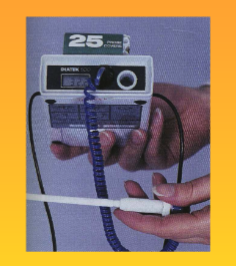
Display window at one end and the
temperature probe at the other end
Uses electronic heat sensor/thermo-resistor technology
Useful in the mouth, rectum, or axilla
Easy to use and easy to read
digital thermometer
35
Measure infrared radiation emission
Can be used from a distance
Tympanic membrane
Temporal Artery
Can be used from a distance
Tympanic membrane
Temporal Artery
infrared thermometer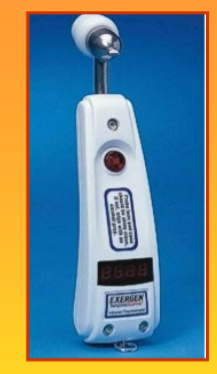
36
normal oral temp
98.6
37
normal rectal/ear/temp artery temp
98.6
38
normal axillary arter temp
98.6
39
fever oral temp
100F
40
fever rectal/TM/teporal artery temp
100.4F
41
fever axillary temp
99F
42
hypothermia temp
<95F
43
hyperthermia temp
>106F
44
A measure of cardiovascular function –
through the rate, rhythm and character of a peripheral pulsation.
through the rate, rhythm and character of a peripheral pulsation.
pulse
45
where is apical pulse auscultated
over heart
46
where is central pulse located?
carotid or femoral a
47
where is peripheral pulse located
brachial, radial, posterior tibial, dorsalis pedis
48
STAND ALONG SIDE OF SUPINE PATIENT
FIRST, AUSCULTATE FOR BRUITS, IF PRESENT
DO NOT PALPATE
PLACE 2ND AND 3RD FINGERS ON THE THYROID
CARTILEGE
MOVE FINGERS LATERALLY UNTIL BETWEEN THE SCM
AND THE TRACHEA
PERFORM LOWER ON THE NECK AS NOT TO STIMULATE
THE CAROTID SINUS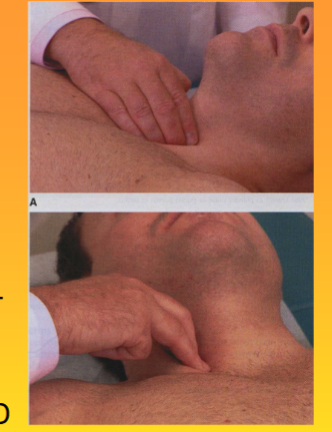
FIRST, AUSCULTATE FOR BRUITS, IF PRESENT
DO NOT PALPATE
PLACE 2ND AND 3RD FINGERS ON THE THYROID
CARTILEGE
MOVE FINGERS LATERALLY UNTIL BETWEEN THE SCM
AND THE TRACHEA
PERFORM LOWER ON THE NECK AS NOT TO STIMULATE
THE CAROTID SINUS
carotid artery pulse
49
how to assess pulse (calculation)
rate over 30 seconds x2
50
>100 beats per minute
tachycardia
51
<60 beats per minute
bradycardia
52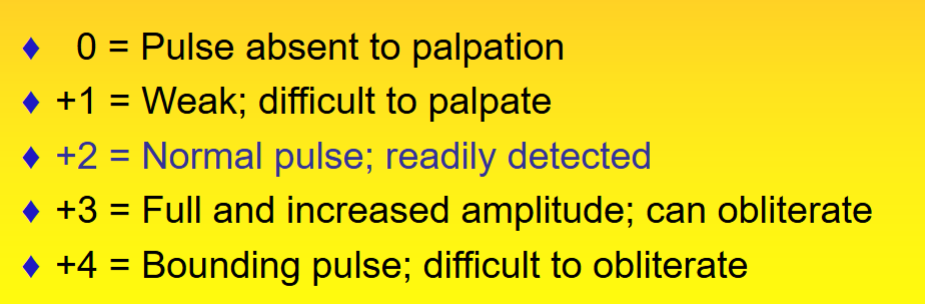
how to rate pulse (scale numbers)
53
An exaggeration of the normal variation in the amplitude of the pulse during
the inspiratory phase of respiration
-exaggeration of the normal drop in systolic BP during
inspiration - inspiratory fall in arterial pressure > 10mmHg (Palpable > 20mmHg)
-The “paradox” is that you appreciate a regular heartbeat by auscultation, yet
the palpated pulse is of variable strength or absent during inspiration
the inspiratory phase of respiration
-exaggeration of the normal drop in systolic BP during
inspiration - inspiratory fall in arterial pressure > 10mmHg (Palpable > 20mmHg)
-The “paradox” is that you appreciate a regular heartbeat by auscultation, yet
the palpated pulse is of variable strength or absent during inspiration
paradoxial pulse
54
The measure of the brain’s ability to respond to the demands
for oxygen and gas exchange.
for oxygen and gas exchange.
respiration rate
55
normal adult respiratory rate
12-20per minute
56
breath rate >20 per minute
tachypnea
57
brath rate <12 per minute
bradypnea
58
no breaths
apnea
59
normal breathing
Chest moves approx. 1 inch on inhalation
♦ Length of inhalation = Length of exhalation
♦ No accessory muscle use
♦ Breathing is quiet
Chest moves approx. 1 inch on inhalation
♦ Length of inhalation = Length of exhalation
♦ No accessory muscle use
♦ Breathing is quiet
eupnea
60
An increase in the effort of breathing
♦ Noisy
♦ Use of accessory muscles
♦ Nasal flaring
♦ Intercostal retractions
♦ Noisy
♦ Use of accessory muscles
♦ Nasal flaring
♦ Intercostal retractions
labored breathing
61
Noisy breathing
♦ Rales
♦ Rhonchi
♦ Snoring
♦ Stridor
♦ Wheezing
♦ Gurgling
♦ Rales
♦ Rhonchi
♦ Snoring
♦ Stridor
♦ Wheezing
♦ Gurgling
stertorous
62
Difficult or labored breathing/shortness
of breath (SOB) that is inappropriate to the level of
exertion
♦ Subjective sensation of SOB
of breath (SOB) that is inappropriate to the level of
exertion
♦ Subjective sensation of SOB
dyspnea
63
Dyspnea that begins or increases with
recumbence
recumbence
orthopnea
64
Sudden onset of
dyspnea after a period of sleep
dyspnea after a period of sleep
paroxysmal nocturnal dyspnea
65
increased depth of breathing
hyperapnea
66
shallow breaths or diminished breathing
(often due to obstruction)
(often due to obstruction)
hypoapnea
67
Self-limiting
♦ Sleep apnea: Breathing begins again as CO2
builds
♦ Periodic apnea of the newborn: A normal
condition with irregular pattern of rapid breathing
followed by short periods of apnea and
associated with REM sleep
♦ Reflex apnea: In response to noxious fumes
♦ Sleep apnea: Breathing begins again as CO2
builds
♦ Periodic apnea of the newborn: A normal
condition with irregular pattern of rapid breathing
followed by short periods of apnea and
associated with REM sleep
♦ Reflex apnea: In response to noxious fumes
primary apnea
68
breathimg starts only w/innervention
secondary apnea
69
The measure of the force of blood within the arterial walls.
blood presure
70
the amount of pressure exerted
against the walls of the arteries when the left ventricle
contracts
against the walls of the arteries when the left ventricle
contracts
systolic pressure
71
the amount of pressure exerted
against the walls of the arteries when the left ventricle
is at rest
against the walls of the arteries when the left ventricle
is at rest
diastolic pressure
72
a too small BP cuff will artificially _ BP
increase
73
preferable BP position of a patient
Patient should be sitting, preferably with feet on
the floor, choose which arm (contraindications),
arm free of clothing, cuff at the level of the heart,
approx. 1 inch (2.5cm) above antecubital fossa
the floor, choose which arm (contraindications),
arm free of clothing, cuff at the level of the heart,
approx. 1 inch (2.5cm) above antecubital fossa
74
5 phases of korotkoff sounds
nitial 'tapping' sound (cuff pressure = systolic pressure)
sounds increase in intensity
sounds at maximum intensity
sounds become muffled
sounds disappear (diastolic pressure)
sounds increase in intensity
sounds at maximum intensity
sounds become muffled
sounds disappear (diastolic pressure)
75
hypotension criteria
Systolic BP < 90 mmHg
♦ Diastolic BP < 60 mmHg
♦ Sudden change > 30 mmHg from baseline
♦ Diastolic BP < 60 mmHg
♦ Sudden change > 30 mmHg from baseline
76
Decrease in Systolic BP > 20 mmHg or Diastolic
BP > 10 mmHg within three minutes of standing
from a sitting or supine position
♦ Failure in one or more of the mechanisms
intended to maintain blood pressure with position
changes
BP > 10 mmHg within three minutes of standing
from a sitting or supine position
♦ Failure in one or more of the mechanisms
intended to maintain blood pressure with position
changes
orthostatic hypotension
77
each SOAP note begins with (x2)
date and time, patient identifiers
78
each SOAP note ends with
legible signature, appropriate title (OMS1)
79
what does the subjective in SOAP begin wuth
CC:"patients own words"
-why they are there
-why they are there
80
what comes after the CC in the S in a SOAP note
HPI in oaragraph form including pertinent info abt patient
81
acronym to use when patuent has no drug allergies
NKDA
82
acronym to use if patient has no allergies
NKA
83
when would you ask an n depth sexual history?
Ask when it is related to the patient’s presenting
complaint
Ask during a comprehensive history
Ask when discussing disease prevention and
screening
Ask if the patient’s disease or medications have a
high prevalence of sexual dysfunction
complaint
Ask during a comprehensive history
Ask when discussing disease prevention and
screening
Ask if the patient’s disease or medications have a
high prevalence of sexual dysfunction
84
what are the 5 Ps of sexual health/sex history
Partners
Practices
Protection from STIs
Past history of STIs
Prevention of Pregnancy
Practices
Protection from STIs
Past history of STIs
Prevention of Pregnancy
85
7 attributes attributed to HPI (you NEED to ask with HPI)
• Timing: onset, duration, frequency, chronology
• Location (ask the patient to point to the area)
• Quality and Radiation
• Quantity or severity (Pain scale). Effect on lifestyle
• Factors that aggravated (precipitated) or relieved (palliated) the symptom
• Setting – in which symptoms occur (temporal/context)
• Associated symptoms (manifestations)
• Location (ask the patient to point to the area)
• Quality and Radiation
• Quantity or severity (Pain scale). Effect on lifestyle
• Factors that aggravated (precipitated) or relieved (palliated) the symptom
• Setting – in which symptoms occur (temporal/context)
• Associated symptoms (manifestations)