All cards
1
What is the ratio of protons inside the nucleus to the electron surrounding it?
Because an atom is neutral overall the number of protons and electrons are the same
2
What is Z? A?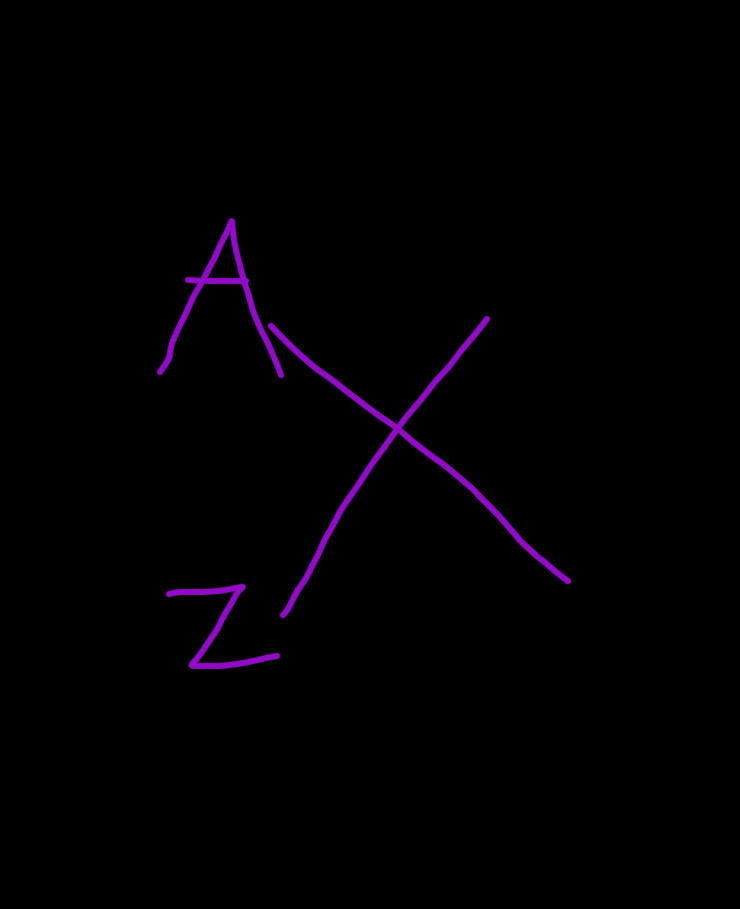
Z- atomic # (# of protons)
A- mass # (#of protons/neutrons)
A- mass # (#of protons/neutrons)
3
Isotopes
same atomic # but different mass #
4
Atomic Weight
weighted average of all isotopes
5
Wave Equation
expression used to describe the motion of waves in a fluid.
6
solution to a wave equation
a wave function, or orbital, and is denoted by the lowercase Greek letter psi (ψ)
7
orbital
- the square of the wave function, ψ2, is plotted in three-dimensional space
- describes the volume of space around a nucleus that an electron is most likely to occupy
- describes the volume of space around a nucleus that an electron is most likely to occupy
8
different kinds of orbitals
s, p, d, and f
9
s orbital
spherical shape with nucleus at its center
10
p orbital
dumbbell shape with two parts or lobes
11
d orbitals
4/5 have a cloverleaf shape with four lobes
12
How are orbitals organized in an atom?
The orbitals in an atom are organized into different layers around the nucleus called electron shells
13
How many electrons can each orbital have within a shell?
2
14
first e- shell
1s orbital, 2 e-
15
second e- shell
2s, 2px, 2py, 2pz; 8 e-
16
third e- shell
3s, 3px, 3py, 3pz, and 5 3d; 18 e-
17
What do the three different p orbitals tell you?
they explain where the orbitals are orientated on an x, y, z axis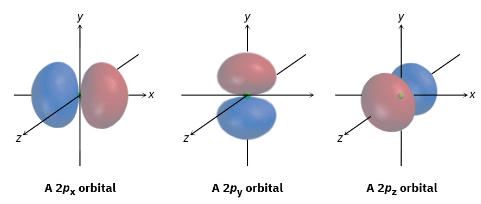
18
ground-state electron configuration
a list of the orbitals occupied by its electrons;
19
the Aufbau principle
lowest energy orbitals fill up first; 1s→2s→2p→3s→3p→4s→3d
20
the Pauli exclusion principle
Only two electrons can occupy an orbital, and they must have opposite spins
21
Hund’s rule
degenerate orbitals are filled one e- at a time before pairing
22
degenerate orbitals
orbitals equal in energy
23
Why is Carbon tetravalent?
in all organic molecules it must have 4 bonds to form stable compounds
24
tetrahedron
a carbon atom bound to 4 atoms are arranged specifically in this shape because it's the most stable because it's lower in energy; has 109 degree angles
25
energy and bond relationship
Making bonds always releases energy, and breaking bonds always absorbs energy.
26
Valence Shell
outermost e- shell
27
octet
8 e- in the valence shell; has special stability
28
ionic bond
loss and gain of an e- to make a bond
29
covalent bond
atoms/molecules share an e- to bond
30
molecule
neutral collection of atoms held together by covalent bonds
31
valence bond (VB) theory
a covalent bond forms when two atoms approach each other closely and a singly occupied orbital on one atom overlaps a singly occupied orbital on the other atom
32
sigma (σ) bonds
are formed by the head-on overlap of two atomic orbitals along a line drawn between the nuclei
33
kcal to kJ
1 kJ = 0.2390 kcal; 1 kcal = 4.184 kJ
34
bond length
optimum distance between nuclei that leads to maximum stability
35
sp3 hybrid orbitals
4 regions of e- density, sigma bond, tetrahedral ~109.5 degrees
36
double bonds
bonds by sharing two electron pairs between atoms
37
triple bonds
bonds by sharing three electron pairs between atoms
38
sp2 hybrid orbitals
3 regions of e- density, 1 pi bond, trigonal ~120 degrees
39
pi (π) bond
the unhybridized p orbitals interact by sideways overlap
40
sp hybrid
2 regions of e- density, 2 pi bonds, linear ~180 degrees
41
Molecular orbital (MO) theory
describes covalent bond formation as arising from a mathematical combination of atomic orbitals on different atoms to form molecular orbitals; orbitals belong to molecule not a lone atom
42
bonding MO
electrons in this MO spend most of their time in the region between the two nuclei
43
antibonding MO
any electrons it contains can’t occupy the central region between the nuclei
44
polar covalent bonds
the bonding electrons are attracted more strongly by one atom than the other so that the electron distribution between atoms is not symmetrical
45
electronegativity (EN)
causes bond polarity; the intrinsic ability of an atom to attract the shared electrons in a covalent bond
46
EN trend on periodic table
Electronegativity generally increases from left to right across the periodic table and increases bottom to top
47
nonpolar covalent EN
EN differs by less than 0.5
48
polar covalent EN
EN differs by 0.5 to 2
49
largely ionic EN
EN differs by more than 2
50
crossed arrow; arrow points in the direction of the e- rich area(δ–) and the tail is in the e- poor area(δ+)
51
An inductive effect
the shifting of electrons in a σ bond in response to the electronegativity of nearby atoms
52
How is net polarity measured?
dipole moment
53
dipole moment
μ, the magnitude of the charge Q at either end of the molecular dipole times the distance r between the charges, μ = Q × r
54
Strategy for idenifying a dipole moment
Look for any lone-pair electrons, and identify any atom with an electronegativity substantially different from that of carbon. (Usually, this means O, N, F, Cl, or Br.) Electron density will be displaced in the general direction of the electronegative atoms and the lone pairs.
55
Formal charge
specific atoms within a molecule, particularly atoms that have an apparently “abnormal” number of bonds
56
Formal charge equation
(# valence e-) - (# bonding e-/2 + # of nonbonding e-)= formal charge
57
resonance forms
the change in structural drawing due to the placement of the π and nonbonding valence electrons; the connections between atoms are the same, and the three-dimensional shapes are the same.
58
resonance hybrid
molecules have single unchanging structure and are hybrids of individual resonance forms and has characteristics of all
59
strategy for drawing resonance forms for an anion
Look for three-atom groupings that contain a multiple bond next to an atom with a p orbital. Then exchange the positions of the multiple bond and the electrons in the p orbital.
60
Brønsted–Lowry acid
donates a hydrogen ion, H+
61
Brønsted–Lowry base
accepts the proton, H+
62
Lewis acid
accepts e-
63
Lewis base
donates e-
64
Large Ka
strong acid
65
Ka less than 1
weak acid or base
66
pKa
smaller= stronger acid
67
Bases
lone pairs or neg charge means its basic; any trivalent N is a base
68
Ranking acid compounds
ARIO and ERIH
69
ARIO
Atom- which atom is H bound to?
Resonance- which conjugate base has resonance?
Inductive effects- which compound has more? EN
Orbital- which orbital is making bond with H?
Resonance- which conjugate base has resonance?
Inductive effects- which compound has more? EN
Orbital- which orbital is making bond with H?
70
ERIH
Element
Resonance
Inductive effects
Hybridization
Resonance
Inductive effects
Hybridization
71
Orbitals for ranking acids
more s-character=most stable; sp3=25% s-chara; sp2=33% s-chara; sp= 50% s-chara
72
Intermelocular forces
Vander waals (london dispersion forces)- anything with e- has these
dipole-dipole moment- need polar bonds
H-bonding- H bound to O, N, F
dipole-dipole moment- need polar bonds
H-bonding- H bound to O, N, F
73
How many bonds do H, C, N, O and X(F, Cl, Br, I) make
H- 1 bond
C- 4 bonds
N- 3 bonds
O- 2 bonds
X- 1 bond
C- 4 bonds
N- 3 bonds
O- 2 bonds
X- 1 bond
74
functional group
a group of atoms within a molecule that has a characteristic chemical behavior
75
Alkenes
have a double bond; naming end in -ene
76
alkynes
have triple bond; name ending in -yne
77
alkanes
single bond between carbons; end in -ane
78
arenes
have alternating double and single bonds in a six-membered ring; end in -yl benzene
79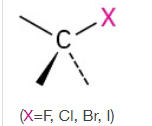
Halide, haloalkane; starts with halo-
80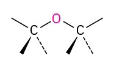
Ether; ends with ether
81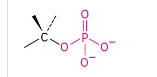
Monophosphate, phosphate
82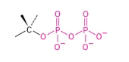
Diphosphate; diphosphate
83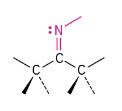
Imine
84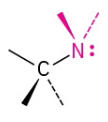
Amine; -amine
85
Nitrile, -nitrile
86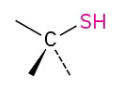
Thiol; -thiol
87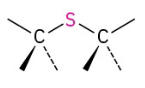
Sulfide; sulfide
88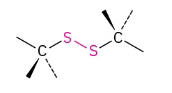
Disulfide; disulfide
89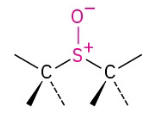
Sulfoxide; sulfoxide
90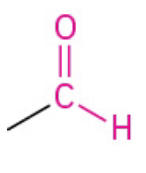
Aldehyde; -al
91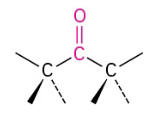
Ketone; -one
92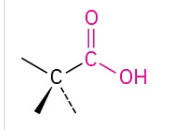
Carboxylic acid; -oic acid
93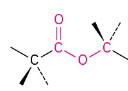
Ester; -yl -oate
94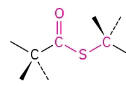
Thioester; -yl -thioate
95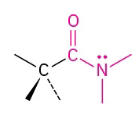
Amide; -amide
96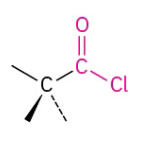
Acid chloride; -oyl chloride
97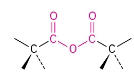
Acid anhydride; -oic anhydride
98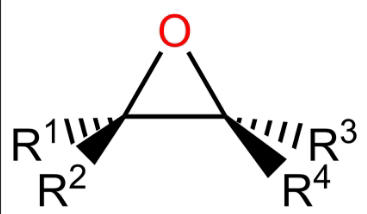
Epoxide; -ene oxide
99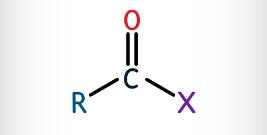
Acyl halide; -oyl (halide)
100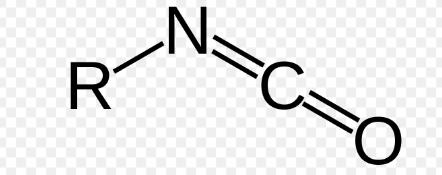
Isocyanate; -yl isocyanate
101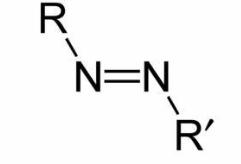
Azo compound; azo-
102
prefixes for parent chain and substituents
meth-, eth-, prop-, but-, pent-, hex-, hept-, oct-, non-, dec-
103
Primary carbon
bonded to 3 H
104
secondary carbon
bonded to 2 H
105
tertiary carbon
bonded to 1 H
106
quaternary carbon
no H bonded
107
Naming
Locant (where sub)-prefix(sub name)-parent(longest carbon chain)-suffix (primary FG)
108
isopropyl sub
109
sec-butyl sub
110
isobutyl sub
111
tert-butyl sub
112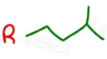
isopentyl sub
113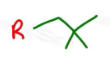
neopentyl sub
114
t-pentyl sub
115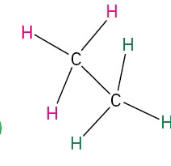
know how to do sawhorse representations
116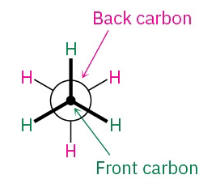
newman projections
117
conformational isomers
different arrangement due to bond rotation
118
staggered conformation
most stable, give elements more room
119
eclipsed conformation
causes tortional strain
120
eclipsed hydrogens
4 kJ/mol each
121
eclipsed hydrogen and methane
6 kJ/mol each
122
Barrier to rotation
energy require to rotate, in projections it is the highest energy conformation value
123
staggered methanes
Gauche(steric strain), 3.8 kJ/mol
124
eclipsed methanes
11 kJ/mol each
125
anti staggered
large constituents on opposit sides
126
Steric strain
is the repulsive interaction that occurs when atoms are forced closer together than their atomic radii allow
127
stereoisomers
with atoms connected in the same order but differing in three-dimensional orientation
128
constitutional isomers
different connections between atoms
129
cis and trans isomers
cis- on the same dimensional plane trans- diff dimensional planes
130
Angle strain
the strain due to expansion or compression of bond angles
131
Torsional strain
the strain due to eclipsing of bonds between neighboring atoms
132
the percentages of two isomers
ΔE = –RT ln K
133
R in equation
gas constant 8.315 J/(molxK)
134
1,3-diaxial interactions
strain between an axial subsituent and the axial hydrogens