7: Soil Composition and Characterization
Study these flashcardsFree · spaced repetition · iPhone, Android, Mac & web
All cards
1
x-ray photoelectron spectroscopy (XPS)
a technique for surface characterization in which absorption of x-ray photons results in photoelectron emission by $\varepsilon= h \nu - Φ$, where
$\varepsilon$ is the electron kinetic energy
$\nu$ is the frequency of the incident radiation
$Φ$ is the work function (binding energy)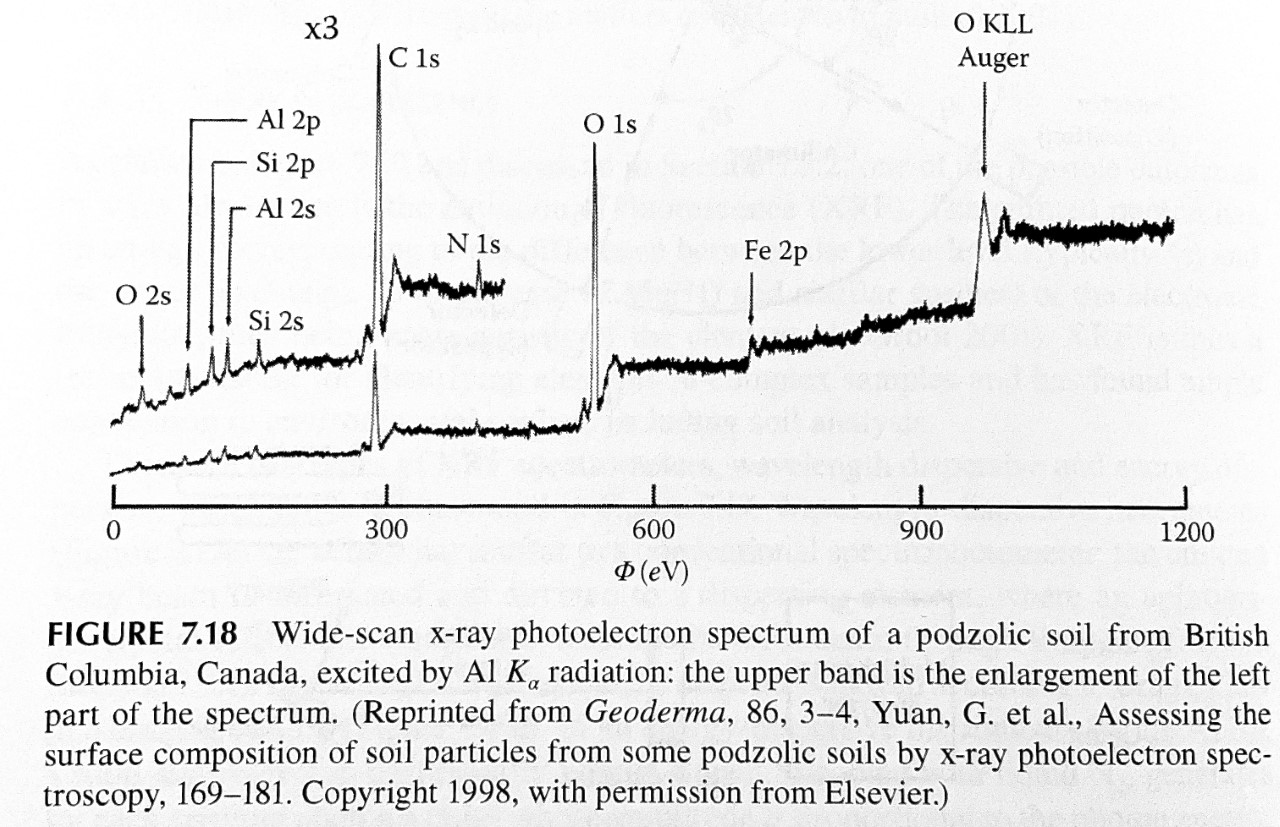
$\varepsilon$ is the electron kinetic energy
$\nu$ is the frequency of the incident radiation
$Φ$ is the work function (binding energy)
2
x-ray fluorescence (XRF)
a technique for surface characterization in which the electron photoemission, leaving an empty state, eventually is occupied by another electron falling from upper levels, which results in energy emission (fluorescence) in the form of x radiation, although of lower energy than the absorbed photon, corresponding to the difference between the lower level (typically 1s) and the upper level (e.g., 3p for Mn(II)) of the electronic transition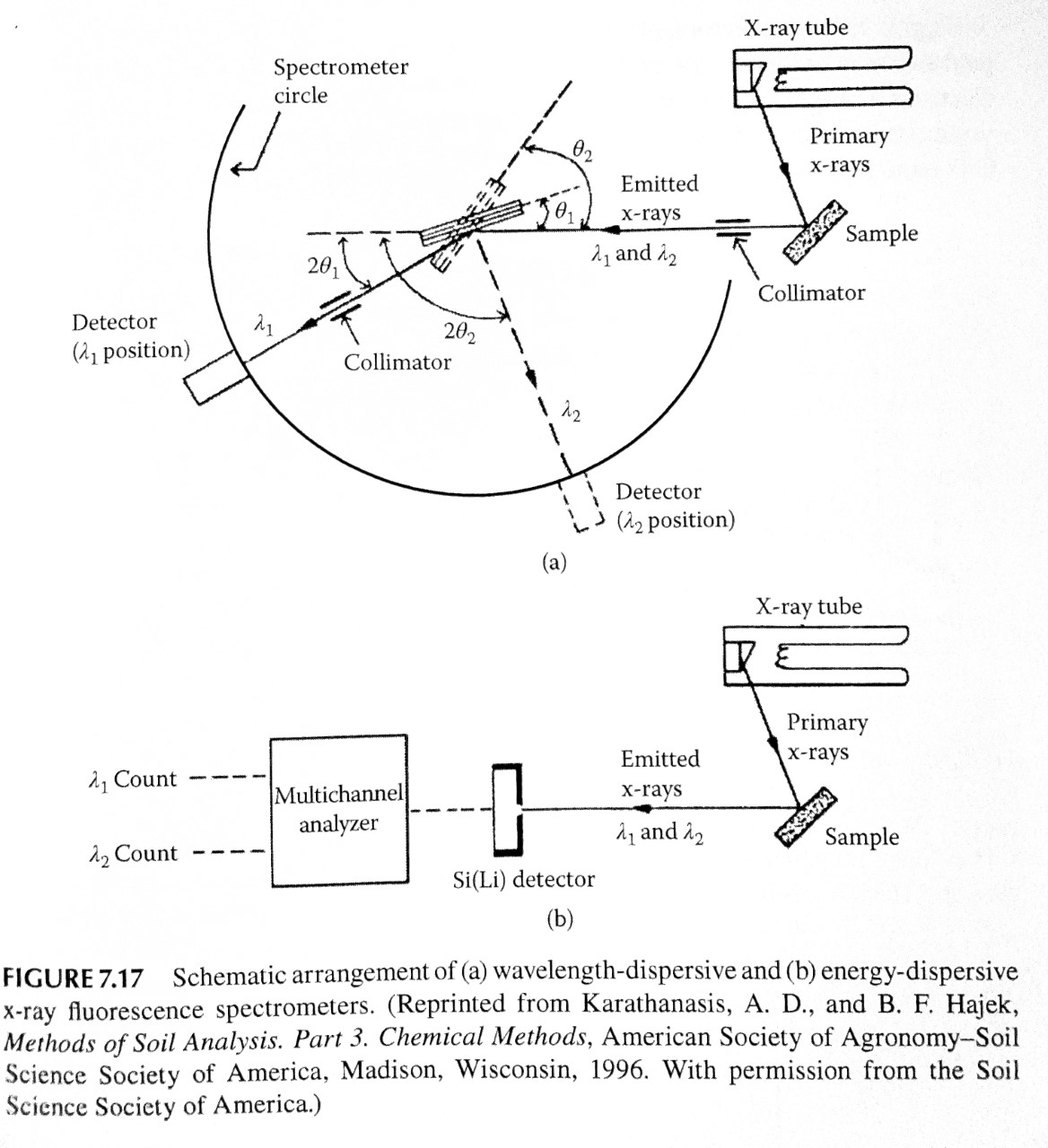
3
x-ray diffractometer
an instrument that measures the intensity of the diffracted beam as a function of the angle θ (or the total angle 2θ), presenting the XRD diffractogram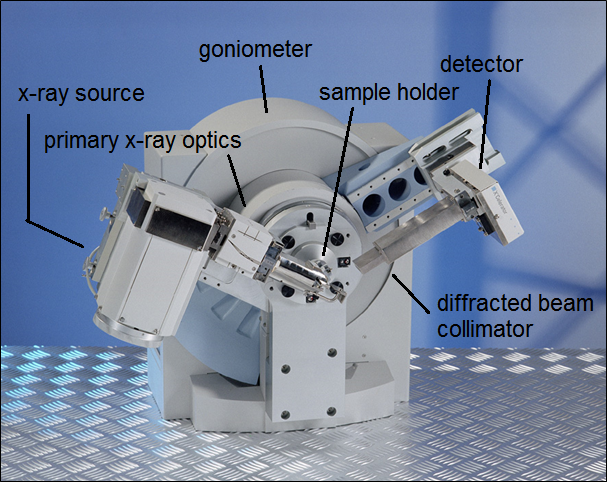
4
x-ray diffractogram
a plot of a unique pattern of intensities as a function of the incidence angle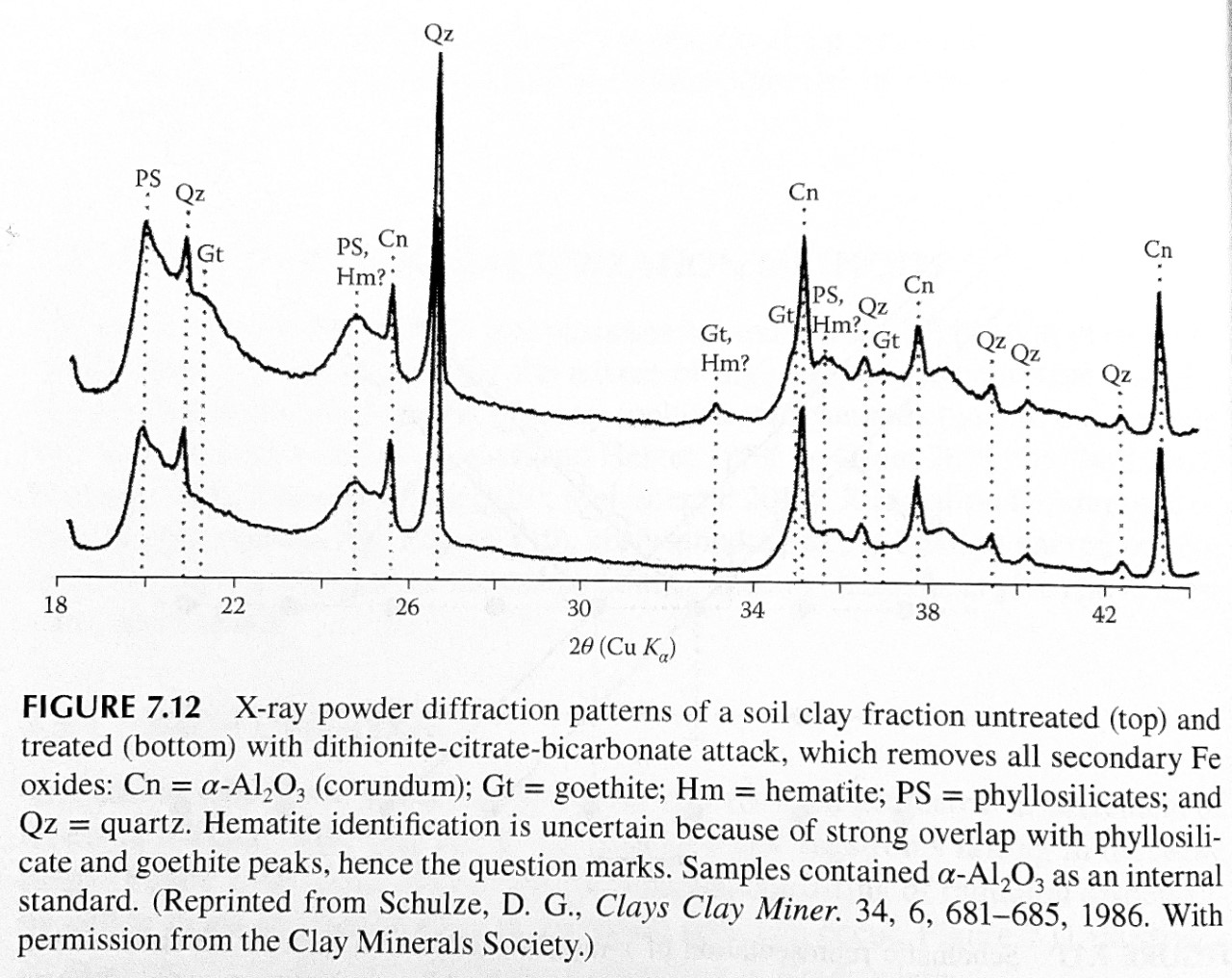
5
x-ray diffraction (XRD)
a qualitative and, usually, semiquantitative technique for studying crystalline solids based on the concepts of Bragg's law; the lattice spacing distances can be determined
6
two types of reactions taking place on heating of mineral phases
1. water molecules that are either part of the crystal structure (water of hydration) or "wetting" the solid, known as "water of adsorption," their removal being termed dehydration and desorption respectively
2. the removal of –OH groups (or OH- ions) in which two such groups react to give a –O- atom (or an O2- ion) liberating a water molecule, termed "dehydroxylation"
2. the removal of –OH groups (or OH- ions) in which two such groups react to give a –O- atom (or an O2- ion) liberating a water molecule, termed "dehydroxylation"
7
topsoil
the surface zone, including the zone of accumulation of organic material (usually the A horizons); can be modified by management practices such as ploughing and addition of fertilizers
8
three main methods of microscopies
optical, electronic, scanning probe
9
three categories of experimental surface area measurement
physical methods, positive adsorption methods, negative adsorption methods
10
thermogravimetric analysis (TGA)
thermal analysis in which the sample mass is continuously weighted as it is heated at a constant rate, and the mass, or its time (or temperature, which is equivalent) derivative, is recorded as a function of temperature. As temperature rises, reactions leading to gas evolution (e.g., water elimination) result in mass losses characteristic of the component involved and its contents in the sample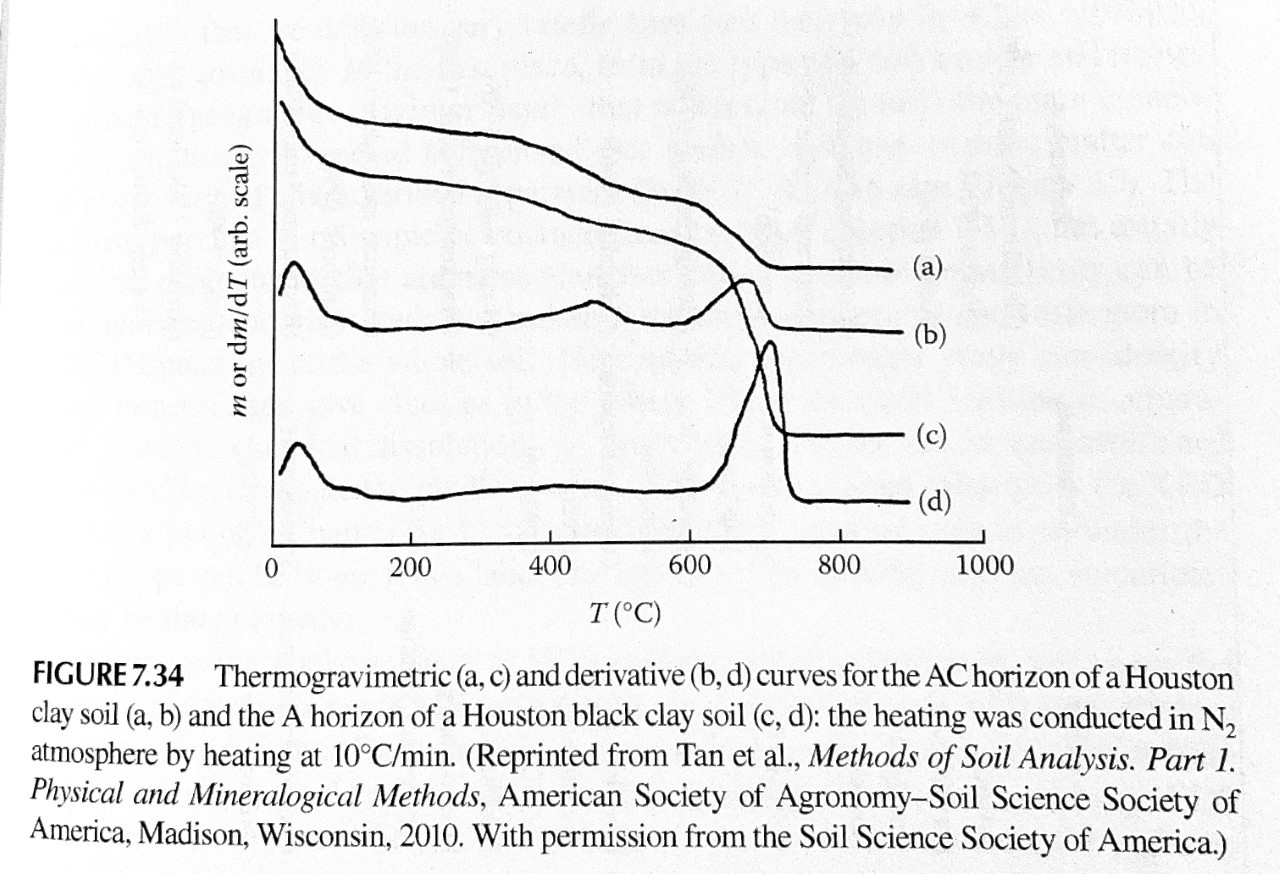
11
the reason silicon (Si) always has a tetrahedral environment
Si acts with a +4 oxidation state (strictly, it is not an ion); also if the surrounding atoms are equal, the polyhedron must be regular due to symmetry
12
subsoil
layers underlying the topsoil (usually B and C horizons), which cannot usually be modified except by drainage
13
soil organic matter (SOM)
the sum of all natural and thermally altered biologically derived organic material found in the soil, or on the soil surface, irrespective of its source or stage of decomposition and whether it is living or dead, but excluding the aboveground portion of living plants
14
soil horizons
the layers of soils, often clearly distinguishable by their color and morphology, developed in pedogenesis, briefly:
A horizon--top layer, high amt organic matter
B horizon--mid layer, mainly partially "weathered" material
C horizon--bot layer, relatively undisturbed material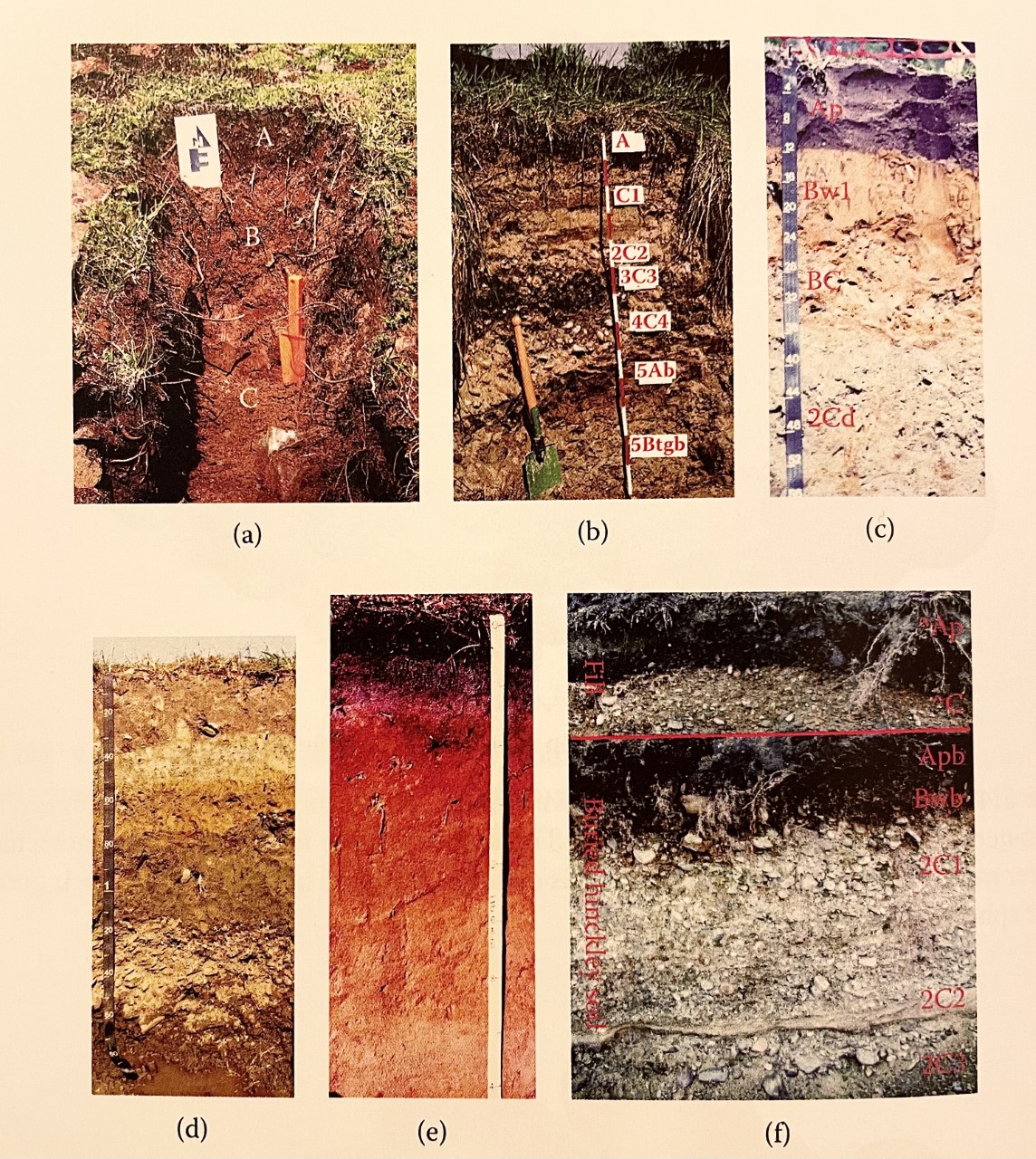
A horizon--top layer, high amt organic matter
B horizon--mid layer, mainly partially "weathered" material
C horizon--bot layer, relatively undisturbed material
15
secondary minerals
new minerals resulting from chemical weathering of primary minerals
-phyllosilicates (clay minerals)
-oxides (e.g., gibbsite [Al], hematite [Fe])
-limes (e.g., calcite, dolomite)
-evaporites (e.g., halite [NaCl], gypsum)
-phyllosilicates (clay minerals)
-oxides (e.g., gibbsite [Al], hematite [Fe])
-limes (e.g., calcite, dolomite)
-evaporites (e.g., halite [NaCl], gypsum)
16
radius ratio, $R_R$
$R_R=\frac{r_+}{r_-}$, the quotient between the cation and the anion radii, respectively
17
R soil horizon
a continuous mass of rock, usually too strong to dig with hand tools; constitutes the basement for the soil structure
18
primary minerals (and important examples)
original rock minerals, formed under volcanic conditions, under high temperatures and pressures
-oxides (e.g., quartz)
-silicates (e.g., pyroxenes, olivines)
-silicoaluminates (e.g., feldspars, micas)
-oxides (e.g., quartz)
-silicates (e.g., pyroxenes, olivines)
-silicoaluminates (e.g., feldspars, micas)
19
positive adsorption methods of surface area measurement
the amount adsorbed of a given chemical species (either molecular or ionic) on an initially free surface is determined and, in principle, from the knowledge of the area covered by that species, the total solid area can be computed, $A_{S,ad}=Q_{ad} N_A a_{ad}$
20
physical methods of surface area measurement
$A^{\text{cryst}}_S=\frac{A_p}{\rho V_p}$
-classically, using XRD and electron microscopy to determine the shapes and dimensions of typical particles, but this is only reasonable for single components (e.g., kaolinite) and difficult at best for whole soil
-more recently, AFM measurements have been employed, but roughness is not taken into account in the equation
-classically, using XRD and electron microscopy to determine the shapes and dimensions of typical particles, but this is only reasonable for single components (e.g., kaolinite) and difficult at best for whole soil
-more recently, AFM measurements have been employed, but roughness is not taken into account in the equation
21
phosphorescence
the long-lived emission of light that sometimes follows the absorption of light by certain atoms and molecules
22
pedogenesis
the continuous process causing soil formation and evolution, including geological and climatological transformations, biological action, etc
23
P soil horizon
dominated by organic minerals in various stages of decomposition that have accumulated either under water or in very wet areas--often referred to as peat layers
24
O soil horizon
dominated by organic matter that has accumulated on the surface of the soil, subdivided by degree of organic material decomposition; these horizons are not common and are mostly restricted to moist or cool environments (e.g., alpine areas, swamps, rainforests)
25
nuclear magnetic resonance (NMR)
a powerful technique for investigating the structure of chemical compounds, in which an atomic nucleus is exposed to high-frequency radiation in a magnetic field (on the order of 1-20 T [tesla])
the frequency of a nucleus is measured relative to that of a standard compound (typically tetramethylsilane)
the resonant frequency is then given as the difference, or "chemical shift" (δ), between these two frequencies, expressed as parts per million
the frequency of a nucleus is measured relative to that of a standard compound (typically tetramethylsilane)
the resonant frequency is then given as the difference, or "chemical shift" (δ), between these two frequencies, expressed as parts per million
26
nonhumic substances
substances recognizable as known biochemical compounds, such as amino acids, carbohydrates, fats, organic acids, resins and waxes; these are usually under degredation conditions and are thus relatively short lived
27
neutron activation analysis (NAA)
a method of elemental analysis based on the production of radioisotopes of the element of interest (this is the activation step), which is done by neutron capture (hence the name)
28
negative adsorption methods of surface area measurement
a charged solid surface is placed in suspension in an electrolyte solution, where the ions of like charge are repelled (desorbed) from the surface, producing a region depleted of such ions; this effect is measured by placing the solution in two chambers separated by a dialysis membrane permeable to water and ions but not to the colloid
29
Lambert-Beer law
$A=\log{\frac{I_0}{I_T}}=\varepsilon bc$, where
$A$ is the absorbance at a given wavelength
$\varepsilon$ is the molar absorptivity at that wavelength
$b$ is the optical path in the sample
$c$ is the absorbent concentration
$A$ is the absorbance at a given wavelength
$\varepsilon$ is the molar absorptivity at that wavelength
$b$ is the optical path in the sample
$c$ is the absorbent concentration
30
infrared (IR) spectroscopy uses
-identify soil constituents
-elucidate structural features of inorganic and organic components
-study the adsorption of ions and small molecules onto soil colloids through techniques such as attenuated total reflection IR spectroscopy
-elucidate structural features of inorganic and organic components
-study the adsorption of ions and small molecules onto soil colloids through techniques such as attenuated total reflection IR spectroscopy
31
hydrolysis
the splitting of a chemical bond with water, resulting in the addition of H and OH to the products
32
humic substances (HSs)
a collection of refractory, relatively high-molecular-weight, dark-colored substances formed from the debris of plants and other biological organisms by degredation and secondary synthesis reactions; these constitute the major fraction of SOM, up to 80%
33
Fourier transform infrared (FTIR) spectroscopy
spectroscopy in which an interference pattern from a Michelson-type interferometer is processed using Fourier transform analysis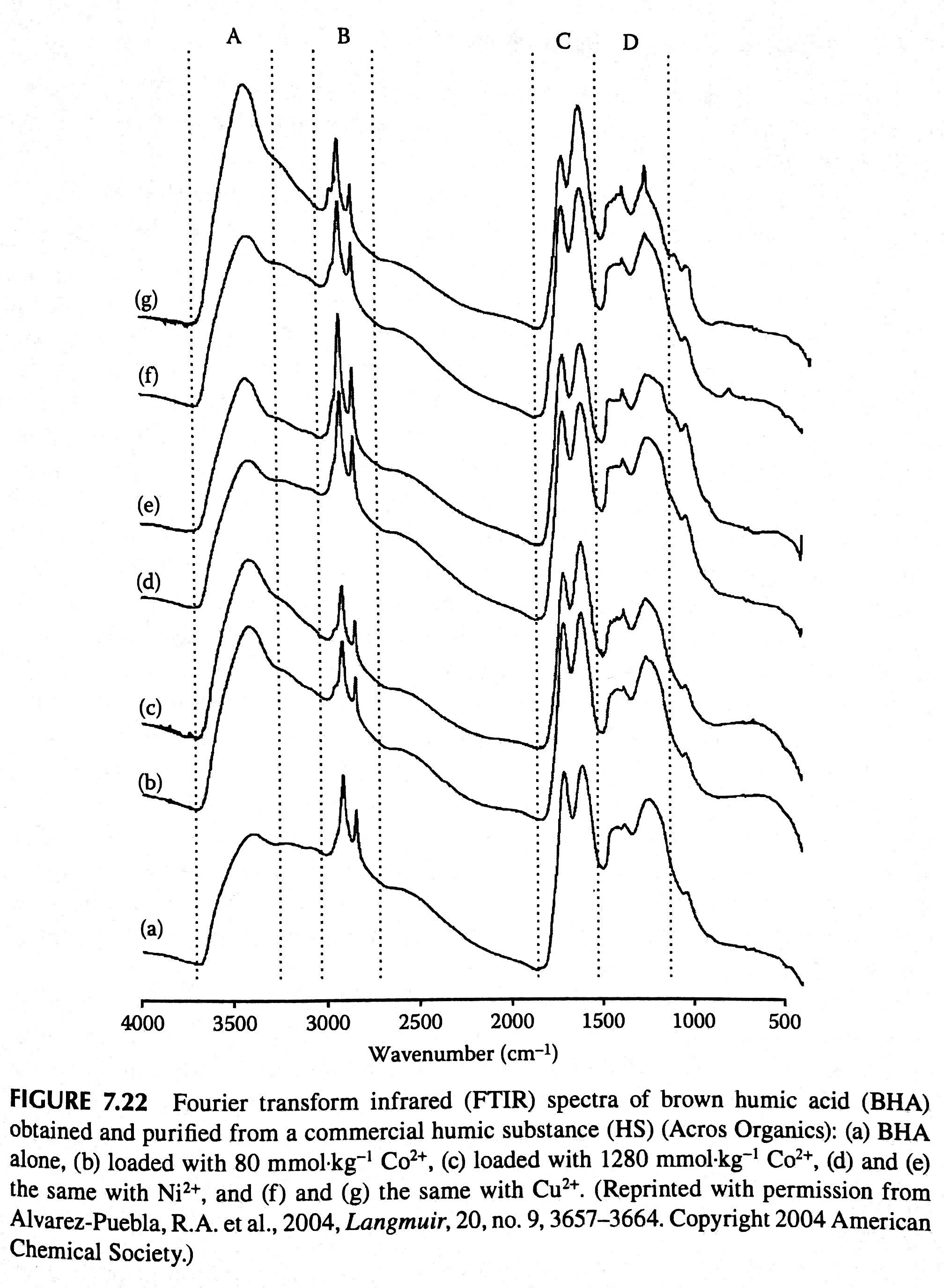
34
field-flow fractionation (FFF)
a family of flow-driven separation techniques that provide a continuous separation of particles whose sizes range from about 1 nm to 50 μm
an external field applies over the particles a force perpendicular to the separation channel, forcing them against a wall; a nonuniform distribution results, due to the different particle sizes and properties, and thus they are separated by the laminar flow in the channel
an external field applies over the particles a force perpendicular to the separation channel, forcing them against a wall; a nonuniform distribution results, due to the different particle sizes and properties, and thus they are separated by the laminar flow in the channel
35
exothermic soil reactions
oxidation (especially organic matter), crystal formation
36
endothermic soil reactions
dehydration
desorption
dehydroxylation
decomposition
phase change
desorption
dehydroxylation
decomposition
phase change
37
differential thermal analysis (DTA)
thermal analysis in which a controlled rate heating is applied simultaneously to a sample and to a reference material, and the differences in temperature are recorded; exothermic is $\Delta T \uparrow$, endothermic is $\Delta T \downarrow$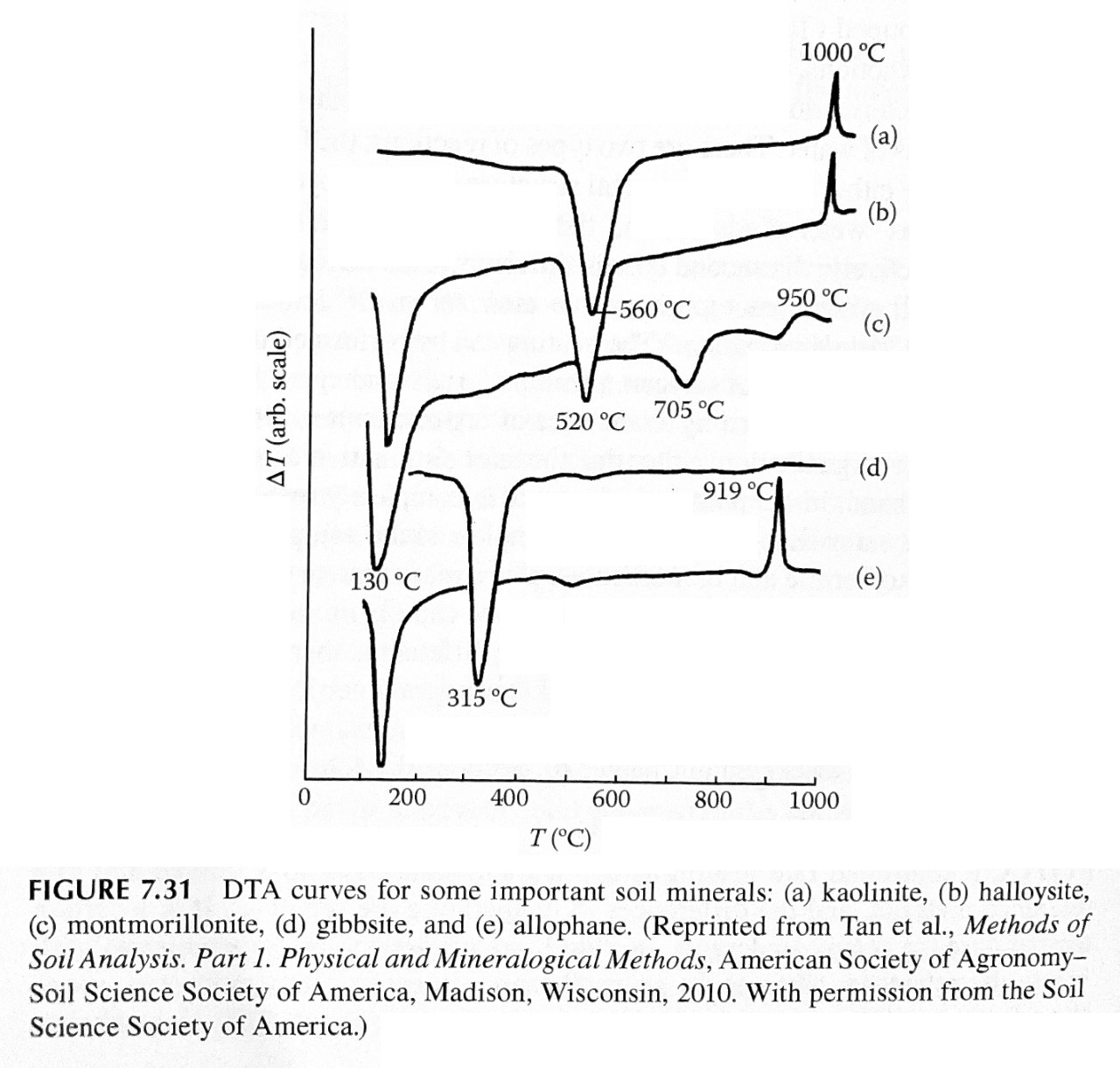
38
differential scanning calorimetry (DSC)
similar to DTA, but here the measured quantity is the amount of energy (heat, q) required to keep the sample and the reference at the same temperature, and the difference between them, δq, is determined and plotted as a function of temperature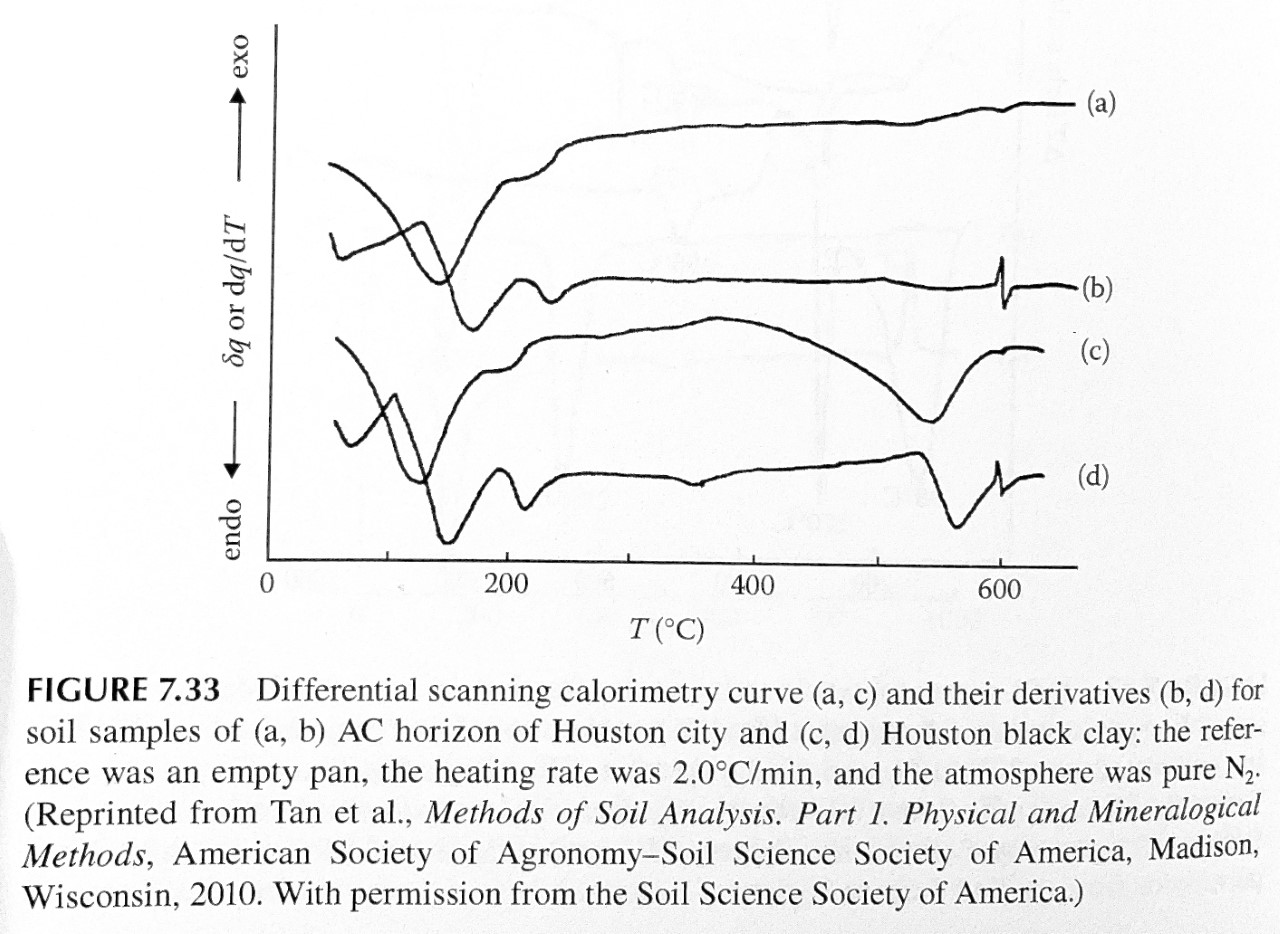
39
D soil horizon
a soil layer below A and B horizons, which differ in general character and are not C horizons. They cannot be reliably described as buried soils but have a contrasting pedological organization to the overlying horizons
40
coordination number (Z)
the maximum number of neighbors that can be accommodated around a given central atom (a cation in this case)--essentially due to the radius of the central cation
41
Al coordination number
borderline 4 and 6; usually 6, but can replace Si in a tetrahedron, thus giving isomorphic substitution
42
cations with Z = 6
Al3+, Fe3+, Mg2+, Ti4+, Fe2+, Mn2+
43
chemical weathering
weathering in which the minerals in a rock undergo slow dissolution and reprecipitation reactions
44
chelation
the complexing and removal of metal ions, helping to drive hydrolysis reactions
45
C soil horizon
-composed of consolidated or unconsolidated materials
-these materials are usually partially weathered and geological features are often evident
-can be dug by hand when moist
-these materials are usually partially weathered and geological features are often evident
-can be dug by hand when moist
46
Bragg's law
$2d \sin{\theta}=n \lambda$
where λ is the radiation wavelength, d the lattice spacing, θ the incidence angle and n an integer giving the order of interference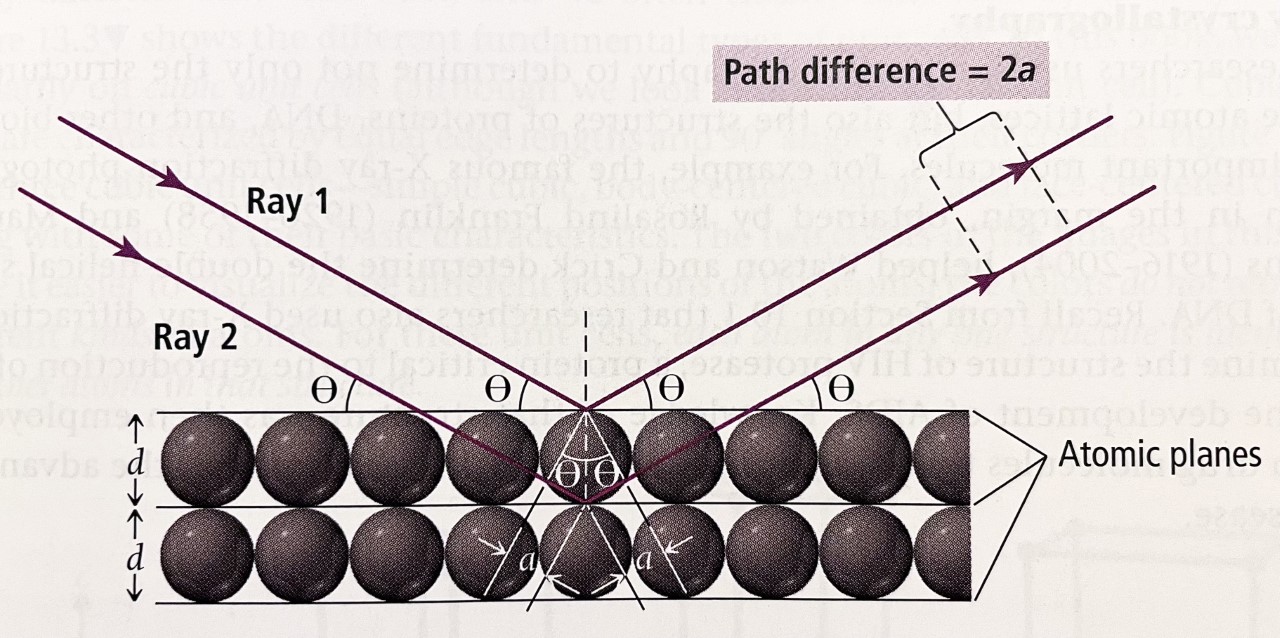
where λ is the radiation wavelength, d the lattice spacing, θ the incidence angle and n an integer giving the order of interference
47
B soil horizon
-concentration of clay, Fe or Al oxides or organic material
-different structure/consistency or stronger colors than horizons above or below
-different structure/consistency or stronger colors than horizons above or below
48
atomic force microscopy (AFM)
a type of scanning probe microscopy, in which a nanometer-sized tip is attached to a cantilever, which scans the surface, moved by piezoelectric actuators (not shown); a laser beam reflected by the cantilever is received by a position-sensitive detector, allowing the detection of deflection under surface-tip forces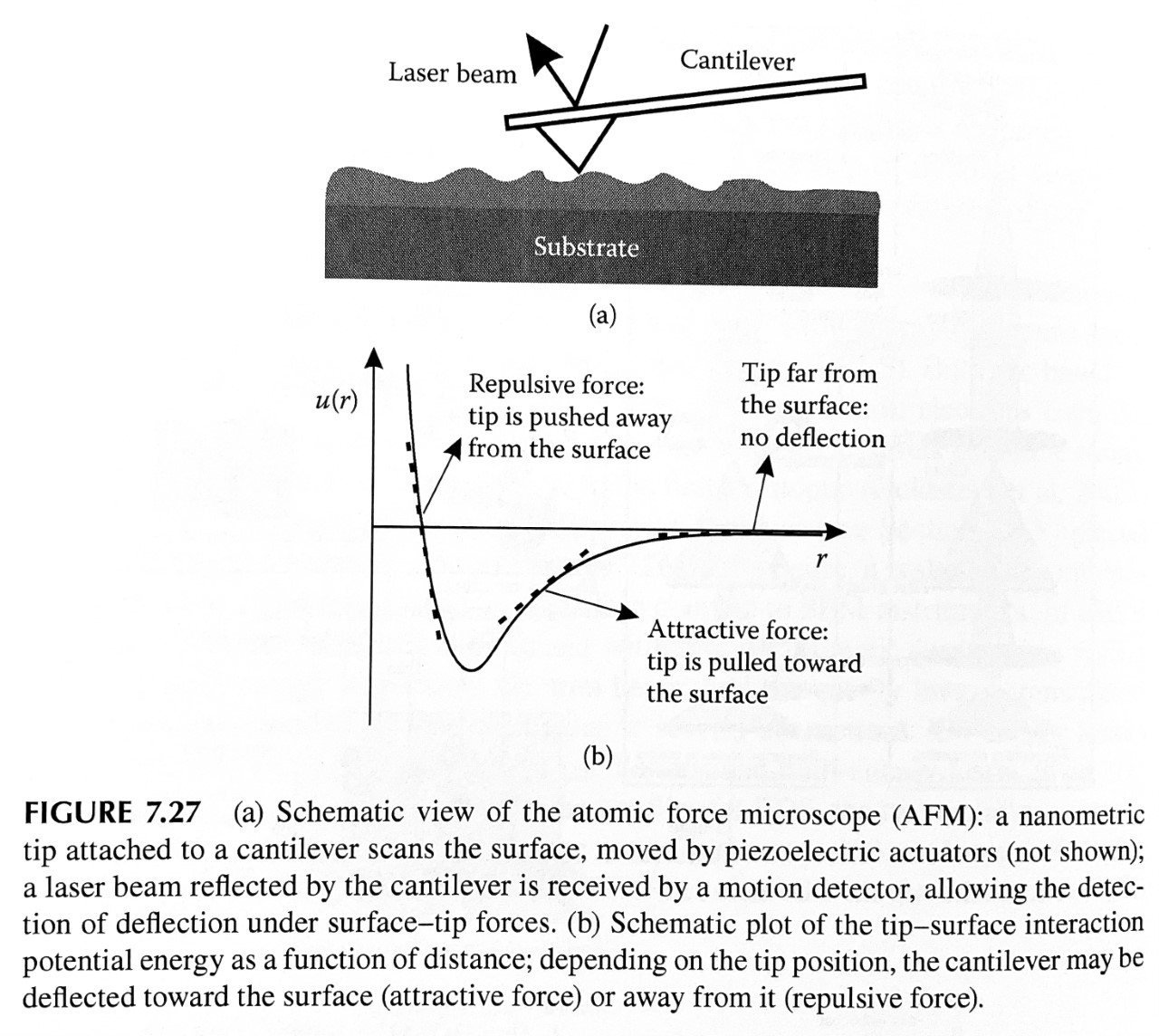
49
A soil horizon
one or more surface mineral horizons (A1, A2, A3) with some accumulation of organic materials (less than that of O horizons); usually darker than underlying (due to increased organic matter), but may be lighter colored (due to lower content of clay)
50
$2 \text{KAlSi}_3 \text{O}_8 + 2 \text{H}_2 \text{CO}_3 + \text{H}_2 \text{O} \rightarrow \text{Al}_2 \text{Si}_2 \text{O}_5 (\text{OH)}_4 + 4 \text{SiO}_2 +2 \text{K}^+ +2 \text{HCO}^-_3$
weathering of feldspar, where the reactants and products, respectively, are: orthoclase feldspar, carbonic acid, water -> dissolved kaolinite, dissolved silica, dissolved potassium ions, dissolved bicarbonate ions
51
XANES
x-ray absorption near-edge structure
OR near-edge x-ray absorption fine structure (NXAFS?)
OR near-edge x-ray absorption fine structure (NXAFS?)
52
EXAFS
extended x-ray absorption fine structure