6: Interparticle Interactions & Col Stab
Study these flashcardsFree · spaced repetition · iPhone, Android, Mac & web
All cards
1
colloid stability
the ability of a colloidal suspension to remain as such, even when the spontaneous tendency should be to aggregate; that is, the kinetics of the aggregation process is slow enough
2
Hamaker constant
an important parameter characterizing VW interactions, in simplified form: $A_{12}=\pi^2 u'_{12} \rho_1 \rho_2$ where $u'_{12}$ is a constant collecting all quantities independent of distance in the van der Waals interaction potential energy expression for an ion attracted to a surface
3
relation between force and potential energy
$\tilde{F}(d)=-\frac{\partial{U(d)}}{\partial{d}}$
4
amphoteric
able to react chemically as either an acid or a base
5
boundary conditions at surfaces separated by distances of the order of $\kappa^{-1}$
constant potential
constant charge
charge regulation
constant charge
charge regulation
6
constant potential (surface electrostatic interaction boundary condition)
the potentials of both surfaces are assumed to remain constant as d decreases
7
constant charge (surface electrostatic interaction boundary condition)
the surface charge densities of both surfaces are assumed to remain constant as d decreases
8
charge regulation (surface electrostatic interaction boundary condition)
neither the potential nor the charge is assumed constant but adjust along with the surface reaction equilibria as the particles approach each other
9
Derjaguin constant potential theory
d1: both surfaces have positive values of potential and charge
d2: slope of the potential profile at surface 2 vanishes (surface charge is null)
d3: the potential profile matches the case of an isolated surface so that the force vanishes
d4: overall force is attractive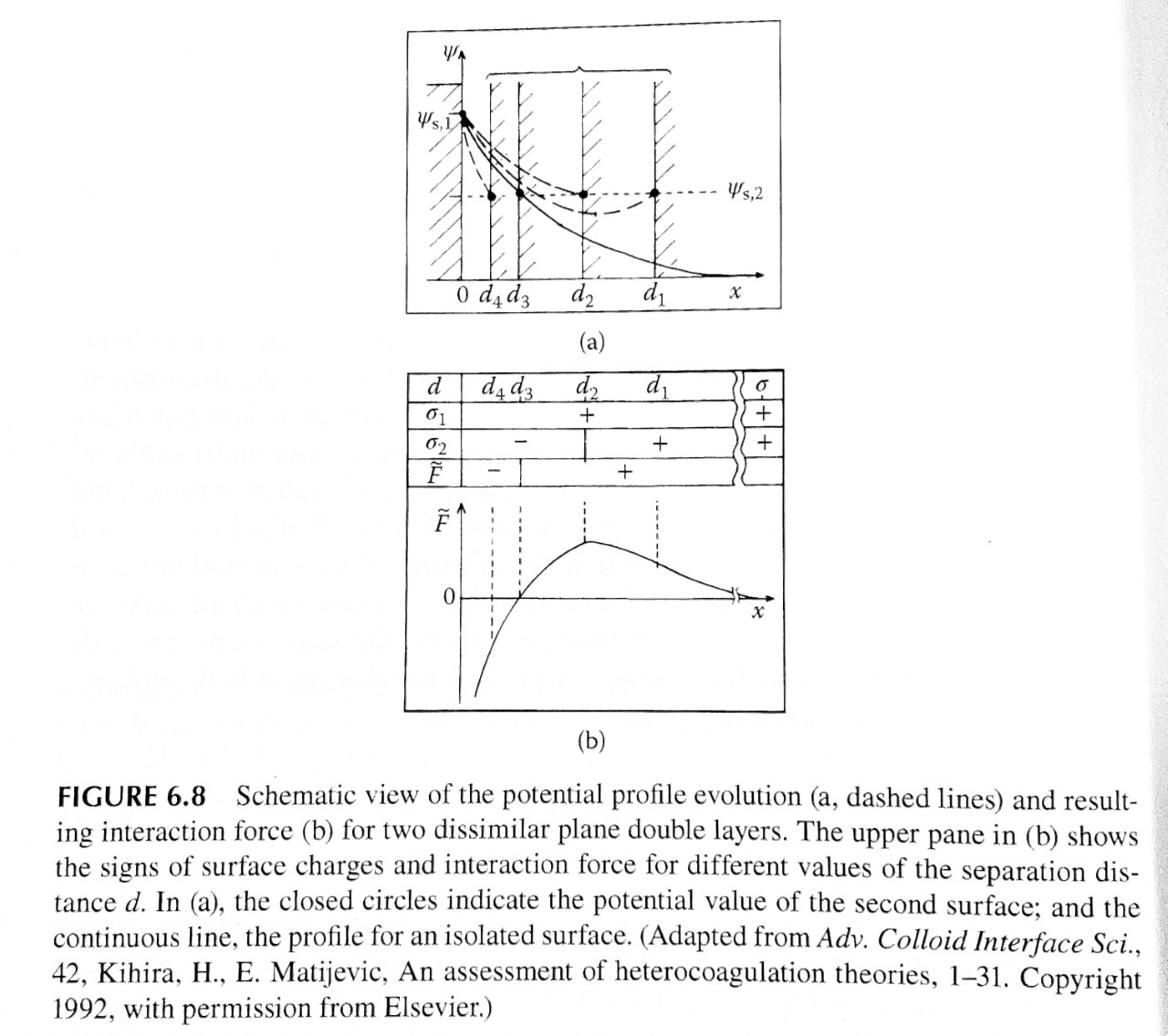
d2: slope of the potential profile at surface 2 vanishes (surface charge is null)
d3: the potential profile matches the case of an isolated surface so that the force vanishes
d4: overall force is attractive
10
Derjaguin-Landau-Verwey-Overbeek (DLVO) theory of colloid stability
the stability of colloidal suspensions is a result of the balance between VW and electrostatic double layer interactions: the dispersion interactions, being always attractive between similar particles, favors flocculation, whereas the repulsive electrostatic interactions prevents or, more precisely, delays this process
11
critical coagulation concentration (CCC)
the concentration value at which a suspension transitions from “stable” to “unstable”
12
Schulze-Hardy rule
the CCC decreases with the counterion charge approximately as $z^6$
13
quick clay
a clay whose structure collapses completely at remolding and whose shear strength is thereby reduced almost to zero
14
remolding (of clay)
the change that occurs in clay that has been disturbed and lost shearing strength but gained compressibility
15
effects of remolding clay
-usually leads to compaction of clay sediment
-in quick clays, may result in collapse
-in quick clays, may result in collapse
16
the effect of soil salinity (ionic strength) on landslides
-quick clay is deposit of clay minerals of marine origin, thus with high saline contents
-water in turn has high ionic concentrations
-attractive forces dominate; large aggregates of particles sediment without any preferred orientation => high void ratio
-when wetted/flooded, salt is slowly leached out
-clay particles need expanded double layers to neutralize particle charge => reflocculation is not possible
-if e high, w may be higher than LL => landslide
-water in turn has high ionic concentrations
-attractive forces dominate; large aggregates of particles sediment without any preferred orientation => high void ratio
-when wetted/flooded, salt is slowly leached out
-clay particles need expanded double layers to neutralize particle charge => reflocculation is not possible
-if e high, w may be higher than LL => landslide
17
limitations of DLVO
-$I \le 0.01 \text{M}$
-interparticle distances not less than a few nanometers
-for soil-related problems, most of the time correct predictions
-in some cases, e.g., highly saline soils, it can fail severely
-interparticle distances not less than a few nanometers
-for soil-related problems, most of the time correct predictions
-in some cases, e.g., highly saline soils, it can fail severely