5: Surface Charge of Colloidal Particles
Study these flashcardsFree · spaced repetition · iPhone, Android, Mac & web
All cards
1
heterovalent isomorphic substitution
the process in which cations in pure solids are replaced by atoms with lower valence; the number of substituting species is small, resulting in an unchanged crystalline structure but a fixed, permanent negative charge
2
time concept of isomorphic substitution
isomorphic substitution happens at the time of particle formation and growth and cannot be changed by the external medium of the soil
3
variables representing the fixed, permanent particle charge
the preferred quantity on fundamental grounds is the fixed or permanent surface charge density $\sigma_f$ (C/m^2); since the surface area is difficult to determine, the practical quantity is the fixed or permanent specific particle charge $\vartheta_f$ (C/kg), usually also expressed as mole of charge (equivalent) per unit of mass (mol/kg)
4
net protonic charge
the net charge of surface groups of a soil particle resulting from the medium pH; charge density given by $\sigma_H=F(\Gamma_H-\Gamma_O)$ where $\Gamma_H$ and $\Gamma_O$ are the surface concentrations of positively and negatively charged sites (protonated and ionized groups), respectively; net proton particle charge is $q_H=A_p \sigma_H$, where $A_p$ is the particle area; net proton-specific charge is $\vartheta_H=z_{\text{H}^+}Q_H+z_{\text{OH}^-}Q_O$ where $Q_H$ and $Q_O$ are the specific amounts of positively and negatively charged groups, the corresponding z being their charges, +1 and -1 respectively
5
intrinsic particle charge
the sum of fixed and protonic charges: $\sigma_{in}=\sigma_f+\sigma_H$ and similarly for $q_{in}$ and $\vartheta_{in}$
6
inner and outer sphere complex charges
the charge added to the soil particle due to inner and outer sphere bound ions; denoted as inner/outer sphere particle charge, charge density and specific charge: $q_I$, $\sigma_I$, $\vartheta_I$ or $q_O$, $\sigma_O$, $\vartheta_O$ respectively
7
resultant particle charge
the sum of intrinsic and inner and outer sphere particle charges: $\sigma_p=\sigma_{in}+\sigma_I+\sigma_O$, similarly for $q_{p}$ and $\vartheta_{p}$
8
diffuse layer charge
$\sigma_d$
9
net adsorbed ion charge
the sum of total adsorbed cation surface charge and total adsorbed anion surface charge: $\sigma_{ad}=\sigma_+-\sigma_-=\sigma_I+\sigma_O+\sigma_d$
10
particle charge balance
the sum of particle charge and diffuse layer charge, or the intrinsic charge and net adsorbed ion charge, which is set to zero due to electrostatic equilibrium: $\sigma_p+\sigma_d \equiv \sigma_f+\sigma_H+\sigma_I+\sigma_O+\sigma_d \equiv \sigma_{in}+\sigma_{ad}=0$
11
colloidal substances with significant amount of fixed charge
some phyllosilicates, such as micas or smectites
12
colloidal substances with significant amount of protonic charge
most soil colloids develop protonic charge (i.e., show a pH-dependent intrinsic charge), but this contribution is more important for oxides and organic matter than for clay minerals
13
the two broad types of soil, based on charge contributions
constant charge soils and variable charge soils; evidently both types contain components with both fixed and variable charges, so there is no clear distinction between them
14
constant charge soil
found mainly in temperate regions, this soil is dominated by clay minerals having an important amount of permanent charge (approximately constant charge in certain pH range, usually low pHs)
15
variable charge soil
found mainly in tropical or subtropical regions, this soil is dominated by oxides and organic matter or clay minerals with low fixed charge such as kaolinite
16
the importance of the difference between specific and nonspecific adsorption
specific adsorption, being a chemical reaction, can cause a reversal of the surface charge sign, whereas nonspecific adsorption, being essentially driven by electrostatic forces, cannot overturn the intrinsic charge
17
potential determining ion (PDI)
the proton, because the surface potential value arises from the acid-base reactions
18
ion exchange
the replacement of sorbed ions by others with charge of the same sign
19
examples of ion exchange chemical reactions
$S^- \text{Na}^++ \text{K}^+(aq) \rightleftharpoons S^- \text{K}^++\text{Na}^+(aq)$
$S^+\text{Cl}^-+\text{NO}^-_3(aq) \rightleftharpoons S^+ \text{NO}^-_3+ \text{Cl}^-(aq)$
where $S^-$ and $S^+$ represent exchanger phases
$S^+\text{Cl}^-+\text{NO}^-_3(aq) \rightleftharpoons S^+ \text{NO}^-_3+ \text{Cl}^-(aq)$
where $S^-$ and $S^+$ represent exchanger phases
20
exchanger phase
a positively or negatively charged site at the solid particle
21
exchange capacity
the maximum amount of monovalent ions (i.e., equivalents of charge) of a given sign that can be retained
22
units of exchange capacity
(mol/kg) moles of charge (equivalents) per unit of exchanger mass
23
cation exchange capacity
$\vartheta_{CE}$ or CEC (mol/kg)
24
anion exchange capacity
$\vartheta_{AE}$ or AEC (mol/kg)
25
index ion method of measuring soil ion exchange capacity
1. saturate the soil colloid (or a whole soil sample) with a salt of a given ion (the index ion, typically Ba2+)
2. treat the sample with MgSO4
3. BaSO4 precipitates and forces the exchange of Ba2+ with Mg2+
4. the amount of Mg2+ consumed in the process gives $\vartheta_{CE}$
2. treat the sample with MgSO4
3. BaSO4 precipitates and forces the exchange of Ba2+ with Mg2+
4. the amount of Mg2+ consumed in the process gives $\vartheta_{CE}$
26
thermodynamic exchange equilibrium constant
$K_{ex}= \frac{ \left( a^W_A \right) ^v \left( a^S_B \right) ^u}{ \left( a^S_A \right) ^v \left( a^W_B \right) ^u}$
the superscripts W and S refer to the solution (water) and solid (exchanger) phases, respectively
$vS_uA+uB^{\text{v}+} \rightleftharpoons uS_vB+vA^{\text{u}+}$
where $A^{\text{u}+}$ and $B^{\text{v}+}$ are cations, S represents sites with single negative charge, u and v are the stoichiometric coefficients resulting from electroneutrality
the superscripts W and S refer to the solution (water) and solid (exchanger) phases, respectively
$vS_uA+uB^{\text{v}+} \rightleftharpoons uS_vB+vA^{\text{u}+}$
where $A^{\text{u}+}$ and $B^{\text{v}+}$ are cations, S represents sites with single negative charge, u and v are the stoichiometric coefficients resulting from electroneutrality
27
activity of solution
$a_i=\frac{m_i \gamma^m_i}{m^0}$
where $m_i$ is the solute molality, $\gamma^m_i$ is the solute activity coefficient in molality scale, $m^0$ is the standard molality, where the standard molality is usually 1 mol/kg
where $m_i$ is the solute molality, $\gamma^m_i$ is the solute activity coefficient in molality scale, $m^0$ is the standard molality, where the standard molality is usually 1 mol/kg
28
activity of solid (exchanger) phase
$a^S_i=x_i \gamma^R_i$
where $x_i$ is the mole fraction and $\gamma^R_i$ is the Raoult activity coefficient
where $x_i$ is the mole fraction and $\gamma^R_i$ is the Raoult activity coefficient
29
selectivity coefficient
a conditional constant used in lieu of the thermodynamic exchange equilibrium constant, in effect bypassing the inability to calculate activity coefficients for the exchanger phase predictively
30
equivalent fraction
$y_i=\frac{z_in_i}{\sum_jz_jn_j}=\frac{z_ic_i}{\sum_jz_jc_j}=\frac{z_ix_i}{\sum_jz_jx_j}$
where the sum is carried by all ions of the same sign as ion i; note that this is the fraction of the total charge (either positive or negative) carried by ions of species i; also note that for a solution composed of all univalent ions, $y_i=x_i$
where the sum is carried by all ions of the same sign as ion i; note that this is the fraction of the total charge (either positive or negative) carried by ions of species i; also note that for a solution composed of all univalent ions, $y_i=x_i$
31
heterovalent exchange
exchange between ions of different charge, e.g., Na+ with Ca2+
32
homoionization (and methods)
saturation of a sample with a single ion, either by repeatedly placing the sample in contact with fresh solutions of the ion of interest or by column leaching with an appropriate solution of such ion
33
how an exchange isotherm is customarily plotted
the (equivalent) fraction of a given cation in the exchanger phase is plotted as a function of the corresponding (mole) fraction of the same or another cation in the solution phase
34
nonpreference isotherm
a plot in the exchange isotherm obtained assuming that:
$K_{ex}=1$
$\gamma^R_i/\gamma^R_{i+1}=1$ and $\gamma^m_i/\gamma^m_{i+1}=1$;
ions plotting over this have preference over ions plotting below
$K_{ex}=1$
$\gamma^R_i/\gamma^R_{i+1}=1$ and $\gamma^m_i/\gamma^m_{i+1}=1$;
ions plotting over this have preference over ions plotting below
35
leaching
the process by which water, from either rain or irrigation, pouring through into deeper soil levels, carries unbound solutes, making them unavailable to plants
36
ions that participate in ion exchange (by location)
technically any bound ion is subject to exchange; however, inner sphere bound ions are assumed not to exchange whereas the diffuse layer and outer sphere will
37
ion-related factors (regarding ion preference)
hydration
polarization
Lewis acidity
ion pair formation
counterion adsorption
polarization
Lewis acidity
ion pair formation
counterion adsorption
38
hydration (ion factor)
for two ions with the same valence, the cation with the smaller hydrated radius, or least negative heat of hydration, is preferred (e.g., K+ over Na+)
39
polarization (ion factor)
given two cations with different valence (e.g., Na+ and Ca2+), the cation with the higher valence (Ca2+) is preferred because of its greater polarization capability. For the case of anions, the opposite is true, larger anions show greater polarizability than smaller anions. Thus, larger anions would be preferred by a positively charged surface
40
Lewis acidity (ion factor)
comparing two cations with the same valence but one being a stronger Lewis acid than the other (e.g., Cu2+ vs. Ca2+), the cation with the stronger Lewis acidity would be preferred if the surface behaves as a relatively strong Lewis base. A similar statement can be formulated for anions (Lewis bases) and a positive (Lewis acid) surface
41
ion pair formation (ion factor)
for a given cation in the presence of two different anions, the anion with the highest potential to form neutral ion pairs with the cation controls the cation adsorption potential, assuming that the anions do not react with the surface, and vice versa. For example, Ca2+ in the presence of Cl- exhibits greater adsorption potential than Ca2+ in the presence of SO4 2- because of the latter's greater preference to form neutral CaSO4 pairs
42
counterion adsorption (ion factor)
for a metal cation in the presence of two different anions, the anion with the highest potential to form surface complexes controls the metal's adsorption potential. E.g., Ni2+ in the presence of Ca(NO3)2 exhibits greater adsorption potential than Ni2+ in the presence of CaSO4 because of the sulfate's potential to react with the surface and produce sites with higher specificity for Ca2+
43
exchanger (surface)-related factors (regarding ion preference)
different adsorption modes
surface electric potential
pH influence
conformational flexibility
surfaces acidity
surface electric potential
pH influence
conformational flexibility
surfaces acidity
44
different adsorption modes (exchanger factor)
a surface capable to form inner sphere complexes with certain cations (e.g., K+ or NH4+) shows stronger preference for these over any other cation (e.g., some layered clay minerals such as vermiculite show strong preference for K+ over Na+ or Ca2+)
45
surface electric potential (exchanger factor)
a surface that does not have the potential to form inner sphere complexes prefers cations with higher valence. This preference depends on the magnitude of the surface electrical potential--the higher the surface electrical potential, the higher the preference for divalent cation (such as Ca2+) over monovalent cations (e.g., Na+)
46
pH influence (exchanger factor)
surfaces that exhibit pH-dependent electrical potential show variable selectivity for a given cation. For example, kaolinite at high pH (where the surface has a high negative charge and so a high negative surface electrical potential) shows increasing preference for divalent cations over monovalent cations, while at low pH (low negative electrical potential), kaolinite or kaolinitic soils show increasing preference for monovalent cations rather than divalent cations
47
conformational flexibility (exchanger factor)
exchangers having the potential to undergo conformational changes (e.g., humic acids) prefer higher valence cations (such as Ca2+) to lower valence cations (such as K+)
48
surfaces acidity (exchanger factor)
exchangers exhibiting weaker acid behavior (high pK_a) show stronger preference for heavy metals than for hard metals in comparison to surfaces with stronger acid behavior (low pK_a)
49
electrophoresis
the movement of charged particles under an electric field
50
electrophoresis FBD
electric field
viscous force
electric force
velocity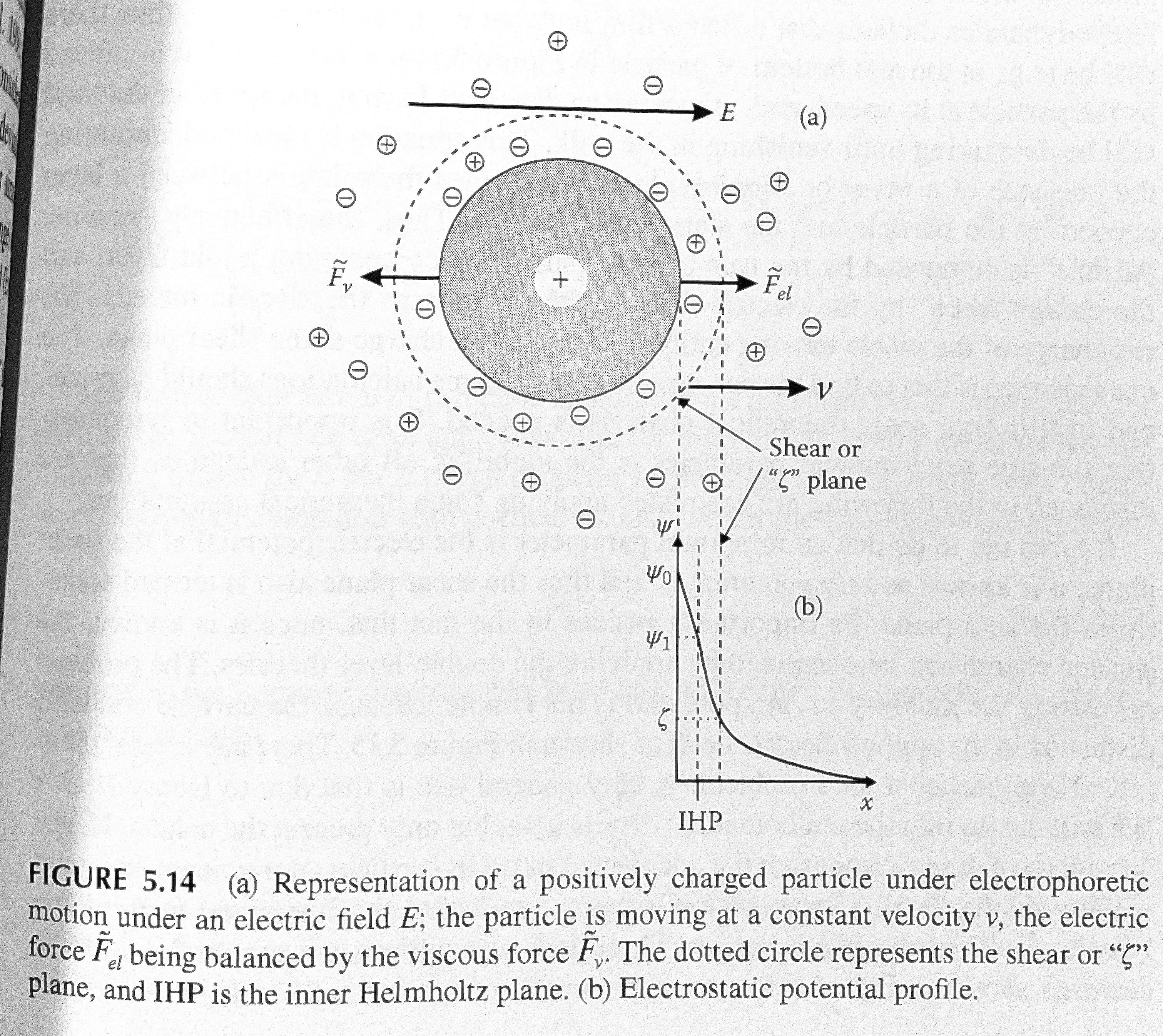
viscous force
electric force
velocity
51
the typical assumption where the OHP is with respect to the shear plane
often, it is assumed that the shear plane is coincident with, or near to, the OHP, i.e., inside the diffuse layer
52
isoelectric point (IEP)
the pH at which colloidal particles do not move under an electric field