8: Silicate-Based Minerals
Study these flashcardsFree · spaced repetition · iPhone, Android, Mac & web
All cards
1
orthosilicic acid
$\text{Si(OH)}_4$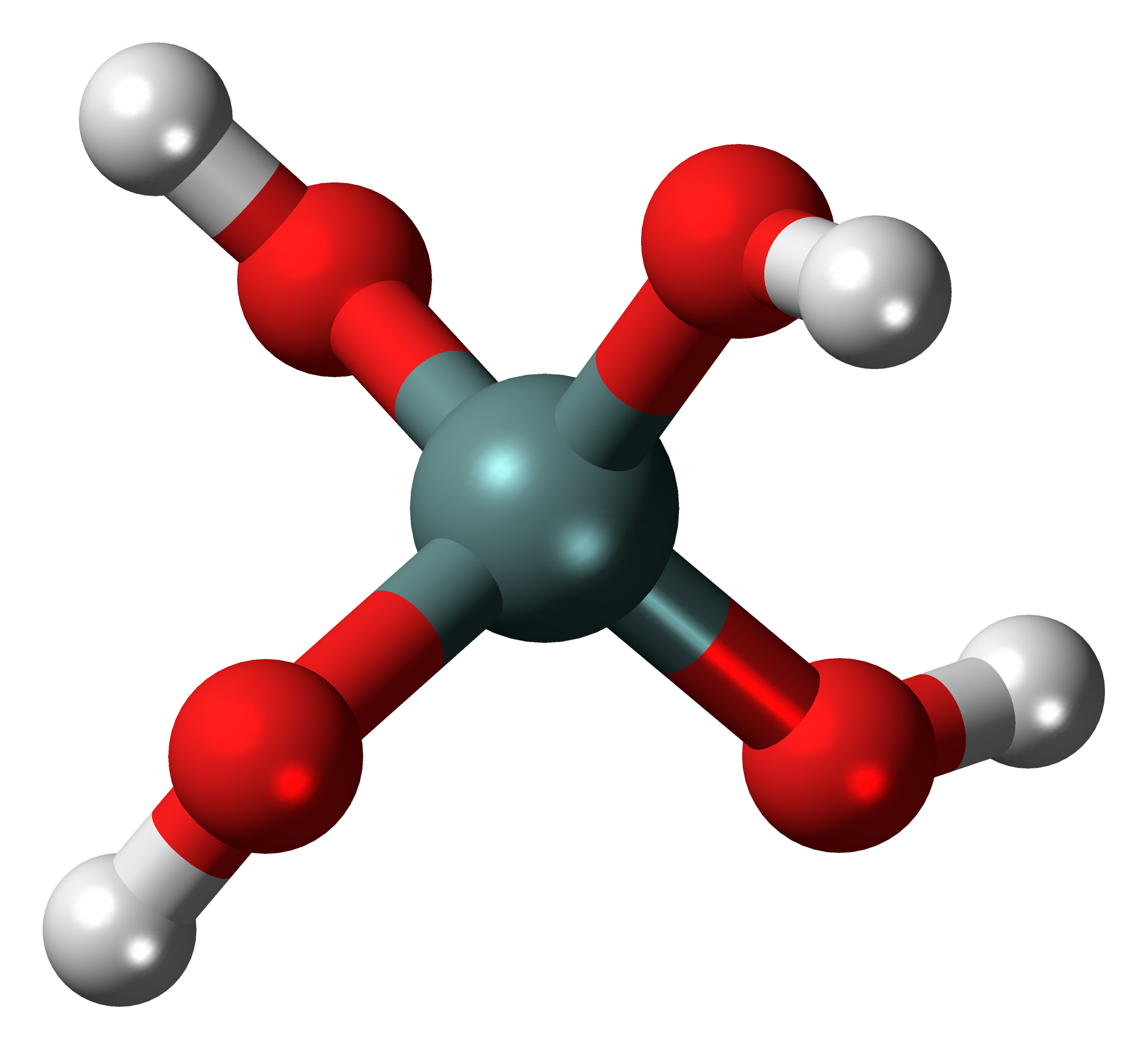
2
nesosilicates
the mineral subclass in which isolated $\text{SiO}_4$ tetrahedra are linked by the bonding of oxygens to cations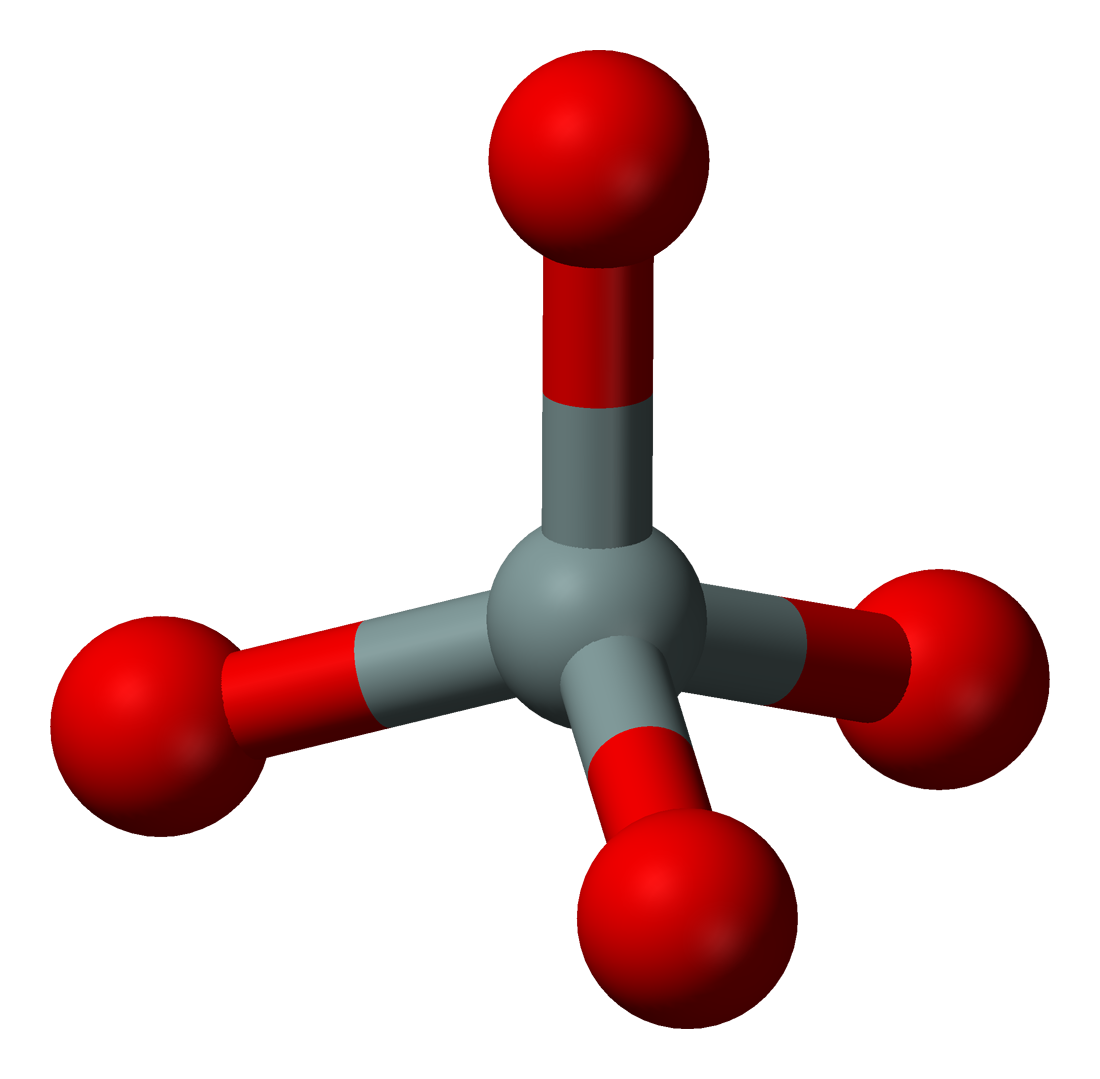
3
pyrosilicic acid
$\text{H}_6 \text{Si}_2 \text{O}_7$, the product of the condensation of two $\text{Si(OH)}_4$ units, losing a water molecule [H atoms not shown in Fig]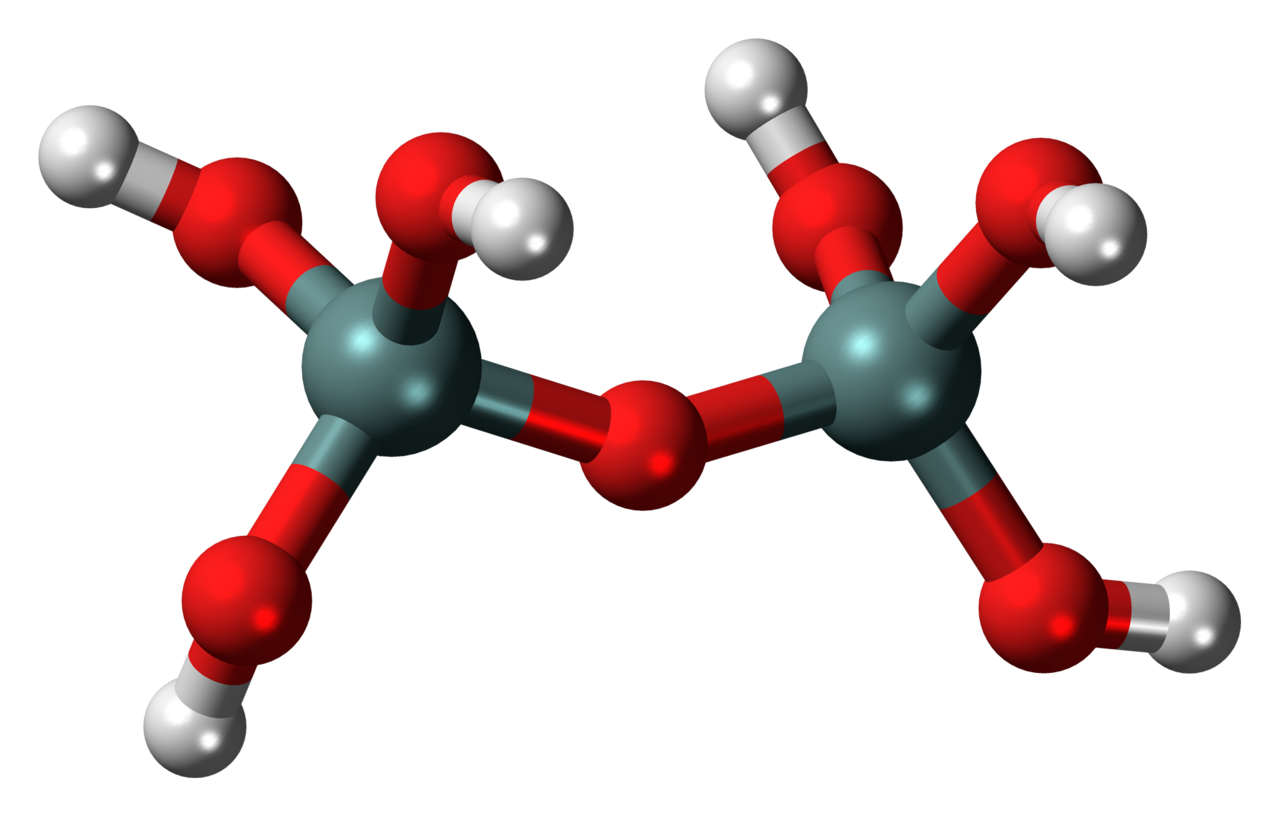
4
sorosilicates
the mineral subclass in which one O is shared between two $\text{SiO}_4$ tetrahedra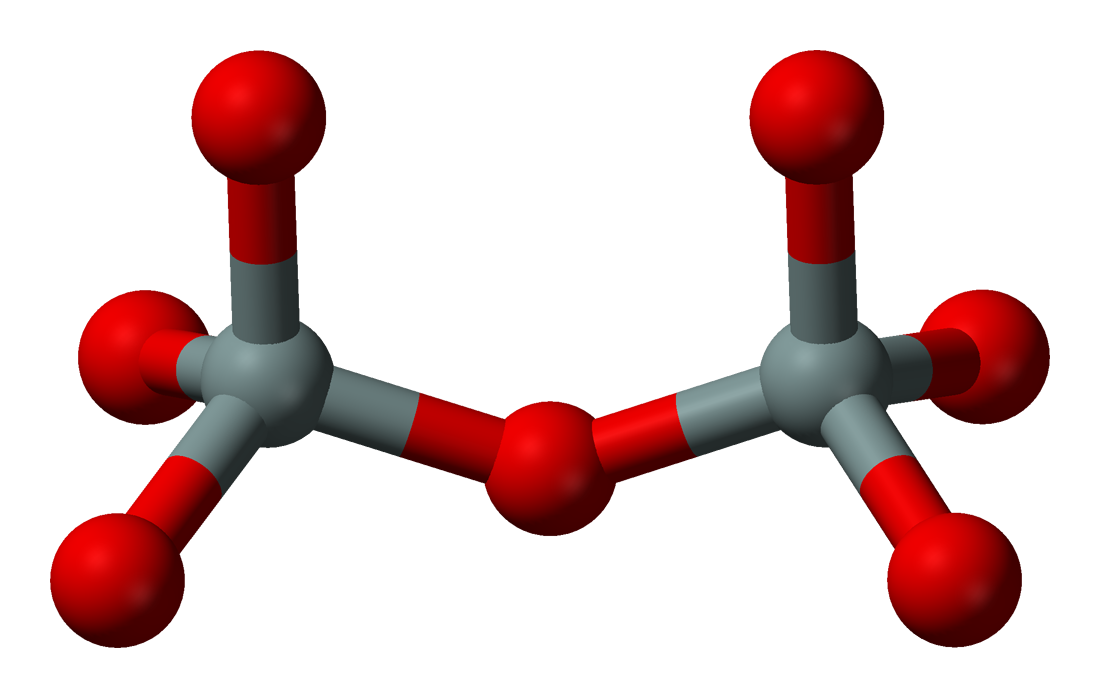
5
metasilicate substances
$\text{SiO}^{2-}_3$, the product of $\text{SiO}_4$ tetrahedra condensating two water molecules, so that the tetrahedra share two O atoms
6
cyclosilicates
the mineral subclass in which cycles are formed by a few metasilicate ($\text{SiO}^{2-}_3$) units, usually 4 to 6--btwn 3 and 8 have been observed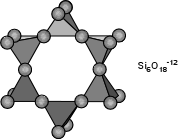
7
single-chain inosilicate
the mineral subclass in which linear chains are formed by metasilicate ($\text{SiO}^{2-}_3$) units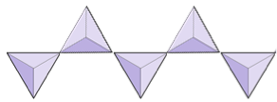
8
amphiboles
$\text{Si}_4 \text{O}^{6-}_{11}$, the mineral subclass consisting of double-chain inosilicates (condensation of single-chains)
9
basal
at or forming the bottom of something
10
apical
situated at the top or tip of something
11
tetrahedral sheet
$\text{Si}_2 \text{O}^{2-}_5$, the mineral structure in which three O atoms per $\text{SiO}_4$ tetrahedron are shared, forming six-member rings--the extension of the double-chain structure in two dimensions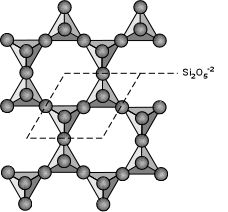
12
basal oxygens
shared oxygens in a tetrahedral sheet
13
apical oxygens
nonshared oxygens in a tetrahedral sheet
14
tectosilicates
$\text{SiO}_2$, the mineral subclass in which all four O atoms between $\text{SiO}_4$ tetrahedra are shared, resulting in three-dimensional structures (e.g., quartz and minerals such as feldspars and zeolites)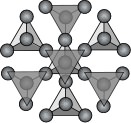
15
octahedron structure
the structure in which a central cation slightly larger than Si(IV) can accommodate six O2- ions (actually usually hydroxyls [OH- ions]). The cation is usually Al(III) but also Mg(II), Fe(II), etc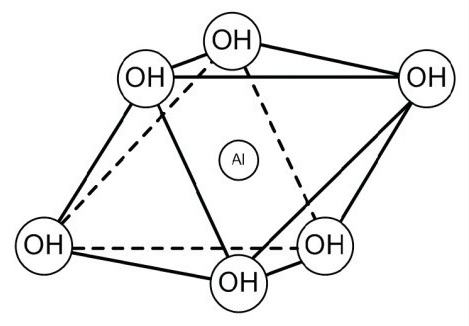
16
dioctahedral sheet
an octahedral sheet in which the cation has valence of 3 [e.g., Al(III)]: all OH- groups are shared between *two* Al centers, giving the minimum formula $\text{Al(OH)}_3$ as in gibbsite; note the "holes" in the structure, required by the stoichiometry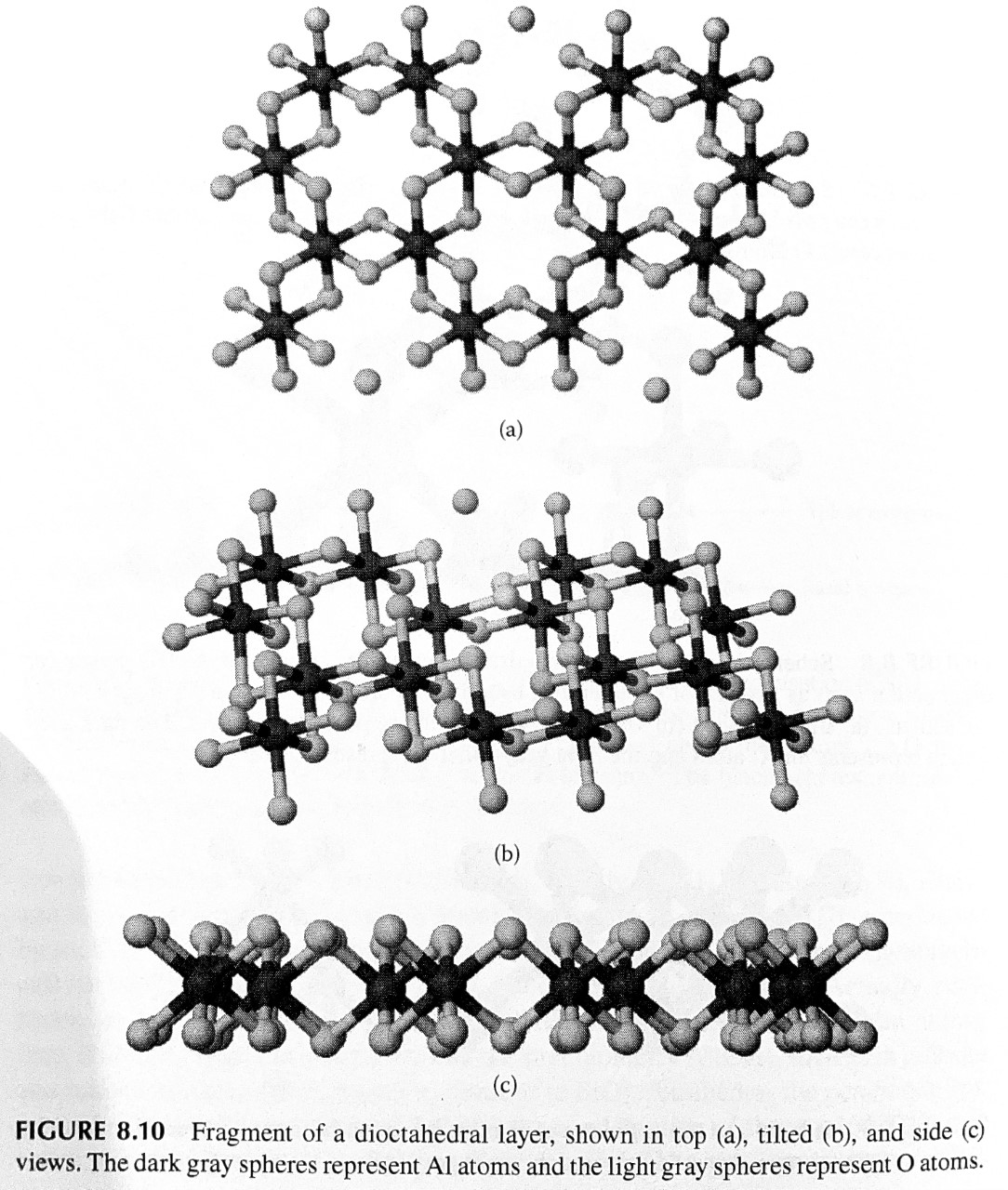
17
trioctahedral sheet
an octahedral sheet in which the cation has valence of 2 [e.g., Mg(II)]: all OH- groups are shared between *three* Mg centers giving the minimum formula $\text{Mg(OH)}_2$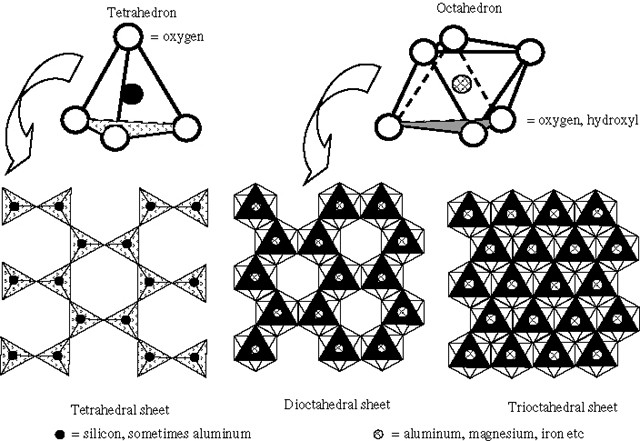
18
phyllosilicates (and structure)
the mineral subclass in which tetrahedral and octahedral sheets are bound by sharing the tetrahedral apical O atoms with the octahedral sheet; these atoms replace OH groups, forming layers characteristic of these types of minerals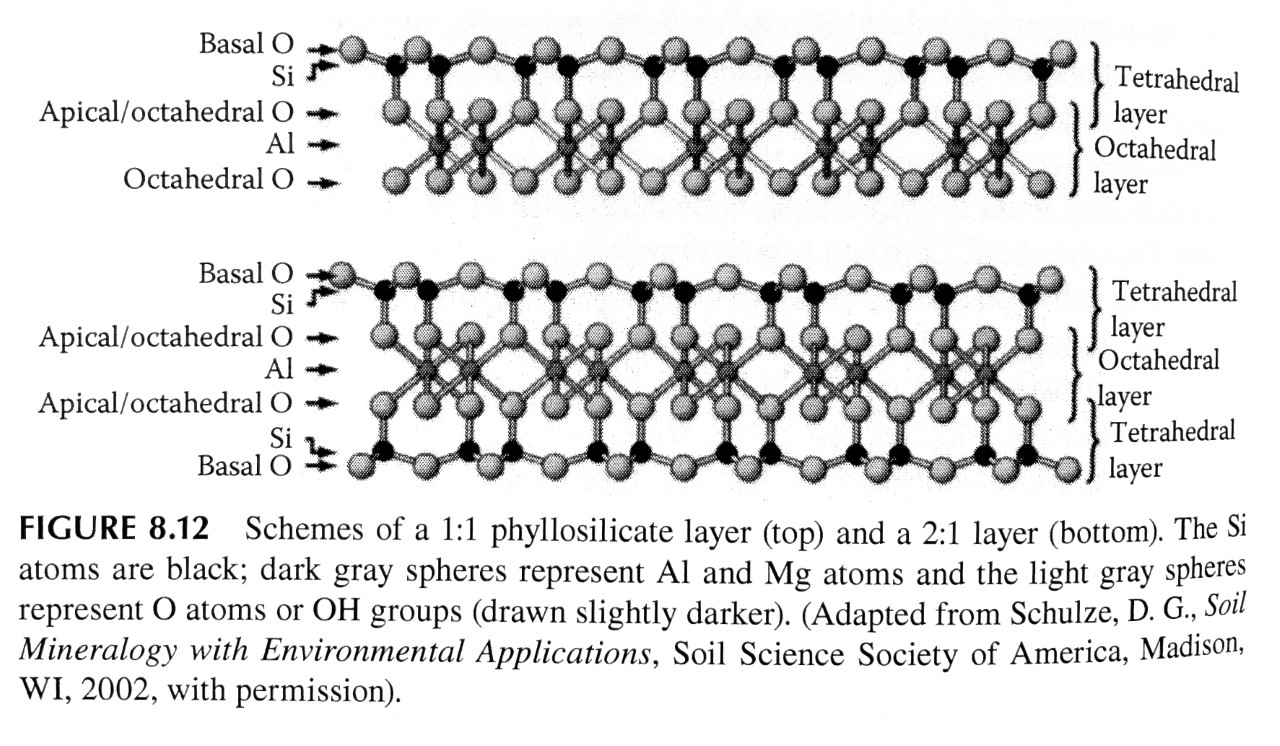
19
1:1 phyllosilicate
the phyllosilicate structure in which one tetrahedral sheet is bound to an octahedral (hydroxyl and siloxane groups exposed)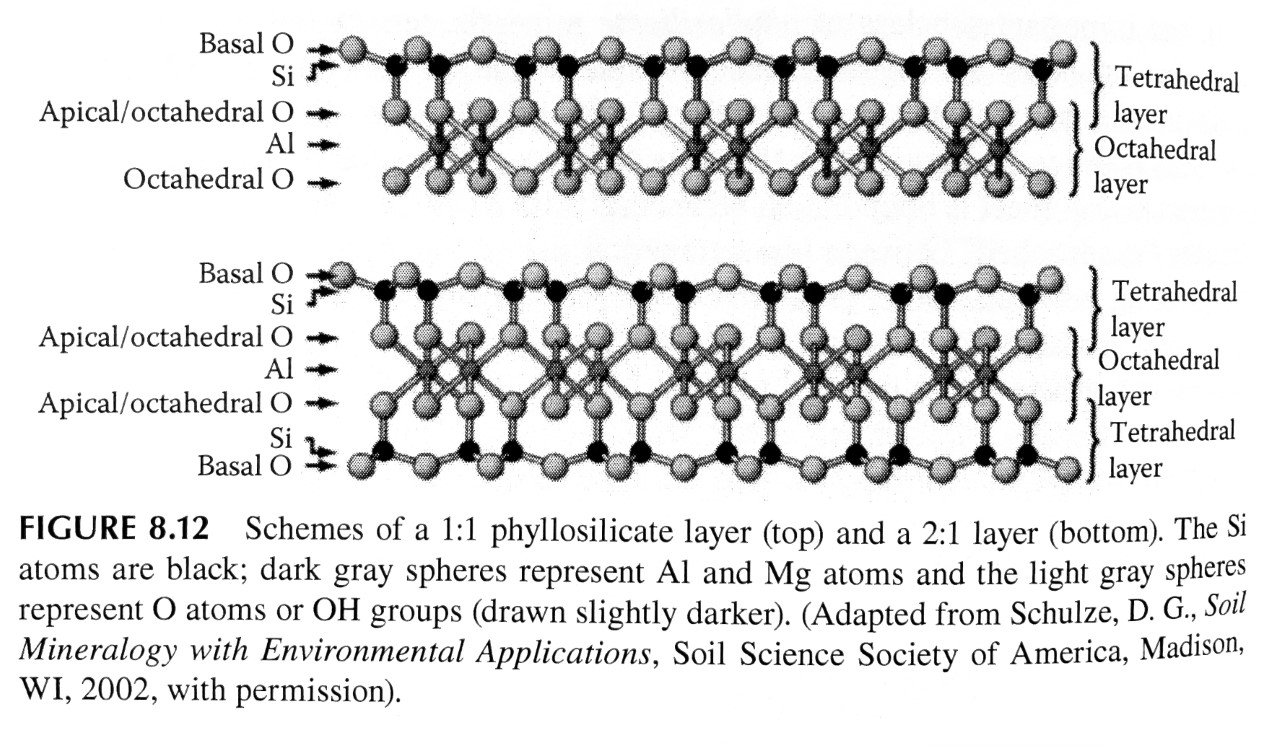
20
2:1 phyllosilicate
the phyllosilicate structure in which one octahedral sheet is "sandwiched" between two tetrahedral sheets (only siloxane groups exposed)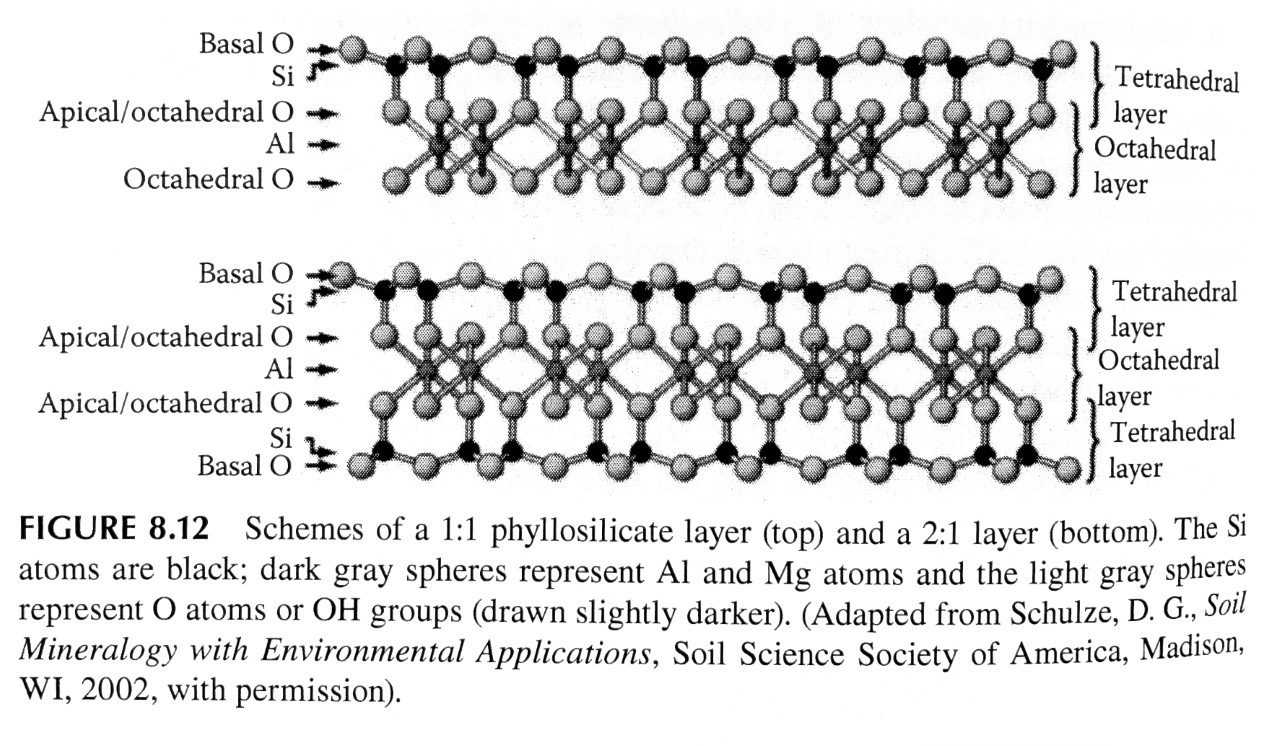
21
hydroxyl surface
the surface of an octahedral sheet in which (except for the O atoms shared between the two sheets) OH groups are exposed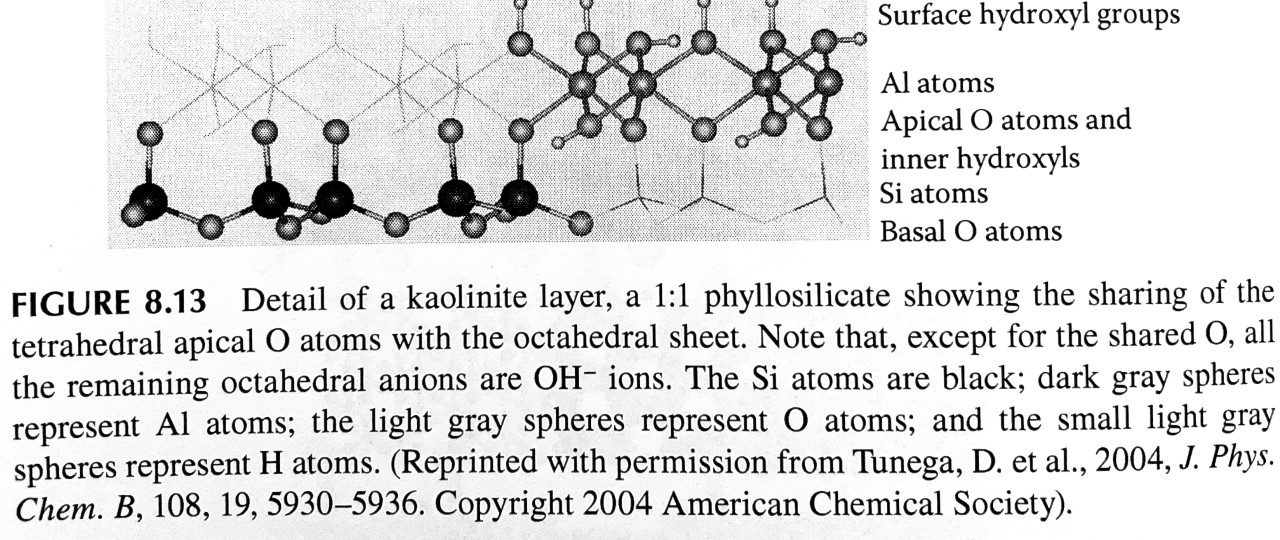
22
siloxane surface
the surface of a tetrahedral sheet in which basal O atoms are exposed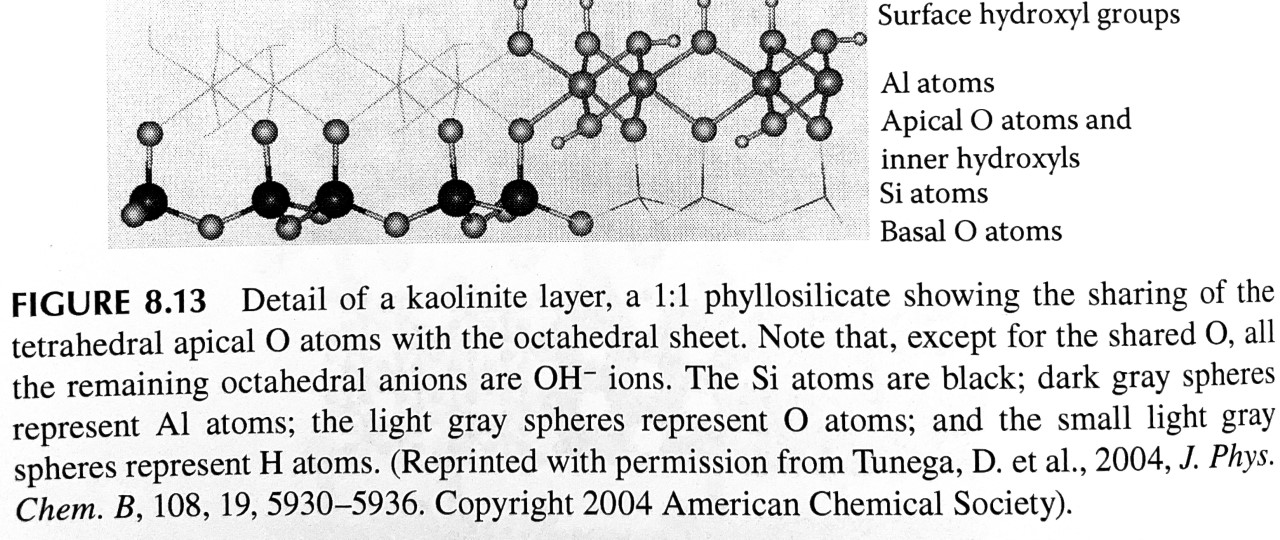
23
results of discontinuity of sheet structures
1. "dangling" O atoms, which, in the presence of water, each accept an H+ ion to form an OH group
2. "exposed" Si4+/Al3+ centers (are Lewis acid sites [with positive charge]), which, in the presence of water, each form an OH group and release an H+ ion
2. "exposed" Si4+/Al3+ centers (are Lewis acid sites [with positive charge]), which, in the presence of water, each form an OH group and release an H+ ion
24
surfaces exposed due to discontinuity of sheet structures
silanol
aluminol
aluminol
25
silanol groups (and reactivity)
-border OH groups bound to a silicon (Si) center
-can release an H+ ion to give a negative charge, but are too acidic to become positively charged (in the normal pH range of soil)
-can release an H+ ion to give a negative charge, but are too acidic to become positively charged (in the normal pH range of soil)
26
aluminol groups (and reactivity)
-border OH groups bound to an aluminum (Al) center
-can either bind or release an H+ ion to acquire (+ve) or (-ve) charge, respectively, depending on medium pH
-can either bind or release an H+ ion to acquire (+ve) or (-ve) charge, respectively, depending on medium pH
27
types of 1:1 phyllosilicate minerals
kaolin (having Al(III) dioctahedral sheet; stable)
serpentine (having Mg(II) trioctahedral sheet; less stable)
serpentine (having Mg(II) trioctahedral sheet; less stable)
28
kaolinite
- almost no isomorphic substitution (only Fe substituting 0.25-1% of Al)
- 1:1 layers held together by H bonding
- low border-to-surface ratio => little reactivity except at edges (silanol/aluminol groups)
- low CEC
- 1:1 layers held together by H bonding
- low border-to-surface ratio => little reactivity except at edges (silanol/aluminol groups)
- low CEC
29
pyrophyllite-talc group
- low permanent charge 2:1 phyllosilicates
- pyrophyllite: Al dioctahedral sheet, talc: Mg trioctahedral sheet
- layers are held together only by weak van der Waals interactions
- pyrophyllite: Al dioctahedral sheet, talc: Mg trioctahedral sheet
- layers are held together only by weak van der Waals interactions
30
micas
- 2:1 phyllosilicate minerals
- 1 of 4 Si atoms replaced by Al
- permanent negative charge is balanced by dehydrated monovalent ions in the interlayer (mainly K+, fitting well in the voids of the siloxane surface)
- not expandable (due to the strong interactions)
- low CEC
- 1 of 4 Si atoms replaced by Al
- permanent negative charge is balanced by dehydrated monovalent ions in the interlayer (mainly K+, fitting well in the voids of the siloxane surface)
- not expandable (due to the strong interactions)
- low CEC
31
minerals in the mica group
muscovite (primary, dioctahedral)
illite (secondary, dioctahedral)
biotite (primary, trioctahedral)
illite (secondary, dioctahedral)
biotite (primary, trioctahedral)
32
vermiculites
- similar to micas, but with lower permanent charge, which is compensated by hydrated cations in the interlayer
- 15-25% Si atoms replaced by Al
- hydrated Mg2+ or Ca2+, etc, in the interlayer
- formed by weathering of biotite
- high CEC
- 15-25% Si atoms replaced by Al
- hydrated Mg2+ or Ca2+, etc, in the interlayer
- formed by weathering of biotite
- high CEC
33
hydroxy interlayering
the presence of hydroxyl-cations in the interlayer, usually Al-OH, which lowers CEC (preference of K over Ca) and swelling is reduced
34
smectites
- expansible clay minerals with lower (weaker) permanent charge, leading to easy expansion/shrinkage depending on medium conditions
- hydrated Ca2+, Mg2+, etc, and water molecules in the interlayer
- high CEC
- formed by weathering of other 2:1 phyllosilicates (esp micas) or other primary minerals
- hydrated Ca2+, Mg2+, etc, and water molecules in the interlayer
- high CEC
- formed by weathering of other 2:1 phyllosilicates (esp micas) or other primary minerals
35
types of smectites
montmorillonite (dioctahedral)
beidelite (dioctahedral)
beidelite (dioctahedral)
36
chlorites
- 2:1 phyllosilicates with isomorphic substitution (or 2:1:1 phyllosilicates; see below)
- negative charge is compensated by a hydroxide sheet (not stoichiometric, having OH- deficiency or water molecules) in the interlayer
- hydroxide sheet usually contains Al(III) or Mg(II) (gibbsite or brucite sheet respectively), also can find Fe(III)
- unstable (due to hydroxide sheet); weather to smectites or vermicultes & release interlayer cations (Mg2+) to environment
- low surface area, low CEC
- negative charge is compensated by a hydroxide sheet (not stoichiometric, having OH- deficiency or water molecules) in the interlayer
- hydroxide sheet usually contains Al(III) or Mg(II) (gibbsite or brucite sheet respectively), also can find Fe(III)
- unstable (due to hydroxide sheet); weather to smectites or vermicultes & release interlayer cations (Mg2+) to environment
- low surface area, low CEC
37
zeolites
- rigid tectosilicates with some Si to Al isomorphic substitution
- inner spaces normally filled by water and exchangeable cations
- important components of sedimentary rocks, mainly of volcanic origin, also found in cavities of igneous rocks such as basalt
- inner spaces normally filled by water and exchangeable cations
- important components of sedimentary rocks, mainly of volcanic origin, also found in cavities of igneous rocks such as basalt
38
medium dependency of SSA measurements
N2, being a nonpolar molecule, interacts only with low polarity surfaces; in particular, it is not able to enter the interlayer regions of clay minerals. Thus, the nitrogen area is often considered as the external area of phyllosilicates
39
mechanism for ion-binding capacity of silicate minerals
- mainly given by electrostatic interactions (i.e., ionic exchange)
- there is relatively little specific binding, mainly through edge silanol and aluminol groups
- there is relatively little specific binding, mainly through edge silanol and aluminol groups