Bio 001 Exam 1
Study these flashcardsFree · spaced repetition · iPhone, Android, Mac & web
All cards
1
single neutral particles
Atoms
2
neutral particles made of 2 or more atoms bonded together
Molecules
3
cloud, negativly charged
electrons
4
nucleus, positivly charged
proton
5
nucleus, NOT charged
neutrons
6
force of attraction to protons
Why electrons attracted to nucleus?
7
determined by the electrons in the outtermost shell of an atom
Atoms reactivity
8
force of attraction that holds together 2 atoms that share a pair of valence electrons, ONLY FORM IN SAME MOLECLUES
covalent bond
9
electrons NOT shared equally, have DIFFERENT attractions for electrons, DIFFERENT electronegativities
polar covalent bond
10
electrons shared equally, have SIMILAR attractions for electrons, SIMILAR electronegativities
nonpolar covalent bond
11
possible for 2 of the same type of atom to be connected with polar bond?
NO, because they have the same electronegativity so the bonds will be NONPOLAR
12
ability to attract shared electrons
Electronegativity
13
low electronegativity
NONPOLAR
14
high electronegativity
POLAR
15
interactions between molecules with opposite charges, weaker than covalent bonds, form between SAME and DIFFERENT molecules
Non Covalent Bond
16
atoms with FULL opposite charges because electron is transferred, STRONGEST type of noncovalent bond
Ionic Bonds
17
form between hydrogen atoms with a permenant partial positive charge and atom with a permenant partial negative charge, MEDIUM type of noncovalent bond
Hydrogen Bonds
18
very quick temporary positive charges, WEAKEST type of noncovalent bond
Vander Waals interactions
19
with up to 4 other water molecules, make strong interactons between water molecules, POLAR molecules
Water bonds
20
STRONGLY COHESIVE, HIGH BOILING POINT (lost of energy to pull apart), EVAPORATIVE COOLING (lots of energy to pull apart), EXPANDS WHEN IT FREEZES (4 hydrogen bonds hold them apart)
Physical Properties of Water
21
interact WELL with water, have atoms with FULL and/or PARTIAL charges (more POLAR bonds in molecule)
hydrophilic molecules
22
do NOT interact well with water, FEW/NO atoms with any charges (more NONPOLAR bonds in molecule)
Hydrophobic Molecules
23
GENETIC INFO, instructions required to create and maintain cells
Nucleic Acid
24
smaller molecules used to form nucleic acids
Nucleotides
25
chains of nucleotides connected by COVALENT BONDS
DNA and RNA
26
double strand, info storage
DNA
27
single strand, messages and more
RNA
28
CELLULAR MACHINES, speed up chemical reactions in cells that form, break down, and change cellular molecules
Proteins
29
building blocks (monomer units of proteins), set of 20 common to ALL cells and share common structure, UNIQUE PROPERTIES determined by R-group
Amino Acids
30
chains of amino acids connected by covalent bonds, fold into complex structures sessential for proper structure; held together by NONCOVALENT BONDS; shape determined by COMPOSITION AND ORDER of amino acids
Polypeptides
31
one or more polypeptides
Protiens
32
unraveling of 3D shape of protiens, does NOT BREAK COVALENT bonds
denaturation
33
energy storage/source (more short term)
Carbohydrates
34
smallest carbohydrates, monomer units (glucose, fructose, galactose)
monosaccharides
35
2 monosaccharides connected by COVALENT bonds (sucrose, lactose, maltose)
disaccharides
36
long chains of monosaccharides connected by COVALENT bonds (starch- energy storage for plants, glycogen- energy storage in animals)
pollysaccharides
37
memberane structure and energy storage/source (more long term), primarily hydrophobic
Lipids
38
form membranes that define boundaries of ALL cells
membrane lipids
39
HYDROPHILLIC head group interact with watery environment inside/outside the cell; HYDROPHOBIC hydrocarbon chains (tails) interact with each other inside the membrane
Structure
40
NO double bonds (straight); pack together better, form MORE Vander Waals interactions, MORE solid
Saturated tails
41
has double bonds (kinked);form FEWER Vander Waals interactions, LESS solid
Unsaturated Tail
42
type of unsaturated tail, more than one double bond
polyunsaturated
43
type of unsaturated tail, one double bond
monounsaturated
44
energy storage lipids, 3 hydrocarbon tails that are different from each other, DO NOT HAVE HYDROPHILIC PART; unsaturated- have double bonds (kinks) and fewer interactions; saturated- no double bonds and more interactions
Triglycerides
45
double bonds can be chemically removed from triglyceride tails to convert liquid fats into solid fats
hydrogenation
46
ALL single celled organisms, one circlular chromosome (piece of DNA), lack internal membrane bound compartments (organelles), SMALLER
Prokaryotic cells
47
single or multicellular organisms, multiple linear chromosomes (peices of DNA wrapped around protiens in nuclues), have various types of organelles
Eukaryotic cells
48
information storage and processing
nucleus
49
energy (plant and animal cells)
mitochodria
50
energy (plant cells only)
chloroplasts
51
protein and lipid synthesis/processing
Endoplasmic Reticulum
52
processing and transport
Golgi Body
53
organize processes = better control, concentrate molecules required for specific functions, anchor cellular molecules in the right place, protect cells by isolating reactive molecules
Benefits of Organelles
54
1. light energy absorbed by antenna pigments gets transferred to reaction center
2. Energy used by reaction center to transfer electrons to mobile electron carrier
3. reaction center pulls electrons from water to replace missing electrons, PRODUCES OXYGEN
2. Energy used by reaction center to transfer electrons to mobile electron carrier
3. reaction center pulls electrons from water to replace missing electrons, PRODUCES OXYGEN
Photosynthesis II
55
energy stored in bonds between atoms
chemical energy
56
degree of disorder, less disorder -> low entropy, more disordered -> high entropy
Entropy
57
products free energy LESS than reactants
release energy
58
products free energy more than reactants
require energy
59
minimum amount of energy required for molecules to react (from transition state)
Activation energy
60
arrangement of atoms with enough energy to form products
transition state
61
rates of chemical reactions can be increased this way, BUT NOT EFFECTIVE (all reactions go faster, molecules would be damaged)
Temperature
62
Speed up reactions by lowering activation energy, free energy of transition state goes down
1. Sustrates bind to enzymes active site
2. Interaction of substrates causes enzyme to change shape (makes forming transition state energetically easier, lower activation energy)
3. Products form and are released by enzyme (enzyme not changed, can interact more)
1. Sustrates bind to enzymes active site
2. Interaction of substrates causes enzyme to change shape (makes forming transition state energetically easier, lower activation energy)
3. Products form and are released by enzyme (enzyme not changed, can interact more)
Enzymes
63
has specific shape, forms many NONCOVALENT bonds with substrates
active site
64
Enzymes; strains bonds taht need to be broken, puts atoms that need to form bonds near each other
shape changes
65
Enzymes, able to make chemical reactions go significantly faster
Highly Efficient
66
Enzymes, catalyze ONE reaction
Specific
67
can change the shape of the enzyme and ability to interact with substrates
pH
68
increase temperature can increase reaction rate UNTIL high temperature denatures enzymes
Temperature
69
changing the amount of enzyme present in a cell, changing the ability of the enzyme to function
Rates of enzyme reactions controlled by
70
molecule that increases an enzymes activity, interact better with substrate
Activator
71
molecule that decreases an enzymes rate of activity, less able to interact with substrate
Inhibitor
72
got attached to enzyme by a COVALENT BOND, permenantly alter shape or active site of enzyme
irreversible inhibitor
73
can interact and dissociate; competitive and non competitive
reversible inhibitor
74
reversible inhibitors; interact in active site, block interaction of substrates and compete for active site
competitive inhibitiors
75
reversible inhibitors; interaction changes enzyme shape, decrease ability of enzymes to interact with substrates
noncompetitive inhibitors
76
a series of connected enzyme-catalyzed reactions
pathway model
77
INCREASES EFFICIENCY of energy release/storage (less lost as heat and lower activation energy), DOES NOT change TOTAL AMOUNT OF ENERGY released (or stored), provides POINTS OF CONTROL (regulation)
benefits of pathway model
78
adenosine triphosphate; main energy currency in cells, 3 phosphate groups connected by high energy bonds
ATP
79
molecules that allow transfer of electrons between other molecules
Electron Carriers
80
ready to accept electrons (EX: NAD+)
Oxidized electron carriers
81
has electrons already (EX: NADPH)
Reduced electron carriers
82
glycolysis prokaryotes and eukaryotes
occurs in cytoplasm
83
(2NAD+ —> 2NADH)
Glucose ——> 2 pyruvate
(2ADP+Pi —> 2 ATP)
Does NOT require oxygen, but can’t convert reduced carriers back to oxidized carriers without it
Glucose ——> 2 pyruvate
(2ADP+Pi —> 2 ATP)
Does NOT require oxygen, but can’t convert reduced carriers back to oxidized carriers without it
glycolysis
84
regenerates oxidized electron carriers required for glycolysis to continue when theres not enough oxygen, DOES NOT generate any additional ATP
Fermentation
85
fermentation prokaryotes and eukaryotes
occurs in cytoplasm (no oxygen)
86
(2NADH —> 2NAD+)
2 pyruvate ——> 2 lactate
2 pyruvate ——> 2 lactate
Lactic Acid Fermentation
87
(2NADH —> 2NAD+)
2 pyruvate ——> 2 ethanol
2 pyruvate ——> 2 ethanol
Alcoholic Fermentation
88
glucose + 6CO2 --> 6CO2 + ~32 ATP (and some heat) 
Cellular Respiration
89
energy (ATP) and electrons (NADPH) used to form carbohydrates from carbon dioxide (and water)
3 CO2 per round, 2 rounds to make glucose
3 CO2 per round, 2 rounds to make glucose
Calvin Cycle
90
cellular respiration eukaryotic
occurs in mitochondrion
91
mitochondrial matrix
some electrons passed to NAD+ (oxidized electron carrier) - forms NADH
One carbon removed- released as CO2
2 other carbons transferred to carrier molecule called CoA, forming Acetly-CoA
some electrons passed to NAD+ (oxidized electron carrier) - forms NADH
One carbon removed- released as CO2
2 other carbons transferred to carrier molecule called CoA, forming Acetly-CoA
Acetyl-CoA formation
92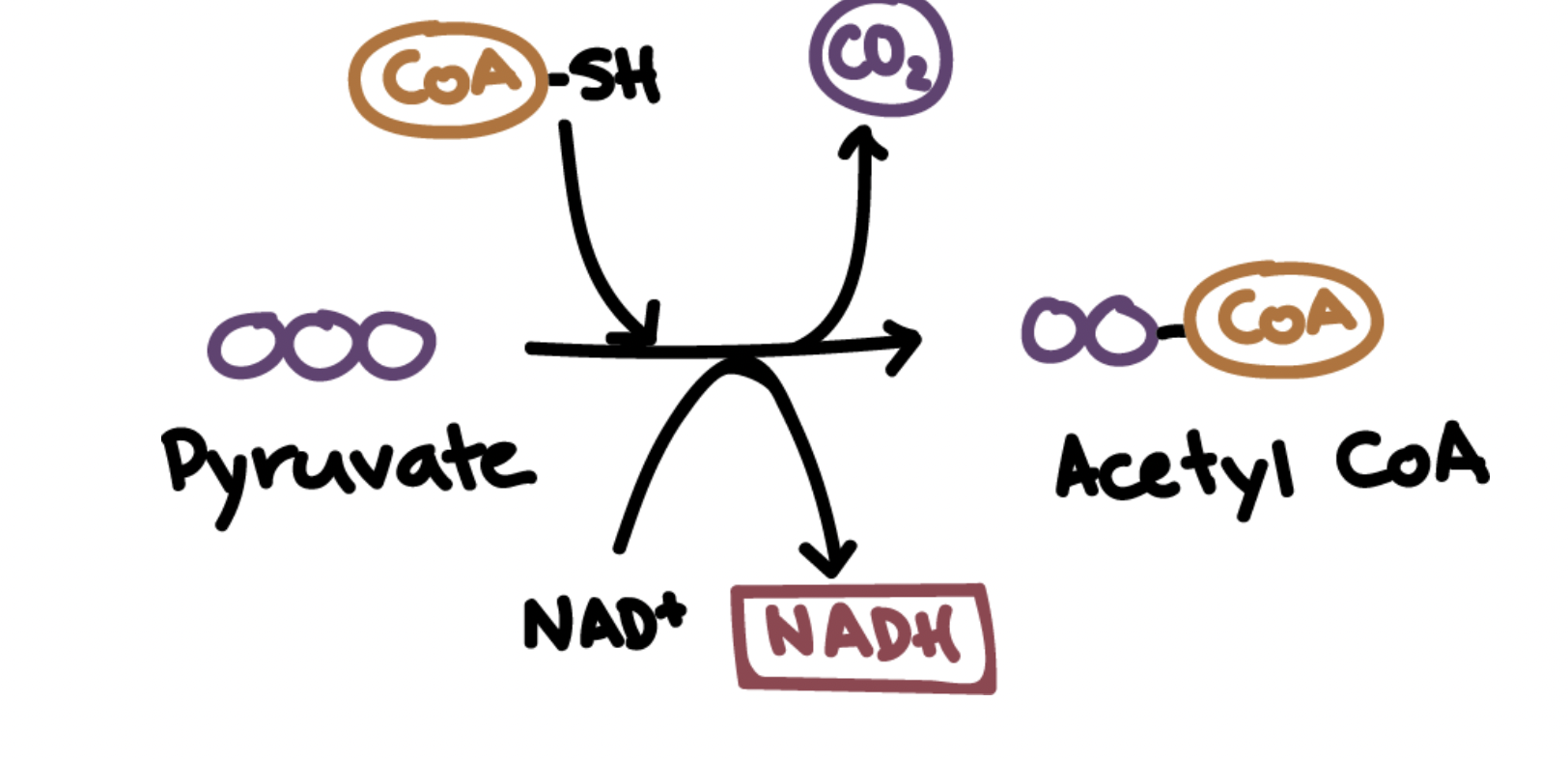
Image occlusion: name the hidden labels
93
Image occlusion: name the hidden labels
94
Image occlusion: name the hidden labels
95
Image occlusion: name the hidden labels
96
cycle of reactions- last reaction generates substrate for 1st reaction
2 carbons transferred from acetyl-CoA gets released as CO2
generates 1 ATP and multiple (4) reduced electron carriers
2 cycles per molecule of glucose- because 2 acetly-CoA are generated from 2 pyruvate produced per glucose by glycolysis
2 carbons transferred from acetyl-CoA gets released as CO2
generates 1 ATP and multiple (4) reduced electron carriers
2 cycles per molecule of glucose- because 2 acetly-CoA are generated from 2 pyruvate produced per glucose by glycolysis
Cirtic Acid Cycle
97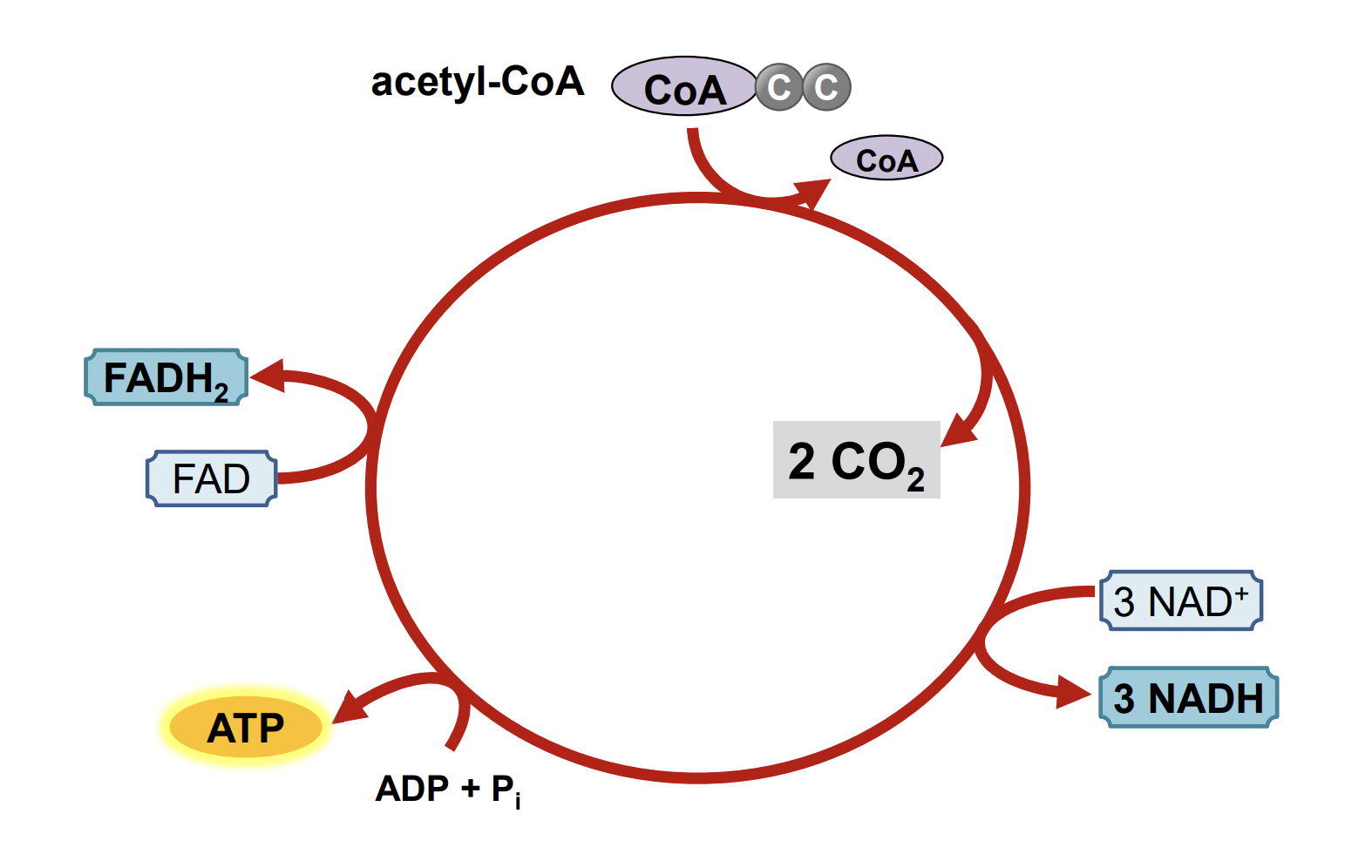
Image occlusion: name the hidden labels
98
Image occlusion: name the hidden labels
99
Image occlusion: name the hidden labels
100
Image occlusion: name the hidden labels
101
Image occlusion: name the hidden labels
102
energy released by passing electrons to oxygen is used to form most of ATP in your cells - regenerates oxidized electron carriers
Electron Transport Chain
Produces most of the ATP for cellular respiration
Electron Transport Chain
Produces most of the ATP for cellular respiration
Oxidative Phosphorylation
103
inner mitochondrial membrane (more folds = more room for enzymes)
oxidative phosphorylation eukaryotic
104
cell membrane (the only membrane they have)
oxidative phosphorylation prokaryotic
105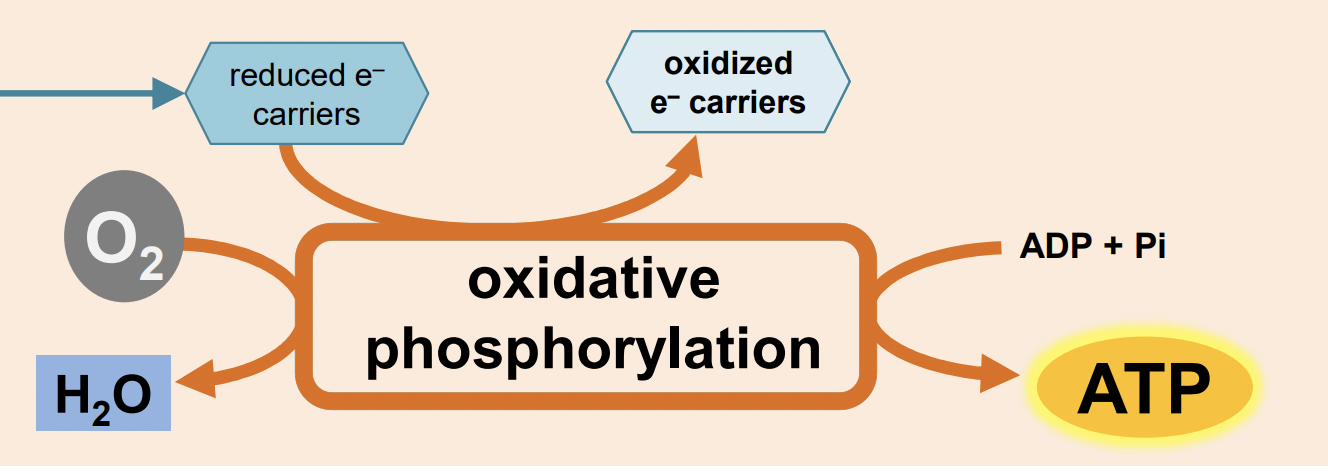
Image occlusion: name the hidden labels
106
Image occlusion: name the hidden labels
107
Image occlusion: name the hidden labels
108
4 enzyme complexes and mobile electron carriers
Proton gradient formed as electrons are passed to oxygen, which is stored energy that is used by ATP synthase (move from higher concentration to lower concentration because it increases entropy - disorder)
Proton gradient formed as electrons are passed to oxygen, which is stored energy that is used by ATP synthase (move from higher concentration to lower concentration because it increases entropy - disorder)
Electron Transport Chain
109
enzyme that uses energy stored in proton gradient to form ATP from ADP and Pi
ATP synthase
110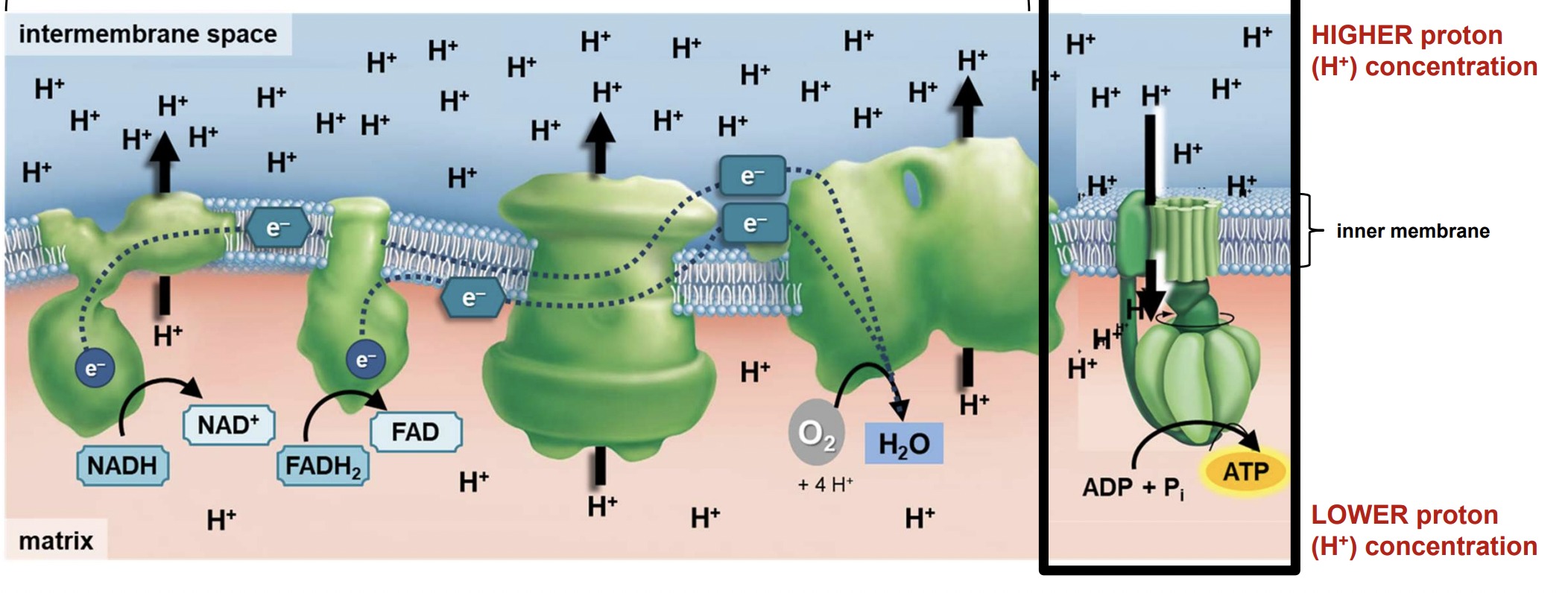
Image occlusion: name the hidden labels
111
Image occlusion: name the hidden labels
112
Image occlusion: name the hidden labels
113
Image occlusion: name the hidden labels
114
(Light energy)
CO2 + H2O ----> O2 + Carbohydrate (3 carbons)
CO2 + H2O ----> O2 + Carbohydrate (3 carbons)
Photosynthesis
115
why we need light energy
photosynthesis energy requiring process
116
site of photosynthesis in plants
chloroplasts
117
allow CO2 in and O2 (and water ) out - can open and close
stromata
118
light reactions location
thylakoid membrane - selectively permeable
119
calvin cycle location
stroma - fluid filling inner space of chloroplasts and surround grana and thylakoids
120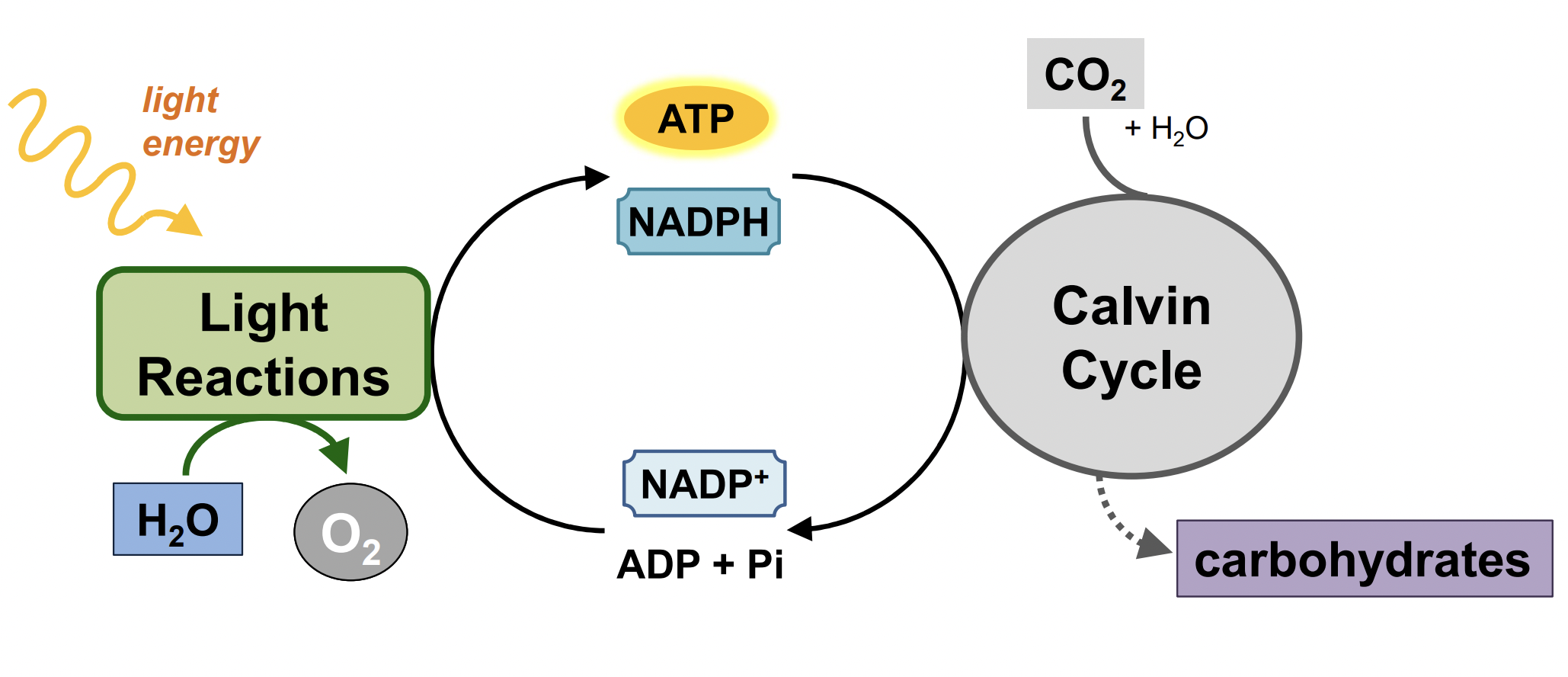
Image occlusion: name the hidden labels
121
Image occlusion: name the hidden labels
122
Image occlusion: name the hidden labels
123
Image occlusion: name the hidden labels
124
Image occlusion: name the hidden labels
125
Image occlusion: name the hidden labels
126
light energy capturing molecules in chloroplasts, having multiple increases range of wavelengths absorbed and used as needed energy for photosynthesis
Photosynthetic Pigments
127
absorb light energy - transfer to reaction center
antenna pigments
128
chlorophylls use energy to transfer electrons to electron carriers
reaction center
129
1. light energy absorbed by antenna pigments gets transferred to reaction center
2. Energy used by reaction center to transfer electrons to mobile electron carrier
3. reaction center pulls electrons from water to replace missing electrons, PRODUCES OXYGEN
2. Energy used by reaction center to transfer electrons to mobile electron carrier
3. reaction center pulls electrons from water to replace missing electrons, PRODUCES OXYGEN
Photosystem II
130
electrons passed through many electron carriers , reactions release energy - used to generate proton gradient
Electron Chain Complex
131
energy stored in proton gradient used by ATP synthase to form ATP from ADP and Pi
ATP synthase
132
1. Light energy absorbed by antenna pigments transferred to reaction center
2. Energy used by reaction center to transfer electrons to mobile electron carriers - ultimately passed to NADP+ (forms NADPH)
3. Reaction center (missing electrons) accepts electrons from electron carriers (come from WATER)
2. Energy used by reaction center to transfer electrons to mobile electron carriers - ultimately passed to NADP+ (forms NADPH)
3. Reaction center (missing electrons) accepts electrons from electron carriers (come from WATER)
Photosystem I
133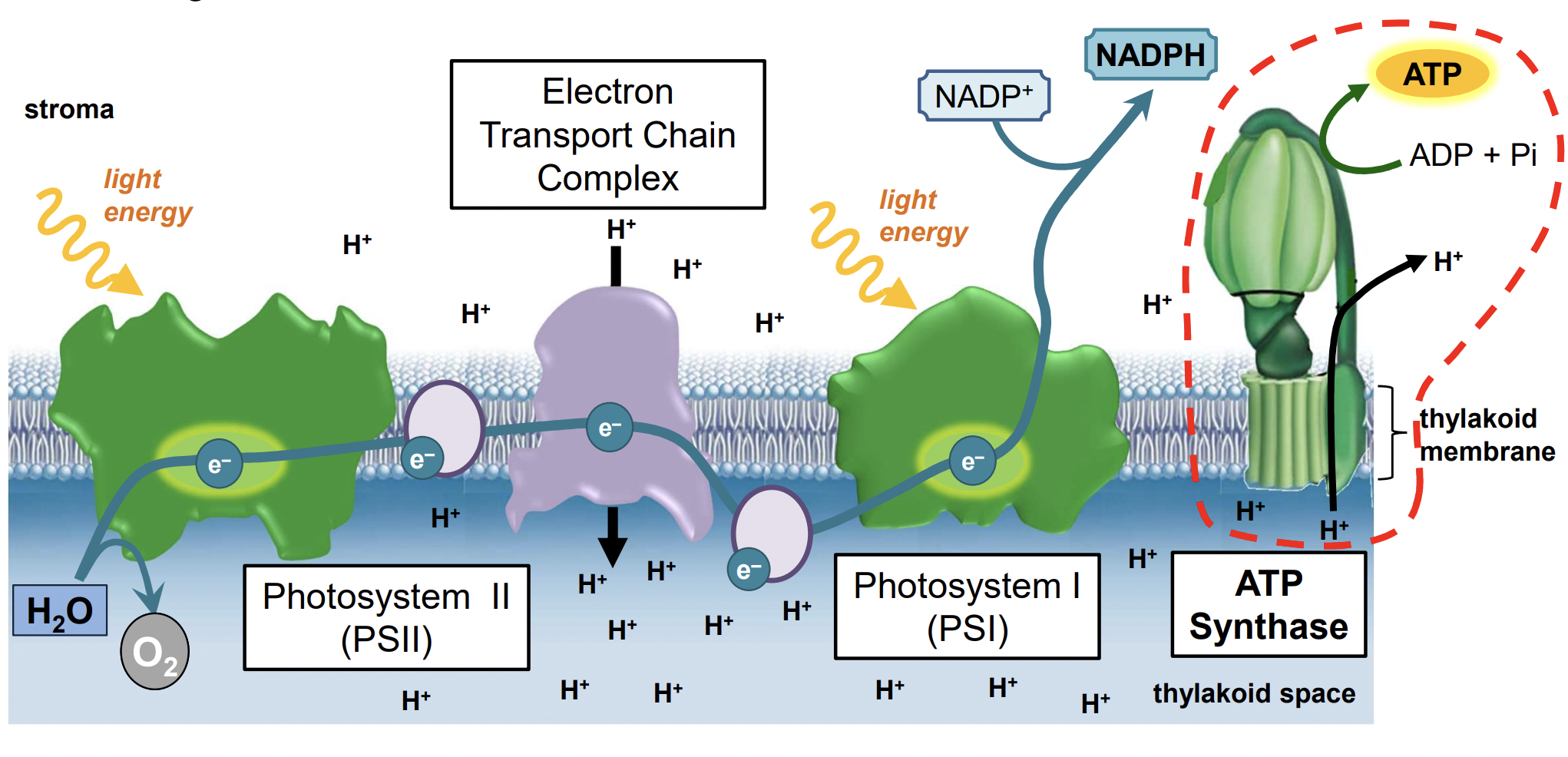
Image occlusion: name the hidden labels
134
Image occlusion: name the hidden labels
135
Image occlusion: name the hidden labels
136
Image occlusion: name the hidden labels
137
energy (ATP) and electrons (NADPH) used to form carbohydrates from carbon dioxide (and water)
3 CO2 per round, 2 rounds to make glucose
3 CO2 per round, 2 rounds to make glucose
Calvin Cycle
138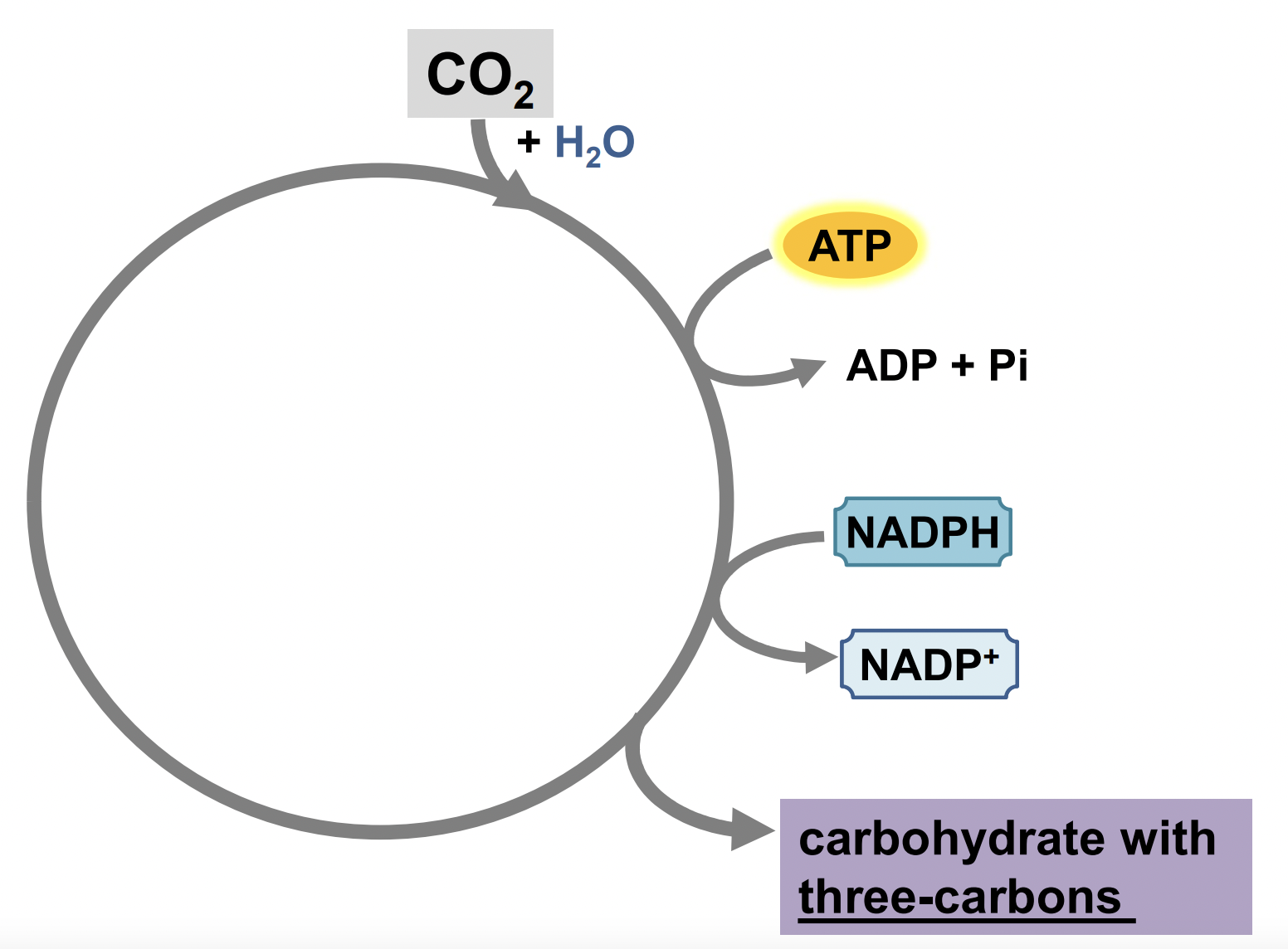
Image occlusion: name the hidden labels
139
Image occlusion: name the hidden labels
140
Image occlusion: name the hidden labels
141
Image occlusion: name the hidden labels