Chap 7: DNA to protein
Study these flashcardsFree · spaced repetition · iPhone, Android, Mac & web
All cards
1
Energetic cost of translation
-- aminoacyl-tRNA activation --> 1 ATP
-- initiation --> 1 GTP
-- elongation step 1 --> 1 GTP for each aa added
-- elongation step 3 --> 1 GTP for each aa added
-- termination --> 1 GTP
-- initiation --> 1 GTP
-- elongation step 1 --> 1 GTP for each aa added
-- elongation step 3 --> 1 GTP for each aa added
-- termination --> 1 GTP
2
Relationship between genes and proteins
- genes are regions of DNA that are transcribed into RNA
- mRNA allows the cell to separate information storage from information utilization
- transcription - copying in same “language”
- translation - goes from nucleic acid language to protein language
- mRNA allows the cell to separate information storage from information utilization
- transcription - copying in same “language”
- translation - goes from nucleic acid language to protein language
3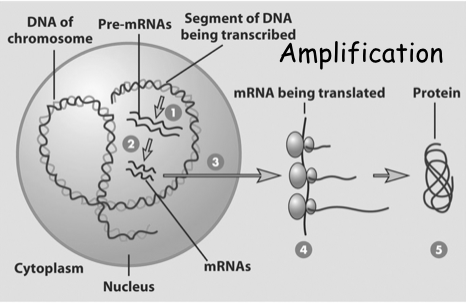
amplification (genes and proteins)
4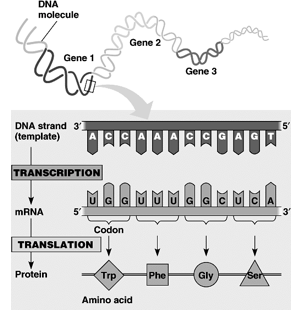
gene and protein transcritpion and translation image
5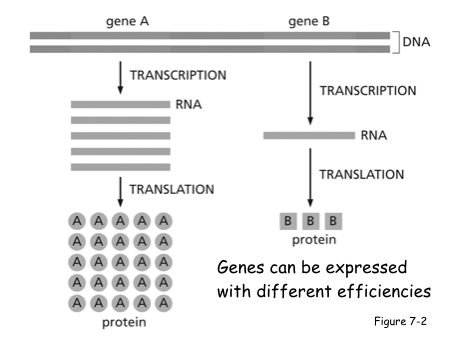
gene expression and effieciency
6
RNA shape
- many RNAs contain complex 3D shape
- Shape imp. for function
- folding driven by complementary base pairs
- single strand with double-stranded regions
- Shape imp. for function
- folding driven by complementary base pairs
- single strand with double-stranded regions
7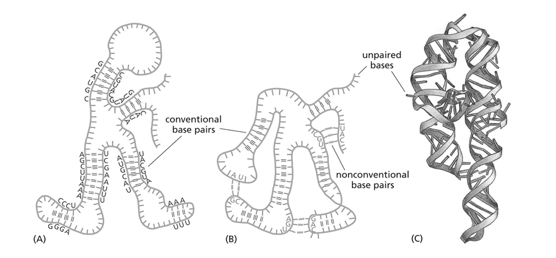
RNAs 3D shape
8
transcription and translation overview
--the flow of information in a cell
- mRNA separates
info storage from info utilization
- signal amplification of mRNAs
- rRNA and tRNAs
are nonspecific for polypeptide being made
- mRNA separates
info storage from info utilization
- signal amplification of mRNAs
- rRNA and tRNAs
are nonspecific for polypeptide being made
9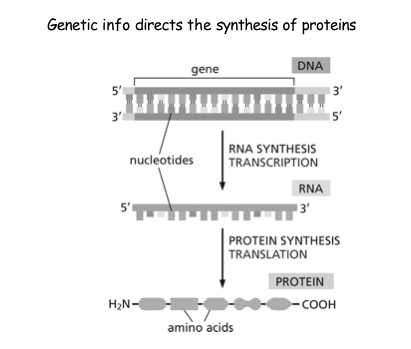
synthesis of proteins
10
Transcription
DNA to RNA
- DNA template strand provides information for the synthesis of an RNA strand
- mRNA, tRNA, rRNA
- One DNA strand copied, thus a single strand of RNA
- DNA template strand provides information for the synthesis of an RNA strand
- mRNA, tRNA, rRNA
- One DNA strand copied, thus a single strand of RNA
11
template strand during trasncription
Notice that the base identity on the non-template strand (coding strand) is equivalent to the RNA sequence
12
DNA to RNA strands
Both DNA strands are not used to make RNA
- there is the template (noncoding) and conding strand
- only the template strand is used to make mRNA
- there is the template (noncoding) and conding strand
- only the template strand is used to make mRNA
13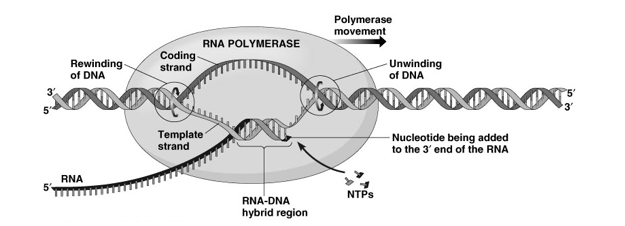
DNA to RNA template and coding strand within the cell
14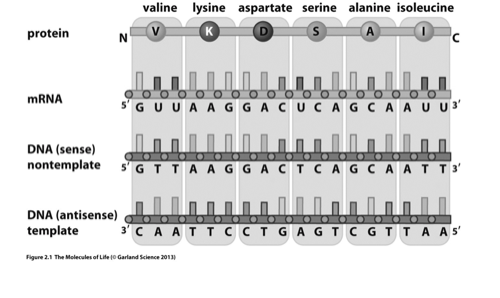
DNA to protein strand
15
Promoters
RNA polymerase does not start at random sites on the DNA
- By convention all orientation is relative to the non-template strand
- Both strands considered part of gene
- Upstream (5' end) Downstream (3' end)
- By convention all orientation is relative to the non-template strand
- Both strands considered part of gene
- Upstream (5' end) Downstream (3' end)
16
stands encoding genes
- Both strands can encode genes (but not in same spot on DNA)
- very unusual (eukaryotes) if both strands in one area encode for a gene ex. yeast genome
- very unusual (eukaryotes) if both strands in one area encode for a gene ex. yeast genome
17
Promoter sequence orientation
- Promoter sequence orientation determines which strand is the template.
- Polymerase always moves 3’ to 5’ along template strand
- Polymerase always moves 3’ to 5’ along template strand
18
Overview of RNAP synthesis of RNA
- DNA-dependent RNA polymerase is the copying enzyme
- one of the DNA strands is the template
- promoter -- DNA binding site
- transcription factors -- proteins that help RNAP recognize promoter
- moves 3’-->5’ on template
- RNAn + NPPP --> RNAn+1 + PPi
- one of the DNA strands is the template
- promoter -- DNA binding site
- transcription factors -- proteins that help RNAP recognize promoter
- moves 3’-->5’ on template
- RNAn + NPPP --> RNAn+1 + PPi
19
Some differences between DNA replication and transcription
- A --> T in replication, but A --> U in transcription
- Unlike replication, new RNA strand does not remain H-bonded, but is displaced and the DNA helix reforms
- Also because RNA is copied from only a limited region of the DNA, RNA molecules are much shorter
- Transcription does not require a primer
- Unlike replication, new RNA strand does not remain H-bonded, but is displaced and the DNA helix reforms
- Also because RNA is copied from only a limited region of the DNA, RNA molecules are much shorter
- Transcription does not require a primer
20
RNAP DNA strands
- Several RNAP molecules on single DNA strands
- Nearly immediate release of RNA from template allows many RNA copies to be made from a gene in a short time
- Nearly immediate release of RNA from template allows many RNA copies to be made from a gene in a short time
21
Transcription in eukaryotic cells
1. Ribosomal RNAs (rRNA)
2. Transfer RNAs (tRNA)
3. Messenger RNAs (mRNA)
2. Transfer RNAs (tRNA)
3. Messenger RNAs (mRNA)
22
Transcription in ECELLS
3 distinct RNAP (prokaryotes have 1)
RNAP-I -- larger (28S, 18S, 5.8S) ribosomal subunits (this polymerase transcribes only one gene = the ribosomal RNA gene )
RNAP-II -- mRNAs and small nuclear RNAs
RNAP-III -- tRNAs and small (5S) ribosomal subunit
mRNA,tRNA,rRNA -- all made as larger pre-RNAs that are processed by “cut and paste” reactions;
snRNAs (small nuclear; 100-300 nt) -- with proteins help process mRNAs
snoRNAs (small nucleolar) -- process rRNAs
miRNAs (micro) -- regulate gene expression
- Transcription unit (sequence of nt that codes for a single RNA)
- all preRNAs are made as larger forms that are processed into smaller pieces
RNAP-I -- larger (28S, 18S, 5.8S) ribosomal subunits (this polymerase transcribes only one gene = the ribosomal RNA gene )
RNAP-II -- mRNAs and small nuclear RNAs
RNAP-III -- tRNAs and small (5S) ribosomal subunit
mRNA,tRNA,rRNA -- all made as larger pre-RNAs that are processed by “cut and paste” reactions;
snRNAs (small nuclear; 100-300 nt) -- with proteins help process mRNAs
snoRNAs (small nucleolar) -- process rRNAs
miRNAs (micro) -- regulate gene expression
- Transcription unit (sequence of nt that codes for a single RNA)
- all preRNAs are made as larger forms that are processed into smaller pieces
23
Ribosomal RNA
cells have millions of ribosomes
80% of RNA in cells is rRNA
rDNA are repeated 100’s of times
ribosomes consist of several rRNAs and dozens of proteins
half-life in days or weeks; gradually accumulate
~82 different proteins + 4 different rRNA molecules
- The genes for 18S, 5.8S, and 28S rRNA form a single transcription unit that is transcribed by RNA polymerase I to give a single large RNA (45S pre-rRNA)
80% of RNA in cells is rRNA
rDNA are repeated 100’s of times
ribosomes consist of several rRNAs and dozens of proteins
half-life in days or weeks; gradually accumulate
~82 different proteins + 4 different rRNA molecules
- The genes for 18S, 5.8S, and 28S rRNA form a single transcription unit that is transcribed by RNA polymerase I to give a single large RNA (45S pre-rRNA)
24
sturcture ribosomal RNA
Structure imp. for:
recognizing other molecules
structural support
catalyze aa covalent
recognizing other molecules
structural support
catalyze aa covalent
25
Processing of mammalian rRNA
- snoRNAs (small, nucleolar RNAs) help process pre-rRNA
- attach to rRNA while being transcribed
- attach to rRNA while being transcribed
26
rRNA in a large subunit of a prokaryotic ribosome
-- a ribosome is ~ 2/3 rRNA and 1/3 protein
27
Nucleolus
- a ribosome- producing factory
- in interphase cells rDNA are clustered together in nucleolus
- most of nucleolus is ribosomal subunits
- in HeLa cells ~7,000 ribosomes are produced in the nucleolus/min
- GFP-ribosomal protein
- in interphase cells rDNA are clustered together in nucleolus
- most of nucleolus is ribosomal subunits
- in HeLa cells ~7,000 ribosomes are produced in the nucleolus/min
- GFP-ribosomal protein
28
Transfer RNA (tRNA)
plants and animals have ~50 different tRNAs
tDNA is repeated (~ 500 genes in humans)
repeats are clustered in genome
~ 80 nt long
transcribed using RNAP-III
half-life in days or weeks; gradually accumulate
tDNA is repeated (~ 500 genes in humans)
repeats are clustered in genome
~ 80 nt long
transcribed using RNAP-III
half-life in days or weeks; gradually accumulate
29
Messenger RNA (mRNA)
- contains a continuous sequence of nt encoding a particular polypeptide
- significant noncoding segment (5’ and 3’ ends; regulatory functions)
- half-life varies; minutes to days
- Unlike ribosome RNA half life varies (bacteria half lives determined when they are needed)
- significant noncoding segment (5’ and 3’ ends; regulatory functions)
- half-life varies; minutes to days
- Unlike ribosome RNA half life varies (bacteria half lives determined when they are needed)
30
Machinery used in mRNA transcription
-RNAP-II
- GTF -- General transcription factors
- promoter -- special sequence of DNA 24-32 nt “upstream” (5’) to transcription coding region
- GTF -- General transcription factors
- promoter -- special sequence of DNA 24-32 nt “upstream” (5’) to transcription coding region
31
TATA box
consensus sequence used by many genes
- key component of many promoters used by RNA polymerase II to from complete transcription initiation complex — order of assembly differ from one promoter to the next (usually); usually 30 nucleotides upstream from the start site. Once TFIID is bond to TATA box — other factors assemble — to from the initiation complex. Both bacteria and eukaryotic promoters are composed of several DNA sequences — to orient RNA polymerase for DNA template strand
- key component of many promoters used by RNA polymerase II to from complete transcription initiation complex — order of assembly differ from one promoter to the next (usually); usually 30 nucleotides upstream from the start site. Once TFIID is bond to TATA box — other factors assemble — to from the initiation complex. Both bacteria and eukaryotic promoters are composed of several DNA sequences — to orient RNA polymerase for DNA template strand
32
How does mRNA know where to start and copy?
- Through the promoters that help mRNA polymerase to know where to start copying.
- Rich TATATA (25 nucleotides areas of richness) tells mRNA polyermerase where to start copying — proteins will bind to it to tell the protein where to start binding
- Proteins recognize certain sequences
- Rich TATATA (25 nucleotides areas of richness) tells mRNA polyermerase where to start copying — proteins will bind to it to tell the protein where to start binding
- Proteins recognize certain sequences
33
Assembly of preinitiation complex (GTF + polymerase)
there are many GTFs in this complex; two imp. are:
-- TFIID (contains TBP)
-- TFIIH (contains a helicase and kinase)
Tail aka C-terminal domain (CTD)
-- TFIID (contains TBP)
-- TFIIH (contains a helicase and kinase)
Tail aka C-terminal domain (CTD)
34
Assembly of preinitiation complex (GTF + polymerase) - the process
A. most eukaryotic promoters contain a DNA sequence called the TATA box
B. The TATA box is recognized by a subunit of the general transcription TFIID called the TATA-binding protein (TBP); ** The DNA disruption produced b TBP is not shown
C. TFIID binding enables adjacent binding of TFIIB
D. The rest of the general transcription factors (as well as the RNA polymerase itself) — assemble at the promoter
B. The TATA box is recognized by a subunit of the general transcription TFIID called the TATA-binding protein (TBP); ** The DNA disruption produced b TBP is not shown
C. TFIID binding enables adjacent binding of TFIIB
D. The rest of the general transcription factors (as well as the RNA polymerase itself) — assemble at the promoter
35
Initiation of transcription
- the C-terminal domain (CTD) of a RNAP-II subunit is phosphorylated by TFIIH
- phosphorylation releases polymerase from promoter site
- TFIID remains bound to TATA to initiate additional transcription
- Phosphorylation of the tail of RNA polymerase II allows RNA processing proteins to assemble there. Capping, polyadenylation, and splicing are all modification that occur as the RNA is being synthesized. The phosphates in this image is in addition to the ones required for transcription initiation.
- phosphorylation releases polymerase from promoter site
- TFIID remains bound to TATA to initiate additional transcription
- Phosphorylation of the tail of RNA polymerase II allows RNA processing proteins to assemble there. Capping, polyadenylation, and splicing are all modification that occur as the RNA is being synthesized. The phosphates in this image is in addition to the ones required for transcription initiation.
36
RNA capping:
modifies the 5’ end of the RNA transcript — the RNA cap includes an atypical nucleotide — the mRNA is simply the first nucleotide of the transcript. In eukaryotic cells, capping takes place after RNA polymerase II produced around 25 nucleotides of RNA before transcribing the whole gene
- increase the stability of mRNA molecule — and generally mark the RNA molecule as mRNA — they are also used by protein synthesis to make sure both ends of mRNA are present
- increase the stability of mRNA molecule — and generally mark the RNA molecule as mRNA — they are also used by protein synthesis to make sure both ends of mRNA are present
37
Overview of processing of pre-mRNA
hnRNA (heterogeneous nuclear RNA) is a pre-mRNA that is processed to mRNA
1. -- 5’ cap
2. -- 3’ polyadenylation (may occur during or after splicing)
3.--removal of introns
- big piece (hnRNA) trimmed to smaller pieces
- only 5% make it to the end (a lot is lost)
- all of this is done in the nucleus before going into the cytoplasm
1. -- 5’ cap
2. -- 3’ polyadenylation (may occur during or after splicing)
3.--removal of introns
- big piece (hnRNA) trimmed to smaller pieces
- only 5% make it to the end (a lot is lost)
- all of this is done in the nucleus before going into the cytoplasm
38
5’ methylguanosine cap
- removal of a phosphate and addition of a methylated guanosine
- protects 5’ from exonucleases
- aids in transport from nucleus
- helps initiate translation
- 5’ cap is needed for starting translation once in the cytoplasm, recognized by proteins to help get into the cytoplasm
- protects 5’ from exonucleases
- aids in transport from nucleus
- helps initiate translation
- 5’ cap is needed for starting translation once in the cytoplasm, recognized by proteins to help get into the cytoplasm
39
3’ poly(A) tail
- endonuclease forms new 3’ end by recognizing AAUAAA sequence
- a polymerase adds 200-250 adenosines without template
- protects from premature degradation ** Going through 300 amines before getting to the source (eats things that do not matter)
- helps initiate translation
- a polymerase adds 200-250 adenosines without template
- protects from premature degradation ** Going through 300 amines before getting to the source (eats things that do not matter)
- helps initiate translation