Chapter 9: genes and genomes
Study these flashcardsFree · spaced repetition · iPhone, Android, Mac & web
All cards
1
genome
•the content of genetic material unique for
each species
•species members have same set of genes;
individuals have slightly different versions
(alleles)
each species
•species members have same set of genes;
individuals have slightly different versions
(alleles)
2
alleles: example
- homologous pair of chromososmes with an allele for purple and allele for white
3
How do we study the
organization of the genome?
organization of the genome?
4
hybridize single strands
•To hybridize the two single strands must
have complementary nt sequences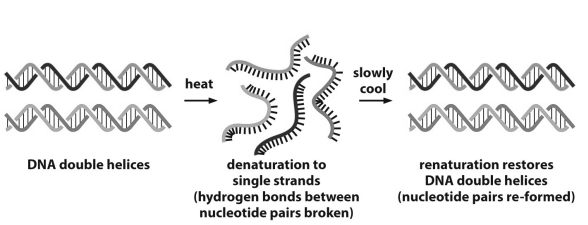
have complementary nt sequences
5
reversible strand
separation
separation
- DNA can undergo reversible strand
separation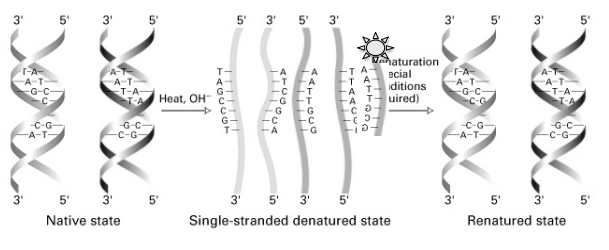
separation
6
FISH
- (fluorescence in situ hybridization)
- Renaturation makes hybridization of two or
more DNA molecules possible
- Renaturation makes hybridization of two or
more DNA molecules possible
7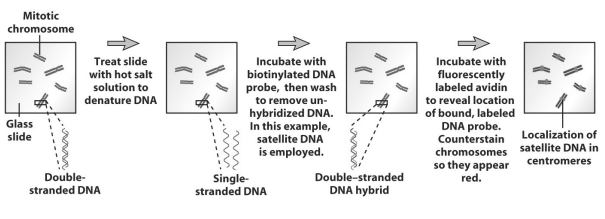
FISH Process
8
FISH of satallite DNA
9
Chromosomal localization of a nonrepeated DNA
sequence:
sequence:
•gene encodes nuclear
lamin protein
•present on the two
homologues of
chromosome 10
•Why are there four
dots?
lamin protein
•present on the two
homologues of
chromosome 10
•Why are there four
dots?
10
DNA sequence variation
any two humans have ~99.9% similar nucleotide
sequence
•only ~1 out of every 1000 nts is different
•these differences are mainly single nt changes
(e.g., an A for a G) due to mutation; Single
nucleotide polymorphisms (SNPs)
•of the total 3 million SNPs, only 60,000 are found
in protein-coding sequences that lead to different
aa; these aa differences may change the function
of the protein; thus we all have different
phenotypes (look different)
sequence
•only ~1 out of every 1000 nts is different
•these differences are mainly single nt changes
(e.g., an A for a G) due to mutation; Single
nucleotide polymorphisms (SNPs)
•of the total 3 million SNPs, only 60,000 are found
in protein-coding sequences that lead to different
aa; these aa differences may change the function
of the protein; thus we all have different
phenotypes (look different)
11
Genes and Genomes can be altered by several mechanisms:
•May help or hurt organism;
most often neutral (e.g.,
within intron or same aa)
•Synonymous mutation (aka
silent)-- both forms lead to
same polypeptide
•Nonsynonymous mutation- a
different polypeptide is
produced
- small mutations, duplications, rearrangement, and even the infusion of fresh genetic material all contribute to genome evolution
- no gene or genome is entirly new -- genetic varations pile up and produce radical change
most often neutral (e.g.,
within intron or same aa)
•Synonymous mutation (aka
silent)-- both forms lead to
same polypeptide
•Nonsynonymous mutation- a
different polypeptide is
produced
- small mutations, duplications, rearrangement, and even the infusion of fresh genetic material all contribute to genome evolution
- no gene or genome is entirly new -- genetic varations pile up and produce radical change
12
Genes and Genomes can be altered by several mechanisms: (the process)
- mutation with a gene
- mutation in regulatory DNA
- gene duplication and divergence
- exon shuffling
- transposition
- horizontal transfer
•Can occur during
repair of doublestrand DNA breaks
or meiosis
- crucial in evoltuion
- mutation in regulatory DNA
- gene duplication and divergence
- exon shuffling
- transposition
- horizontal transfer
•Can occur during
repair of doublestrand DNA breaks
or meiosis
- crucial in evoltuion
13
Mutation within a gene:
- An existing gene can be modified by a mutation that changes a single nucleotide or deletes or duplicates one or more nucleotides.
- These mutations can alter the splicing of a gene’s RNA transcript or change the stability, activity, location, or interactions of its encoded protein or RNA product.
- These mutations can alter the splicing of a gene’s RNA transcript or change the stability, activity, location, or interactions of its encoded protein or RNA product.
14
Mutation within regulatory DNA sequences:
- When and where a gene is expressed can be affected by a mutation in the stretches of DNA sequence that regulate the gene’s activity (described in Chapter 8).
- For example, humans and fish have a surprisingly large number of genes in common, but changes in the regulation of those shared genes underlie many of the most dramatic differences between those species.
- For example, humans and fish have a surprisingly large number of genes in common, but changes in the regulation of those shared genes underlie many of the most dramatic differences between those species.
15
Gene duplication and divergence:
- An existing gene, or even a whole genome, can be duplicated.
- As the cell containing this duplication, and its progeny, continue to divide, the original DNA sequence and the duplicate sequence can acquire different mutations and thereby assume new functions and patterns of expression.
- As the cell containing this duplication, and its progeny, continue to divide, the original DNA sequence and the duplicate sequence can acquire different mutations and thereby assume new functions and patterns of expression.
16
Exon shuffling:
- Two or more existing genes can be broken and rejoined to make a hybrid gene containing DNA segments that originally belonged to separate genes.
- In eukaryotes, such break- ing and rejoining often occurs within the long intron sequences, which do not encode protein. Because these intron sequences are removed by RNA splicing, the breaking and joining do not have to be precise to produce a functional gene.
- In eukaryotes, such break- ing and rejoining often occurs within the long intron sequences, which do not encode protein. Because these intron sequences are removed by RNA splicing, the breaking and joining do not have to be precise to produce a functional gene.
17
Transposition of mobile genetic elements:
Specialized DNA sequences that can move from one chromosomal location to another can alter the activity or regulation of a gene; they can also promote gene duplication, exon shuffling, and other genome rearrangements.
18
Horizontal gene transfer:
- A piece of DNA can be passed from the genome of one cell to that of another—even to that of another spe- cies.
- This process, which is rare among eukaryotes but common among bacteria, differs from the usual “vertical” transfer of genetic information from parent to progeny.
- This process, which is rare among eukaryotes but common among bacteria, differs from the usual “vertical” transfer of genetic information from parent to progeny.
19
Mutations in germ-line and somatic cells
- fudementally ARE DIFFERENT f(x)s
- In sexually reproducing organisms, genetic information is propagated into the next generation exclusively by germ-line cells (red).
- This cell lineage includes the specialized reproductive cells—the gametes (eggs and sperm, half circles)—which contain only half the number of chromosomes than do the other cells in the body (full circles). When two gametes come together during fertilization, they form a fertilized egg or zygote (purple), which once again contains a full set of chromosomes (discussed in Chapter 19).
- The zygote gives rise to both germ-line cells and to somatic cells (blue). Somatic cells form the body of the organism but do not contribute their DNA to the next generation.
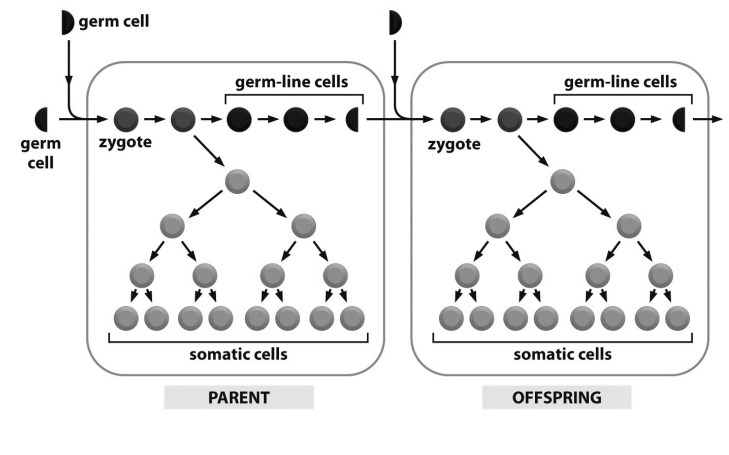
- In sexually reproducing organisms, genetic information is propagated into the next generation exclusively by germ-line cells (red).
- This cell lineage includes the specialized reproductive cells—the gametes (eggs and sperm, half circles)—which contain only half the number of chromosomes than do the other cells in the body (full circles). When two gametes come together during fertilization, they form a fertilized egg or zygote (purple), which once again contains a full set of chromosomes (discussed in Chapter 19).
- The zygote gives rise to both germ-line cells and to somatic cells (blue). Somatic cells form the body of the organism but do not contribute their DNA to the next generation.
20
germ lines
- in sexually reproducing organisms, only chnages to the germ line are passsed on to progeny
- asexual repoduction = straightfwd
- multicellular (sexually) = more complex
gemetes: carry a copy of its genome to the next generation of organisms
somatic cells: are doomed to die without leaving evolutionary decendants of their own -- they are only to support the germ-line cell lineage that give rise to the gametes
- A mutation that occurs in a somatic cell—although it might have unfortu-
nate consequences for the individual in which it occurs (causing cancer,
for example)—will not be transmitted to the organism’s offspring.
- For a mutation to be passed on to the next generation, it must alter the germ line
- asexual repoduction = straightfwd
- multicellular (sexually) = more complex
gemetes: carry a copy of its genome to the next generation of organisms
somatic cells: are doomed to die without leaving evolutionary decendants of their own -- they are only to support the germ-line cell lineage that give rise to the gametes
- A mutation that occurs in a somatic cell—although it might have unfortu-
nate consequences for the individual in which it occurs (causing cancer,
for example)—will not be transmitted to the organism’s offspring.
- For a mutation to be passed on to the next generation, it must alter the germ line
21
Point Mutations in germ-line
- care caused by failures of the normal mechanisms for copying and repairing DNA
- Mutations in germ-line cells and somatic cells have different consequences
- A mutation that occurs in a germ-line cell (A) can be passed on to
the next generation (green).
- By contrast, a mutation that arises in a somatic cell (B) affects only the progeny of that cell (orange) and will not be passed on to the organism’s offspring. As we discuss in Chapter 20, somatic mutations are responsible for most human cancers
- Mutations in germ-line cells and somatic cells have different consequences
- A mutation that occurs in a germ-line cell (A) can be passed on to
the next generation (green).
- By contrast, a mutation that arises in a somatic cell (B) affects only the progeny of that cell (orange) and will not be passed on to the organism’s offspring. As we discuss in Chapter 20, somatic mutations are responsible for most human cancers
22
point mutations
changes that affect a single nucleotide pair
- typically arise from rare errors in DNA replication or repiar
- Point mutations can destroy a gene’s activity or—very rarely—improve it (as shown in Figure 9−5). More often, however, they do neither of these things.
- At many sites in the genome, a point mutation has absolutely no effect on the organism’s appearance, viability, or ability to reproduce.
- typically arise from rare errors in DNA replication or repiar
- Point mutations can destroy a gene’s activity or—very rarely—improve it (as shown in Figure 9−5). More often, however, they do neither of these things.
- At many sites in the genome, a point mutation has absolutely no effect on the organism’s appearance, viability, or ability to reproduce.
23
Mutation rates can be measured in the laboratory. How?
~ 3 mistakes per 1010 nucleotides copied
•Based on size of genome and number of bacteria in overnight
growth, statistically every single nonlethal base pair
substitution is present in culture
•(humans 1 mistake per 1010 nucleotides)
- through E coli
•Based on size of genome and number of bacteria in overnight
growth, statistically every single nonlethal base pair
substitution is present in culture
•(humans 1 mistake per 1010 nucleotides)
- through E coli
24
Mutations measured in the lab: the process
- In this experiment, an E coli strain that acrries a deterious point mutation in the His gene -- which is needed to manufacture amino acid histidine - is used.
- The mutation has converted a G-C nucleotide pair of A-T, resulting in a premature stop signal in the mRNA produced from the mutant gene (left box)
- As long as histidine is supplied in the growth medium, this strain can grow and divide normally
- If a large number of mutatnt cells (say 10^10) is spread on ana agar plate that lack histidine, the great majority will die
- the rare survivors will contain a new mutation in which the A-T is chnaged back to a G-C
- This "reversion" corrects the original defect and allows the bacterium to make the enzyme it needs to survive in the absence of histidine
- such mutations happen by chnage and only rarely, but the ability to work with very large numbers of E coli calles make it possible to detenct this chnage and to accurately measure its freqeuncy
- The mutation has converted a G-C nucleotide pair of A-T, resulting in a premature stop signal in the mRNA produced from the mutant gene (left box)
- As long as histidine is supplied in the growth medium, this strain can grow and divide normally
- If a large number of mutatnt cells (say 10^10) is spread on ana agar plate that lack histidine, the great majority will die
- the rare survivors will contain a new mutation in which the A-T is chnaged back to a G-C
- This "reversion" corrects the original defect and allows the bacterium to make the enzyme it needs to survive in the absence of histidine
- such mutations happen by chnage and only rarely, but the ability to work with very large numbers of E coli calles make it possible to detenct this chnage and to accurately measure its freqeuncy
25
Humans (germ cells)
--fertilized egg to
female gamete (20-30
genome replications)
--fertilized egg to
sperm (200 genome
replications)
-- ~ 0.1–1 mutations per
replication
-- 10–100 mutations
between individual and
gametes they make
-- 20-200 divisions
female gamete (20-30
genome replications)
--fertilized egg to
sperm (200 genome
replications)
-- ~ 0.1–1 mutations per
replication
-- 10–100 mutations
between individual and
gametes they make
-- 20-200 divisions
26
regulation of genes and mutations
- Mutations can change the regulation of a gene
•Some mutations don’t lead to an aa change, but to the level of expression
of a gene
•10,000 years ago mutation that allowed lactase to be expressed in adults
(not just in infants- 3 years)
•Individuals that can digest milk sugar (lactose) from domesticated cows
may have an advantage during starvation
•Some mutations don’t lead to an aa change, but to the level of expression
of a gene
•10,000 years ago mutation that allowed lactase to be expressed in adults
(not just in infants- 3 years)
•Individuals that can digest milk sugar (lactose) from domesticated cows
may have an advantage during starvation
27
Mutations can change the regulation of a gene: example
- DNA Duplications (new to old genes) give rise to families of related genes
- The widespread ability of adult humans to digest milk followed the domestication of cattle.
- Approximately 10,000 years ago, humans in northern Europe and central Africa began to raise cattle.
- The subsequent availability of cow’s milk—particularly during periods of starvation—gave a selective advantage to those humans able to digest lactose as adults.
- Two independent point mutations that allow the expression of lactase in adults arose in human populations—one in northern Europe and another in central Africa. These mutations have since spread through different regions of the world.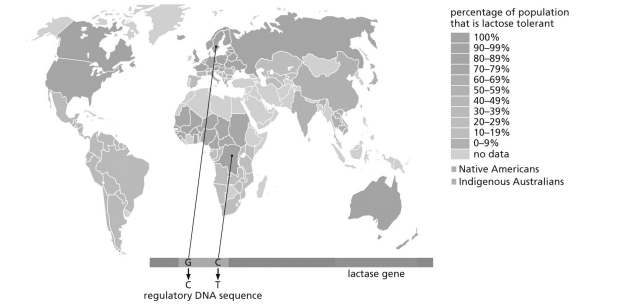
- The widespread ability of adult humans to digest milk followed the domestication of cattle.
- Approximately 10,000 years ago, humans in northern Europe and central Africa began to raise cattle.
- The subsequent availability of cow’s milk—particularly during periods of starvation—gave a selective advantage to those humans able to digest lactose as adults.
- Two independent point mutations that allow the expression of lactase in adults arose in human populations—one in northern Europe and another in central Africa. These mutations have since spread through different regions of the world.
28
gene duplication and divergence
- By repeated rounds of this process of gene duplication and divergence over many millions of years, one gene can give rise to a whole family of genes, each with a specialized function, within a single genome.
- Analysis of genome sequences reveals many examples of such gene families.
- Analysis of genome sequences reveals many examples of such gene families.
29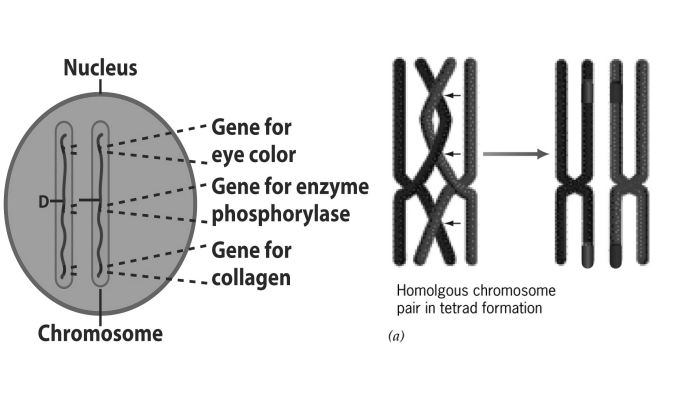
Genetic recombination (crossing-over)
30
Gene duplication/deletion by unequal crossing over
during meiosis
during meiosis
- Gene duplication can be caused by crossovers between short, repeated DNA sequences in adjacent homologous chromosomes.
- The two chromosomes shown here undergo homologous recombination at short repeated sequences (red ), that bracket a gene (orange).
- For simplicity, only one gene is shown on each homolog. The repeated sequences can be remnants of mobile genetic elements, which are present in many copies in the human genome, as we discuss shortly.
- When crossing-over occurs unequally, as shown, one chromosome will get two copies of the gene, while the other will get none. The type of homologous recombination that produces gene duplications is called unequal crossing-over because the resulting products are unequal in size.
- If this process occurs in the germ line, some progeny will inherit the long chromosome, while others will inherit the short one.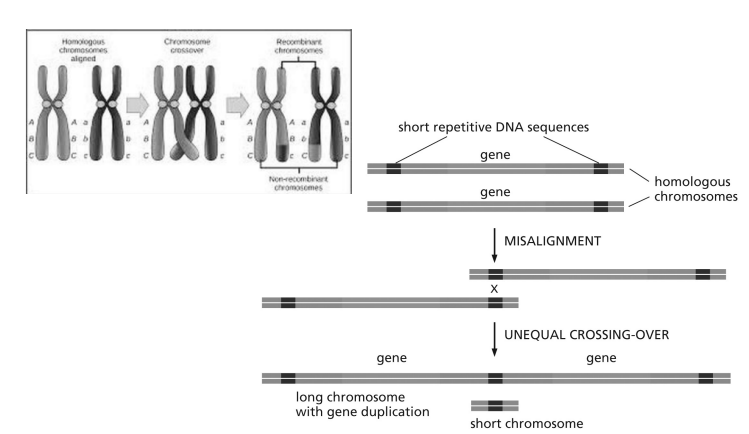
- The two chromosomes shown here undergo homologous recombination at short repeated sequences (red ), that bracket a gene (orange).
- For simplicity, only one gene is shown on each homolog. The repeated sequences can be remnants of mobile genetic elements, which are present in many copies in the human genome, as we discuss shortly.
- When crossing-over occurs unequally, as shown, one chromosome will get two copies of the gene, while the other will get none. The type of homologous recombination that produces gene duplications is called unequal crossing-over because the resulting products are unequal in size.
- If this process occurs in the germ line, some progeny will inherit the long chromosome, while others will inherit the short one.
31
Evolution of globin genes
- An ancestral globin gene encoding a single-chain globin molecule gave rise to the pair of genes that produce four-chain hemoglobin proteins of modern humans and other mammals.
- The mammalian hemoglobin molecule is a complex of two α-globin (green) and two β-globin (blue) chains. Each chain contains a tightly bound heme group (red) that is responsible for binding oxygen.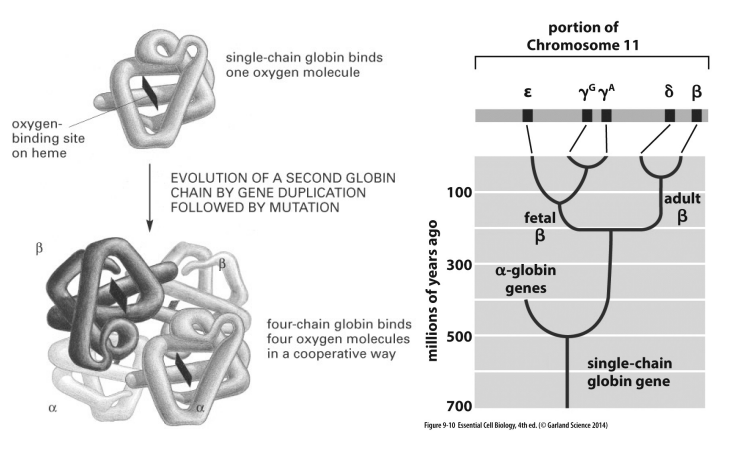
- The mammalian hemoglobin molecule is a complex of two α-globin (green) and two β-globin (blue) chains. Each chain contains a tightly bound heme group (red) that is responsible for binding oxygen.
32
globin genes tree - evolution
- Repeated rounds of duplication and mutation generated the globin gene family in humans. About 500 million years ago, an ancestral globin gene duplicated and gave rise to both the β-globin gene family (including the five genes shown) and the α-globin gene family. In most vertebrates, a molecule of hemoglobin (see Figure 9−9) is formed from two chains of α globin and two chains of β globin—which can be any one of the five subtypes of the β family listed here.
The evolutionary scheme shown was worked out by comparing globin genes from many different organisms.
- The nucleotide sequences of the γG and γA genes—which produce the β-globin-like chains that form fetal hemoglobin—are much more similar to each other than either of them is to the adult β gene. The δ-globin gene encodes a minor form of adult β-globin. In humans, the β-globin genes are located in a cluster on Chromosome 11.
- A subsequent chromosome breakage event, which occurred
about 300 million years ago, is believed to have separated the
α- and β-globin genes; the α-globin genes now reside on human Chromosome 16 (not shown).
The evolutionary scheme shown was worked out by comparing globin genes from many different organisms.
- The nucleotide sequences of the γG and γA genes—which produce the β-globin-like chains that form fetal hemoglobin—are much more similar to each other than either of them is to the adult β gene. The δ-globin gene encodes a minor form of adult β-globin. In humans, the β-globin genes are located in a cluster on Chromosome 11.
- A subsequent chromosome breakage event, which occurred
about 300 million years ago, is believed to have separated the
α- and β-globin genes; the α-globin genes now reside on human Chromosome 16 (not shown).
33
Chromosomal localization of a duplicated gene:
34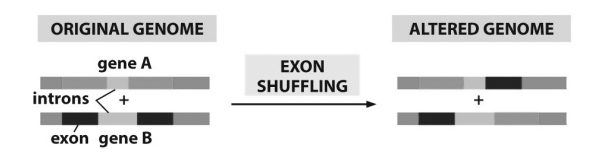
Homologous recombination between exons:
35
Correspondence between exons and
protein domains:
protein domains:
•part of a protein sequence that can
function, evolve and exist independently of
the rest of the protein chain
•usually 25-500 AA in length
•multi-domain proteins probably evolved by
the fusion of genes that once encoded
separate proteins
(Homologous recombination between exons)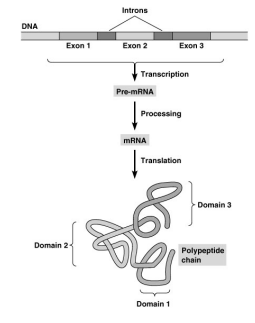
function, evolve and exist independently of
the rest of the protein chain
•usually 25-500 AA in length
•multi-domain proteins probably evolved by
the fusion of genes that once encoded
separate proteins
(Homologous recombination between exons)
36
Exon shuffling
- can generate proteins with new
combinations of domains
•It has been
proposed that of all
of the proteins
encoded in the human
genome (~21,000)
arose from
duplication/shuffling
of a few thousand
distinct domains of
30-50 aa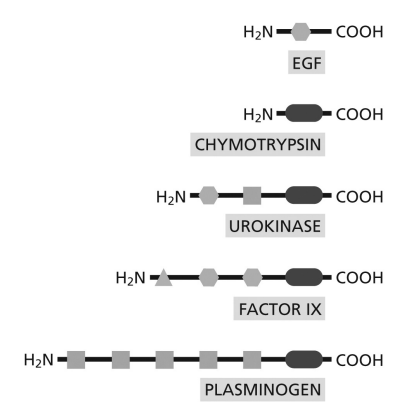
combinations of domains
•It has been
proposed that of all
of the proteins
encoded in the human
genome (~21,000)
arose from
duplication/shuffling
of a few thousand
distinct domains of
30-50 aa
37
exon duplication
- An exon can be duplicated by recombination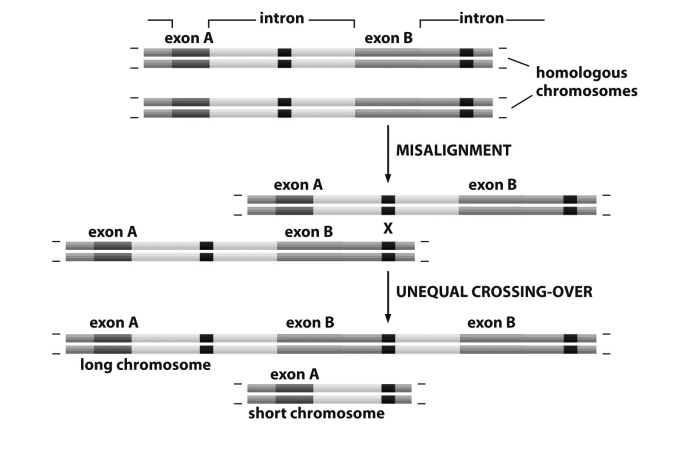
38
The evolution of genomes:
- has been accelerated by
movement of mobile genetic elements (jumping genes)
~ 45% human genome
• 100-1000’s base pairs long
• copied and inserted into a new site in the genome by
the process of transposition
• may be 0.5-1 million copies
• sequences appear to serve no useful function
• > 99% can no longer move (due to mutation)
• Can generate mutations (1 in 500 human diseasescausing mutations)
movement of mobile genetic elements (jumping genes)
~ 45% human genome
• 100-1000’s base pairs long
• copied and inserted into a new site in the genome by
the process of transposition
• may be 0.5-1 million copies
• sequences appear to serve no useful function
• > 99% can no longer move (due to mutation)
• Can generate mutations (1 in 500 human diseasescausing mutations)
39
I. DNA only
enzyme catalyzing transpostion is
transposase (most common genes in
euks are transposases!)
• the transposon DNA encodes the
transposase
• Common in bacteria
transposase (most common genes in
euks are transposases!)
• the transposon DNA encodes the
transposase
• Common in bacteria
40
I. DNA only (the process)
41
Transposons
- Transposons can create new exon arrangements—
exons move to another gene
exons move to another gene
42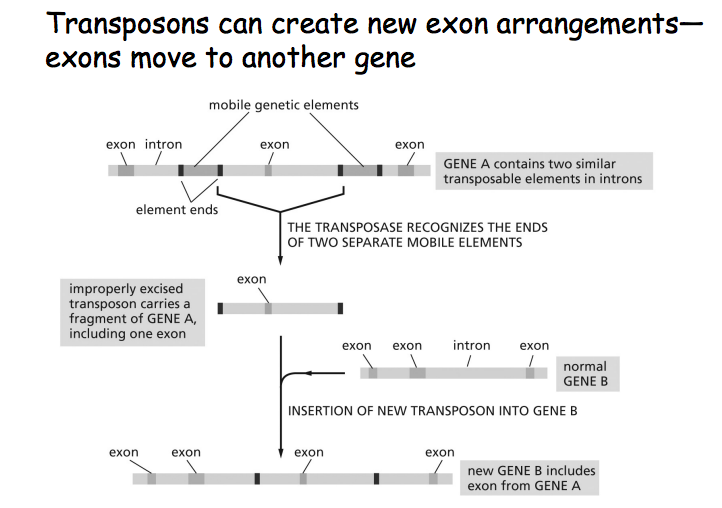
Transposons : process
43
II. RNA-mediated retrotransposon pathway—
unique to eukaryotes
unique to eukaryotes
•L-1 (LINE-1) elements--(15% of genome; ~6000 bp long)
•Alu sequence--(10% of genome; ~300 bp long)
•Alu sequence--(10% of genome; ~300 bp long)
44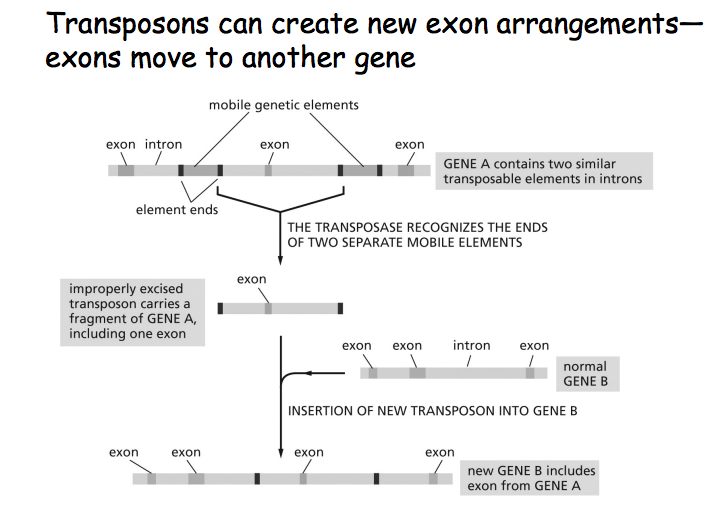
II. RNA-mediated retrotransposon pathway—
unique to eukaryotes (the process)
unique to eukaryotes (the process)
45
"Jumping Gene"
• Appears 500,000 times in human DNA
• LINE 1 RNA needed
for mouse embryo
development
•The RNA acts as a
“molecular glue” to
assemble molecules
needed to leave 2-cell
stage
•Blocking jumping
ability did not affect
embryonic development
•Embryos may be able
to make LINE1 RNA,
but prevent them from
jumping in the genome
• LINE 1 RNA needed
for mouse embryo
development
•The RNA acts as a
“molecular glue” to
assemble molecules
needed to leave 2-cell
stage
•Blocking jumping
ability did not affect
embryonic development
•Embryos may be able
to make LINE1 RNA,
but prevent them from
jumping in the genome
46
genes distrubution in genome
- Genes are sparsely distributed in the human genome:
a comparision
DNA segments of 50,000 nt pairs contains:
26 yeast genes
11 fly genes
4 human genes
a comparision
DNA segments of 50,000 nt pairs contains:
26 yeast genes
11 fly genes
4 human genes
47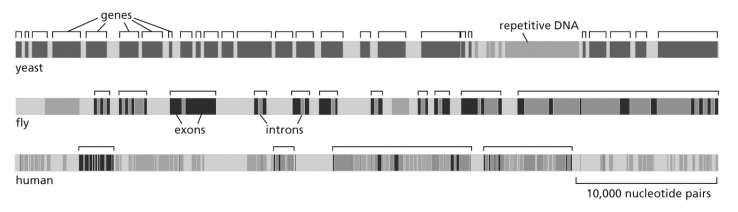
genes distrubution in genome (image)
48
Most of the human genome is made of?
- noncoding and
repetitive sequences
•Average gene 27,000 nucleotides, but only ~ 1,300 nucleotides in
exons
•Only ~ 1.5% of DNA in protein-coding regions
•3.5% conserved with other mammals and do note encode for protein
repetitive sequences
•Average gene 27,000 nucleotides, but only ~ 1,300 nucleotides in
exons
•Only ~ 1.5% of DNA in protein-coding regions
•3.5% conserved with other mammals and do note encode for protein
49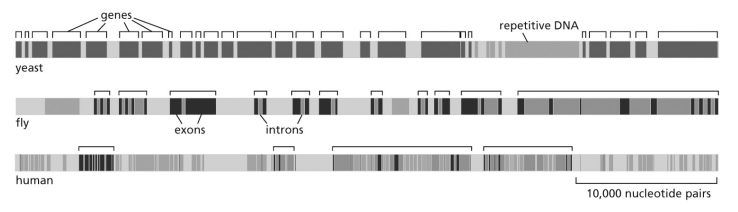
repeated and unique sequences