All cards
1
Chemical Equilibrium
Chemical equilibrium exists when
- Rates of forward and reverse reactions are equal
- Reaction appears to stop
- Concentration of reactants and products do not change over time
- Remain constant
- Both forward and reverse reaction never cease
- Equilibrium signified by double arrows
- Rates of forward and reverse reactions are equal
- Reaction appears to stop
- Concentration of reactants and products do not change over time
- Remain constant
- Both forward and reverse reaction never cease
- Equilibrium signified by double arrows
2
Dynamic Equilibrium
ex. N2O4 <-> 2 NO2
- Only forward reaction
- As N2O4 reacts NO2 forms
As NO2 forms:
- Reverse reaction begins to occur
- NO2 collide more frequently as concentration of NO2 increases
Eventually, equilibrium is reached:
- Concentration of N2O4 does not change
- Concentration of NO2 does not change
- Only forward reaction
- As N2O4 reacts NO2 forms
As NO2 forms:
- Reverse reaction begins to occur
- NO2 collide more frequently as concentration of NO2 increases
Eventually, equilibrium is reached:
- Concentration of N2O4 does not change
- Concentration of NO2 does not change
3
Dynamic Equilibrium graph
- Almost all systems come to equilibrium
- Where equilibrium lies depends on system
- Some system’s equilibrium hard to detect
- Essentially no reactants or no products present
- Where equilibrium lies depends on system
- Some system’s equilibrium hard to detect
- Essentially no reactants or no products present
4
Reaction Reversibility:
Closed system:
- Equilibrium can be reached from either direction
- Independent of whether it starts with “reactants” or “products”
- Always have the same composition at equilibrium under same conditions
- Equilibrium can be reached from either direction
- Independent of whether it starts with “reactants” or “products”
- Always have the same composition at equilibrium under same conditions
5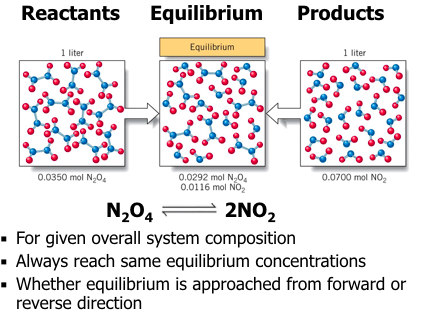
Reactants Products Equil image
6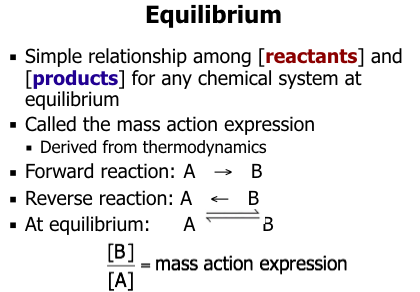
Equilibrium
7
Mass Action Expression
- Derived from thermodynamics
Forward reaction:A → B
Reverse reaction: A ← B
At equilibrium: A <-> B
- [B]/[A]
- concentration of products / concentration of reactants
- lets say your not at equilibrium - B/A is a fraction a Quationent (Q)
- at equilibrium Q = B/A will be a number that will not change
- Kp (gasses with respect to partial pressures)
Forward reaction:A → B
Reverse reaction: A ← B
At equilibrium: A <-> B
- [B]/[A]
- concentration of products / concentration of reactants
- lets say your not at equilibrium - B/A is a fraction a Quationent (Q)
- at equilibrium Q = B/A will be a number that will not change
- Kp (gasses with respect to partial pressures)
8
Mass Action - How to set up?
- Uses stoichiometric coefficients as exponent for each reactant
- raised of the power of coefficients multiplied by each other — format for ALL equations (all mass action)
- at equilibrium becomes a CONSTANT = values do not change
- equilibrium constant only valid at a specific temperatures - change temp, change number
Reaction quotient:
- Numerical value of mass action expression
- Equals “Q ” at any time, and
- Equals “K ” only when reaction is known to be at equilibrium
- raised of the power of coefficients multiplied by each other — format for ALL equations (all mass action)
- at equilibrium becomes a CONSTANT = values do not change
- equilibrium constant only valid at a specific temperatures - change temp, change number
Reaction quotient:
- Numerical value of mass action expression
- Equals “Q ” at any time, and
- Equals “K ” only when reaction is known to be at equilibrium
9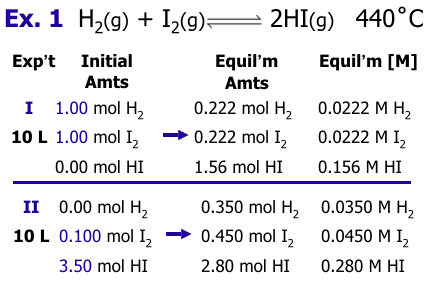
- this is a reversible reaction
- at equilibrium - there is equal masses — figure out experimentally (equil amnts)
- 10L vessel
- look like a number that is consistent = it is a constant
- does not matter what you start with
- taking the average — you are canceling out the errors
Q = (same for all data sets at equilibrium)
- at equilibrium - there is equal masses — figure out experimentally (equil amnts)
- 10L vessel
- look like a number that is consistent = it is a constant
- does not matter what you start with
- taking the average — you are canceling out the errors
Q = (same for all data sets at equilibrium)
10
Equilibrium Law
- at equilibrium write the following equilibrium law = write mass action expression (for Kc)
- Equilibrium constant = Kc = constant at given T
- Use Kc since usually working with concentrations in mol/L
- For chemical equilibrium to exist in reaction mixture, reaction quotient Q must be equal to equilibrium constant, Kc
- at equal — mass action = expression
- units are usually mol/L
- equilibrium is when Q = Kc (at any time)
- Equilibrium constant = Kc = constant at given T
- Use Kc since usually working with concentrations in mol/L
- For chemical equilibrium to exist in reaction mixture, reaction quotient Q must be equal to equilibrium constant, Kc
- at equal — mass action = expression
- units are usually mol/L
- equilibrium is when Q = Kc (at any time)
11
when would Q equal Kc?
the reaction is at equilibrium
example. If Q > Kc, Q will tend to decrease so as to become equal to K. As a result, the reaction will proceed in the backward direction. If Q < Kc, Q will tend to increase so as to become equal to K.
example. If Q > Kc, Q will tend to decrease so as to become equal to K. As a result, the reaction will proceed in the backward direction. If Q < Kc, Q will tend to increase so as to become equal to K.
12
Predicting Equilibrium Law: (example) For general chemical reaction:
dD + eE <-> fF + gG
dD + eE <-> fF + gG
- Where D, E, F, and G represent chemical formulas
- d, e, f, and g are coefficients
Mass action expression is : F^f G^g / D^dE^e (this is the equilibrium law)
- Note: Exponents in mass action expression are stoichiometric coefficients in balanced equation.
- Basically states mass action equals equilibrium constant at equilibrium at a SPECIFIC TEMP
- d, e, f, and g are coefficients
Mass action expression is : F^f G^g / D^dE^e (this is the equilibrium law)
- Note: Exponents in mass action expression are stoichiometric coefficients in balanced equation.
- Basically states mass action equals equilibrium constant at equilibrium at a SPECIFIC TEMP
13
Predicting Equilibrium Law
- Only concentrations that satisfy this equation are equilibrium concentrations
- large equilibrium constant the products are favored
- fraction products larger then the reactants == number of Kc will be larger then 1
- you CANNOT have a negative Kc
Numerator:
Multiply concentration of products raised to their stoichiometric coefficients
Denominator:
Multiply concentration reactants raised to their stoichiometric coefficients
- large equilibrium constant the products are favored
- fraction products larger then the reactants == number of Kc will be larger then 1
- you CANNOT have a negative Kc
Numerator:
Multiply concentration of products raised to their stoichiometric coefficients
Denominator:
Multiply concentration reactants raised to their stoichiometric coefficients
14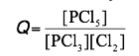
Which of the following is the correct mass action expression for the reaction:
PCl3(g) + Cl2(g) < -> PCl5(g)?
PCl3(g) + Cl2(g) < -> PCl5(g)?
15
- public relations — P comes before R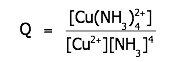
Which of the following is the correct mass action expression for the reaction:
Cu2+(aq) + 4NH3(aq) <-> [Cu(NH3)42+](aq)?
Cu2+(aq) + 4NH3(aq) <-> [Cu(NH3)42+](aq)?
- public relations — P comes before R
16
Manipulating Equations for Chemical Equilibria
Various operations can be performed on equilibrium expressions
1. When direction of equation is reversed, new equilibrium constant is reciprocal of original
2. When coefficients in equation are multiplied by a factor, equilibrium constant is raised to a power equal to that factor.
3. When chemical equilibria are added, their equilibrium constants are multiplied
1. When direction of equation is reversed, new equilibrium constant is reciprocal of original
2. When coefficients in equation are multiplied by a factor, equilibrium constant is raised to a power equal to that factor.
3. When chemical equilibria are added, their equilibrium constants are multiplied
17
When direction of equation is reversed, new equilibrium constant is reciprocal of original
- you could write it both ways! - it is a reversible reaction
- reverse reaction turn fraction upside down so 1/Kc
- coefficients become the exponents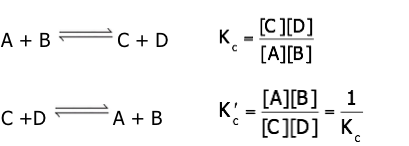
- reverse reaction turn fraction upside down so 1/Kc
- coefficients become the exponents
18
Manipulating Equilibria 2 (example)
19
Manipulating Equilibria 3 (example)
- If you wanted to add these equations — cancel out to get overall reaction
- equilibrium constant multiply 1 and 2 to get the third equation
- add equations then multiply the constants
- equilibrium constant multiply 1 and 2 to get the third equation
- add equations then multiply the constants
20
Equilibrium Constant, Kc
- Most often Kc is expressed in terms of a ratio of concentrations of products and reactants as shown on previous slides
- Sometimes partial pressures, in atmospheres, may be used in place of concentrations
** a system is gaseous —
** you could use partial pressures to express
- Sometimes partial pressures, in atmospheres, may be used in place of concentrations
** a system is gaseous —
** you could use partial pressures to express
21
Equilibrium Constant, Kp
- Based on reactions in which all substances are gaseous
- Gas quantities are expressed in atmospheres in mass action expression
- Use partial pressures for each gas in place of concentrations
e.g. N2(g) + 3H2(g) <-> 2NH3(g)
- this gives you a new constant Kp
- the set up of the mass action is identical
- Gas quantities are expressed in atmospheres in mass action expression
- Use partial pressures for each gas in place of concentrations
e.g. N2(g) + 3H2(g) <-> 2NH3(g)
- this gives you a new constant Kp
- the set up of the mass action is identical
22
Homogeneous reaction/equilibrium
All reactants and products in same phase
23
Heterogeneous reaction/equilibrium
- Reactants and products in different phases
- Solutions are expressed in M
- Gases are expressed in M
- Governed by Kc
- Equilibrium law for heterogeneous system written without concentrations of pure solids or liquids
- Solutions are expressed in M
- Gases are expressed in M
- Governed by Kc
- Equilibrium law for heterogeneous system written without concentrations of pure solids or liquids
24
Heterogeneous Equilibria
ex. 2NaHCO3(s) <-> Na2CO3(s) + H2O(g) + CO2(g)
- Can write in simpler form
- For any pure liquid or solid, ratio of moles to volume of substance (M ) is constant
ex. 1 mol NaHCO3 occupies 38.9 cm3 2 mol NaHCO3 occupies 77.8 cm3
- different mol different L -- same M
- Ratio (n/V ) or M of NaHCO3 is constant (25.7 mol/L) regardless of sample size
- Likewise can show that molar concentration of Na2CO3 solid is constant regardless of sample size
-
- Equilibrium law for heterogeneous system written without concentrations of pure solids or liquids
- So concentrations of pure solids and liquids can be incorporated into equilibrium constant, Kc
- you could change concentration of gas and solutions, BUT NOT OF A PURE SOLID and A PURE LIQUID (cannot get them any more close - they are incompressible)
- Can write in simpler form
- For any pure liquid or solid, ratio of moles to volume of substance (M ) is constant
ex. 1 mol NaHCO3 occupies 38.9 cm3 2 mol NaHCO3 occupies 77.8 cm3
- different mol different L -- same M
- Ratio (n/V ) or M of NaHCO3 is constant (25.7 mol/L) regardless of sample size
- Likewise can show that molar concentration of Na2CO3 solid is constant regardless of sample size
-
- Equilibrium law for heterogeneous system written without concentrations of pure solids or liquids
- So concentrations of pure solids and liquids can be incorporated into equilibrium constant, Kc
- you could change concentration of gas and solutions, BUT NOT OF A PURE SOLID and A PURE LIQUID (cannot get them any more close - they are incompressible)
25
Ag+(aq) + Cl–(aq) <-> AgCl(s)
do not put is S so 1/ reactants
26
H3PO4(aq) + H2O(l) <-> H3O+(aq) + H2PO4–(aq)
- do not put in water! for second equation
27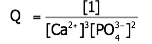
Given the reaction:
3Ca2+(aq) + 2PO43–(aq) <-> Ca3(PO4)2(s)
What is the mass action expression?
3Ca2+(aq) + 2PO43–(aq) <-> Ca3(PO4)2(s)
What is the mass action expression?
28
- Means product rich mixture
- Reaction goes far toward completion (reaction procceeds forward twds completion)
Large K (K >>1)
- Means product rich mixture
- Reaction goes far toward completion (reaction procceeds forward twds completion)
29
K ≈ 1
- Means product and reactant concentrations close to equal
- Reaction goes only about halfway
- Reaction goes only about halfway
30
Small K (K << 1)
- Means reactant rich mixture
- Only very small amounts of product formed
- hardly any reaction has occured
- Only very small amounts of product formed
- hardly any reaction has occured
31
Size of K
- gives measure of how reaction proceeds
- K >> 1 [products] >> [reactants]
- K = 1 [products] = [reactants]
- K << 1 [products] << [reactants]
- K >> 1 [products] >> [reactants]
- K = 1 [products] = [reactants]
- K << 1 [products] << [reactants]
32
Consider the reaction of 2NO2(g) N2O4(g)
If Kp = 0.480 at 25 °C, does the reaction favor product or reactant?
If Kp = 0.480 at 25 °C, does the reaction favor product or reactant?
- K is small (K < 1)
- Reaction favors reactant
- Since K is close to 1, significant amounts of both reactant and product are present
- Reaction favors reactant
- Since K is close to 1, significant amounts of both reactant and product are present
33
How can we manipulate a chemical reaction at equilibrium?
- le chantelier principle
- stress
- stress
34
Le Chatelier’s Principle:
When a system at equilibrium is subjected to a stress, the equilibrium will shift in the direction that reduces that stress.
35
Stress:
a change in conditions.
- moving in such a way to get rid of stress
- need energy to move towards the stress
- moving in such a way to get rid of stress
- need energy to move towards the stress
36
TYPES OF STRESS
1. ΔT
2. Δ concentrations at equil.
3. Δ P (for gases only)
2. Δ concentrations at equil.
3. Δ P (for gases only)
37
ΔT
- Refrigerator analogy
- If temperature is decreased, the system will try to relieve this stress by producing more heat favors the exothermic rxn.
- An increase in temp. will shift the equil. in favor of the endothermic rxn. (to absorb the extra heat).
- If temperature is decreased, the system will try to relieve this stress by producing more heat favors the exothermic rxn.
- An increase in temp. will shift the equil. in favor of the endothermic rxn. (to absorb the extra heat).
38
ΔT (example) - 3 H2(g) + N2(g) ↔ 2NH3(g) + heat
- temp decreased system will try and make more heat in favor of exothermic reaction (bc this reaction makes heat) — shifts to the right
- when you are cold want to become warmer!
- In favor of endothermic if temp is higher — NH3 absorbs heat to make more H2 and N2
- which direction will reduce stress?
- reactants increase products decrease option 1
on exams: how do we increase the concentration of…
- when you are cold want to become warmer!
- In favor of endothermic if temp is higher — NH3 absorbs heat to make more H2 and N2
- which direction will reduce stress?
- reactants increase products decrease option 1
on exams: how do we increase the concentration of…
39
Δ concentrations at equil. (example)
- Keq would not change with any of these concentration stresses as long at temperature is constant! 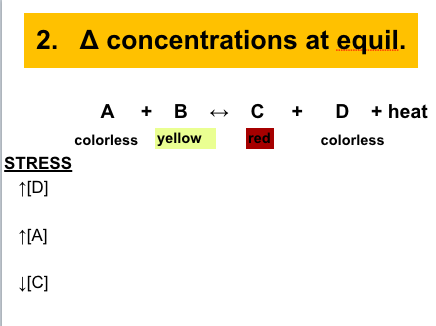
40
Q: Which side of this equation would take up less space? N2(g) + 2 O2(g) ↔ 2 NO2(g)
- An increase in pressure will “shift” the equilibrium towards the side with the smaller # of gas molecules (less moles).
- A decrease in pressure will shift the equilibrium towards the side with the larger # of gas particles.
- A decrease in pressure will shift the equilibrium towards the side with the larger # of gas particles.
41
Equilibrium Positions and “Shifts”
- Equilibrium positions
- Le Châtelier’s principle
- Le Châtelier’s principle
42
Equilibrium positions
- Combination of concentrations that allow Q = K
- Infinite number of possible equilibrium positions
- Infinite number of possible equilibrium positions
43
Le Châtelier’s principle
- System at equilibrium (Q = K) when upset by disturbance (Q ≠ K) will shift to offset stress
- System said to “shift to right” when forward reaction is dominant (Q < K)
- System said to “shift to left” when reverse direction is dominant (Q > K)
- System said to “shift to right” when forward reaction is dominant (Q < K)
- System said to “shift to left” when reverse direction is dominant (Q > K)
44
Relationship Between Q and K
Q = K - reaction at equilibrium
Q < K - reactants go to products
- Too many reactants
- Must convert some reactant to product to move reaction toward equilibrium
Q > K products go to reactants
- Too many products
- Must convert some product to reactant to move reaction toward equilibrium
Q < K - reactants go to products
- Too many reactants
- Must convert some reactant to product to move reaction toward equilibrium
Q > K products go to reactants
- Too many products
- Must convert some product to reactant to move reaction toward equilibrium
45
Examples of Le Châtelier’s Principle
Let’s see how this works with changes in:
1. Concentration
2. Pressure and volume
3. Temperature
4. Catalysts
5. Adding inert gas to system at constant volume
1. Concentration
2. Pressure and volume
3. Temperature
4. Catalysts
5. Adding inert gas to system at constant volume
46
Effect of Change in Concentration
- When changing concentrations of reactants or products
Equilibrium shifts to remove reactants or products that have been added
Equilibrium shifts to replace reactants or products that have been removed
Equilibrium shifts to remove reactants or products that have been added
Equilibrium shifts to replace reactants or products that have been removed
47
Effect of Change in Concentration (example)
48
For the reaction:
2SO2(g) + O2(g) <-> 2SO3(g)
Kc = 2.4 × 10⁻³ at 700 °C
Which direction will the reaction move if 0.125 moles of O2 is added to an equilibrium mixture?
Kc = 2.4 × 10⁻³ at 700 °C
Which direction will the reaction move if 0.125 moles of O2 is added to an equilibrium mixture?
A. Towards the products
B. Towards the reactants
C. No change will occur
B. Towards the reactants
C. No change will occur
49
Effect of Pressure and Volume Changes
ex. Consider gaseous system at constant T and n
3H2(g) + N2(g) <-> 2NH3(g)
- If volume is reduced
- Expect pressure to increase
- To reduce pressure, look at each side of reaction
- Which has less moles of gas
- Reactants = 3 mol + 1 mol = 4 mol gas
- Products = 2 mol gas
- Reaction favors products (shifts to right)
3H2(g) + N2(g) <-> 2NH3(g)
- If volume is reduced
- Expect pressure to increase
- To reduce pressure, look at each side of reaction
- Which has less moles of gas
- Reactants = 3 mol + 1 mol = 4 mol gas
- Products = 2 mol gas
- Reaction favors products (shifts to right)
50
Effect of P and V Changes
ex. H2(g) + I2(g) <-> 2HI(g)
- If pressure is increased, what is the effect on equilibrium?
- nreactant = 1 + 1 = 2
- nproduct = 2
- Predict no change or shift in equilibrium
- If pressure is increased, what is the effect on equilibrium?
- nreactant = 1 + 1 = 2
- nproduct = 2
- Predict no change or shift in equilibrium
51
If you decrease volume of reaction, what is the effect on equilibrium?
2NaHSO3(s) <-> NaSO3(s) + H2O(g) + SO2(g)
- Reactants: All solids, no moles gas
- Products: 2 moles gas
- Decrease in V, causes an increase in P
- Reaction shifts to left (reactants), as this has fewer moles of gas
- Reactants: All solids, no moles gas
- Products: 2 moles gas
- Decrease in V, causes an increase in P
- Reaction shifts to left (reactants), as this has fewer moles of gas
52
Reducing volume of gaseous reaction mixture causes reaction to decrease number of molecules of gas, if it can
increase pressure
53
Moderate pressure changes
- have negligible effect on reactions involving only liquids and/or solids
- Substances are already almost incompressible
- Substances are already almost incompressible
54
Changes in V,P on equilibrium constants
- Changes in V, P and [X ] effect position of equilibrium (Q), but not K
55
Effect of Change in Temperature: (endothermic rxn)
- Reaction endothermic
- Adding heat shifts equilibrium toward products
- Cooling shifts equilibrium toward reactants
- Adding heat shifts equilibrium toward products
- Cooling shifts equilibrium toward reactants
56
Effect of Temperature Changes: + vs. - delta H rnx
+:
Energy is reactant
Add heat energy, shift reaction right
-:
Energy is product
Add heat, shift reaction left
Energy is reactant
Add heat energy, shift reaction right
-:
Energy is product
Add heat, shift reaction left
57
Effect of Temperature Changes: endo and exo
- Increase in temperature shifts reaction in direction that produces endothermic (heat absorbing) change
- Increase in temperature of endothermic reaction makes K larger
More heat (reactant) forces equilibrium to products
- Decrease in temperature shifts reaction in direction that produces exothermic (heat releasing) change
- Increase in temperature of exothermic reaction makes K smaller
More heat (product) forces equilibrium to reactants
- Changes in T change value of mass action expression at equilibrium, so K changed
K depends on T
- Increase in temperature of endothermic reaction makes K larger
More heat (reactant) forces equilibrium to products
- Decrease in temperature shifts reaction in direction that produces exothermic (heat releasing) change
- Increase in temperature of exothermic reaction makes K smaller
More heat (product) forces equilibrium to reactants
- Changes in T change value of mass action expression at equilibrium, so K changed
K depends on T
58
Catalysts And Equilibrium
- Catalyst lowers Ea for both forward and reverse reaction
- Change in Ea affects rates k r and k f equally
- Catalysts have no effect on equilibrium
- Since the difference in Ea will be the same with or without the catalyst, The K value remains constant.
- Change in Ea affects rates k r and k f equally
- Catalysts have no effect on equilibrium
- Since the difference in Ea will be the same with or without the catalyst, The K value remains constant.
59
Inert gas
One that does not react with components of reaction
e.g. argon, helium, neon, usually N2
e.g. argon, helium, neon, usually N2
60
Effect of Adding Inert Gas
- Adding inert gas to reaction at fixed V (n and T), increase P of all reactants and products
- Since it doesn’t react with anything
* No change in concentrations of reactants or products
* No net effect on reaction
- Since it doesn’t react with anything
* No change in concentrations of reactants or products
* No net effect on reaction
61
How to Use Le Châtelier’s Principle
1. Write mass action expression for reaction
2. Examine relationship between affected concentration and Q (direct or indirect)
3. Compare Q to K
** If change makes Q > K, shifts left
** If change makes Q < K, shifts right
** If change has no effect on Q, no shift expected
2. Examine relationship between affected concentration and Q (direct or indirect)
3. Compare Q to K
** If change makes Q > K, shifts left
** If change makes Q < K, shifts right
** If change has no effect on Q, no shift expected
62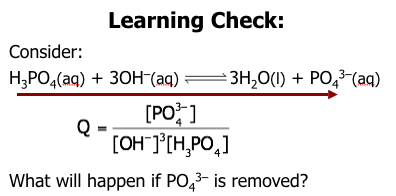
- Q is proportional to [PO43–]
- Decrease [PO43–], decrease in Q
- Q < K equilibrium shifts to right
- Decrease [PO43–], decrease in Q
- Q < K equilibrium shifts to right
63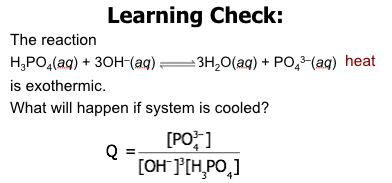
- Since reaction is exothermic, heat is product
- Heat is directly proportional to Q
- Decrease in T, decrease in Q
- Q < K equilibrium shifts to right
- Heat is directly proportional to Q
- Decrease in T, decrease in Q
- Q < K equilibrium shifts to right
64
pressure equation
P = mRT (pressure and molarity are not equal!)
65
It is noted that heating a pink sample causes it to turn violet (pink is in the reactants)
reaction would be endothermic if heat is in the reactants
66
The following are equilibrium constants for the reaction of acids in water, Ka. Which reaction proceeds the furthest to products?
Ka = 2.2 × 10⁻³
Ka = 1.8 × 10⁻⁵
Ka = 4.0 × 10⁻¹⁰
Ka = 6.3 × 10⁻³
Ka = 2.2 × 10⁻³
Ka = 1.8 × 10⁻⁵
Ka = 4.0 × 10⁻¹⁰
Ka = 6.3 × 10⁻³
largest K will proceed furthest from the right
products are the numerater ops of ka value !
products are the numerater ops of ka value !
67
Equilibrium Calculations
1. For gaseous reactions, use either KP or KC
2. For solution reactions, must use KC
Either way, two basic categories of calculations:
- Calculate K from known equilibrium concentrations or partial pressures
- Calculate one or more equilibrium concentrations or partial pressures using known KP or KC
2. For solution reactions, must use KC
Either way, two basic categories of calculations:
- Calculate K from known equilibrium concentrations or partial pressures
- Calculate one or more equilibrium concentrations or partial pressures using known KP or KC
68
Calculating KC from Equilibrium Concentrations
- When all concentrations at equilibrium are known
- Use mass action expression to relate concentrations to KC
Two common types of calculations
A. Given equilibrium concentrations, calculate K
B. Given initial concentrations and one final concentration
- Calculate equilibrium concentration of all other species
- Then calculate K
- could do it different ways - most involve ICE table
1. concentrations plug into mass action expression solve (these values are concentrations - usually in terms of Molarity)
These are all measurements so round to the proper degree — round at the end !
- Use mass action expression to relate concentrations to KC
Two common types of calculations
A. Given equilibrium concentrations, calculate K
B. Given initial concentrations and one final concentration
- Calculate equilibrium concentration of all other species
- Then calculate K
- could do it different ways - most involve ICE table
1. concentrations plug into mass action expression solve (these values are concentrations - usually in terms of Molarity)
These are all measurements so round to the proper degree — round at the end !
69
N2O4(g) <-> 2NO2(g)
- If you place 0.0350 mol N2O4 in 1 L flask at equilibrium, what is KC?
[N2O4]eq = 0.0292 M
[NO2]eq = 0.0116 M
- If you place 0.0350 mol N2O4 in 1 L flask at equilibrium, what is KC?
[N2O4]eq = 0.0292 M
[NO2]eq = 0.0116 M
- plug and chug — given equilibrium concentration — asked to find the equilibrium constant for the equation *easy (3 sig figs)
KC = 4.61 × 10⁻³
KC = 4.61 × 10⁻³
70
2SO2(g) + O2(g) <-> 2SO3(g)
At 1000 K, 1.000 mol SO2 and 1.000 mol O2 are placed in a 1.000 L flask. At equilibrium 0.925 mol SO3 has formed. Calculate K C for this reaction?
At 1000 K, 1.000 mol SO2 and 1.000 mol O2 are placed in a 1.000 L flask. At equilibrium 0.925 mol SO3 has formed. Calculate K C for this reaction?
What do you have? In terms of Molarity — first, determine molarity
1. Calculate at equilibrium — once you know the concentration of reactants at equilibrium plug into mass action expression
2. Calculate equilibrium concentrations (given to you)
1. Calculate at equilibrium — once you know the concentration of reactants at equilibrium plug into mass action expression
2. Calculate equilibrium concentrations (given to you)
71
(cont.) How to Solve:
Set up concentration table
Based on the following:
- Changes in concentration must be in same ratio as coefficients of balanced equation
- Set up table under balanced chemical equation
Initial concentrations:
Controlled by person running experiment
Changes in concentrations:
Controlled by stoichiometry of reaction
Based on the following:
- Changes in concentration must be in same ratio as coefficients of balanced equation
- Set up table under balanced chemical equation
Initial concentrations:
Controlled by person running experiment
Changes in concentrations:
Controlled by stoichiometry of reaction
72
ICE
employing I (given) C (change — the delta — of reactants and products) E (at equilibrium — know concentrations will not change anymore) table
changes are controlled by STOICHIOMETRY
changes are controlled by STOICHIOMETRY