Review Exam 1
Study these flashcardsFree · spaced repetition · iPhone, Android, Mac & web
All cards
1
What is the science of Geography (Physical Geography)
Study of the processes that shape the Earth's surface, the animals and plants that inhabit it, and the spatial patterns they exhibit
2
What is Spatial Analysis
Examination of spatial interactions, patterns, and variations over area and/or space
3
What is the Scientific Method (steps)
1. Recognize the problem/ Make an observation (factual data; measurable); pose a question
2. Collect data; make more observations
3. Develop idea(s) to explain -> Hypothesis
4. Test Hyptohesis
5. Validate or refute the hypothesis
2. Collect data; make more observations
3. Develop idea(s) to explain -> Hypothesis
4. Test Hyptohesis
5. Validate or refute the hypothesis
4
Difference between open and closed systems? And Examples
Open Systems
Not self-contained; inputs of energy and or matter are received while outputs of energy and or matter flow out ex: cup of tea, boiling water in pot uncovered
Closed Systems
Self-contained; shut off from the surrounding environment; rarely found in nature; earth is technically a closed system with respect to air, water, and mineral, resources
Not self-contained; inputs of energy and or matter are received while outputs of energy and or matter flow out ex: cup of tea, boiling water in pot uncovered
Closed Systems
Self-contained; shut off from the surrounding environment; rarely found in nature; earth is technically a closed system with respect to air, water, and mineral, resources
5
Difference betwen Negative and Positive System Feedback? And Examples
Negative feedback - Stability; discourages change
The cloud cover increases with increasing water vapor, but the cloud cover serves to reduce incoming solar radiation which leads to cooling. The stimulus is counteracted by the response.)
Positive feedback - Encourages change; stimulates system changes
EX: Polar ice reflects light from the sun. As this ice begins to melt, less sunlight gets reflected into space. It is instead absorbed into the oceans and land, raising the overall temperature, and fueling further melting
The cloud cover increases with increasing water vapor, but the cloud cover serves to reduce incoming solar radiation which leads to cooling. The stimulus is counteracted by the response.)
Positive feedback - Encourages change; stimulates system changes
EX: Polar ice reflects light from the sun. As this ice begins to melt, less sunlight gets reflected into space. It is instead absorbed into the oceans and land, raising the overall temperature, and fueling further melting
6
What is the difference between latitude and longitude? Prime merdian vs Equator?
Latitudes are lines that go up just like latters; How far north or south; Prime merdian is the middle line in lattiude
Longtitudes and long across left to right; how far east or west; equator is middle line for longitude
Longtitudes and long across left to right; how far east or west; equator is middle line for longitude
7
What is a map? And what must if have?
A map is a generalized view of an area, as seen from above & reduced in size
Must have the following: title, date, legend, scale, and direction
Must have the following: title, date, legend, scale, and direction
8
Parallels vs Meridians
Parallels run from east to west and never intersect with each other whereas meridians run from north to south and intersect at the north and south poles
9
What is the name of the theory behind the formation of our solar system?
Physical theory that describes how the universe expanded from an initial state of high density and temperature; big nebula of dust that slowly combines to make gases and planets
10
Uses contour lines, which are lines of equal elevation, to show the shape of earth's surface
Also show other geogrpahic features such as roads, rivers, lakes, and more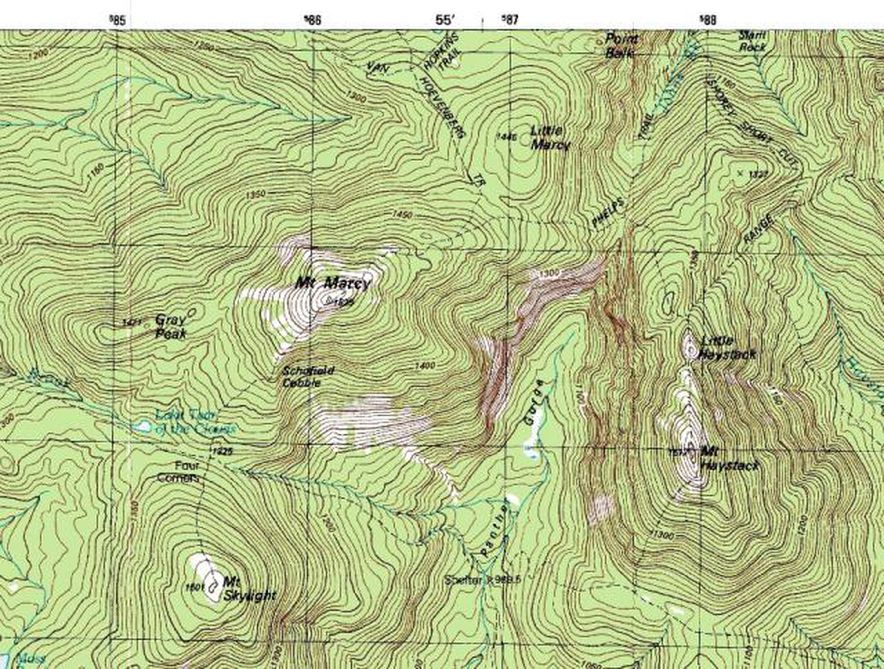
Also show other geogrpahic features such as roads, rivers, lakes, and more
11
What type of solar activity occurs on the sun?
Sunspots, Solar Flairs, Solar Wind
12
What are map scales and what are different examples?
Scales can change size: a small scale map will show large areas but with little detail, while a large scale map will show smatter areas but with more detail
13
Sunspots?
Dark spots on the Sun's surface, Tempeatures coolar than other parts,
Caused by magnetic storms due to the interacton of suns surface and magnetic field
Reach maximum activity every 11 years due to the flipping magnetic field
Caused by magnetic storms due to the interacton of suns surface and magnetic field
Reach maximum activity every 11 years due to the flipping magnetic field
14
Solar Flairs?
Magnetic field lines near sunspots often tangle, cross, and reorginize --->
leads to brief, bright eruptions/ explostions of hot energy gases
leads to brief, bright eruptions/ explostions of hot energy gases
15
Do map projections always results in some type of distortion?
Distortions always occur
16
Solar Wind?
Sun constantly emits coulds of elctircallty charged particals. Takes 3 days to reach earth
17
What protects earth from solar activity?
Earth’s Magnetosphere, 2 magnetic metals move past eachother which creates a magnetic field; protects us from radiation poisoning
18
What is the electromagnetic spectrum?
The range of all types of EM radiation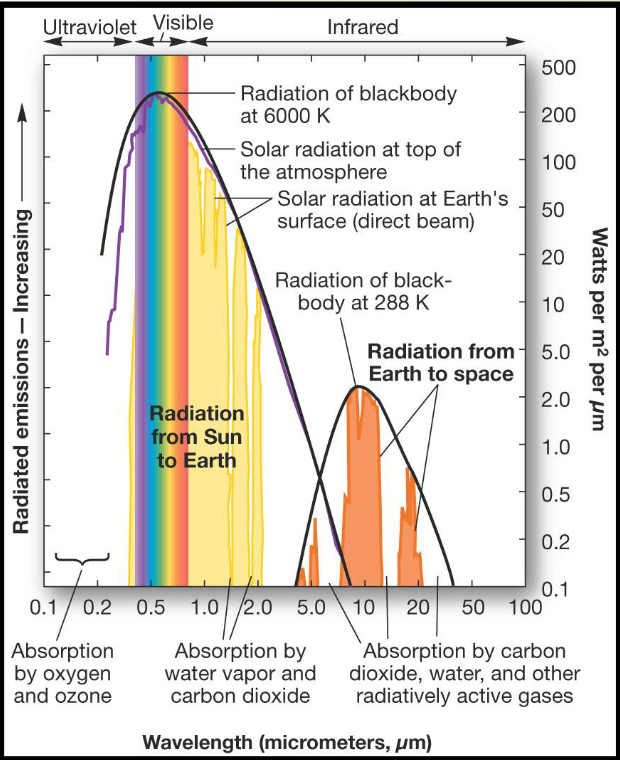
19
What do we mean when we say the Earth’s energy budget?
Describes the balance between the radiant energy that reaches Earth from the sun and the energy that flows from Earth back out to space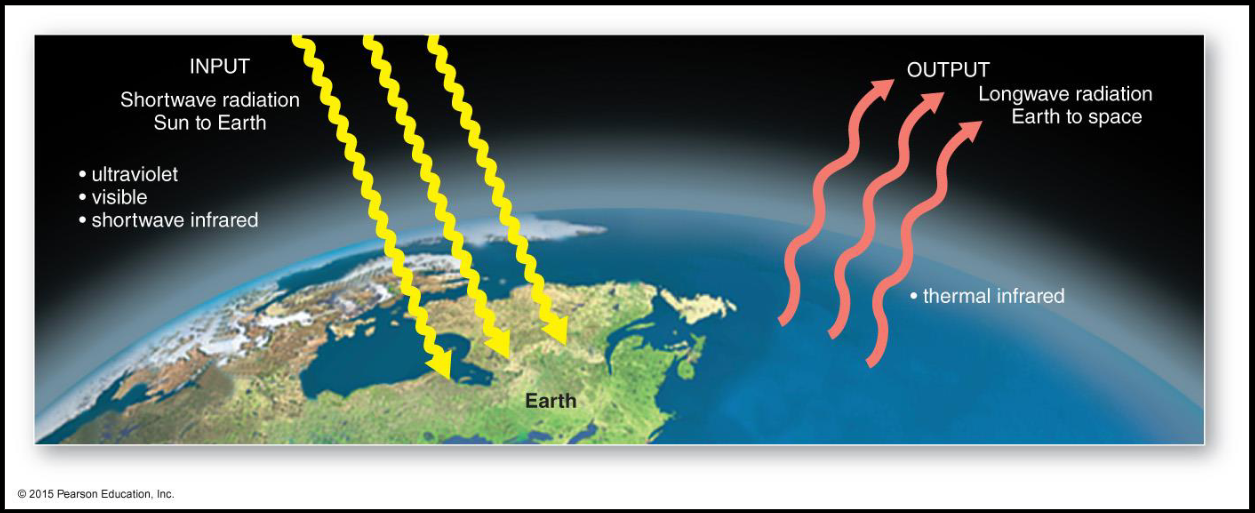
20
What is insolation?
Insolation - Incident Solar radiation
Tropics recieve more concentrated insolation due to the earth's cruvature
Tropics receive 2.5x more than the poles
Tropics recieve more concentrated insolation due to the earth's cruvature
Tropics receive 2.5x more than the poles
21
Why do we have seasons?
Revolution, Rotation, Tilt of the earths axis, axial parallelism, sphericity
22
Understand the atmospheric profile (e.g., what is air pressure, how does it change with altitude)
As altitude increases, the amount of gas molecules in the air decreases—the air becomes less dense than air nearer to sea level. This is what meteorologists and mountaineers mean by "thin air."
23
Understand the three different criteria (e.g what is the major difference between homosphere & heterosphere)
Heterosphere - Outermost atmosphere (80km)
Homosphere - Innter atmosphere (80 km inward), gasses evenly blended N typically oems from volcanic sources and the O comes from photosynthesis
Only exception is the ozon layer (18-50km) which has water vapor, pollutants, and other trace gasses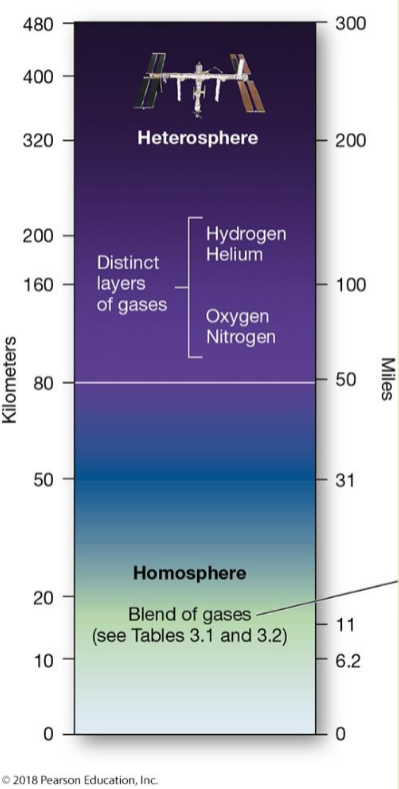
Homosphere - Innter atmosphere (80 km inward), gasses evenly blended N typically oems from volcanic sources and the O comes from photosynthesis
Only exception is the ozon layer (18-50km) which has water vapor, pollutants, and other trace gasses
24
What are the sources of the different NATURAL pollutants?
Volcanoes
Forest fires
Plants
Decaying Plants
Soil
Ocean
Forest fires
Plants
Decaying Plants
Soil
Ocean
25
What are the sources of the different Anthropogenic pollutants?
Carbon monoxide - cars
Photochemical smog - From UV radiation in auto exhaust
Industrial smog and sulfur oxides - Coal burning industries, differrnt cars
Particulates - Haze, smoke, dust, soot, pollen
Photochemical smog - From UV radiation in auto exhaust
Industrial smog and sulfur oxides - Coal burning industries, differrnt cars
Particulates - Haze, smoke, dust, soot, pollen
26
What did the clean air act do?
US federal law regulating air emissions from stationary and mobile sources
Was made to address public health
Was successful in significant reductions in air pollution and higher quality of life
Was made to address public health
Was successful in significant reductions in air pollution and higher quality of life
27
What is temperature?
A measure of the average kinetic energy (motion) of individual molecules of matter
hot = fast moving
cold = slow-moving
hot = fast moving
cold = slow-moving
28
Flow of kinetic energy between molecules from on body to another
Flows from high to low
What is Heat
Flow of kinetic energy between molecules from on body to another
Flows from high to low
29
What is sensible heat?
Sensible - What you feel, temperature is a measure of molecule vibration
30
What is latent heat?
Latent - Heat due to change in state (liquid->gas)
Melting, evaporation, sublimation = absorbs heat
Freezing, condenstation, depostion = releases heat
Melting, evaporation, sublimation = absorbs heat
Freezing, condenstation, depostion = releases heat
31
What are the methods of heat transfer? (list 4)
Radiation - Electromagnetic Waves
Conduction - Molecule to molecule diffusion
Convection - Mixing and ciruclation
Advection - Directional mass movment
Conduction - Molecule to molecule diffusion
Convection - Mixing and ciruclation
Advection - Directional mass movment
32
How does energy move through our atmosphere ( scattering, refraction, reflection & absorbtion)?
Transmission - Passage of energy thorugh atmosphere and water
Scattering - Changing direciton (reflection)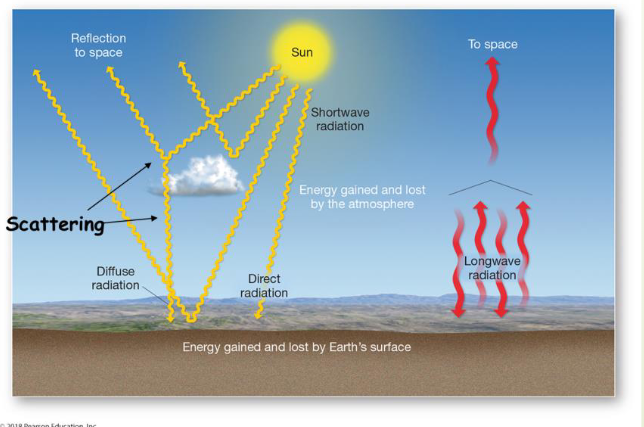
Scattering - Changing direciton (reflection)
33
How do clouds and aerosols affect this movement?
Clouds, atmosphere and surface reflection, reflect or scatter 31% back to space
34
Understand the greenhouse effect
About half of the incoming energy passes thorugh the atmosphere and is abosrbed. This heat is radiated back towards space
35
Explain the conecpt of energy balence and budget
Earth’s energy budget describes the balance between the radiant energy that reaches Earth from the sun and the energy that flows from Earth back out to space
Inputs = UV, visible, near infrared (shotwave)
Outputs = Thermal infrared (longwave)
Inputs = UV, visible, near infrared (shotwave)
Outputs = Thermal infrared (longwave)
36
What are the scales and insturmnets used to measure temperature?
Thermistors measure the electrical resistnace of a semiucondutor
This electrical resistance is then converted to temp
This electrical resistance is then converted to temp
37
What does absolute zero mean?
Temperature at which a thermodynamic system has the lowest energy
38
Why is it colder at higher altitudes?
The farther away you get from the earth, the thinner the atmosphere gets. The total heat content of a system is directly related to the amount of matter present, so it is cooler at higher elevations
39
Water boils at what degree?
100C
40
Water freezes at what degree?
0C
41
What are Earth's temperature patterns and how do they change over a season?
...
42
Isotherm - line of constant value (temperature)
Thermal Equator – isotherm w/ highest mean temperature
What is an isotherm?
Isotherm - line of constant value (temperature)
Thermal Equator – isotherm w/ highest mean temperature
43
How does the human body respond to changes in temperature?(Heat and cold)
As wind speed increases, the body cools at a faster rate causing skin temperature to drop (evaporation)
Frostbite – body tissue that froze
Usually starts with fingers, toes, nose, and ear lobes
Hypothermia – body's temperature drops too low
Uncontrollable shivering, disorientation, and incoherence are signs
of this issue and medical attention should be found immediately
Frostbite – body tissue that froze
Usually starts with fingers, toes, nose, and ear lobes
Hypothermia – body's temperature drops too low
Uncontrollable shivering, disorientation, and incoherence are signs
of this issue and medical attention should be found immediately
44
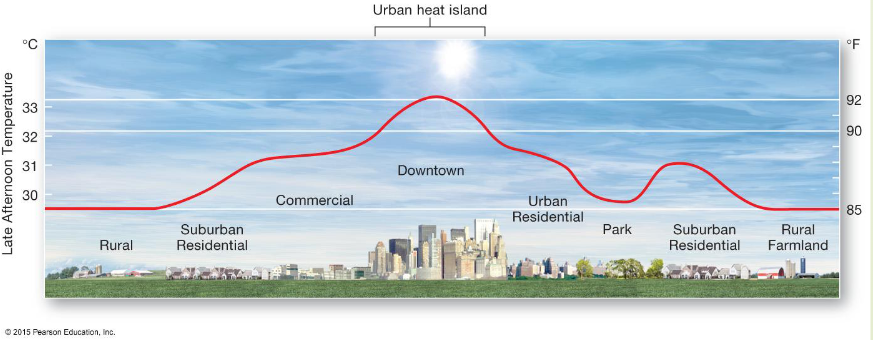
What is a typical urban heat island profile
...