Review Exam 3
Study these flashcardsFree · spaced repetition · iPhone, Android, Mac & web
All cards
1
What is relative age dating?
The process of determining if one rock or geologic event is older or younger than another, without knowing their specific ages
2
What is absolute age dating?
Give rocks an actual date or date range in numbers of years
3
What is
uniformitarianism?
uniformitarianism?
Assumes the same physical processes that are occurring
today have operated throughout geologic time
today have operated throughout geologic time
4
What is superposition?
The law of superposition is one of the principles of geology scientists use to determine the relative ages of rock strata, or layers
Sedimentary (and some volcanic) rocks are created in
succession, with the oldest rocks at the bottom, and
progressively younger rocks above
Sedimentary (and some volcanic) rocks are created in
succession, with the oldest rocks at the bottom, and
progressively younger rocks above
5
What are cross-cutting
relationships?
relationships?
Geologic features such as dikes and faults that cut across rock must
be younger than the rock they cut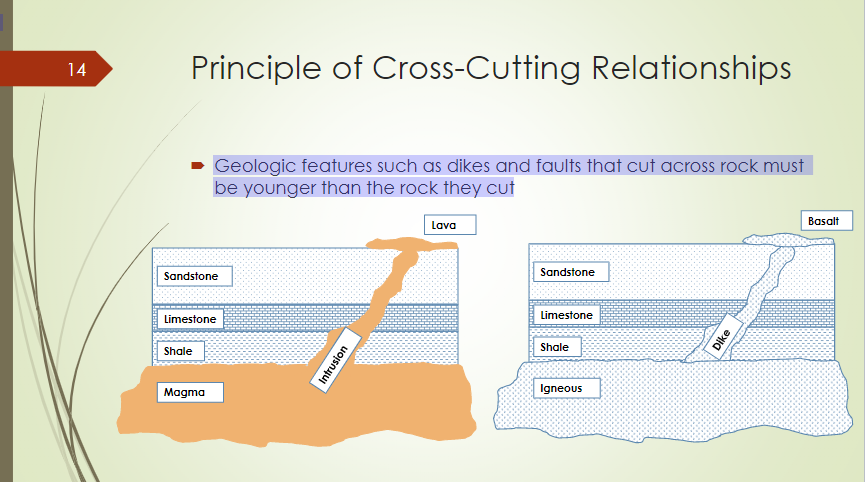
be younger than the rock they cut
6
What is the structure of Earth?
Core
Inner – Solid iron
Outer – molten iron; magnetic field
generated
Mantle
Lower – rigid (solid); silicates rich in
iron and magnesium
Upper – more silicates
Upper Mantle
Rigid
Plastic (“mushy”)
Rigid
Mohorovicic (Moho)
Separates crust from upper mantle
Crust
Oceanic (more dense)
Continental (less dense)
Inner – Solid iron
Outer – molten iron; magnetic field
generated
Mantle
Lower – rigid (solid); silicates rich in
iron and magnesium
Upper – more silicates
Upper Mantle
Rigid
Plastic (“mushy”)
Rigid
Mohorovicic (Moho)
Separates crust from upper mantle
Crust
Oceanic (more dense)
Continental (less dense)
7
What is the Lithosphere and Asthenosphere
Lithosphere
Rigid rock comprising the crust
(oceanic and continental) as well as
the underlying rock
Asthenosphere
Plastic or mushy upper part of the
mantle
Convective movements in this layer
drive movements of the crustal
plates
Rigid rock comprising the crust
(oceanic and continental) as well as
the underlying rock
Asthenosphere
Plastic or mushy upper part of the
mantle
Convective movements in this layer
drive movements of the crustal
plates
8
What’s a mineral?
Rocks are made of minerals; a mineral is defined
Naturally occurring solid
Definable chemical composition
Possess a crystalline structure
‘typically’ inorganic
Naturally occurring solid
Definable chemical composition
Possess a crystalline structure
‘typically’ inorganic
9
What are the types of minerals? (families)
Silicates – silicon and oxygen
Oxides – oxygen and metallic elements
Sulfides & Sulfates – sulfur and metallic elements
Carbonates – carbon with oxygen and other elements
Oxides – oxygen and metallic elements
Sulfides & Sulfates – sulfur and metallic elements
Carbonates – carbon with oxygen and other elements
10
What is the most
prevalent in our crust?
prevalent in our crust?
Silicates
11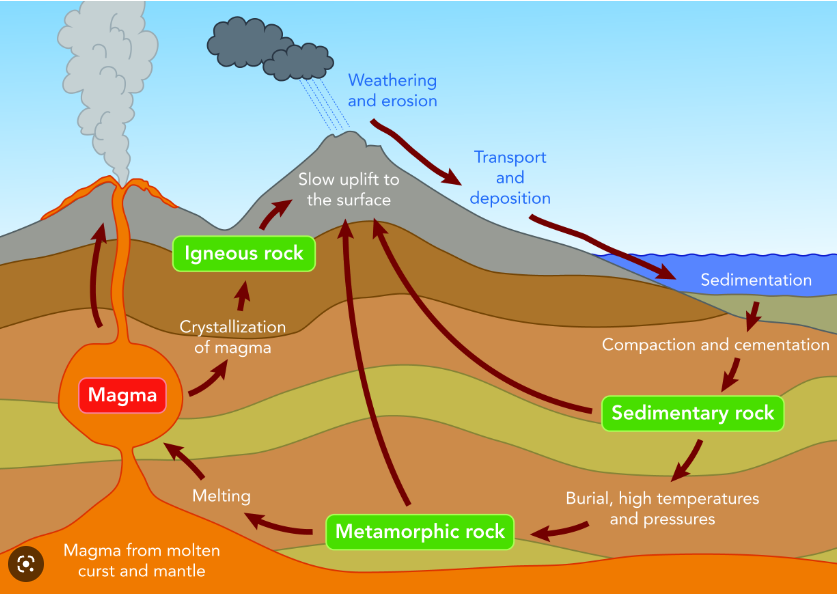
What is the rock cycle?
12
What’s the difference between igneous,
metamorphic, and sedimentary rocks?
metamorphic, and sedimentary rocks?
Igneous rocks are formed from melted rock deep inside the Earth. Sedimentary rocks are formed from layers of sand, silt, dead plants, and animal skeletons. Metamorphic rocks formed from other rocks that are changed by heat and pressure underground.
13
What are some examples?
Igneous rocks form from volcanoes diorite, gabbro
Metamorphics are deep within the Earth or where tectonic plates meet like where mountains meet diamonds, marble, quartz
often start as sediments carried in rivers and deposited in lakes and oceans. When buried, the sediments lose water and become cemented to form rock like sandstone or limestone
Metamorphics are deep within the Earth or where tectonic plates meet like where mountains meet diamonds, marble, quartz
often start as sediments carried in rivers and deposited in lakes and oceans. When buried, the sediments lose water and become cemented to form rock like sandstone or limestone
14
What is continental drift?
the gradual movement of the continents across the earth's surface through geological time.
15
What is plate tectonics?
A theory explaining the structure of the earth's crust and many associated phenomena as resulting from the interaction of rigid lithospheric plates which move slowly over the underlying mantle
16
What are the
different plate boundaries and how do they move in relation to
each other?
different plate boundaries and how do they move in relation to
each other?
Divergent boundaries -- where new crust is generated as the plates pull away from each other.
Convergent boundaries -- where crust is destroyed as one plate dives under another.
Transform boundaries -- where crust is neither produced nor destroyed as the plates slide horizontally past each other.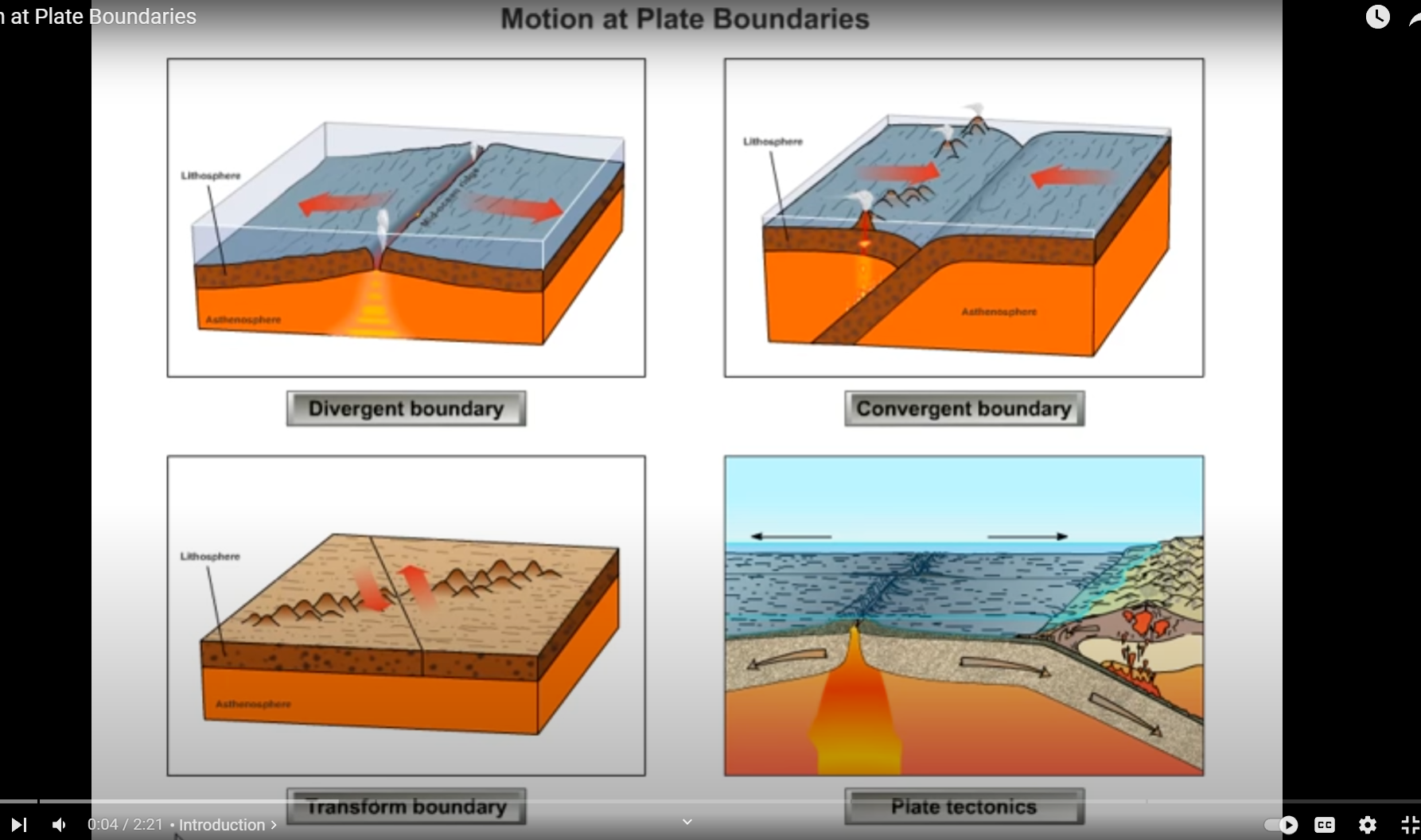
Convergent boundaries -- where crust is destroyed as one plate dives under another.
Transform boundaries -- where crust is neither produced nor destroyed as the plates slide horizontally past each other.
17
What is stress and what are the three types?
18
Endogenic processes
Tectonic activity
Driven by planet’s internal energy
Builds crust
Driven by planet’s internal energy
Builds crust
19
Weathering and erosion
Powered by Sun through motion of air, water, and ice
Shapes crust
Exogenic processes
Weathering and erosion
Powered by Sun through motion of air, water, and ice
Shapes crust
20
Strain is what?
how rocks
respond to stress
Folding (bending)
Faulting (breaking)
respond to stress
Folding (bending)
Faulting (breaking)
21
Stress is what?
force over a
given area
Tension (stretching)
Compression (shortening)
Shear (twisting and tearing)
given area
Tension (stretching)
Compression (shortening)
Shear (twisting and tearing)
22
What are the three types of faults?
3 types of faults
Normal
Thrust or Reverse
Strike-Slip (Left and Right Lateral)
Normal
Thrust or Reverse
Strike-Slip (Left and Right Lateral)
23
What is an earthquake, magnitude, focus, and epicenter? Where
do they occur?
do they occur?
Sudden movements along
plate boundaries, releasing
enormous amounts of energy
(magnitude)
Focus – spot along fault where
quake originates
Epicenter – point on surface
directly above the focus
plate boundaries, releasing
enormous amounts of energy
(magnitude)
Focus – spot along fault where
quake originates
Epicenter – point on surface
directly above the focus
24
Effusive Eruptions is?
- pours out a more liquid type of lava more
frequently (shield volcanoes and flood basalts)
frequently (shield volcanoes and flood basalts)
25
Explosive Eruptions is?
has a more viscous type of lava that leads
fewer eruptions that are more violent
(composite/stratovolcanoes, lava domes and calderas)
fewer eruptions that are more violent
(composite/stratovolcanoes, lava domes and calderas)
26
How does viscosity and
gas build up change the type of volcano?
gas build up change the type of volcano?
Magmas that are more rhyolitic have a higher gas content. This gas content and relative viscosity leads to the more explosive and violent eruptions that occur at composite volcanoes
27
What is the difference
between a composite and shield volcano?
between a composite and shield volcano?
The main difference between the two is that a shield volcano is composed of basaltic lava while a composite volcano is composed of andesitic magma
28
What is denudation and what are the processes?
Denudation is the name for the processes of erosion, leaching, stripping, and reducing the mainland due to removal of material from higher to lower areas like valleys, river valleys, lakes and seas with a permanent filling of low lands
29
What is the difference between physical and chemical
weathering?
weathering?
Physical, or mechanical, weathering happens when rock is broken through the force of another substance on the rock such as ice, running water, wind, rapid heating/cooling, or plant growth
Chemical weathering occurs when reactions between rock and another substance dissolve the rock, causing parts of it to fall away
Chemical weathering occurs when reactions between rock and another substance dissolve the rock, causing parts of it to fall away
30
What are examples of each?
Physical weathring - fast moving water, Ice wedging, plant roots,
chemical - rust
chemical - rust
31
What is karst topography and what are some of the features?
A type of landscape where the dissolving of the bedrock has created sinkholes, sinking streams, caves, springs, and other characteristic features
32
How
does karst topography form?
does karst topography form?
When much of the water falling on the surface interacts with and enters the subsurface through cracks, fractures, and holes that have been dissolved into the bedrock
33
What is mass movement?
Any movement of a body of material under gravity
Requires a slope under influence of gravitational stress
Angle of repose – steepness angle that a pile of material
will form when it has stabilized
Categories include: fall, slide, flow, and creep
Human-induced mass movements is scarification
Requires a slope under influence of gravitational stress
Angle of repose – steepness angle that a pile of material
will form when it has stabilized
Categories include: fall, slide, flow, and creep
Human-induced mass movements is scarification
34
Angle of repose is?
steepness angle that a pile of material
will form when it has stabilized
will form when it has stabilized
35
What is the study of hydrology?
The fundamental transport processes to be able to describe the quantity and quality of water as it moves through the cycle
36
What are drainage basins and divides?
A drainage basin is a land area that drains its water into a waterway or waterways that result in common outlet
The boundary between drainage basins is a drainage divide
The boundary between drainage basins is a drainage divide
37
What is an internal drainage
basin?
basin?
Inland basins that do not drain to an ocean
38
How do we calculate drainage intensity?
Drainage Density is the total length of all the streams and Rivers in a Drainage basin divided by the total area of the drainage basin.
39
What are
examples of drainage patterns and what are their characteristics?
examples of drainage patterns and what are their characteristics?
The drainage pattern is the arrangement of channels in
an area, which is influenced by climatic and geologic
conditions
Dendritic drainage
Parallel drainage
Trellis drainage
Radial drainage
Rectangular drainage
an area, which is influenced by climatic and geologic
conditions
Dendritic drainage
Parallel drainage
Trellis drainage
Radial drainage
Rectangular drainage
40
What is discharge and how do we measure it?
Volume of flow over time (discharge)
The discharge of a river is just the volume of water passing a certain point every second, multiplying the cross sectional area of the river by its velocity.
The discharge of a river is just the volume of water passing a certain point every second, multiplying the cross sectional area of the river by its velocity.
41
hat is a stream
hydrograph?
hydrograph?
A hydrograph is a graph of the flow in a stream over a period of time
42
What is an exotic stream?
A stream that derives much of its waters from a drainage system in another region
43
Describe fluvial transport and how it changes our landscape.
This material is then transported to new locations (fluvial transport)
44
What
are the different types of material that is transported in rivers?
are the different types of material that is transported in rivers?
Solution
Suspension
Saltation
Traction
Suspension
Saltation
Traction
45
What are the different types of channels formed from stream
erosion?
erosion?
However, many streams in steep mountain regions or in
bedrock-controlled channels have a relatively straight
channel pattern
In large river systems, an anabranching channel pattern
sometimes occurs, in which multiple large channels are
present across a vast floodplain
With excess sediment, stream
might become maze
of interconnected channels
forming a braided stream
bedrock-controlled channels have a relatively straight
channel pattern
In large river systems, an anabranching channel pattern
sometimes occurs, in which multiple large channels are
present across a vast floodplain
With excess sediment, stream
might become maze
of interconnected channels
forming a braided stream
46
What are the channel characteristics?
A channel is a wide strait or waterway between two landmasses that lie close to each other
47
What are some
common features found within these channel types?
common features found within these channel types?
However, many streams in steep mountain regions or in
bedrock-controlled channels have a relatively *straight
channel* pattern
In large river systems, an *anabranching channel* pattern
sometimes occurs, in which multiple large channels are
present across a vast floodplain
With excess sediment, stream
might become maze
of interconnected channels
forming a *braided stream*
bedrock-controlled channels have a relatively *straight
channel* pattern
In large river systems, an *anabranching channel* pattern
sometimes occurs, in which multiple large channels are
present across a vast floodplain
With excess sediment, stream
might become maze
of interconnected channels
forming a *braided stream*
48
What are the fluvial depositional landforms?
alluvial fans, terraces, deltas, and floodplains
Alluvial Stream Terraces
Formed by phases of cyclic erosion
and deposition of alluvial sediments
River Deltas
Mouth of a river →where river reaches base level
River’s velocity decelerates as it enters standing body of water
Reduced stream energy causes deposition of the sediment load
Coarse sand deposits closest to river’s mouth
Finer materials (silts & clays) are carried farther and form the
extreme end of the deposit
The level or nearly level depositional plain that forms at the mouth
of a river is a delta
Floodplains
Flat, low-lying area adjacent to a
channel and subjected to recurrent
flooding
Area inundated when river overflows
its channel during times of high flow
When water recedes, leaves behind
alluvial deposits masking underlying
rock with accumulating thickness
The present river channel is
embedded in these alluvial deposits
The general term for the unconsolidated clay, silt, sand,
gravel, and mineral fragments deposited by running
water is alluvium
The processes of fluvial deposition occur when a stream
deposits alluvium, thereby creating depositional
landforms, such as bars, floodplains, and deltas
Alluvial Stream Terraces
Formed by phases of cyclic erosion
and deposition of alluvial sediments
River Deltas
Mouth of a river →where river reaches base level
River’s velocity decelerates as it enters standing body of water
Reduced stream energy causes deposition of the sediment load
Coarse sand deposits closest to river’s mouth
Finer materials (silts & clays) are carried farther and form the
extreme end of the deposit
The level or nearly level depositional plain that forms at the mouth
of a river is a delta
Floodplains
Flat, low-lying area adjacent to a
channel and subjected to recurrent
flooding
Area inundated when river overflows
its channel during times of high flow
When water recedes, leaves behind
alluvial deposits masking underlying
rock with accumulating thickness
The present river channel is
embedded in these alluvial deposits
The general term for the unconsolidated clay, silt, sand,
gravel, and mineral fragments deposited by running
water is alluvium
The processes of fluvial deposition occur when a stream
deposits alluvium, thereby creating depositional
landforms, such as bars, floodplains, and deltas
49
What is wind and how does it affect our Earth?
The Work of Wind
Eolian means work of wind
Eolian erosion is controlled by particle grain size
Intermediate – move easily by bouncing
Large – resist movement due to their weight
Small – resist movement due to their mutual cohesiveness
Two principal types of wind erosion
Deflation – lifting and removal of individual loose particles
Abrasion – grinding of rock surfaces via “sandblasting”
Produce a variety of distinctive landforms
Eolian means work of wind
Eolian erosion is controlled by particle grain size
Intermediate – move easily by bouncing
Large – resist movement due to their weight
Small – resist movement due to their mutual cohesiveness
Two principal types of wind erosion
Deflation – lifting and removal of individual loose particles
Abrasion – grinding of rock surfaces via “sandblasting”
Produce a variety of distinctive landforms
50
What are the erosional and depositional landforms?
Erosional landforms: Caves, arches, stacks and stumps
Depositional landforms: beaches, spits and bars
Depositional landforms: beaches, spits and bars
51
What are the three climate controls?
Three climate controls of deserts
Subtropical highs (25-35ºN&S)
Rain shadows of mountains
Continentality
Subtropical highs (25-35ºN&S)
Rain shadows of mountains
Continentality
52
What are some common
characteristics of deserts
characteristics of deserts
Common characteristics of deserts
High sensible heat
High ground heating
Low PRECIP, high POTET, leading to large DEFIC
Intermittent streams
High sensible heat
High ground heating
Low PRECIP, high POTET, leading to large DEFIC
Intermittent streams
53
What are the desert fluvial landforms?
Desert Fluvial Processes and Landforms
Wash (arroyo) – a dry stream bed
Flash flood – sudden torrent of water that fills a channel
Slot canyon – long, narrow channel with sheer rock walls
Playa – a dry lake bed
Alluvial fan – fan-like deposit of sediments at the mouth of a canyon
stream
Bajada – broad slope composed of several alluvial fans
Wash (arroyo) – a dry stream bed
Flash flood – sudden torrent of water that fills a channel
Slot canyon – long, narrow channel with sheer rock walls
Playa – a dry lake bed
Alluvial fan – fan-like deposit of sediments at the mouth of a canyon
stream
Bajada – broad slope composed of several alluvial fans
54
What is desertification?
The process of land degradation in arid, semi-arid and dry sub-humid areas as a result of various climatic and human factors.
55
What contributes to this?
Extended droughts and deforesting/ vegetation removal
56
What are the
problems associated with this?
problems associated with this?
Loss of biodiversity by worsening the living conditions of many species
57
What are the deserts of the US Southwest and what is the reason
behind their aridity?
behind their aridity?
A rain shadow is a patch of land that has become a desert because mountain ranges block much of the rainfall necessary for plant growth