Probability
Study these flashcardsFree · spaced repetition · iPhone, Android, Mac & web
All cards
1
Discrete Uniform
-Pr(X=x)
-E[X]
-Variance
-Pr(X=x)
-E[X]
-Variance
-$1/n$
-$(a+b)/2$
-$((b-a+1)^2) - 1/12$
-$(a+b)/2$
-$((b-a+1)^2) - 1/12$
2
additive property
probabilities must satisfy additive property (sum=1)
3
Binomial Pr(X=y)
E(X)
Var(X)
E(X)
Var(X)
Let Y be the # of successes in the n attempts
$\binom{n}{y} p^y * q^(n-y)$
$n*p$
$n*p*q$
$\binom{n}{y} p^y * q^(n-y)$
$n*p$
$n*p*q$
4
Geometric E[X] , Var[X]
E[X] = $1/p$, but if N=0 $q/p$
Var[X] = $q/(p^2)$
Var[X] = $q/(p^2)$
5
Unique Geometric Properties
Memoryless & Mode = 1
6
Negative Binomial
x = trial where the r^th success occurs
Pr(X=x): $\binom{x-1}{r-1}p^r(1-p)^{x-r}, \quad x=r,r+1,r+2,\dots$
E[X] = $(rq)/p$
Var[X] = $rq/(p^2)$
Pr(X=x): $\binom{x-1}{r-1}p^r(1-p)^{x-r}, \quad x=r,r+1,r+2,\dots$
E[X] = $(rq)/p$
Var[X] = $rq/(p^2)$
7
Permutations
(ORDER MATTERS!!!) Given set of n distinguishable objects, an ordered selection of r different elements is chosen from the n objects
Denoted by nPr = $ \frac{n!}{(n-r)!}$
Denoted by nPr = $ \frac{n!}{(n-r)!}$
8
If finding duplicated event
Pr(E’) = 1 - $\frac{nP_r}{n^r}$
9
Combinations
order doesn't matter!!
Given a set of n distringuishable objects, an unordered selection of r different elements of set is called combination of n objects chosen r at a time
$nCr = \frac{P}{r!} = \frac{n!}{r!(n-r)!}$
Given a set of n distringuishable objects, an unordered selection of r different elements of set is called combination of n objects chosen r at a time
$nCr = \frac{P}{r!} = \frac{n!}{r!(n-r)!}$
10
Partitions
nCr = nC(n-r)
11
Multinominal Cofficients (Partitions)
# of partitions of n distinct objects into k subsets of sizes $r_1, r_2 … r_k $ where $r_1+r_2+r_k = n$ denoted by $n \choose{r_1,r_2,r_k}$ = $ \frac{n!}{r_1!r_2!…r_k!} $
12
Binomial thm
$(x+y)^n=\sum_{r=0}^{n} nC_r (x^r)(y^{n-r})$
13
multinomial thm
$(x_1+x_2+...+x_r)^n = \sum_{n_1+...+n_r=n}^{} \frac{n!}{n_1!,n_2!...n_r!}(x_r)^{n_r}$
14
Inclusion exclusion rule
$Pr(E\cup F)=Pr(E)+Pr(F)-Pr(E\cap F)$
15
Conditional probability
$Pr(A | B)=\frac{Pr(A\cap B)}{Pr(B)}$
16
Poisson
$e^(-λ) * (λ^k)/k!$
E[X] and Var[X] both = λ
E[X] and Var[X] both = λ
17
Poisson independence thm
Supposed $Z_i$ are independent Poisson RV with mean $λ$. Then $Z = Z_1 + Z_2$ is a poisson RV with mean $E[Z] = λ_1 + λ_2$
18
Mode for Poisson
Int floor OR the # and #-1
19
Linear Transformation: Let X be discrete RV and Y = aX + b
E[Y] = a*E[X] + b
Var[Y] = a^2 * Var[X]
Var[Y] = a^2 * Var[X]
20
Coefficient of variation
$100 * (sd)/(mean)$
21
Uniform (a,b)
f(x) = $\frac{1}{b-a}$
F(x) = $\frac{x-a}{b-a}$
E[X] = $\frac{a+b}{2}$
Var[X] =$\frac{(b-a)^2}{12}$
F(x) = $\frac{x-a}{b-a}$
E[X] = $\frac{a+b}{2}$
Var[X] =$\frac{(b-a)^2}{12}$
22
Exponential
f(x) = $\frac{1}{θ} * e^{\frac{-x}{ θ}}$
F(x) = $1 - e^{\frac{-x}{ θ}}$
E[X] = $θ$
Var[X] =$θ^2$
F(x) = $1 - e^{\frac{-x}{ θ}}$
E[X] = $θ$
Var[X] =$θ^2$
23
Exponential Memoryless
E[X | X>a] = θ+a
Var[X | X>a] = θ^2
Var[X | X>a] = θ^2
24
Covariance formula
E[X*Y] - E[X]E[Y]
25
correlation coefficent
Cov(X,Y) / SDx * SDy
26
Gamma f(x)
f(x) = $\frac{1}{(a-1)!} * \frac{x^{a-1}}{ θ^a}*e^{-x/θ}$
27
Gamma E[X], Var
Let X ~ Exp(θ) and Y ~ Gamma (a,θ)
E[Y] = a*θ
Var[Y] = a*θ^2
E[Y] = a*θ
Var[Y] = a*θ^2
28
What does Γ
Γ(n)=(n−1)!
29
Beta f(x)
30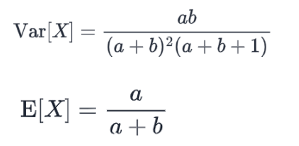
Beta E and Var
31
Gamma Mode
(a-1)* θ
32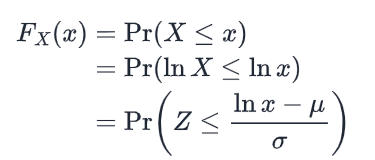
Lognormal F(x) = Pr(X <= x)
33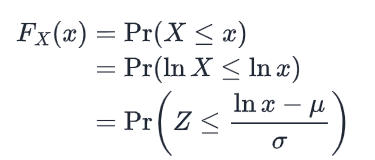
Lognormal mean
34
If T~exponential( θ) and X = max(T, k)
$E[X] = k + θ*e^{-k/ θ}$
35
Finding IQR from SD/normal
Q_3 - Q_1 = SD(π75 - π25)
36
MGF for Exponential Random Variable (Poisson)\
$\frac{1}{1-Bt}$
37
Mode of exponential
x=0
38
Median of exponential
= B * ln(2)
39
SD for Normal Random Variable sample mean
SD / sqrt(n)
40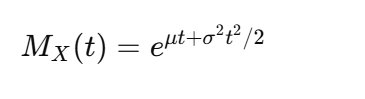
MGF for normal
41
Multinomial formulas
E[X} and Var[X] same as binomial
Cov is $-n*p_1*p_2$
Cov is $-n*p_1*p_2$