GCSE Edexcel Phsyics 14.2 - Thermal Capacity
Study these flashcardsFree · spaced repetition · iPhone, Android, Mac & web
All cards
1
What name is given to the total kinetic energy and potential energy of all particles in a substance?
Internal energy
Internal energy = Kinetic energy + Potential energy
Internal energy = Kinetic energy + Potential energy
2
What are the two possible effects of heating (transferring energy) to a substance?
The kinetic energy of the molecules increases, and the temperature of the substance increases
The potential energy of the molecules increases, and the substance changes state
In both cases, internal energy increases
The potential energy of the molecules increases, and the substance changes state
In both cases, internal energy increases
3
How does the internal energy of particles change when they are heated?
When particles are heated, their kinetic energy increases and they move faster
4
How does the internal energy of particles change during a change of state?
When particles are at a boiling or melting point, their kinetic energy doesn’t change, but the potential energy will increase and they will move further apart
5
A substance is heated, the graph shows how the temperature of the substance changes with time. Explain what happens at each stage of the graph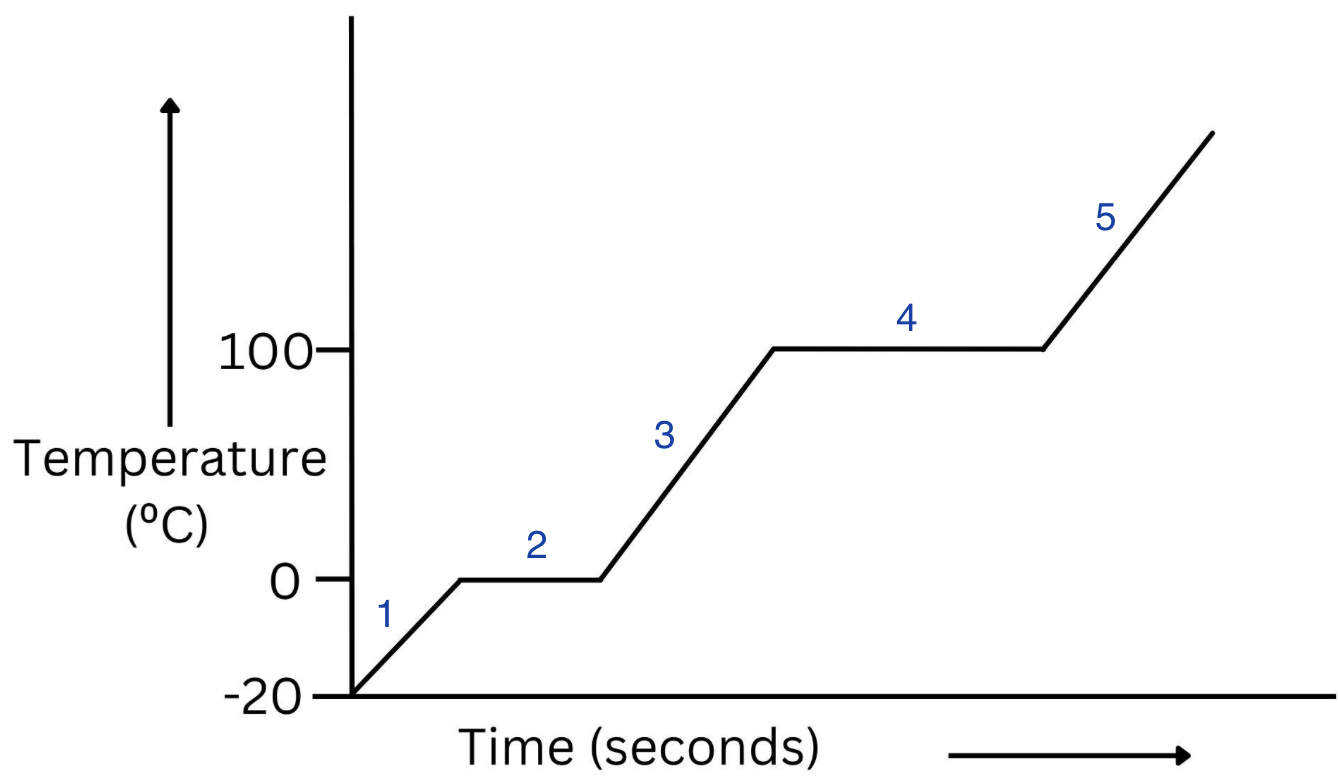
1. Solid - kinetic energy of particles is increasing so temperature is increasing
2. Melting - energy is used to break bonds between molecules instead of increasing kinetic energy, so temperature stays the same
3. Liquid - kinetic energy of particles is increasing so temperature is increasing
4. Boiling - energy is used to break bonds between molecules instead of increasing kinetic energy, so temperature stays the same
5. Gas - kinetic energy of particles is increasing so temperature is increasing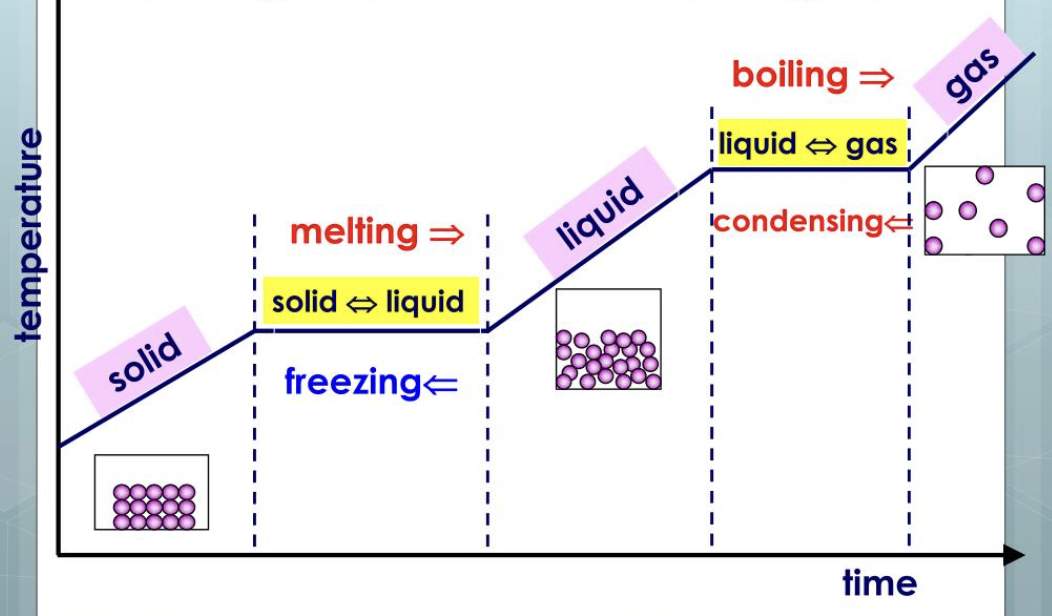
2. Melting - energy is used to break bonds between molecules instead of increasing kinetic energy, so temperature stays the same
3. Liquid - kinetic energy of particles is increasing so temperature is increasing
4. Boiling - energy is used to break bonds between molecules instead of increasing kinetic energy, so temperature stays the same
5. Gas - kinetic energy of particles is increasing so temperature is increasing
6
Definition of Specific Heat Capacity
The amount of energy needed to increase the temperature of 1kg of substance by 1°C
7
If a substance has a high specific heat capacity…
It heats up and cools down slowly (more energy required to change temperature)
8
If a substance has a low specific heat capacity…
It heats up and cools down quickly (less energy required to change temperature)
9
Why is water used in radiators?
It has a high specific heat capacity, meaning it will remain hot for a long time
10
Definition of Specific Latent Heat
The amount of energy required to change the state of 1kg of substance with no change in temperature
11
Specific Latent Heat of Fusion
Solid to liquid and liquid to solid
12
Specific Latent Heat of Vaporisation
Liquid to gas and gas to liquid
13
Specific Heat Capacity Equation
ΔThermal Energy (J) = mass (kg) x S.H.C. (J/kg°C) x ΔTemperature (°C)
ΔE = mcΔθ
ΔE = mcΔθ
14
Specific Latent Heat Equation
Thermal energy required to change state = mass (kg) x S.L.H. (J/kg)
E = mL
E = mL
15
Three processes by which energy is transferred from hotter to cooler areas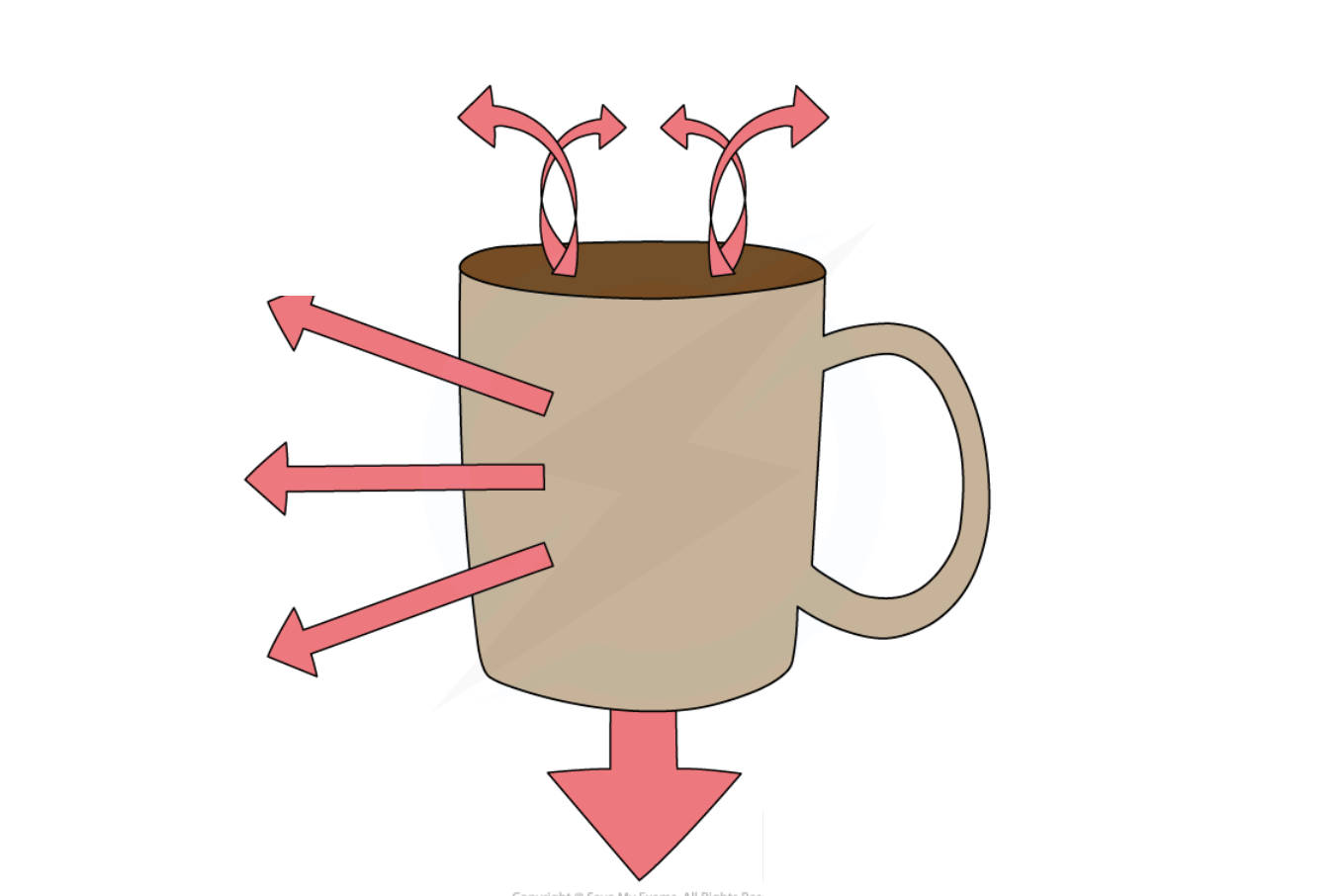
Conduction
Convection
Radiation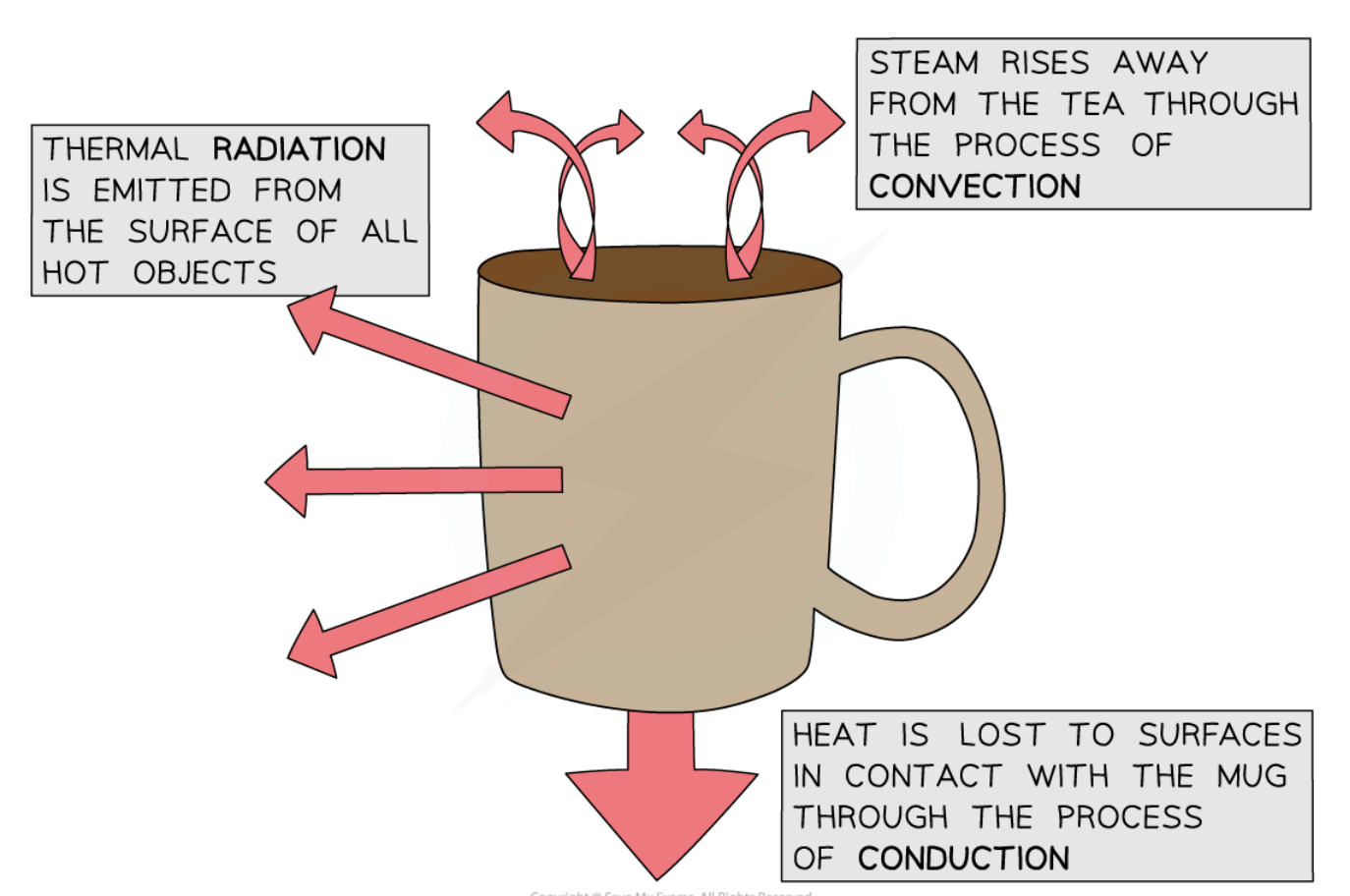
Convection
Radiation
16
Why is thermal insulation useful?
It reduces the rate of unwanted heat transfer/loss
17
How would you use insulators to reduce heat transfer by conduction of heat?
Wrap the insulator around the object
18
How would you use insulators to reduce heat transfer by convection?
Place a lid over the object to stop air from circulating
19
How can you reduce heat transfer by radiation?
Cover material with a shiny coating - radiation is reflected back into the object