1.1 Atomic Structure
Study these flashcardsFree · spaced repetition · iPhone, Android, Mac & web
All cards
1
What are the three key ideas of Dalton's atomic theory (1803)?
1. Atoms cannot be created, destroyed, or divided.
2. Atoms of the same element are identical. 3. Atoms combine to form new substances.
2. Atoms of the same element are identical. 3. Atoms combine to form new substances.
2
Contributions of J. Thomson to the structure of the atom (1897)
Discovered the electron
Using Cathode Ray Tube experiment
Proposed the plum pudding model
Using Cathode Ray Tube experiment
Proposed the plum pudding model
3
Describe J. Thomson’s Plum Pudding model (1897)
Negative electrons (plums) spread out in a positive sphere (pudding)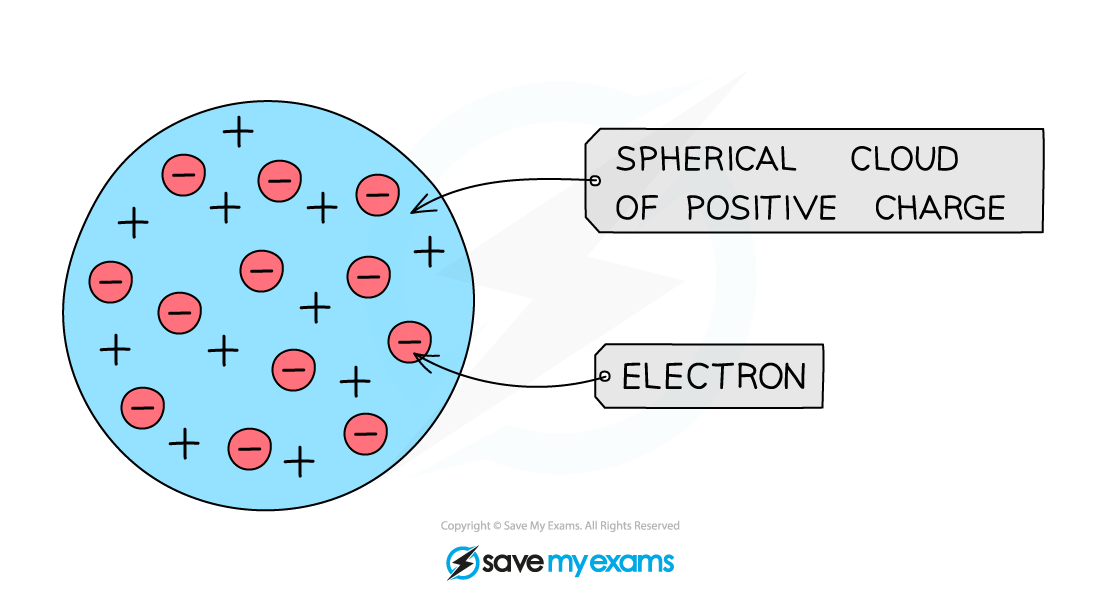
4
Contributions of Rutherford to the structure of the atom (1909)
Discovered the proton, proved mass is concentrated in the nucleus and most of the atom is empty space
Using the Gold Foil experiment
Proposed nuclear model of atom
Using the Gold Foil experiment
Proposed nuclear model of atom
5
Describe Rutherford’s nuclear model of the atom (1909)
Atom is mainly empty space
With electrons orbiting a small, positively charged nucleus at the centre
Mass is concentrated in the nucleus (at the centre of the atom)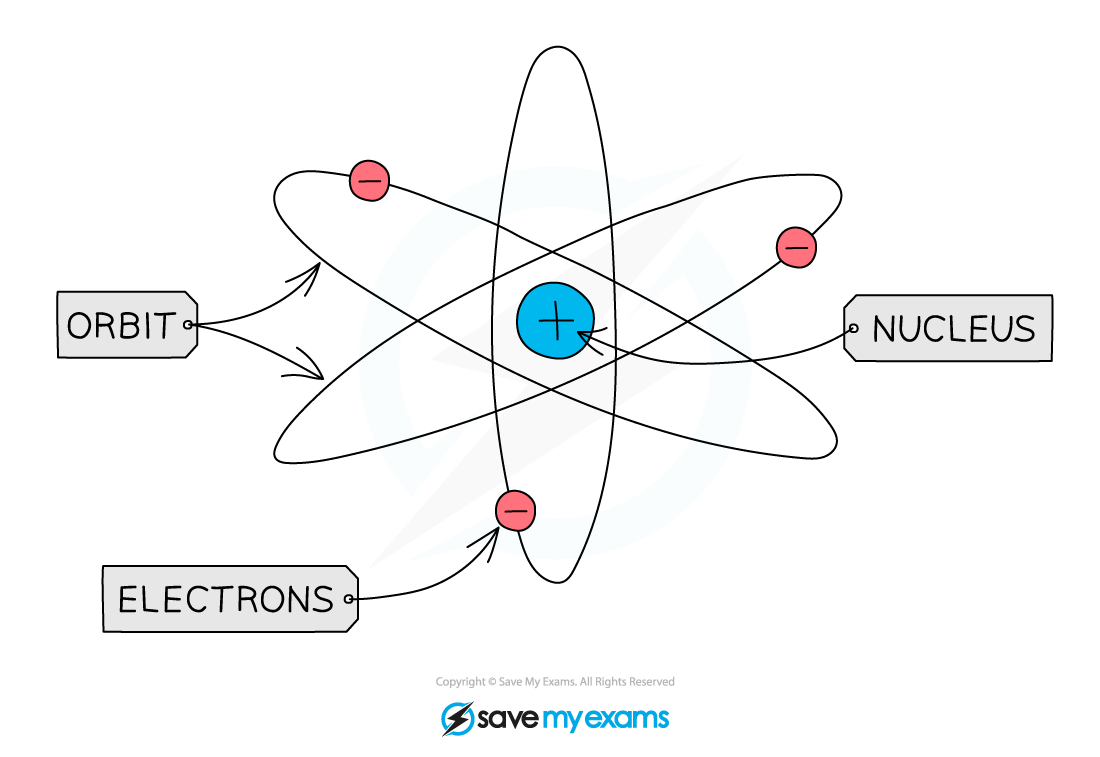
With electrons orbiting a small, positively charged nucleus at the centre
Mass is concentrated in the nucleus (at the centre of the atom)
6
What did Rutherford do in his Gold Foil Experiment? (1909)
Fired positively charged alpha particles at a thin sheet of gold foil (made up of gold atoms)
7
Name the three observations and conclusions for Rutherford’s Golden Foil experiment (1909)
Most alpha particles went straight through - most of the atom is empty space
Some alpha particles were scattered at small angles - nucleus is small and positively charged
A few alpha particles were deflected straight back - most of the mass is concentrated in a small dense nucleus
Some alpha particles were scattered at small angles - nucleus is small and positively charged
A few alpha particles were deflected straight back - most of the mass is concentrated in a small dense nucleus
8
Explain how Niels Bohr contributed to the atomic model (1913)
Proposed electrons orbit the nucleus in fixed shells/energy levels
Each shell has a different energy associated with it
Higher energy levels are further from the nucleus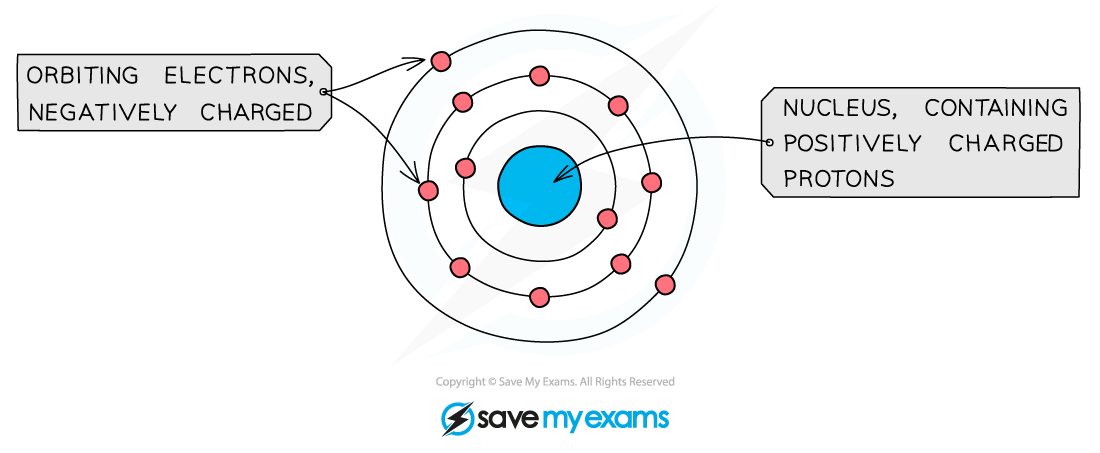
Each shell has a different energy associated with it
Higher energy levels are further from the nucleus
9
Following Dalton’s theory of the atom, name the scientist whose experiments helped improve understanding of the structure of the atom
1. J. Thomson - discovered the electron
2. Rutherford - discovered the proton, proved mass is concentrated in the nucleus, and most of the atom is empty space
3. Bohr - electrons orbit the nucleus in shells
4. Chadwick - existence of neutrons
2. Rutherford - discovered the proton, proved mass is concentrated in the nucleus, and most of the atom is empty space
3. Bohr - electrons orbit the nucleus in shells
4. Chadwick - existence of neutrons
10
When can a scientific model be changed or replaced?
When new experimental evidence improves our understanding.
11
What is an atom?::A tiny particle that makes up matter.
Describe the structure of the atom::A nucleus containing protons and neutrons, surrounded by electrons orbiting in shells
12
What is the relative mass and charge of a proton?
RM: 1
Charge: +1 (positive)
Charge: +1 (positive)
13
What is the relative mass and charge of an electron?
RM: ~0 (negligible)
Charge: -1 (negative)
Charge: -1 (negative)
14
What is the relative mass and charge of a neutron?
RM: 1
Charge: 0 (neutral)
Charge: 0 (neutral)
15
What are nucleons?
Protons and neutrons (particles found in the nucleus of an atom)
16
What is the overall charge of an atom? Why?
Neutral - there is the same number of protons and electrons
The negative charge of an electron cancels out a positive charge of a proton
The negative charge of an electron cancels out a positive charge of a proton
17
Compare the size of the nucleus to the overall size of an atom?
The nucleus is very small compared to the overall size of an atom
About 10,000 times smaller
About 10,000 times smaller
18
Radius of atom
About 0.1 nanometers
Or
1x10⁻¹⁰ metres
Or
1x10⁻¹⁰ metres
19
Where is most of the mass of an atom concentrated?
In the nucleus
20
What is the mass number of an atom?
Sum of number of protons and number of neutrons in the nucleus of an atom
(Sum of the number of nucleons)
(Sum of the number of nucleons)
21
What is the atomic number of an atom?
Number of protons in the nucleus of an atom
(Same as the number of electrons)
(Same as the number of electrons)
22
What do atoms and ions of the same element all have in common?
Atomic number - number of protons
23
What would you use to decide what element an unknown atom is?
Atomic number - number of protons
24
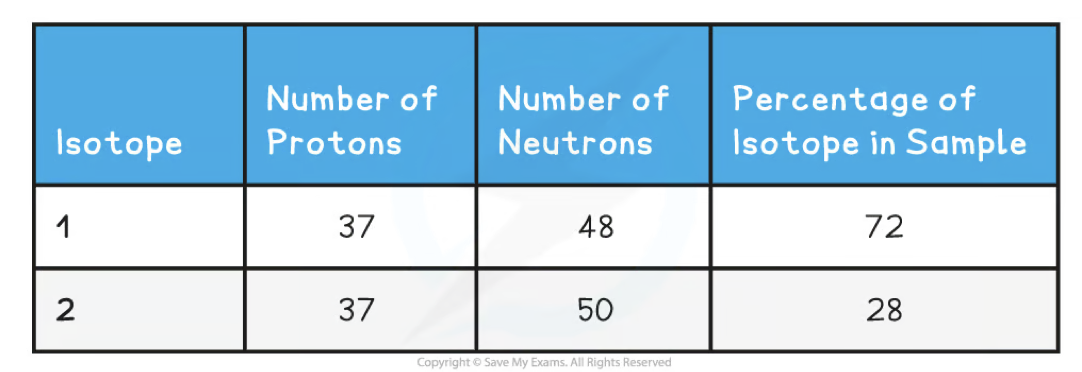
What are isotopes? (3 marks)
Atoms of the same element
Which contain the same number of protons (and electrons)
But different number of neutrons
Which contain the same number of protons (and electrons)
But different number of neutrons
25
How do you use the atomic number and mass number of an atom to calculate the number of protons, electrons and neutrons?
Protons = atomic number
Electrons = atomic number
Neutrons = mass number - atomic number
Electrons = atomic number
Neutrons = mass number - atomic number
26
Why is the relative atomic mass of some elements in the periodic table not a whole number? (E.g. R.A.M. of Cl is 35.5)
It is the weighted average of the masses of all isotopes of that element
27
How do you calculate the relative atomic mass of an element?