GCSE Edexcel Physics 6.2 - Radioactive decay
Study these flashcardsFree · spaced repetition · iPhone, Android, Mac & web
All cards
1
What types of radiation can be emitted by the decay of unstable nuclei?
Alpha, Beta-plus, Beta-minus, gamma and neutron radiation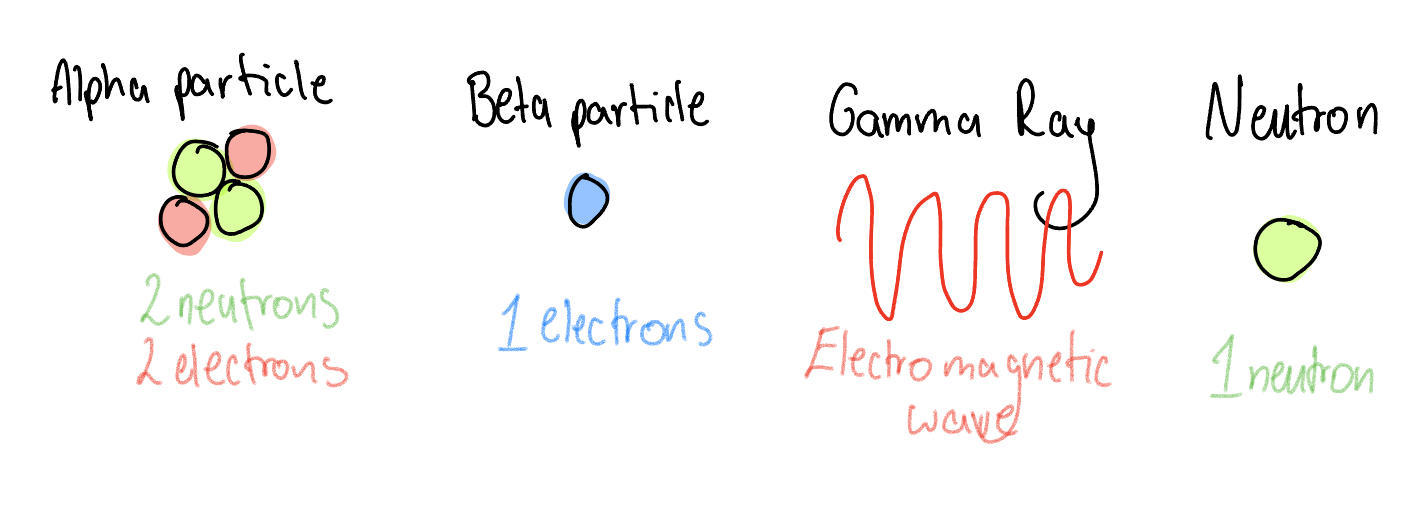
2
What types of nuclei can emit radiation and what happens to them when they do?
Unstable nuclei decay and they become more stable
3
Define radioactive decay (4 marks)
Random process
when an unstable nucleus decays
and emits radiation
to become more stable
when an unstable nucleus decays
and emits radiation
to become more stable
4
Why might isotopes of an element be unstable?
Too many/too few neutrons
Too much energy
Too much energy
5
Define background radiation
The radiation that exists around us all the time
6
What are the two types of sources of background radiation?
Natural sources
Man-made sources
Man-made sources
7
Examples of natural sources of background radiation
Rocks
Cosmic rays from space
Foods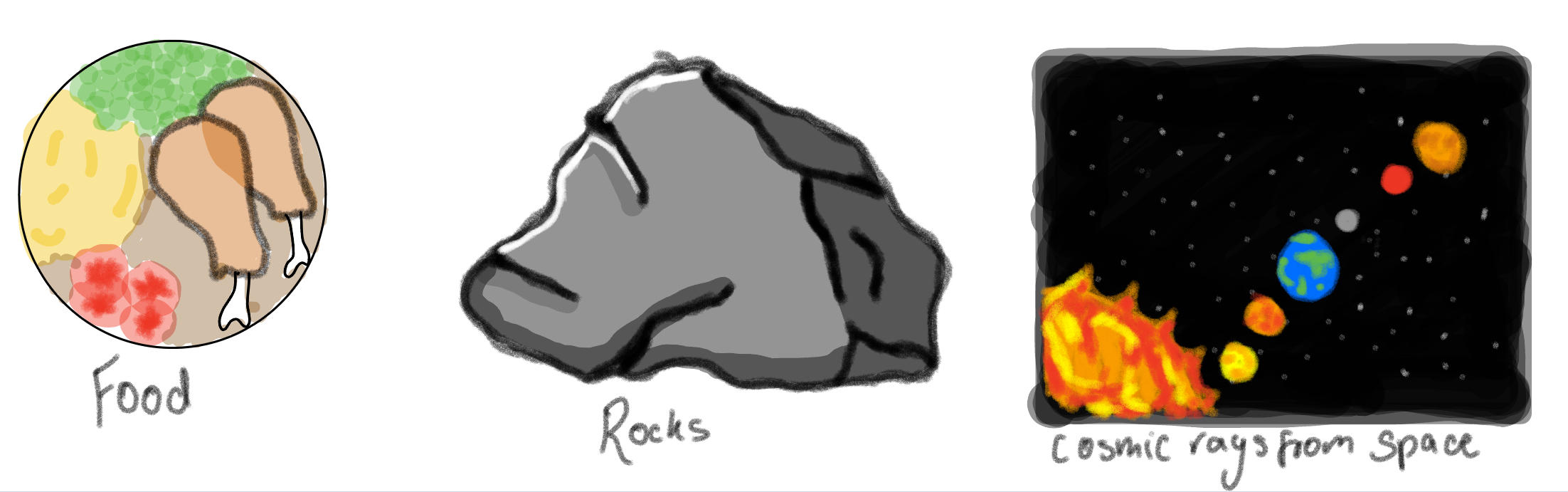
Cosmic rays from space
Foods
8
Examples of man-made sources of background radiation
Medical sources
Nuclear waste
Nuclear weapons
Nuclear accidents
Nuclear waste
Nuclear weapons
Nuclear accidents
9
Types of medical sources of background radiation
X-rays
CT scans
Radioactive tracers
CT scans
Radioactive tracers
10
What can be used to detect radioactivity
Geiger-Müller (GM) Tube
Photographic film
Photographic film
11
How does photographic film help detect radiation
The more radiation the film absorbs, the darker it gets
12
How to obtain the corrected count rate of a radioactive source
Measure the background radiation (no radioactive source present)
Measure count with radioactive source present
Subtract both readings
Measure count with radioactive source present
Subtract both readings
13
What is an alpha particle?
2 protons and 2 neutrons (helium nucleus)
Charge of +2 (affected by electric fields)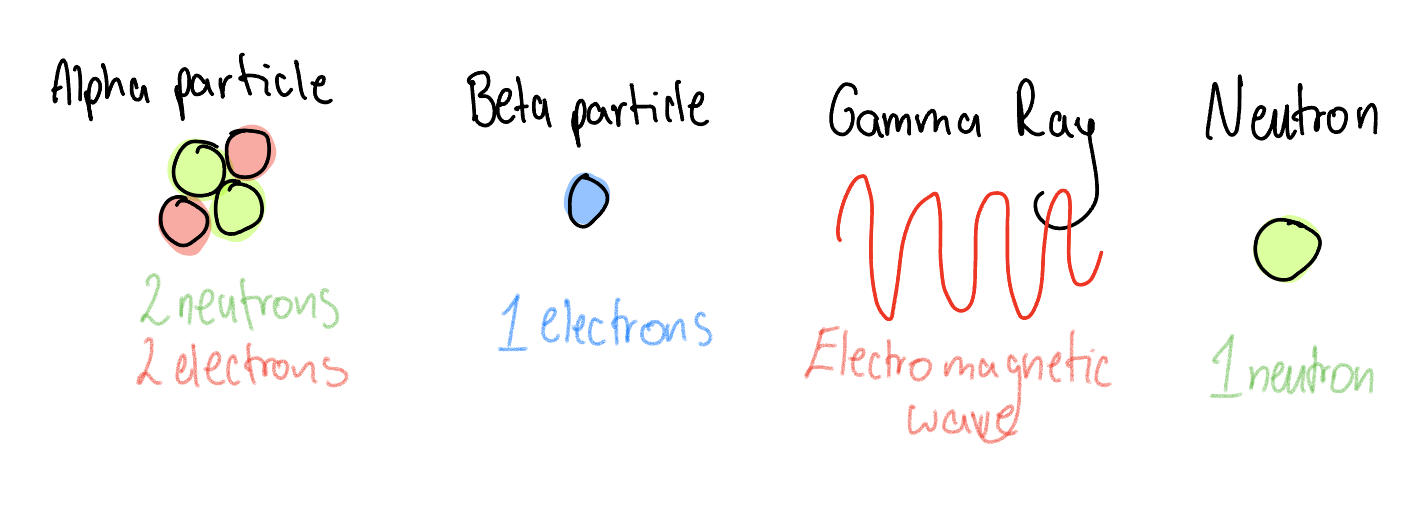
Charge of +2 (affected by electric fields)
14
What is a beta-minus particle?
Fast moving electron
Charge of -1 (affected by electric fields)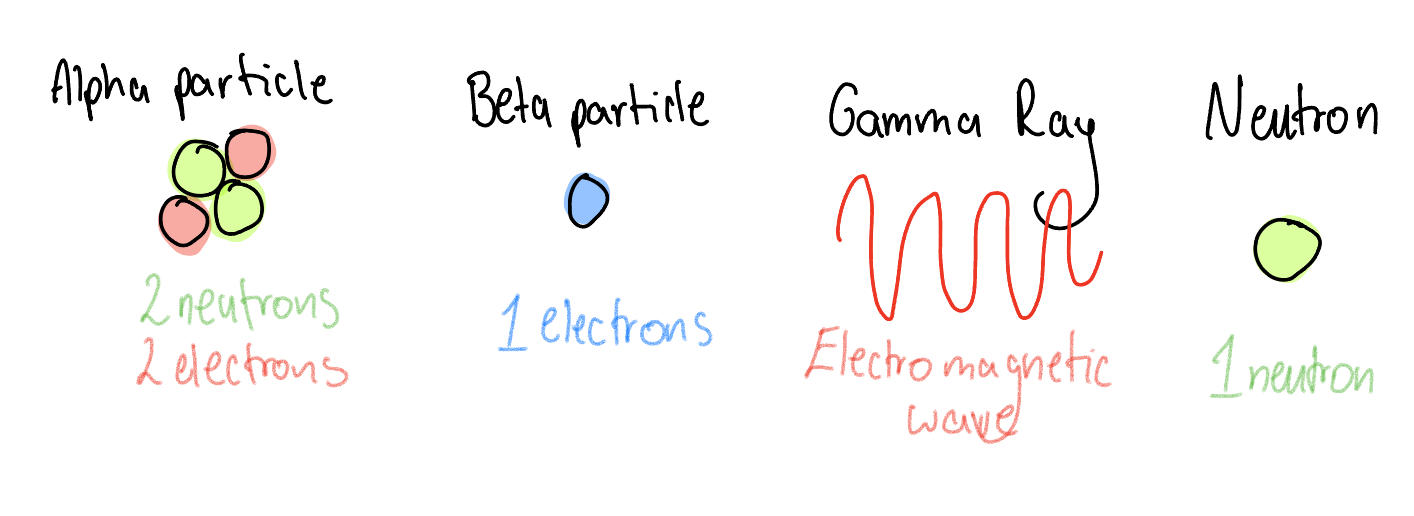
Charge of -1 (affected by electric fields)
15
What is a beta-plus particle?
Fast moving positron
Charge of +1 (affected by electric fields)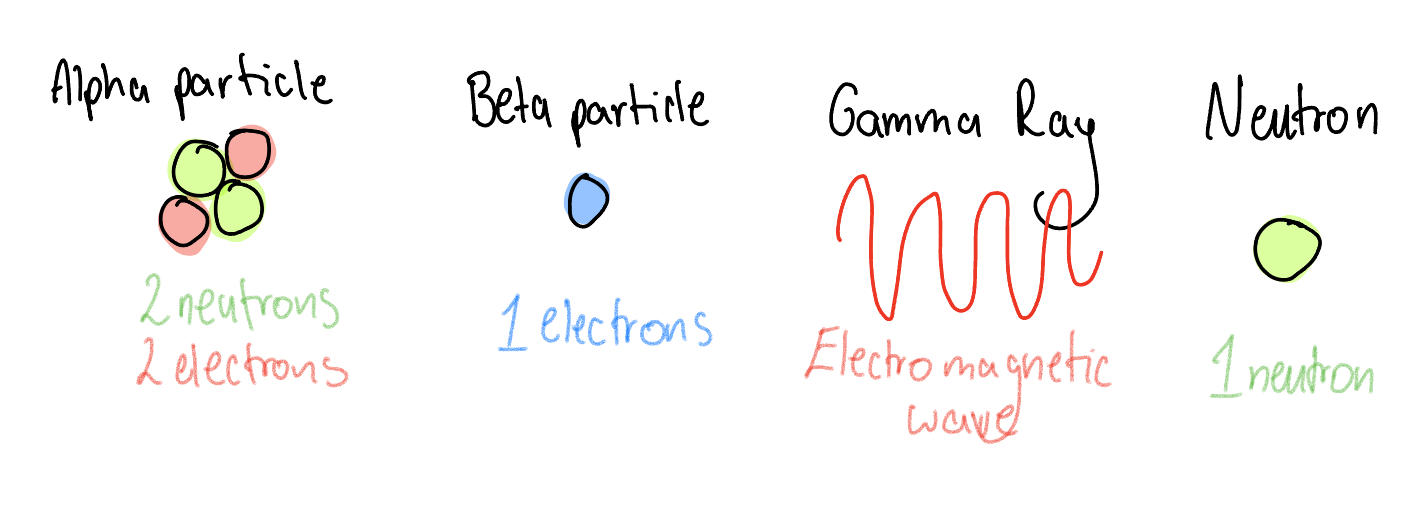
Charge of +1 (affected by electric fields)
16
What is a gamma ray?
High energy EM wave
No charge (not affected by electric fields)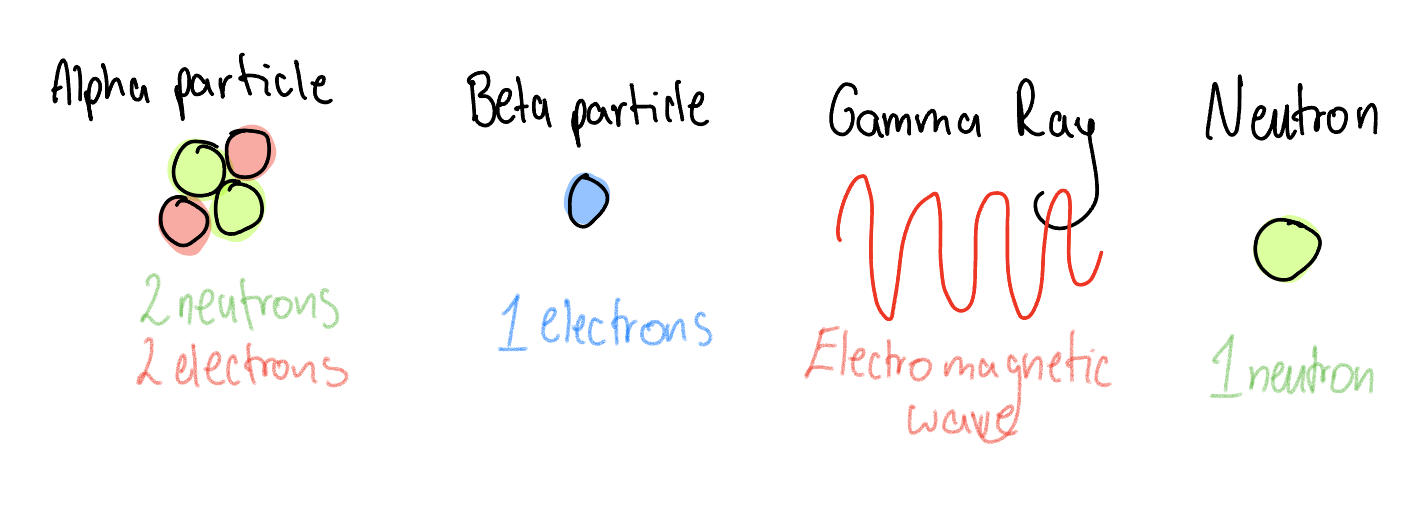
No charge (not affected by electric fields)
17
What particle is emitted in neutron radiation?
A neutron
18
Range, penetration and ionisation of alpha particle
Few cm, stopped by paper, strongly ionising
19
Range, penetration and ionisation of beta-minus particle
Few 10s of cm, stopped by a few mm of aluminium, moderately ionising
20
Range, penetration and ionisation of gamma ray
Infinite, stopped by a few mm of lead, weakly ionising
21
Compare penetration of alpha, beta and gamma
Alpha is least penetrating
Beta is more penetrating than alpha, but less penetrating than Gamma
Gamma is most penetrating
Beta is more penetrating than alpha, but less penetrating than Gamma
Gamma is most penetrating
22
Compare ionising power of alpha, beta and gamma
Alpha is most ionising
Beta is less ionising than Alpha, but more ionising than Gamma
Gamma is least ionising
Beta is less ionising than Alpha, but more ionising than Gamma
Gamma is least ionising
23
Why does more ionising radiation have a shorter range?
The more ionising, the sooner it will react with the air it is moving through
24
Describe JJ THompson’s plum pudding model
Negatively charged electrons in a positively charged dough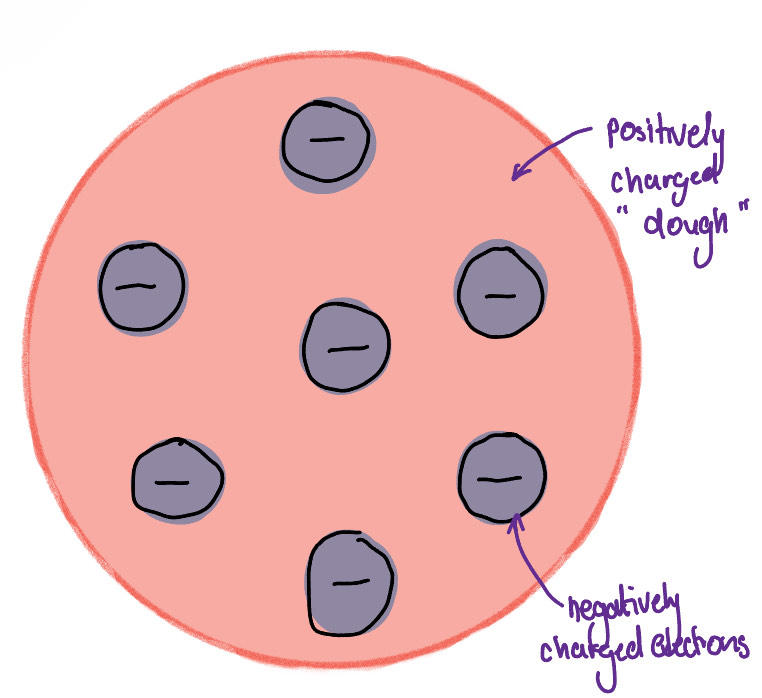
25
Describe how Rutherford’s alpha particle scattering experiment was conducted
A beam of alpha particles was directed at thin gold foil
26
What happened to the alpha particles in Rutherford’s alpha particle scattering experiment?
Most passed straight through
Some slightly changed direction
A few bounced back
Some slightly changed direction
A few bounced back
27
Why did most of the alpha particles pass straight through?
Positively charged alpha particles not affected
Atoms are mostly empty space
Atoms are mostly empty space
28
Why did some alpha particles slightly change direction?
Nucleus is positively charged
Alpha particles are positively charged
Positive charges repel
Alpha particles are positively charged
Positive charges repel
29
Why did only a few alpha particles rebound?
The nucleus of the atom is very very small
30
Rutherford’s nuclear model
Nearly all of the mass is concentrated in the centre of the atom
Nucleus is positively charged
Electrons orbit nucleus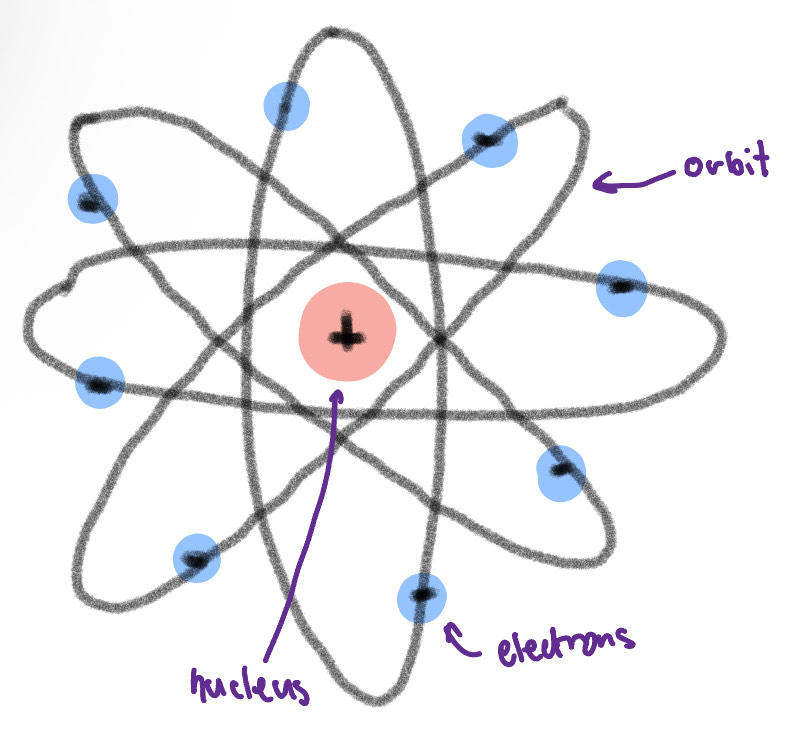
Nucleus is positively charged
Electrons orbit nucleus
31
Bohr model of an atom
Similar to nuclear model (mass concentrated in centre, positive nucleus)
Electrons orbit nucleus at different distances (energy levels)
2 electrons in first energy level, 8 electrons in second and third energy levels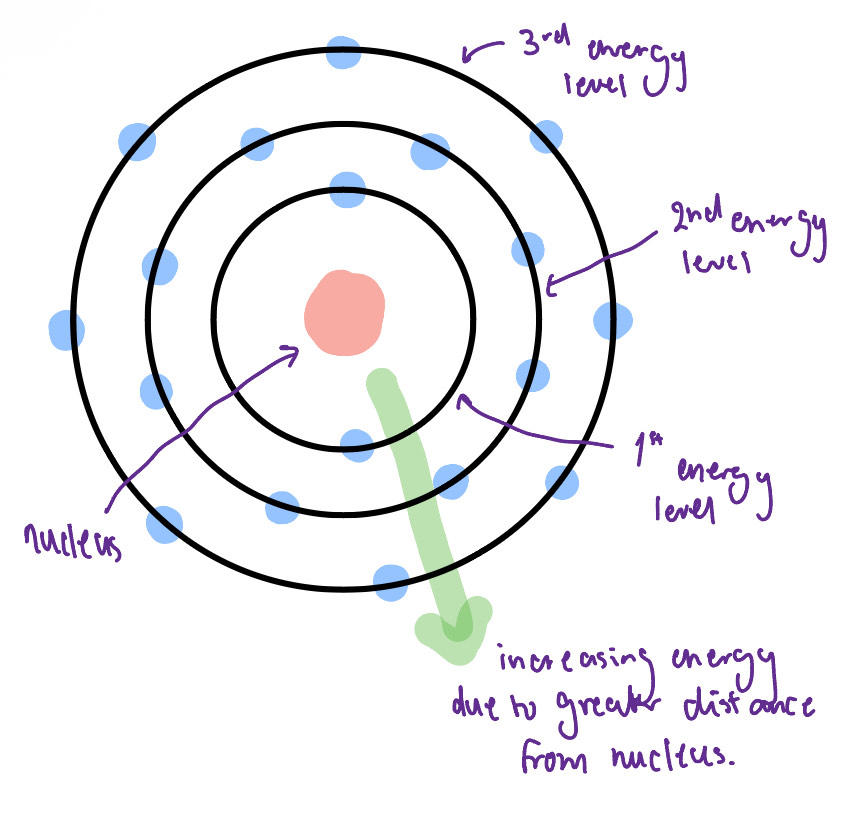
Electrons orbit nucleus at different distances (energy levels)
2 electrons in first energy level, 8 electrons in second and third energy levels
32
Why is the Bohr model of the atom accepted over the nuclear model?
It can explain the process of absorption and emission of EM radiation
33
When does beta-minus decay occur?
When a nucleus has too many neutrons
34
What happens during beta-minus decay?
A neutron changes into a proton and an electron
The proton remains in the nucleus
The electron (beta-minus particle) is emitted
The proton remains in the nucleus
The electron (beta-minus particle) is emitted
35
When does beta-plus decay occur?
When a nucleus has too many protons
36
What happens during beta-plus decay?
A proton changes into a neutron and an positron
The neutron remains in the nucleus
The positron (beta-plus particle) is emitted
The neutron remains in the nucleus
The positron (beta-plus particle) is emitted
37
What happens to the atomic and mass number when an alpha particle is emitted from a nucleus?
Atomic number decreases by 2
Mass number decreases by 4
Mass number decreases by 4
38
What happens to the atomic and mass number when a beta-minus particle is emitted from a nucleus?
Atomic number increases by 1
Mass number does not change
Mass number does not change
39
What happens to the atomic and mass number when a beta-plus particle is emitted from a nucleus?
Atomic number decreases by 1
Mass number does not change
Mass number does not change
40
What happens to the atomic and mass number when a gamma ray is emitted from a nucleus?
Atomic number does not change
Mass number does not change
Mass number does not change
41
What happens to the atomic and mass number when a neutron is emitted from a nucleus?
Atomic number does not change
Mass number decreases by 1
Mass number decreases by 1
42
What often happens to nuclei that have undergone radioactive decay?
Nuclear rearrangement (change in structure)
Loss of energy as gamma radiation
Loss of energy as gamma radiation
43
What happens to the activity of a radioactive isotope over a period of time and why?
As an isotope decays, the number of nuclei left will decrease
meaning activity will decrease
meaning activity will decrease
44
Unit of activity of a radioactive isotope
Becquerel (Bq)
1 decay per second
1 decay per second
45
Define half-life
Time taken for half the undecayed nuclei to decay
Time taken for the activity of a source to reduce by half
Time taken for the activity of a source to reduce by half
46
Explain the random nature of decay (4 marks)
Radioactive decay is a random process
You cannot predict which nucleus will decay next
You cannot predict when a nucleus will decay
You can predict the activity of large numbers of nuclei with the half-life
You cannot predict which nucleus will decay next
You cannot predict when a nucleus will decay
You can predict the activity of large numbers of nuclei with the half-life
47
Why is ionisiing radiation dangerous to human cells?
Can cause tissue damage and mutations
Can also cause skin burns
and reduce white blood cells in blood - weakening immune system
Can also cause skin burns
and reduce white blood cells in blood - weakening immune system
48
How can tissue damage caused by ionising radiation be useful and what do you need to be careful of?
Ionising radiation can be used to destroy cancerous tumour cells
However it can damage healthy tissue if not targetted properly.
However it can damage healthy tissue if not targetted properly.
49
How can ionising radiation cause mutations in DNA?
Radiation ionises atom in a DNA strand
DNA strand becomes damaged
Cell dies or DNA becomes mutated
If mutated, the cell can replicate and form a tumour (example of cancer)
DNA strand becomes damaged
Cell dies or DNA becomes mutated
If mutated, the cell can replicate and form a tumour (example of cancer)