GCSE Edexcel Physics 4.2 - Sound
Study these flashcardsFree · spaced repetition · iPhone, Android, Mac & web
All cards
1
A type of pressure wave with compressions (regions of high density) and rarefactions (regions of low density)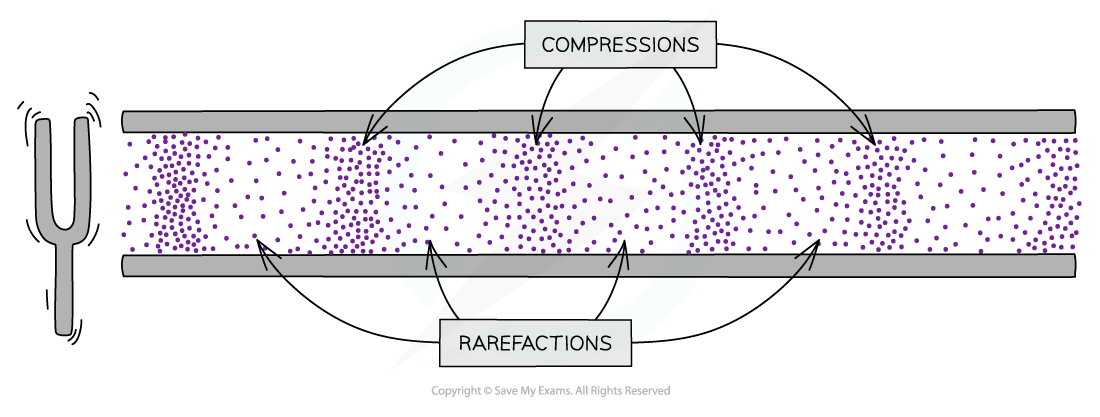
2
What happens when a sound wave reaches a solid?
It causes the solid to vibrate in sync with the sound wave
Some of the energy is transmitted, some reflected and some absorbed.
Some of the energy is transmitted, some reflected and some absorbed.
3
Explain natural frequency
The frequency at which a solid will vibrate after it has been disturbed.
4
How will sound waves with a frequency closer to the natural frequency of an object affect the object?
They will cause larger vibrations. Frequencies closer to the natural frequency will be transferred more efficiently.
5
Explain how humans hear sound (6 marks)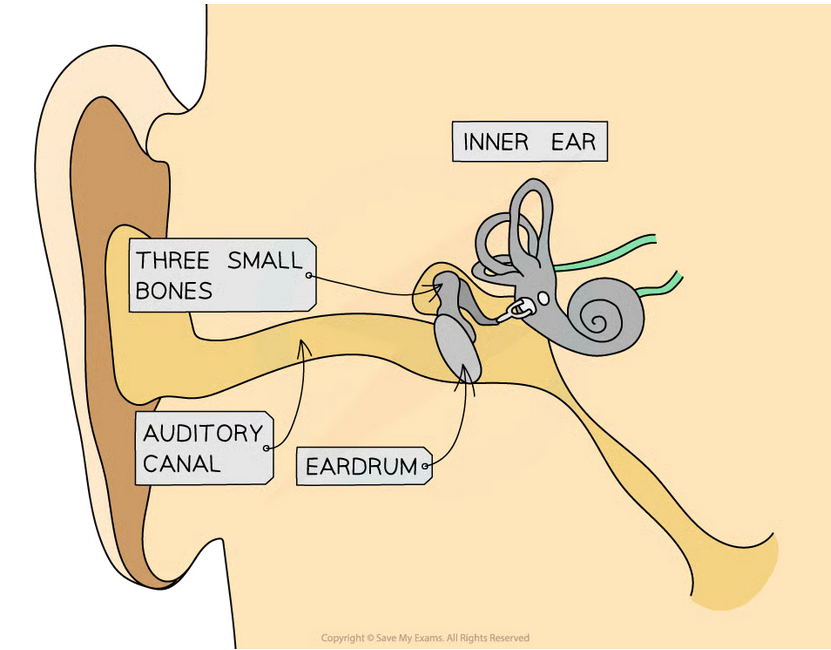
Sound waves travel down the auditory canal
and cause the ear drum to vibrate
The ear drum causes the small bones in the ear to vibrate.
The small bones amplify the vibrations and transfer them to the liquid in the cochlea
Tiny hairs inside the cochlea detect vibrations
and send electrical impulses along the auditory nerve to the brain.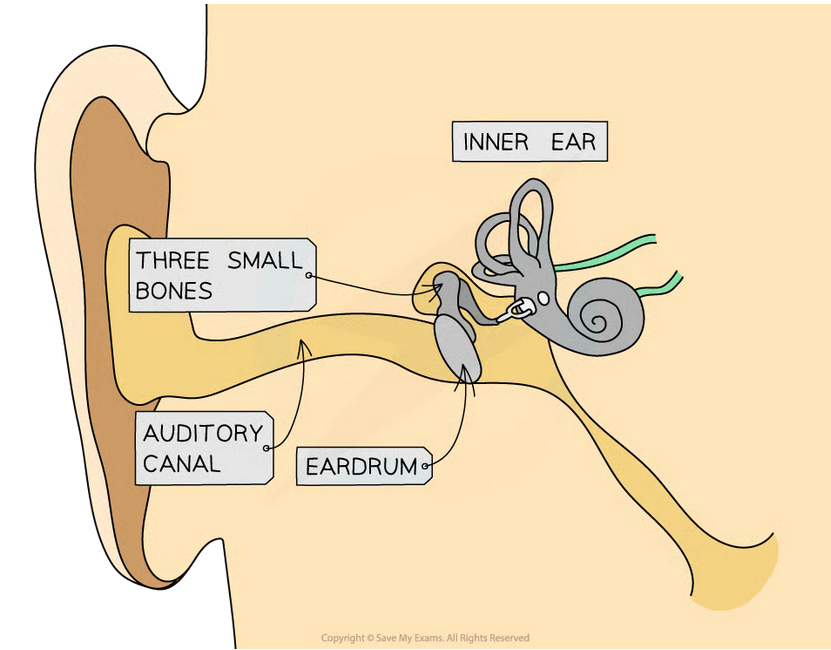
and cause the ear drum to vibrate
The ear drum causes the small bones in the ear to vibrate.
The small bones amplify the vibrations and transfer them to the liquid in the cochlea
Tiny hairs inside the cochlea detect vibrations
and send electrical impulses along the auditory nerve to the brain.
6
What is the range of frequencies humans can hear?
20Hz to 20,000Hz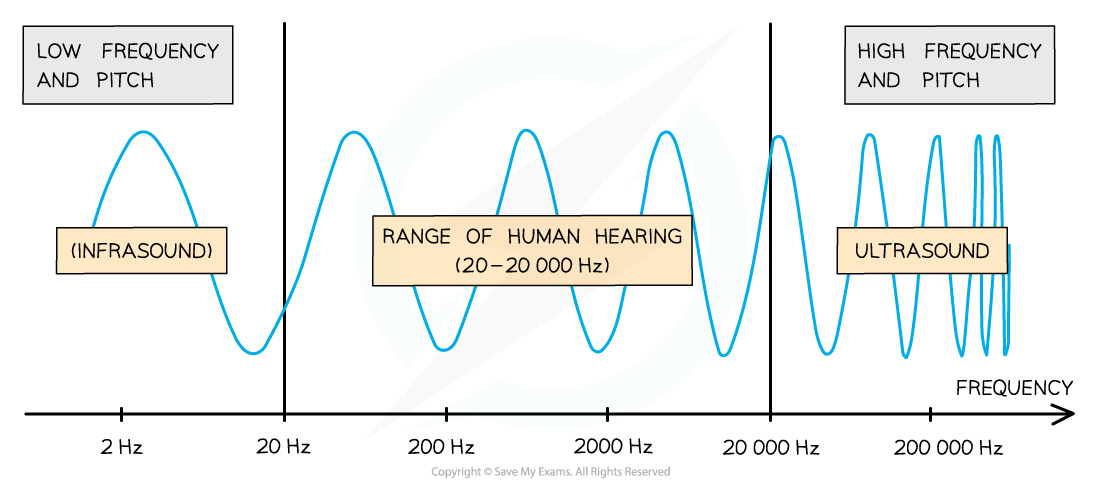
7
Why can astronauts not hear sounds from outside their spacesuits?
Sound waves need particles to travel
Space is a vacuum (no particles in space)
Space is a vacuum (no particles in space)
8
What are sound waves with frequencies lower than 20Hz called?
Infrasound
9
Define infrasound
Sound waves with frequencies lower than 20Hz
10
What are sound waves with frequencies higher than 20,000Hz called?
Ultrasound
11
Define ultrasound
Sound waves with frequencies higher than 20,000Hz
12
Explain how sonar can be used for detecting objects underwater
Sonar uses ultrasound
The sound wave is reflected off the ocean floor
The time it takes for the sound wave to return is used to calculate depth of water
The distance the wave travels is twice the depth of the ocean
The sound wave is reflected off the ocean floor
The time it takes for the sound wave to return is used to calculate depth of water
The distance the wave travels is twice the depth of the ocean
13
Explain how foetal scanning works
A pulse of ultrasound is emitted by transducer
The pulse reflects at boundaries in the body
The reflected pulse is detected by transducer
The signal is processed to create an image
The pulse reflects at boundaries in the body
The reflected pulse is detected by transducer
The signal is processed to create an image
14
What are the benefits of using ultrasound for foetal scanning over other imaging techniques
Non-invasive and harmless
15
What two types of waves are produced by earthquakes?
P-waves (primary waves) and S-waves (secondary waves)
16
What can be used to detect P-waves and S-waves
Seismometers
17
Features of P-waves
Longitudinal waves - oscillations parallel to the direction of the wave
Faster than S-waves
Can pass through solids and liquids
Frequencies below 20Hz - infrasound
Faster than S-waves
Can pass through solids and liquids
Frequencies below 20Hz - infrasound
18
Features of S-waves
Transverse waves - oscillations perpendicular to the direction of the wave
Slower than P-waves
Can only travel through solids
Slower than P-waves
Can only travel through solids
19
What are the layers of the earth and their states?
Crust - solid
Mantle - solid
Outer core - liquid
Inner core - solid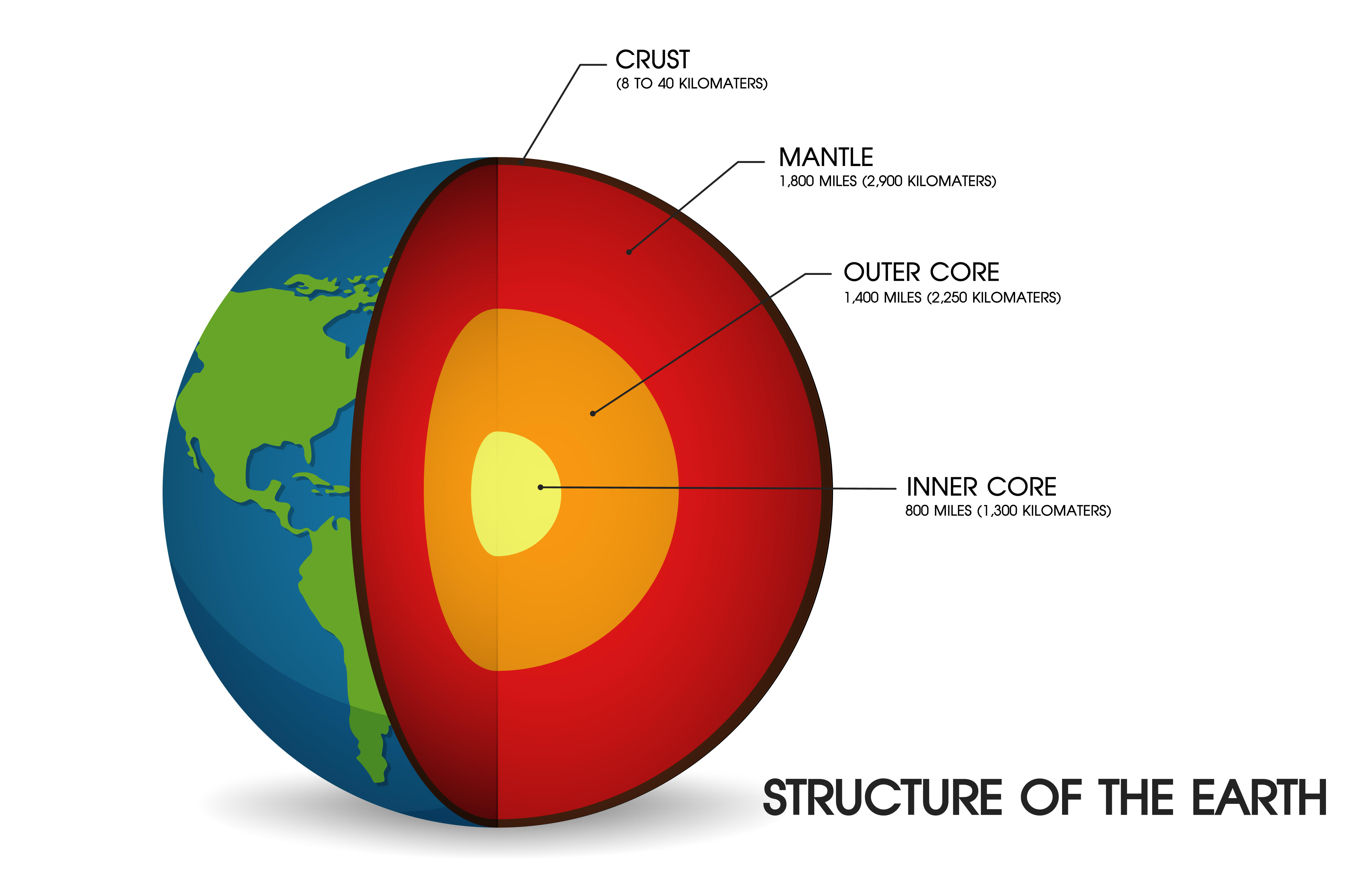
Mantle - solid
Outer core - liquid
Inner core - solid
20
How do we know that the outer core is liquid?
When an earthquake happens:
Only P-waves are detected on the opposite side of the Earth, not S-waves.
P-waves can travel through liquids, S-waves cannot.
Only P-waves are detected on the opposite side of the Earth, not S-waves.
P-waves can travel through liquids, S-waves cannot.
21
How do we know that the inner core is solid?
Refractions between layers cause two shadow zones where no P-waves are detected.
22
How do we know the mantle is solid?
Both P-waves and S-waves can pass through it.
Both can pass through solids
Both can pass through solids
23
Compare the speed of sound in solids, liquids and gases
In solids, molecules are very close together so energy is transferred between molecules fastest.
In gases, molecules are spread out so energy is transferred between molecules slowest.
In liquids, molecules are close together so energy is transferred faster than in gases but slower than in solids.
In gases, molecules are spread out so energy is transferred between molecules slowest.
In liquids, molecules are close together so energy is transferred faster than in gases but slower than in solids.
24
What changes when a sound wave moves from one medium to another?
Wave speed and wave length
Frequency does not change
Frequency does not change
25
How does temperature affect speed of sound?
When colder: Sound waves travel slower
When it is warmer: sound waves travel faster
When it is warmer: sound waves travel faster