1.5 Types Of Substance
Study these flashcardsFree · spaced repetition · iPhone, Android, Mac & web
All cards
1
Properties of Ionic Compounds
High melting point
High boiling point
Non-volatile
Usually soluble in water
Can conduct electricity when molten or dissolved in water
Cannot conduct electricity when solid
High boiling point
Non-volatile
Usually soluble in water
Can conduct electricity when molten or dissolved in water
Cannot conduct electricity when solid
2
Explain why Ionic Compounds have a high melting and boiling point, and are non-volatile
A lot of energy is required to break many ionic bonds
3
Explain why Ionic Compounds can conduct electricity only if they are molten or dissolved in water
Ions can carry charge
When solid, ions cannot move
When liquid or dissolved, ions are able to move
When solid, ions cannot move
When liquid or dissolved, ions are able to move
4
Properties of Simple Covalent Molecules
Low melting point
Low boiling point
Volatile
Cannot conduct electricity
Low boiling point
Volatile
Cannot conduct electricity
5
Explain why Simple Covalent Molecules have low melting and boiling points, and are volatile
Weak intermolecular forces are easily overcome
6
What happens to the melting and boiling points of Simple Covalent Molecules as molecular size increases? Why?
As molecular size increases, the intermolecular forces increase
So melting and boiling point increases
So melting and boiling point increases
7
Why can Simple Covalent Molecules not conduct electricity?
They do not have free electrons
8
Properties of Giant Covalent Structures
High melting point
High boiling point
Most cannot conduct electricity (graphite is exception)
High boiling point
Most cannot conduct electricity (graphite is exception)
9
Why do Giant Covalent Structures have high melting and boiling points?
A lot of energy is required to overcome many strong covalent bonds
10
Why can most Giant Covalent Structures not conduct electricity?
They do not contain free electrons
11
How do metal atoms bond?
Atoms lose valence electrons
And become positive metal ions
Form a sea of delocalised electrons around ions
Very strong attraction between positive metal ions and negative electrons
And become positive metal ions
Form a sea of delocalised electrons around ions
Very strong attraction between positive metal ions and negative electrons
12
Describe the structure of metals
Positive metal ions
arranged in a metal lattice
surrounded by a sea of delocalised electrons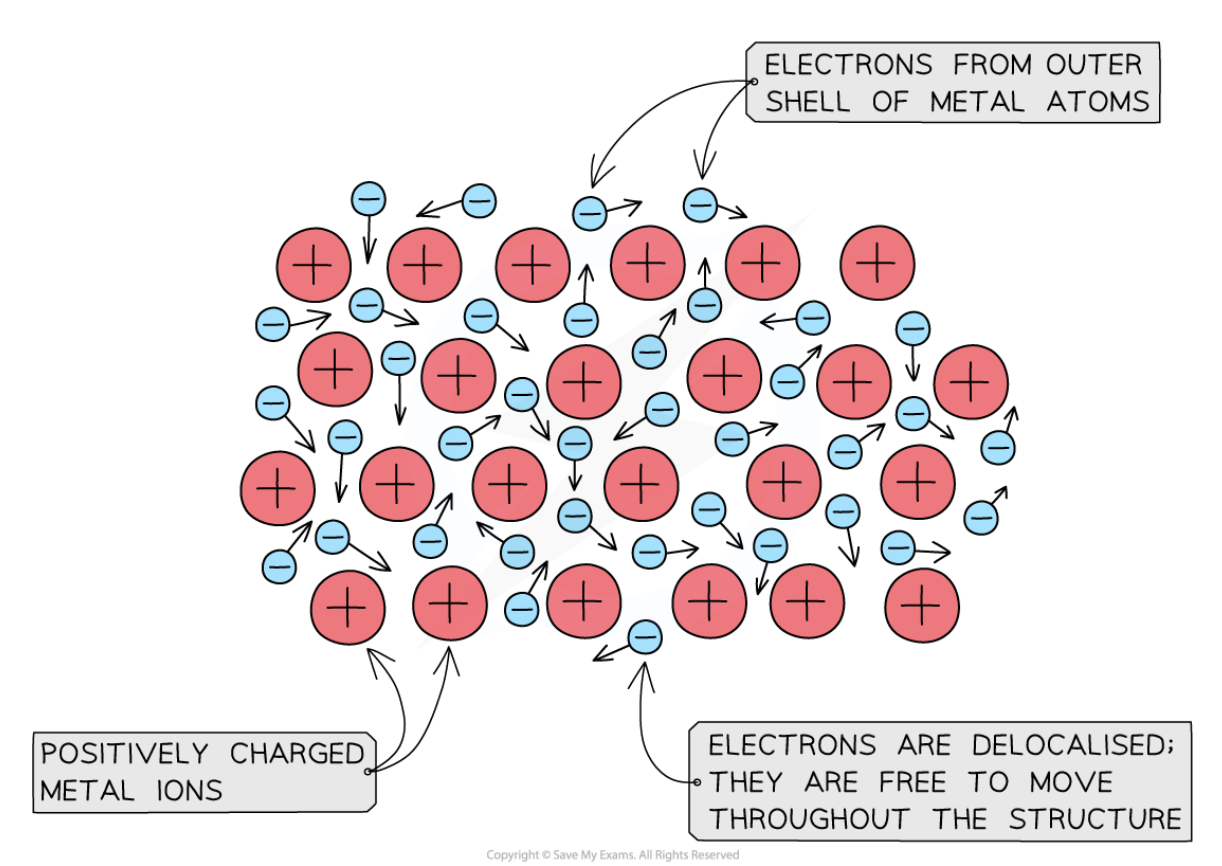
arranged in a metal lattice
surrounded by a sea of delocalised electrons
13
Properties of metals
High melting point
High boiling point
Insoluble in water (but some react with water)
Good conductors of heat
Good conductors of electricity
Malleable
Shiny solids
High density
High boiling point
Insoluble in water (but some react with water)
Good conductors of heat
Good conductors of electricity
Malleable
Shiny solids
High density
14
What is meant by the term ‘malleable’
Can be hammered and bent into shapes
15
Why are the melting and boiling points of metals high?
Metallic bonds are very strong
16
What makes metals good conductors of heat and electricity?
Delocalised electrons
Which are free to move throughout metal lattice
Which are free to move throughout metal lattice
17
What makes metals malleable?
Layers of atoms can slide over each other
18
Definition of allotropes
Different structural forms of the same element
19
Allotropes of carbon
Diamond
Graphite
Graphene
Fullerenes
Carbon Nanotubes
Graphite
Graphene
Fullerenes
Carbon Nanotubes
20
Describe the structure of diamond
Giant covalent structure made from carbon
Each carbon atom bonds with 4 other carbons (forming tetrahedron)
All covalent bonds are strong and identical
No intermolecular forces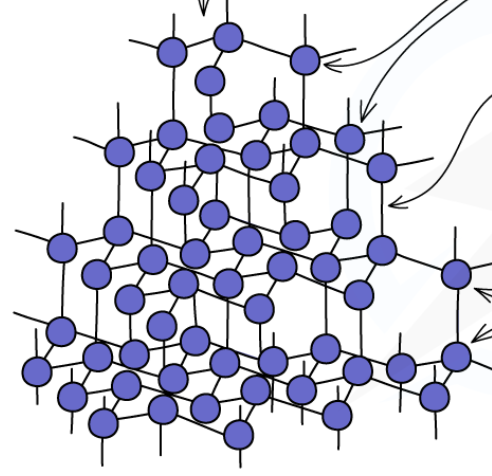
Each carbon atom bonds with 4 other carbons (forming tetrahedron)
All covalent bonds are strong and identical
No intermolecular forces
21
Properties of diamond
Very high melting point
Does not conduct electricity
Extremely hard (but brittle)
Does not conduct electricity
Extremely hard (but brittle)
22
Explain why diamond has a very high melting point
It takes a lot of energy to break the many covalent bonds between atoms
23
Explain why diamond does not conduct electricity
All 4 of carbon’s outer shell electrons are used to bond so no freely moving electrons
24
Why is diamond used to coat cutting tools and drill bits?
It is extremely hard - does not wear out quickly
It has a very high melting point - can withstand heat from friction
It has a very high melting point - can withstand heat from friction
25
Describe the structure of graphite
Giant covalent structure made from carbon
Each carbon atom bonds with 3 other carbons (forming layers of hexagons)
Very strong covalent bonds between atoms in layers
Weak intermolecular forces between layers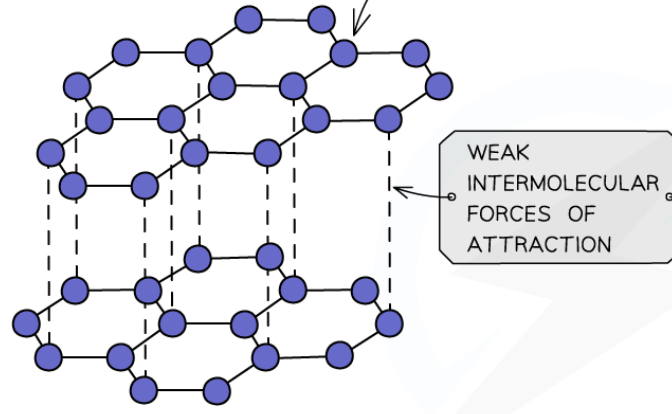
Each carbon atom bonds with 3 other carbons (forming layers of hexagons)
Very strong covalent bonds between atoms in layers
Weak intermolecular forces between layers
26
Properties of graphite
Very high melting point
Conducts electricity and heat
Soft and slippery
Conducts electricity and heat
Soft and slippery
27
Explain why graphite has a very high melting point
It takes a lot of energy to break the many covalent bonds between atoms in layers
28
Explain why graphite conducts electricity and heat
Each carbon only bonds with 3 other carbons
One free electron in outer shell (per atom)
Freely moving electrons present
One free electron in outer shell (per atom)
Freely moving electrons present
29
Explain why graphite is soft and slippery
Weak intermolecular forces between layers
So layers can slide over each other
So layers can slide over each other
30
Explain why graphite is used to make pencils and as a lubricant
Weak intermolecular forces between layers
Which means they can slide over each other
Which means they can slide over each other
31
Explain why graphite is used to make electrodes for electrolysis
It can conduct electricity
Because it has freely moving electrons
Because it has freely moving electrons
32
Describe the structure of graphene
Single layer of graphite
Each carbon atom bonds with 3 other carbons (forming layers of hexagons)
Very strong covalent bonds between atoms
One atom thick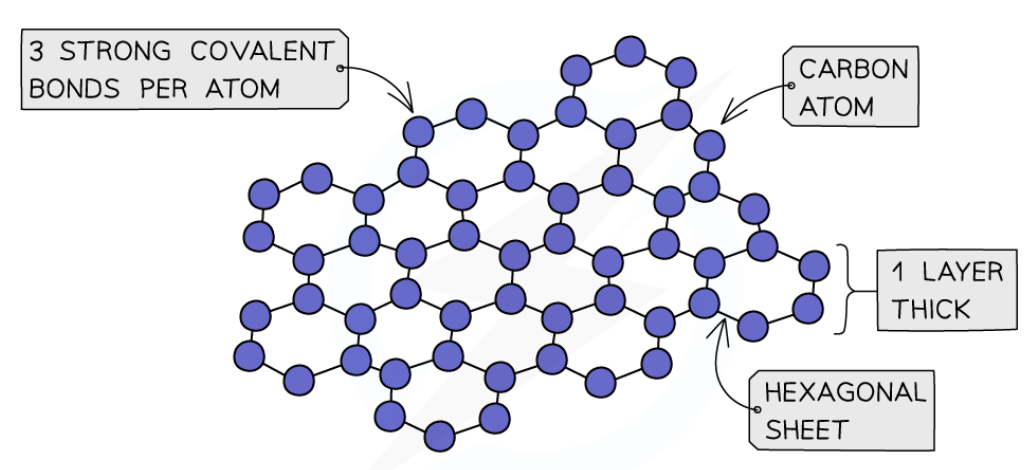
Each carbon atom bonds with 3 other carbons (forming layers of hexagons)
Very strong covalent bonds between atoms
One atom thick
33
Properties of graphene
Extremely strong
Amazingly light
Conducts heat and electricity
Transparent
Flexible
Amazingly light
Conducts heat and electricity
Transparent
Flexible
34
Describe the structure of fullerenes
Molecules that form hollow tubes or spheres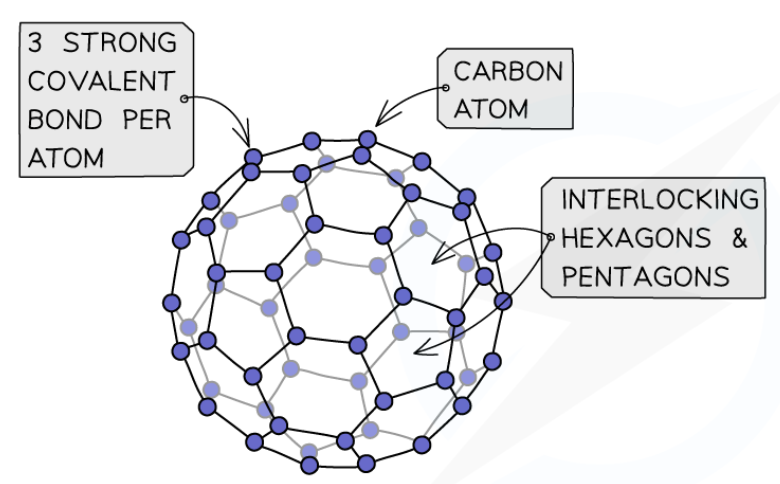
35
First fullerene to be discovered
Buckminsterfullerene - C₆₀
Made from 60 carbon atoms
Made from 60 carbon atoms
36
Properties of fullerenes
Hollow
Huge surface area
Huge surface area
37
Properties of Buckminsterfullerene C₆₀
Spherical
Some delocalised electrons but not across entire structure - electrical insulator
Some delocalised electrons but not across entire structure - electrical insulator
38
Why are (buckminster)fullerenes useful as electrical insulators?
Some electrons delocalised but not across entire structure
39
Why are (buckminster)fullerenes useful as lubricants?
They have a spherical shape and weak intermolecular forces
They can roll over each other reducing friction
They can roll over each other reducing friction
40
Why are fullerenes useful for targeted drug delivery systems?
They are hollow, and can be used to transport other molecules to specific areas of the body
41
Why are fullerenes useful as catalysts?
Large surface area allows particles to attach to surface and be more easily accessible
42
How can carbon nanotubes be made?
Graphene rolled into a tube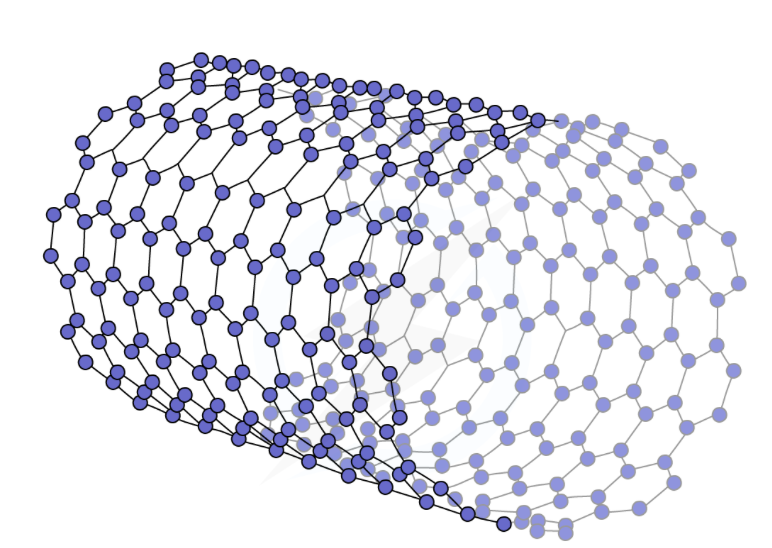
43
Properties of carbon nanotubes
High tensile strength
Resistance to stretching and breaking
Delocalised electrons
Resistance to stretching and breaking
Delocalised electrons
44
Why are carbon nanotubes useful in composite materials?
High tensile strength and resistance to stretching and breaking can increase the strength of materials
45
Why are carbon nanotubes useful in electronics?
Delocalised electrons - conduct electricity
46
Describe the structure of polymers
Large molecules built by linking smaller molecules (called monomers)
Solid at room temperature due to strong intermolecular forces between molecules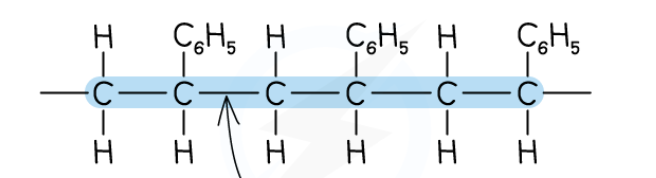
Solid at room temperature due to strong intermolecular forces between molecules
47
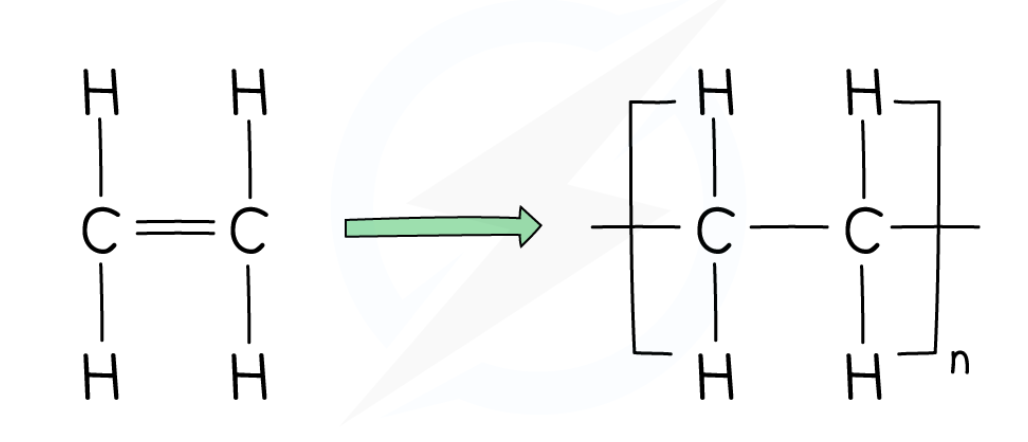
What is poly(ethene)
Polymer formed from many ethene monomers