GCSE Edexcel Physics 2.3 + 2.HT - Circular Motion & Momentum
Study these flashcardsFree · spaced repetition · iPhone, Android, Mac & web
All cards
1
Describe the velocity of an object moving in a circular orbit at a constant speed
Speed is constant
Velocity is constantly changing
because the direction is changing.
Velocity is constantly changing
because the direction is changing.
2
What is the force that causes circular motion or orbiting?
Centripetal force
Acts towards the centre of the circle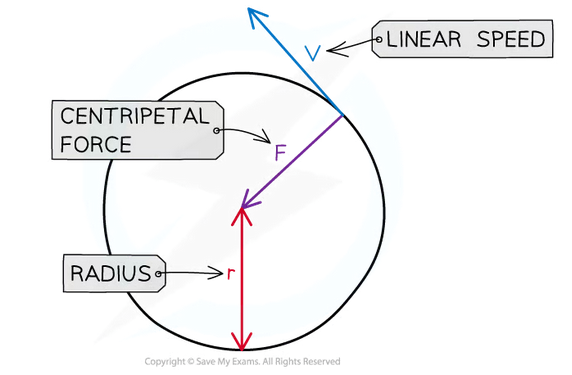
Acts towards the centre of the circle
3
Is the moon orbiting the Earth at a constant SPEED an example of Newton’s first law?
No! The moon is constantly changing direction
so velocity is changing/not constant
There is a centripetal force (gravitational force).
so velocity is changing/not constant
There is a centripetal force (gravitational force).
4
Name the centripetal force which acts when a satellite orbits a planet
Gravitational force
5
Is a car going around a racetrack at constant SPEED an example of Newton’s first law
No! The moon is constantly changing direction
so velocity is changing/not constant
There is a centripetal force (friction).
so velocity is changing/not constant
There is a centripetal force (friction).
6
What quantities are constant in circular motion?
Size of centripetal force
Size of acceleration
Speed (Not velocity)
Radius
Size of acceleration
Speed (Not velocity)
Radius
7
What is Inertia (3 marks)
An object’s resistance to a change in motion
If an object is at rest, it will tend to remain at rest
If an object is moving at a constant velocity it will continue to do so
If an object is at rest, it will tend to remain at rest
If an object is moving at a constant velocity it will continue to do so
8
Inertial Mass (3 marks)
How difficult it is to change the velocity of an object
Defined as ratio of force over acceleration
Inertial mass (kg) = force (N) ÷ acceleration (m/s²)
m=F/a
Defined as ratio of force over acceleration
Inertial mass (kg) = force (N) ÷ acceleration (m/s²)
m=F/a
9
Relationship between inertial mass and acceleration
Inertial mass is inversely proportional to acceleration
Larger inertial masses - smaller acceleration
Smaller inertial masses - larger acceleration
Larger inertial masses - smaller acceleration
Smaller inertial masses - larger acceleration
10
Conservation of momentum
In a closed system:
total momentum before collision = total momentum after collision
total momentum before collision = total momentum after collision
11
Meaning of closed system
Energy is constant
No external forces
No external forces
12
Momentum definition (equation)
Momentum (kgm/s) = mass (kg) x velocity (m/s)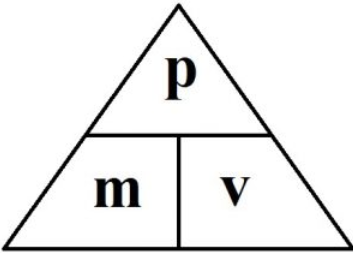
13
Momentum changes when…
Object accelerates or decelerates
Changes direction
Mass changes
Changes direction
Mass changes
14
(Perfectly) Elastic Collisions
When objects collide and move in opposite directions
K.E. before collision = K.E after collision
No energy is dissipated to the surroundings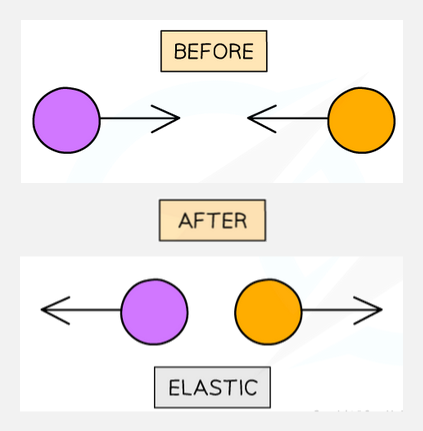
K.E. before collision = K.E after collision
No energy is dissipated to the surroundings
15
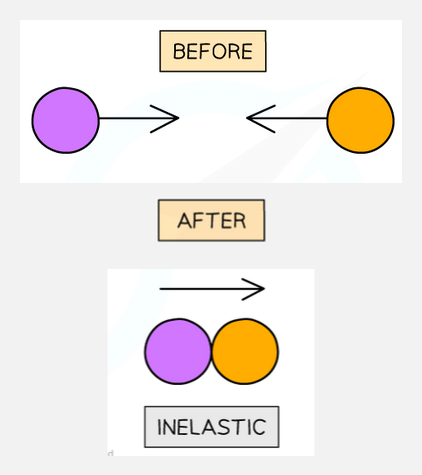
(Perfectly) Inelastic Collisions
Usually when objects collide and move in the same direction together (combined mass and velocity)
Kinetic energy is not conserved
Energy may be dissipated to the surroundings through heat or sound
Kinetic energy is not conserved
Energy may be dissipated to the surroundings through heat or sound
16
Force and momentum equation
Force (N) = change in momentum (kgm/s) ÷ time (s)
F = Δp / t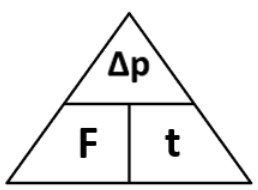
F = Δp / t
17
Calculating change in momentum
Δp = mv - mu
18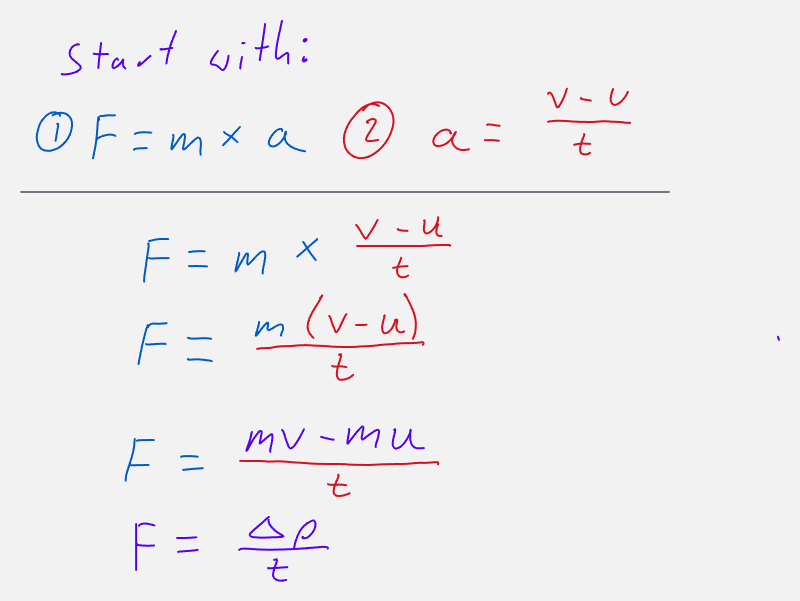
Derivation of force and momentum equation from Newton’s second law