GCSE Edexcel Physics 2.4 - Stopping Distances
Study these flashcardsFree · spaced repetition · iPhone, Android, Mac & web
All cards
1
Reaction time
Time between seeing something and reacting to it
2
Human reaction time for someone who is alert
0.2-0.9 seconds
3
Measuring a person’s human reaction time
Hold ruler so bottom is just over the person's hand
Release the ruler unexpectedly
Person closes hand and catches ruler
Mark the point where caught
Greater distance fallen means longer reaction time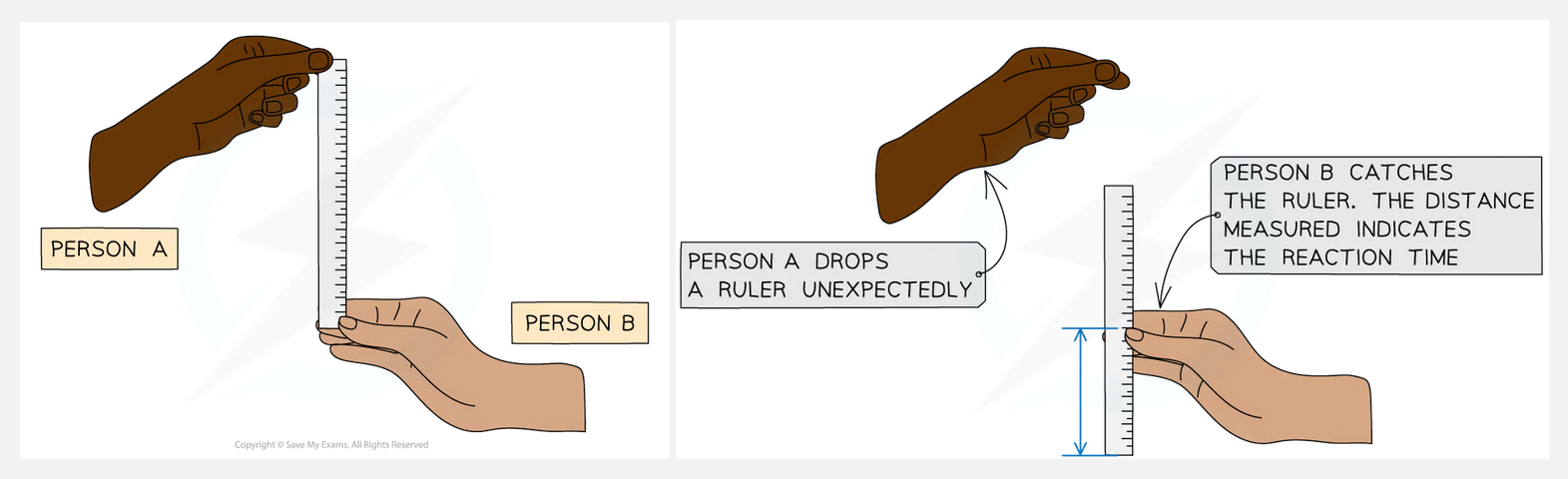
Release the ruler unexpectedly
Person closes hand and catches ruler
Mark the point where caught
Greater distance fallen means longer reaction time
4
Stopping Distance
Stopping distance = Thinking distance + Braking distance
5
Thinking distance (or Reaction distance)
Distance travelled in the time it takes the driver to react (in metres)
Thinking distance (m) = Speed of car (m/s) x Driver’s reaction time (s)
Thinking distance (m) = Speed of car (m/s) x Driver’s reaction time (s)
6
Braking distance
Distance travelled after driver applies brakes
Braking distance (m) = Kinetic Energy (J) / Braking force (N)
(Using W = F x d)
Braking distance (m) = Kinetic Energy (J) / Braking force (N)
(Using W = F x d)
7
Why does the braking distance equation not apply for very high speeds?
Brakes get hot and become less effective.
Braking force is reduced
Braking distance would increase even more.
Braking force is reduced
Braking distance would increase even more.
8
Main factor affecting braking distance
Speed - the greater the speed, the greater the braking distance
9
Factors affecting braking distance
Speed
Worn tyres or poor brakes (vehicle condition)
Wet or icy roads (road condition)
Greater mass of car
Worn tyres or poor brakes (vehicle condition)
Wet or icy roads (road condition)
Greater mass of car
10
Why do worn tyres, poor brakes, and wet or icy roads increase the stopping distance?
There is less friction between the tyres and road surface
11
Main factor affecting thinking distance
Speed - the greater the speed, the greater the thinking distance
12
Factors affecting thinking distance
Speed
Tiredness
Distractions (using a mobile phone)
Intoxication (drugs or alcohol)
Tiredness
Distractions (using a mobile phone)
Intoxication (drugs or alcohol)
13
Why can a large deceleration be dangerous? (4 marks)
Newton's second law - Force is proportional to acceleration (F=ma)
Large deceleration means large force
Drivers also experience force which can cause injuries (like whiplash).
+ It is more difficult to control a vehicle that is decelerating
Large deceleration means large force
Drivers also experience force which can cause injuries (like whiplash).
+ It is more difficult to control a vehicle that is decelerating
14
What is Whiplash?
When the driver’s head moves suddenly during large decelerations
Causes injuries
Causes injuries
15
Why can brakes fail?
There is friction between brake and wheels
Kinetic energy of wheel is transferred to thermal energy of brakes
If brakes get too hot, they can fail
Kinetic energy of wheel is transferred to thermal energy of brakes
If brakes get too hot, they can fail
16
Energy transfer when a vehicle brakes to a stop
Kinetic energy of vehicle is transferred to thermal energy in the brakes
Kinetic energy = Thermal Energy
Kinetic energy = Thermal Energy
17
Work done by brakes
W = F x d
= braking force (N) x braking distance (m)
= braking force (N) x braking distance (m)
18
Relationship between thinking distance and velocity
Thinking distance is proportional to velocity
If velocity double, thinking distance doubles
If velocity double, thinking distance doubles
19
Relationship between braking distance and velocity
Braking distance is proportional to the v²
If velocity doubles, thinking distance quadruples
(If velocity increases by a factor of x, braking distance increases by a factor of x²)
If velocity doubles, thinking distance quadruples
(If velocity increases by a factor of x, braking distance increases by a factor of x²)