GCSE Edexcel Physics 2.2 - Forces
Study these flashcardsFree · spaced repetition · iPhone, Android, Mac & web
All cards
1
State Newton's first law (3marks)
If there is no resultant force:
An object will continue moving at a constant velocity
Or remain at rest if stationary.
An object will continue moving at a constant velocity
Or remain at rest if stationary.
2
According to Newton’s first law if there is no resultant force… (2 marks)
A moving object will continue moving at a constant velocity
A stationary object will remain stationary
A stationary object will remain stationary
3
If an object is at rest or has a constant velocity…
Forces acting on an object are balanced
Resultant force is zero
Example of Newton's First Law
Resultant force is zero
Example of Newton's First Law
4
If the direction of an object changes but the speed stays the same…
Velocity is changing!
So there is a resultant force.
Not Newton’s First law!
So there is a resultant force.
Not Newton’s First law!
5
State Newton’s second law
Acceleration is proportional to the resultant force
Acceleration is inversely proportional to the mass
Acceleration is inversely proportional to the mass
6
Newton’s Second Law Equation
Force (N) = mass (kg) x acceleration (m/s²)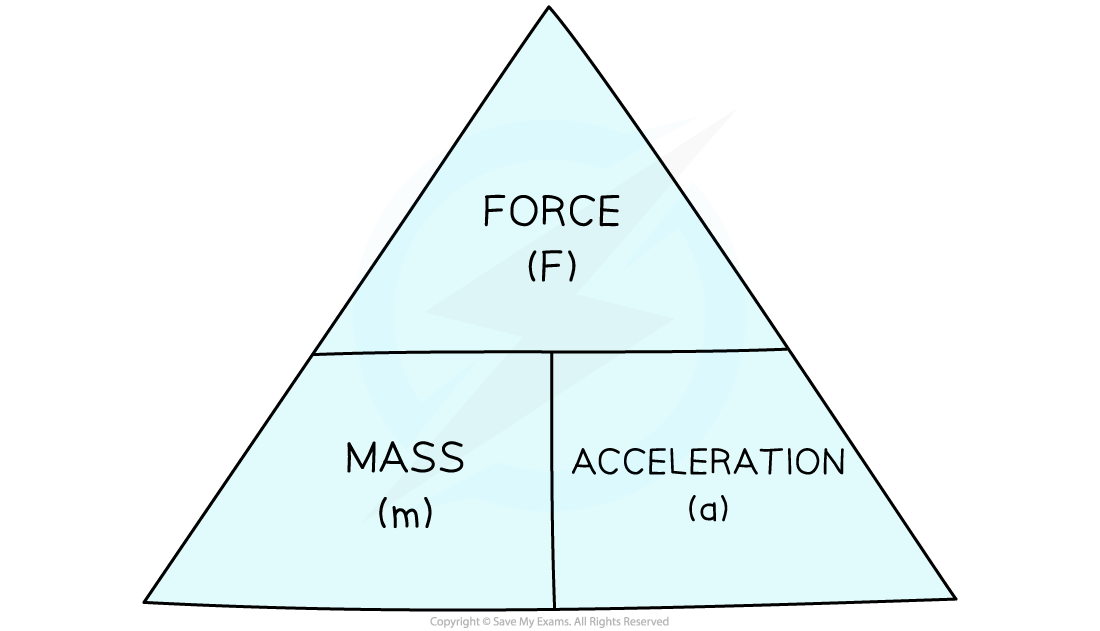
7
According to Newton’s second law… (3 marks)
If there is a resultant force, an object will accelerate (or decelerate)
The larger the resultant force, the larger the acceleration
The larger the mass, the smaller the acceleration
The larger the resultant force, the larger the acceleration
The larger the mass, the smaller the acceleration
8
Weight (definition)
Force due to gravitational attraction (N)
9
Two names for g (and units)
Acceleration due to gravity (m/s²)
Gravitational field strength (N/kg)
Gravitational field strength (N/kg)
10
Weight Equation
Weight (N) = mass (kg) x gravitational field strength (N/kg)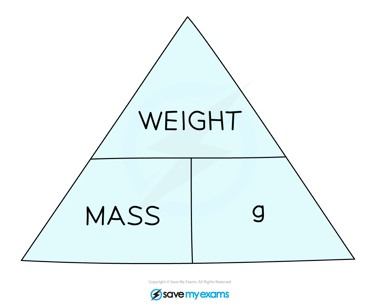
11
Mass (definition)
Measure of the amount of matter (kg)
12
Equipment used for measuring mass
(Electronic) Balance
13
What does a spring balance measure?
Weight
14
How to measure the mass of an object using a newton meter (2 marks)
Attach object to newton meter
The reading is the weight (in Newtons)
Use W=mg to calculate the mass.
The reading is the weight (in Newtons)
Use W=mg to calculate the mass.
15
Relationship between weight of a body and gravitational field strength.
Weight is proportional to gravitational field strength
As gravitational field strength increases, weight increases.
As gravitational field strength increases, weight increases.
16
State Newton’s Third Law
When two bodies interact, the forces they exert on each other are equal and opposite
17
Identifying Third Law pairs
Two forces acting on different objects
Equal in magnitude but opposite in direction
Same type of force (push or pull)
Equal in magnitude but opposite in direction
Same type of force (push or pull)
18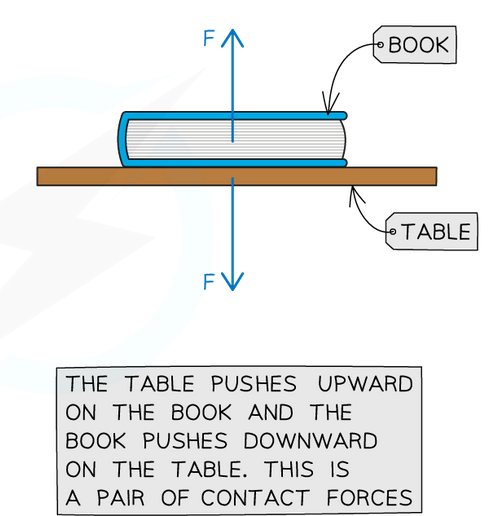
Force pair for book on table
19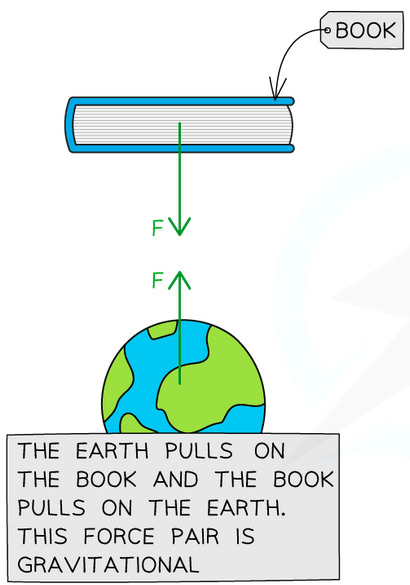
Force pair for book in freefall
20
Similarity and difference between Newtons 1'st and 3rd Law force diagrams
In both forces are equal and opposite
1st Law: Both forces acting on the same object
3rd Law: Forces acting on different objects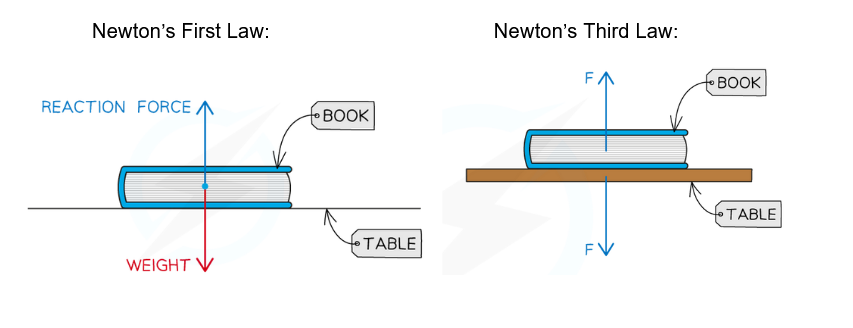
1st Law: Both forces acting on the same object
3rd Law: Forces acting on different objects