Section 8: aircraft separation
Study these flashcardsFree · spaced repetition · iPhone, Android, Mac & web
All cards
1
longitudinal separation
Expressed in miles or minutes
2
Lateral seperation
Expressed in miles, airways, or routes
3
Vertical separation.
Expressed in feet
- ifr and vfr aircraft are assigned different altitudes
- ifr and vfr aircraft are assigned different altitudes
4
Aircraft altitude assignment
If a aircra ft is flying below 18,000ft, then they will be issued
There own altimeter setting
There own altimeter setting
5
Vertical seperation minima
- 1,000ft for aircraft up to and including FL410
- 2000ft for aircraft above FL410 to FL600
- 5000ft for aircraft above FL600
- 2000ft for aircraft above FL410 to FL600
- 5000ft for aircraft above FL600
6
Why do we have vertical separation?
Due to altimeter errors the higher the aircraft is
7
Reduced vertical separation minima (rvsm)
- For operations between FL290 - FL410
- allows a minimum of 1000ft vert separation, 2000ft for
Aircrafts flying opposite, and 4000ft for aircraft on same
Course
- aircrafts flying this below altitude are assigned odd Fl numbers
- aircrafts below 18,000ft fly fl based on magnetie course
- allows a minimum of 1000ft vert separation, 2000ft for
Aircrafts flying opposite, and 4000ft for aircraft on same
Course
- aircrafts flying this below altitude are assigned odd Fl numbers
- aircrafts below 18,000ft fly fl based on magnetie course
8
Non-RVSM aircrafts
- aircrafts that are not equipped with adequate autopilot
Or altimeters
-must be assigned FL280 or lower or FL430 or higher
- 2000ft vertical seperation must be maintained
- special government or manufactured a/c are an exception
But must keep 2000 ft vertical seperation
Or altimeters
-must be assigned FL280 or lower or FL430 or higher
- 2000ft vertical seperation must be maintained
- special government or manufactured a/c are an exception
But must keep 2000 ft vertical seperation
9
Non-Rvsm and Non-Rvsm Seperation
- Minimum 2000ft vertical seperation required between
FL290 - FL410
- an additional 5 miles radar and lateral separation is
Required between IFR and fuel dumping aircraft
FL290 - FL410
- an additional 5 miles radar and lateral separation is
Required between IFR and fuel dumping aircraft
10
Block altitude
Range of altitudes pilot may operate
- standard vertical separation is provided
- standard vertical separation is provided
11
Dumping fuel seperation
- Through FL410 1000ft above
-above FL410 is 2000ft
- regardless of altitude, 2000ft
-above FL410 is 2000ft
- regardless of altitude, 2000ft
12
Separation below aircraft dumping fuel
- Always a minimum of 2000ft
- 5 miles of radar and lateral seperation for VFR and IFR aircraft
- 5 miles of radar and lateral seperation for VFR and IFR aircraft
13
Vertical separation for SUA areas
For up to and including FL290
- 500 ft above and or below the upper or lower limit
Above FL290
- by at least l000ft above or below the upper/lower limit
* in the real world ATC may tell aircraft to remain 1000ft aboveelow a SUA
- 500 ft above and or below the upper or lower limit
Above FL290
- by at least l000ft above or below the upper/lower limit
* in the real world ATC may tell aircraft to remain 1000ft aboveelow a SUA
14
Non-radar
- Used by atc to indicate aircraft are not under radar contact
- occurs in mountainous areas
- means radar facility cannot pickup aircraft signal
- occurs in mountainous areas
- means radar facility cannot pickup aircraft signal
15
Lateral seperation
Lateral spacing of aircraft at the same altitude by requiring them to fly different routes or geographical locations
16
Lateral non-radar seperation
Applied in traffic situations when neither vertical or longitudinal seperation exist
- to apply this seperation clear aircrafts to fly on different airways or routes whose widths or protected airspace
do not overlap
- to apply this seperation clear aircrafts to fly on different airways or routes whose widths or protected airspace
do not overlap
17
Applying lateral nonradar divergence seperation
Instruct departing aircraft to fly specified headings which diverge by a minimum of 45 degrees
18
Whats protected airspace?
Area around each aircraft from side to side is known as protected airspace
19
Standard longitudinal seperation
- Any aircraft traveling 45° to the left or right of reference aircraft is flying on the same course as reference
- any aircraft more than 45° but less than 135° from reference aircraft are considered crossing courses
- any aircraft more than 135° from the reference aircraft are on opposite courses
- any aircraft more than 45° but less than 135° from reference aircraft are considered crossing courses
- any aircraft more than 135° from the reference aircraft are on opposite courses
20
Standard minima for nonradar longitudinal seperation
Is 10 minutes or 20 miles. Depending on aircraft speed 10 minutes is usually more than 20 miles
21
Using Time For Nonradar longitudinal separation
1- provide specific departure time
2- arrive at fix at a specified time
3- hold at fix till specified time
4- change altitude at specified time
2- arrive at fix at a specified time
3- hold at fix till specified time
4- change altitude at specified time
22
DME Basic Principals
In order to establish nonradar longitudinal seperation with DME....
- ATC is required to solicit position reports from pilots recieving air traffic services
- controller should always get a position report from lead aircraft
- ATC is required to solicit position reports from pilots recieving air traffic services
- controller should always get a position report from lead aircraft
23
What is radar seperation?
Radar separation is accomplished by using a radar derived presentation to provide applicable spacing between aircraft based on certain mileage minimums.
24
Radar Seperation Minima
- 2 aircrafts less than 40 miles from antenna, 3 miles minimum radar seperation is required
- if 2 aircrafts are more than 40 miles away from each other, then 5 miles of radar seperation is needed
- if 2 aircrafts are more than 40 miles away from each other, then 5 miles of radar seperation is needed
25
Wake Turbulence Seperation
- minimum longitudinal seperation for all aircraft Operating behind a super or heavy at the same altitude, small aircraft behind heavier aircraft, etc
B737: INM seperation for small aircraft
Heavy: 4 NM for another heavy aircraft, 5 NM for B737, Heavy, and small aircraft
Super: 6NM distance for heavy, 7NM for B737, large, and 8 NM for small aircraft
B737: INM seperation for small aircraft
Heavy: 4 NM for another heavy aircraft, 5 NM for B737, Heavy, and small aircraft
Super: 6NM distance for heavy, 7NM for B737, large, and 8 NM for small aircraft
26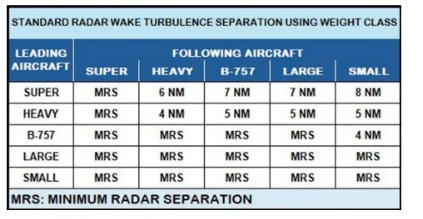
Standard Radar Wake TB Sepration Application
27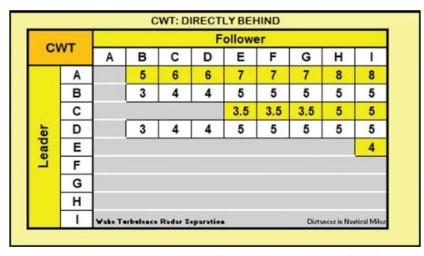
Radar Seperation When Operating Directly Behind
28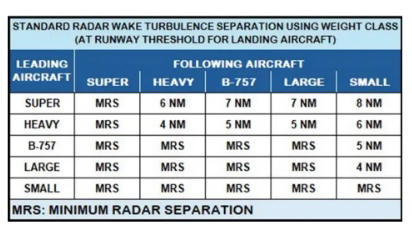
Standard radar wake turbulence separation application when landing.
29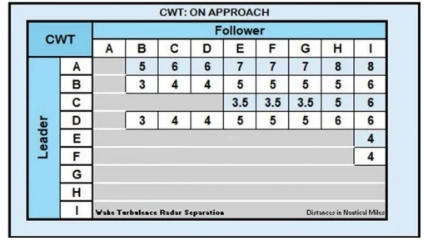
CWT radar separation application when on approach.
30
Runway seperation
- Only applied by ATC operating in a control tower
- when operating between proceeding departing aircraft and a departing aircraft, atc must ensure a departing aircraft's
Takeoff roll does not begin until the other aircraft has either crossed the departure end of runway or has turned to avoid conflict
* if ATC is using landmarks to determine distance, then the other aircraft only needs to be airborne if…..
- 3,000ft distance is kept when CAT 1 aircraft is involved
- 3000ft distance when a CAT1 aircraft is proceeded by a cat 2 aircraft
- 4,500ft when either the suceeding or both aircrafts are cat 2
- 6,000ft when either aircrafts are cat 3
- when suceeding aircraft is a helicopter where visual seperation must be applied with distance minima ( with heavy aircrafts
The distance minimu does not apply)
- when operating between proceeding departing aircraft and a departing aircraft, atc must ensure a departing aircraft's
Takeoff roll does not begin until the other aircraft has either crossed the departure end of runway or has turned to avoid conflict
* if ATC is using landmarks to determine distance, then the other aircraft only needs to be airborne if…..
- 3,000ft distance is kept when CAT 1 aircraft is involved
- 3000ft distance when a CAT1 aircraft is proceeded by a cat 2 aircraft
- 4,500ft when either the suceeding or both aircrafts are cat 2
- 6,000ft when either aircrafts are cat 3
- when suceeding aircraft is a helicopter where visual seperation must be applied with distance minima ( with heavy aircrafts
The distance minimu does not apply)
31
Application of runway wake TB
- 2 minutes for full length and intersecting runway departures
- 3 minutes for departure from a taxiway intersection
- 3 minutes for departure from a taxiway intersection
32
Departure versus arrival runway seperation
ATC must ensure takeoff roll does not begin until proceeding arriving aircraft hus taxied off runway
33
Intersecting runway seperation
- Atc first must issue traffic information to each aïrcraft operating in that intersection
Begin
Takeoff roll does not until...
1- proceeding aircraft has departed and passed the intersection or is turning to avoid any conflict
2- proceeding arriving aircraft is clear of the landing runway, has completed landing roll, will lahso, has passed the intersection
And or has crossed over the departure runway
Begin
Takeoff roll does not until...
1- proceeding aircraft has departed and passed the intersection or is turning to avoid any conflict
2- proceeding arriving aircraft is clear of the landing runway, has completed landing roll, will lahso, has passed the intersection
And or has crossed over the departure runway
34
Non - intersecting runway seperation
* Nearly identical to intersecting runway seperation
- requires departing aircraft to be cleared of the runway or turning to avert conflict so that the aircraft holding short
Can takeoff
- requires departing aircraft to be cleared of the runway or turning to avert conflict so that the aircraft holding short
Can takeoff
35
3 types of visual seperation
Tower, radar, and visual seperation used with visual approaches
36
Tower visual seperation
Used when controller visually has an aircraft in sight
- must maintain communications with one aircraft and or ensure that there is a way to immediately communicate with aircraft
- must maintain communications with one aircraft and or ensure that there is a way to immediately communicate with aircraft
37
Visual separation in radar environment
- SFC to FL180
- ability to communicate with other pilot must be there
- to apply this rule pilot must have another aircraft in sight so controller can visually instruct them to maintain visual separation
communication will go...
1- pilot will be informed of other aircrafts position, direction and intentions
2- pilot will then acknowledge on radio when they have another aircraft insight
3- pilot of the first aircraft is instructed to maintain visual seperation from second aircraft
- ability to communicate with other pilot must be there
- to apply this rule pilot must have another aircraft in sight so controller can visually instruct them to maintain visual separation
communication will go...
1- pilot will be informed of other aircrafts position, direction and intentions
2- pilot will then acknowledge on radio when they have another aircraft insight
3- pilot of the first aircraft is instructed to maintain visual seperation from second aircraft
38
Visual separation when two aircrafts are converging
1- atc should advise pilots they are converging
2- atc will alert the second pilot of the first aircraft
3- atc will inform second pilot that visual seperation is being applied
2- atc will alert the second pilot of the first aircraft
3- atc will inform second pilot that visual seperation is being applied
39
Visual seperation in conjunction with visual approach
Often used by radar controllers when ...
- aircraft is number 1 in approach sequence
- aircraft is following proceeding aircraft and reports proceeding aircraft in sight
- trailing aircraft has the airport in sight but does not see other aircraft. Once the other aircraft is in sight visual separation
can be maintained
Remember…
Two aircrafts on visual approach can fly closer them the 3-5 mile radar seperation. Further runway separation is based on SRS
Cat
- aircraft is number 1 in approach sequence
- aircraft is following proceeding aircraft and reports proceeding aircraft in sight
- trailing aircraft has the airport in sight but does not see other aircraft. Once the other aircraft is in sight visual separation
can be maintained
Remember…
Two aircrafts on visual approach can fly closer them the 3-5 mile radar seperation. Further runway separation is based on SRS
Cat
40
Hold procedure
Used to keep an aircraft in a specified area on ground / sky till further clearance from ATC
- can be used in beginning segment for instrument approach procedure
- can be used in beginning segment for instrument approach procedure
41
Flow control
Measures designed to obtimize the flow of traffic in NAS
42
Holding fix
Specified location by pilot thats identified by navaid or visual ground reference to maintain position while holding
43
Clearance limit
A fix, point, or location to which an aircraft is cleared when issued a clearance
44
Expect further clearance (efc)
Refers to the time a pilot can expect to recieve clearance beyond a clearance limit
45
Holding patterns
identified by…
- reference to a navaid
- navaid radial and DME point
- by ver aircraft with visual reference to the ground
types
Standard
- IFR ( right hand turns)
- one-minute legs ( except 1 1/2 minute legs above 14,000 MSL )
NonStandard
- left hand turns
- anything other than standard timing or holding leg length
- reference to a navaid
- navaid radial and DME point
- by ver aircraft with visual reference to the ground
types
Standard
- IFR ( right hand turns)
- one-minute legs ( except 1 1/2 minute legs above 14,000 MSL )
NonStandard
- left hand turns
- anything other than standard timing or holding leg length
46
Abeam fixed point
Anything 90° to the aircraft track which indicates a position rather than a precise point
47
Outbound leg
Pilot begins timing this leg when they are over / abeam the fixed point
- when using DME the outbound leg is timed by the ATC who issues the holding instructions
- when using DME the outbound leg is timed by the ATC who issues the holding instructions
48
Inbound leg
The inbound course, radial, bearing, azimuth, airway, or route to the holding fix on which the aircraft is to hold
- usually expressed in units of time or distance
- usually expressed in units of time or distance
49
Holding pattern entries
Parallel, teardrop, or direct entry procedure
50
Parallel procedure
- Pilot has to direct aircraft so it flies right over holding fix
- after passing fix a left hand turn to parallel inbound course
is flown for one minute
- after 1 minute a left hand course reversal of more than 180°
is made which pilot can choose to intercept holding course
or return to the holding fix
- after passing fix a left hand turn to parallel inbound course
is flown for one minute
- after 1 minute a left hand course reversal of more than 180°
is made which pilot can choose to intercept holding course
or return to the holding fix
51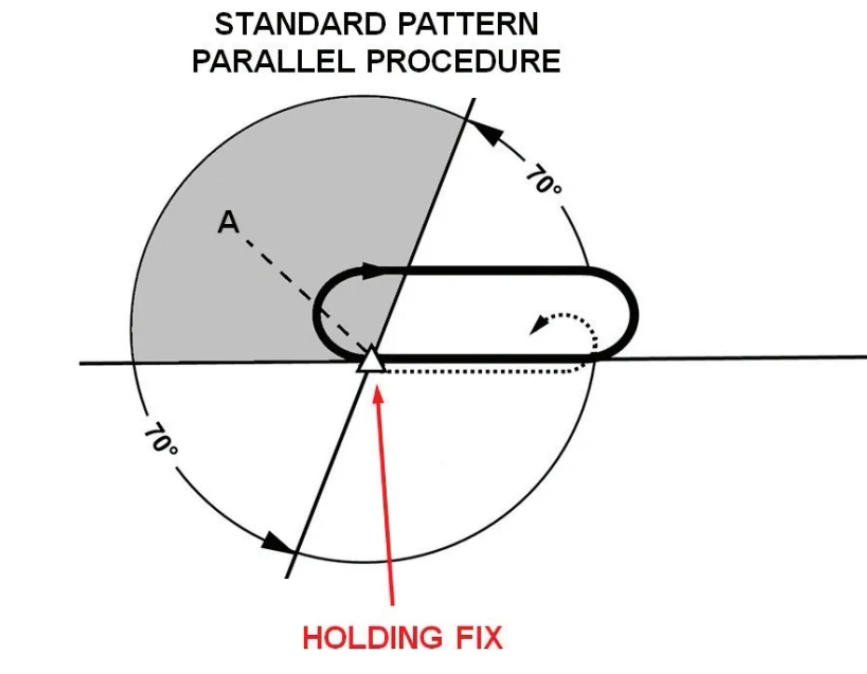
Example of Parallel Entry
52
Teardrop procedure
- Pilot should first overfly holding fix
- pilot then should turn outbound heading of 30°
- course should be flown for 1 minute followed by right
hand turn toward holding patten to intercept inbound course
- pilot then should turn outbound heading of 30°
- course should be flown for 1 minute followed by right
hand turn toward holding patten to intercept inbound course
53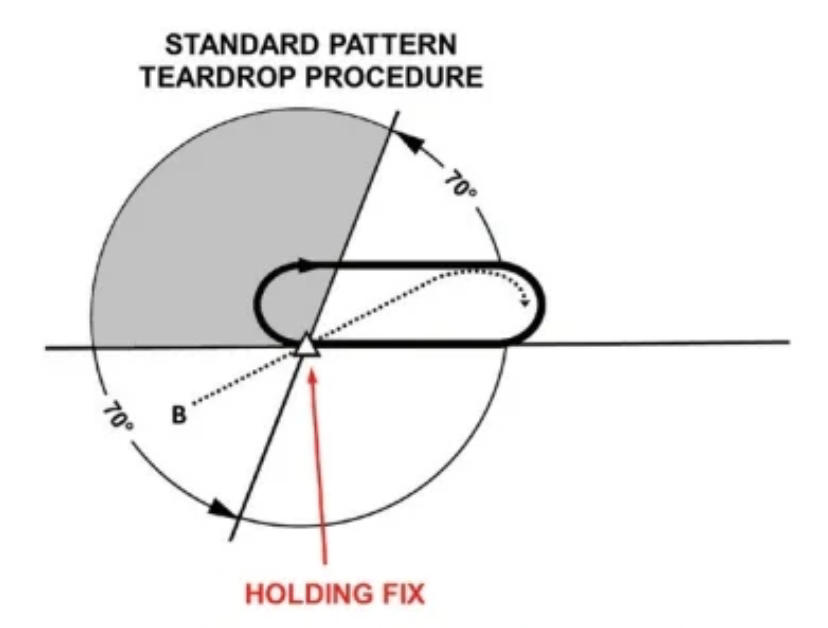
Example of Teardrop Procedure
54
Direct entry procedure
Pilot should fly directly to holding fix and make a right hand
Turn to enter the holding pattern
Turn to enter the holding pattern
55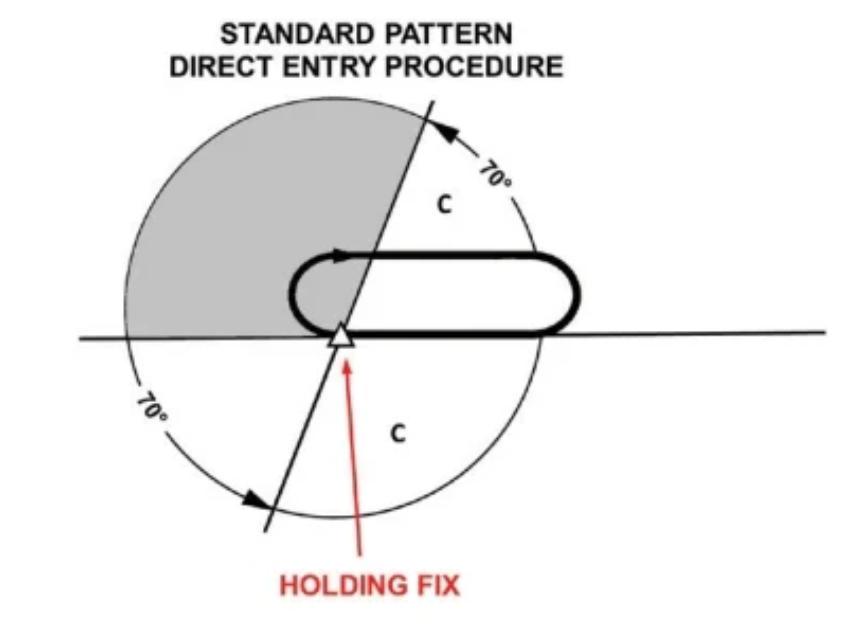
Example of Direct Procedure