Airports
Study these flashcardsFree · spaced repetition · iPhone, Android, Mac & web
All cards
1
Movement areas
active areas like runways, taxiways, and heliports that are used for taxiing, takeoff, and landing of aircraft
2
Non-movement areas
Areas like the taxiways and ramps that are not under the control of atc
3
White Pavement Markings
runways and landing areas (heliports too).
4
Yellow Pavement
- taxiways
- closed and hazardous areas
- holding positions
- closed and hazardous areas
- holding positions
5
Runway Designator
- identifies runway by a number and letter determined with respect to the direction (heading) of appraoch
- each runway has two designators, one at each end
- runway numbers are determined by its centerline place and magnetic direction rounded to the nearest 10th degree
Exp: 163 = RW 16, 345 = RW 35
- each runway has two designators, one at each end
- runway numbers are determined by its centerline place and magnetic direction rounded to the nearest 10th degree
Exp: 163 = RW 16, 345 = RW 35
6
Runway Threshold Markings
Closely identify the actual beginning point of the runway threshold used for landings. Also consists of a pattern of longitudinal stripes of uniform dimension spaced symmetrically about the runway centerline.
- usually white
- number of stripes signifies the length
- standard length of longitudinal stripe is 150ft
- usually white
- number of stripes signifies the length
- standard length of longitudinal stripe is 150ft
7
Stripe Numbers
4 - 60ft
6 - 75ft
8- 100ft
12- 150ft
16 - 200ft
6 - 75ft
8- 100ft
12- 150ft
16 - 200ft
8
Runway Aiming Point Marks
- are white
- beginning of the markings is 1000ft from landing threshold
- beginning of the markings is 1000ft from landing threshold
9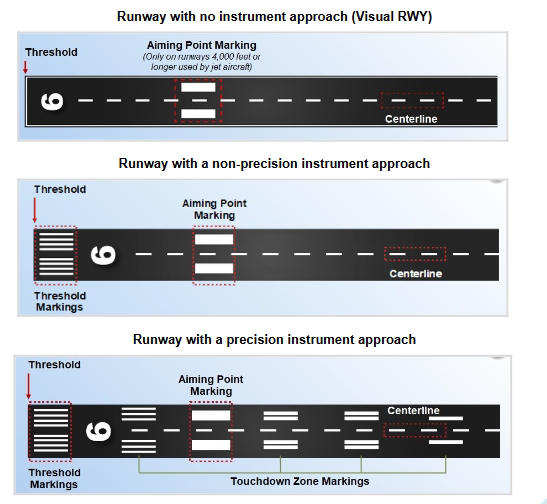
Runway Approach Types
10
Runway side stripes
are white
11
runway shoulder markings
yellow and start at the runway midpoint and are slanted at a 45 degree angle to the runway centerline
12
displaced threshold
- located at a point on the runway other than the designated beginning of the runway
- has white cheverons (4) and indicates it can only be used for taxiing and takeoff, not landing
- has white cheverons (4) and indicates it can only be used for taxiing and takeoff, not landing
13
demarcation bar
- delineates a runway with a displaced threshold from a blast pad, stop way, or aligned taxiway that precedes the runway
14
Permanently Closed RW
- lighting circuits are disconnected
- yellow crosses are ainted at each end of the runway and at the 1000ft
- threshold, runway degsination, and touchdown zone markings are obliterated
- yellow crosses are ainted at each end of the runway and at the 1000ft
- threshold, runway degsination, and touchdown zone markings are obliterated
15
Surface Painted Hold Position
- mandatory instruction sign
- has red background with white text
- has red background with white text
16
Runway Location sign
- black background and yellow letters
17
runway distance remaining sign
- black background and white letters
- informs pilots of distance remaining with 1000ft
- used by tower to apply seperation standards
- informs pilots of distance remaining with 1000ft
- used by tower to apply seperation standards
18
Mandatory Instruction Signs
- red background with white inscription
- used to denote an entrance to a runway or critical area and areas where an aircraft is prohibited from entering without an atc clearance
- usually runway hold position
- runway approach and area holding position
- ils critical holding area
- no entry sign
- used to denote an entrance to a runway or critical area and areas where an aircraft is prohibited from entering without an atc clearance
- usually runway hold position
- runway approach and area holding position
- ils critical holding area
- no entry sign
19
Taxiway location signs
- black background, yellow inscription and yellow boarder
20
Taxiway Directional Sign
- indicates the direction an aircraft must turn in order to get to the desired taxiway
- marked by yellow background and black inscription
- always has an arrow
- marked by yellow background and black inscription
- always has an arrow
21
Lighted Land Airport
flashing white and green
22
Lighted Water Airport
flashing white and yellow
23
Lighted Heliport
flashing white, yellow, and green
24
Military Airport
two quick white flashes followed by a green flash
25
Types of Runway Lights
- Runway end identifier lights (REILS)
- Runway Edge Light System
- In Runway Lighting
- Runway Edge Light System
- In Runway Lighting
26
REILS
- runway end identifer lights
- sycronized white flashing strobe lights located laterally on each side of the runway threshold
- sycronized white flashing strobe lights located laterally on each side of the runway threshold
27
Runway edge light system
green - approach
white- runway (3000fr remaining)
yellow- 2000ft remaining
red - end of runway (last 1000fr)
white- runway (3000fr remaining)
yellow- 2000ft remaining
red - end of runway (last 1000fr)
28
Touchdown Zone Lighting (TDZL)
consists of two rows of lights, one on each side and parallel to the runway centerline lights
- starts from 100ft from the landing threshold
- extends to 3000ft from the threshold or midpoint of the runway
- starts from 100ft from the landing threshold
- extends to 3000ft from the threshold or midpoint of the runway
29
Runway centerline lighting system (RCLS)
consists of lights spaced at 50 foot intervals
- white until last 3000ft
- white alternating with red for the next 2000ft
- red at the last 1000ft
- white until last 3000ft
- white alternating with red for the next 2000ft
- red at the last 1000ft
30
Runway Status Lights
tells pilots and vehicle operatiors to stop when the runway is not safe
31
Visual Glide Slopes
- PAPI (precision approach path indicators) are arranded 4 lights in a row horiziontally (two red first and two white last lets you know that you are on the glideslope)
- VASI (visual approach slope indicators) are arranded with two lights in the front and two lights in the back, you want two white upfront and two red in the back to be on the glideslope
- VASI (visual approach slope indicators) are arranded with two lights in the front and two lights in the back, you want two white upfront and two red in the back to be on the glideslope
32
Stop Bar Lights
used by atc to confirm air traffic control clearance to enter or cross the active runway in low visibility conditions
- has a row of red lights across entire taxiway
- has a row of red lights across entire taxiway
33
lead on lights
row of alternating yellow and green lights to show that atc clearance to proceed is given and will reset after aircraft lines up and takes off
34
RELS
shows that pilot and drivers must stop at runway hold line and remain stopped when the are on
- indiactes atc clearance is required to cross and or enter the runways
- indiactes atc clearance is required to cross and or enter the runways
35
THLS
lit when an aircraft is waiting to take off in the takeoff hold area and another aircraft is on the runway
- will turn off when the departing aircraft is no longer on the runway
- atc clearance is still required for takeoff
- will turn off when the departing aircraft is no longer on the runway
- atc clearance is still required for takeoff